


 English
 عربى


Lightweight Portable Camping Hammock: Comfort, Strength, and Efficient Outdoor Manufacturing
Introduction: A Better Way to Rest Outdoors
Outdoor equipment is becoming lighter, more adaptable, and more comfortable. Hikers, campers, travelers, beachgoers, and backyard users increasingly expect one product to serve several purposes without adding unnecessary weight to their equipment. A portable camping hammock meets this need by creating a comfortable resting platform that can be packed into a small bag and installed in minutes.
The Lightweight Portable Camping Hammock with Tree Straps for Outdoors Backpacking is designed for people who want a practical alternative to bulky chairs, sleeping pads, or traditional camp furniture. Made from ripstop nylon, the hammock weighs approximately 1.5 pounds while supporting up to 500 pounds. It combines portability, strength, comfort, and simple setup in one compact outdoor product.
Its value is not limited to recreational use. The hammock is suitable for backpacking, camping, picnics, beach trips, park visits, festivals, travel, and casual relaxation at home. It can be used by one person or shared by two people when installed correctly and used within its rated capacity.
Behind the product is Ningbo Zhenhai Tiansai Leisure Products Co., Ltd., a China-based outdoor equipment manufacturer with experience in tent and leisure product development. The company operates a factory covering more than 13,000 square meters and serves customers in North America, Europe, Asia, and other regions. Its capabilities in product design, material selection, sample development, testing, quality management, and overseas supply make it a suitable manufacturing partner for outdoor brands and distributors.
This article examines the hammock’s design, performance, competitive advantages, manufacturing strengths, use cases, maintenance requirements, and suitability for wholesale or OEM cooperation.

Lightweight Portable Camping Hammock with Tree Straps for Outdoors Backpacking
Product Overview
The product is a lightweight, portable hammock designed for outdoor relaxation and temporary suspension between two secure anchor points. Its main components include a ripstop nylon hammock body, heavy-duty tree straps, carabiners, and a compact carry bag.
Ripstop nylon is widely used in outdoor equipment because it provides a useful balance between low weight and tear resistance. The woven structure is engineered to help prevent a small puncture or tear from spreading rapidly through the fabric. For a portable hammock, this is particularly valuable because the product may be packed tightly, moved between locations, and exposed to changing outdoor conditions.
At approximately 1.5 pounds, the hammock is light enough for backpacking and day hikes. It adds less bulk than many folding chairs or conventional relaxation systems. When packed into its carry bag, it can be stored inside a backpack, attached to external gear loops, placed in a vehicle, or kept in a home storage cabinet without taking up much space.
The hammock supports up to 500 pounds, giving it a broad range of applications. A single user can enjoy generous space and stability, while two users may share the hammock when the combined weight remains within the stated limit and the installation points are suitable. Users should always inspect the fabric, straps, carabiners, and anchor points before use.
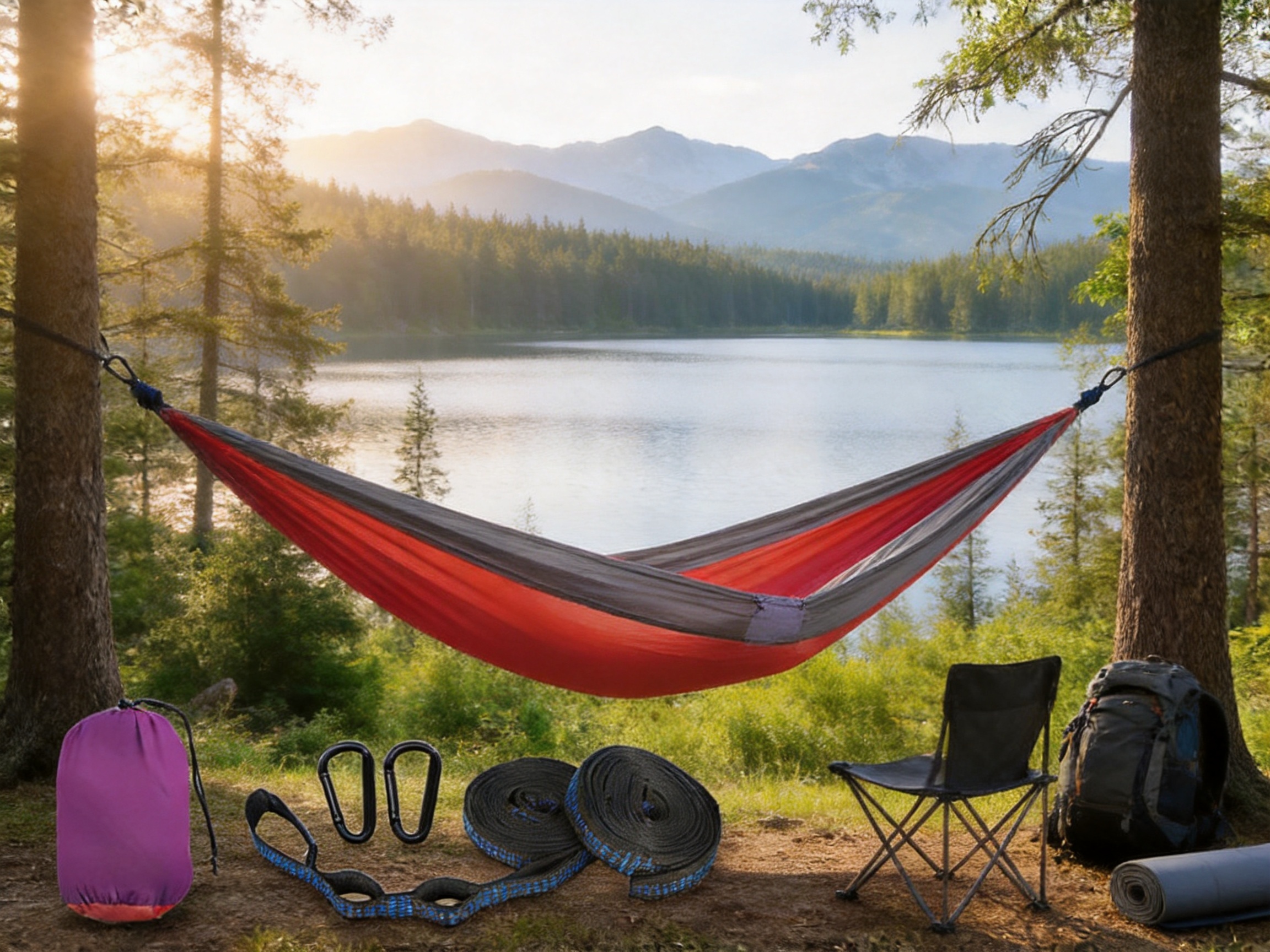
The included tree straps are designed to simplify setup while reducing the need for knots. Adjustable strap positions allow users to change the hanging height and tension according to tree spacing, terrain, and personal comfort. The carabiners provide a quick connection between the hammock and the suspension straps.
Core Product Specifications
| Feature | Product Information | Practical Benefit |
|---|---|---|
| Product type | Portable outdoor hammock | Provides a temporary resting and relaxation platform |
| Primary material | Ripstop nylon | Combines low weight, flexibility, and tear resistance |
| Approximate product weight | 1.5 pounds | Suitable for backpacking and travel |
| Maximum supported weight | Up to 500 pounds | Suitable for solo use or sharing within the rated capacity |
| Suspension system | Adjustable tree straps and carabiners | Enables quick installation and tension adjustment |
| Storage | Compact carry bag | Reduces packing volume and simplifies transport |
| Recommended environments | Camping areas, parks, beaches, backyards, and travel locations | Supports multiple outdoor and leisure applications |
Advantages Over Conventional Outdoor Seating
A major advantage of a hammock is that it provides comfort without requiring a flat surface. A folding chair needs stable ground and often has a rigid frame. A sleeping pad usually requires a clean, level area. By contrast, a hammock uses two suitable anchor points and suspends the user above the ground.
This elevated design can be especially useful on uneven, damp, sandy, or rocky terrain. Users can avoid direct contact with wet grass, small stones, mud, and some ground insects. In warm weather, the suspended structure also permits air movement beneath the body, creating a more comfortable resting experience than some ground-based options.
The product is also easier to transport than many alternatives. A conventional camping chair may include metal or composite components that increase both weight and packed dimensions. A hammock consists primarily of flexible fabric and suspension accessories. When folded into the included bag, it can fit into spaces where rigid equipment cannot.
Another advantage is deployment speed. Once suitable anchor points have been identified, the user can wrap the straps around the trees, connect the carabiners, adjust the length, and test the suspension. This process is generally faster than unfolding and locking a multi-part chair or assembling a more complex outdoor shelter.
The hammock also supports flexible use. It can serve as a reading area at a campsite, a rest station during a hike, a comfortable place for a beach break, or a casual outdoor lounge in a backyard. One product can therefore replace several types of occasional-use furniture.
Comparison with Other Portable Resting Products
| Product Type | Typical Strength | Common Limitation | Hammock Advantage |
|---|---|---|---|
| Folding camping chair | Raised seating and back support | Heavier frame and need for level ground | More compact, lighter, and suitable for uneven ground |
| Ground sleeping pad | Simple and lightweight | Requires a clean, relatively level surface | Suspends the user above the ground |
| Inflatable lounger | Soft and portable | Requires inflation and can be vulnerable to punctures | Needs no pump and packs into a small bag |
| Traditional rope hammock | Familiar hammock structure | May be heavier, less compact, or less comfortable against bare skin | Ripstop nylon offers a lightweight and soft fabric surface |
| Large camping cot | Stable and elevated from the ground | Bulky frame and longer setup time | Flexible fabric construction minimizes packed volume |
These comparisons do not mean that a hammock replaces every outdoor product. Chairs can be preferable for upright dining, cots may be better for extended sleeping, and ground pads can be useful where no anchor points exist. The hammock’s competitive advantage is its combination of low weight, compact storage, elevated comfort, and rapid setup.
Lightweight Design for Backpacking and Travel
Weight is one of the most important factors in backpacking equipment. Every additional item affects carrying comfort, energy consumption, and the distance a traveler can cover. A 1.5-pound hammock is practical for hikers who want a comfortable rest system without carrying a heavy chair or cot.
The compact design also improves packing efficiency. The hammock can be compressed into its carry bag after drying and inspection. It may be placed near the top of a backpack for quick access, stored in a side compartment, or attached externally if the pack has suitable loops. Since the product is soft and flexible, it can fit around other equipment rather than occupying a rigid rectangular space.
For travelers, the small packed size is useful in luggage and vehicles. A family can keep one or more hammocks in a trunk for spontaneous stops. A traveler staying in a cabin, hostel, resort, or vacation rental can use the hammock outdoors without transporting large furniture.
Lightweight construction does not mean the product is intended to be handled carelessly. Users should avoid dragging the fabric over sharp rocks, placing it against abrasive surfaces, or exceeding the rated weight. Proper handling helps preserve the ripstop structure and extend product life.
Why Ripstop Nylon Is Suitable
Ripstop nylon is valued in outdoor products because the fabric is engineered for demanding, repeated use. Its woven reinforcement pattern helps limit the progression of small tears. The material is also flexible, allowing it to conform to the user’s body and distribute pressure across a broad surface.
The soft fabric can be more comfortable against the skin than coarse rope or rigid woven materials. Its flexibility also enables compact folding. At the same time, nylon is relatively easy to clean and dry when maintained correctly.
Material selection is an important stage in hammock manufacturing. The fabric must support the intended load, maintain its shape during use, and work effectively with stitching, webbing, and attachment points. Consistency in fabric quality is therefore essential for a dependable finished product.
Comfort and Usability in Different Outdoor Settings
The hammock is designed to transform a simple outdoor location into a resting area. In a forest or campsite, it can provide a quiet place to read, relax, observe nature, or take a short nap. In a backyard, it can become a regular leisure product for warm afternoons and evenings.
At the beach, the raised position helps users avoid sitting directly on hot sand. In a park, the hammock provides an alternative to crowded benches or damp grass. During a road trip, it can be used at suitable rest locations where trees or other secure anchor points are available.
The fabric surface supports a reclining posture rather than an upright sitting position. Users can adjust the tension and hanging height to achieve a preferred level of support. A flatter diagonal position may provide a wider resting surface, while a deeper curve may feel more enclosed. Small adjustments to the strap length can significantly change the experience.
The product can be used by adults, but users should consider the individual’s size, mobility, and ability to enter and exit safely. Children should use the hammock only under appropriate adult supervision. The hammock is not a substitute for a certified infant or child sleeping product.
Practical Setup Procedure
First, choose two healthy, stable trees or other approved anchor points. The supports should be strong enough to handle the dynamic load created when a person enters, moves, or exits the hammock. Avoid dead trees, thin branches, damaged poles, unstable structures, or surfaces that could shift.
Second, inspect the area beneath the hammock. Remove sharp objects, broken branches, glass, and other hazards. Although the hammock is elevated, a low installation height is generally preferable because it reduces the distance to the ground if the user loses balance.
Third, wrap the adjustable tree straps around the selected supports. The straps should sit securely and should not be placed over sharp edges that could damage the webbing. Where environmental rules apply, users should follow local guidance for protecting trees and avoiding damage to bark.
Fourth, attach the carabiners to the appropriate strap loops and hammock connection points. Confirm that each connection is fully closed and correctly seated. Do not rely on partially engaged hardware.
Fifth, adjust both sides so that the hammock hangs evenly. The fabric should not be stretched excessively tight. A moderate sag generally improves comfort and reduces unnecessary stress on the suspension system.
Finally, perform a gradual test. Apply light pressure first, then sit carefully near the center. Inspect the straps, carabiners, stitching, and anchor points again before reclining fully. Recheck the setup whenever the user’s position changes significantly or when the hammock has been left unattended.
Safety, Care, and Long-Term Performance
Outdoor equipment performs best when users follow basic safety practices. The 500-pound capacity should be treated as a maximum rated load, not a target. The total load includes all users and any items placed in the hammock. Sudden impacts, jumping, swinging aggressively, or dropping into the fabric can create forces greater than the static body weight.
Users should not modify the straps, cut the fabric, replace hardware with unapproved components, or use damaged suspension equipment. Any visible fraying, torn stitching, fabric holes, bent carabiners, or weakened strap loops should be taken seriously.
The hammock should be kept away from open flames, sparks, hot cooking equipment, and sharp tools. Synthetic fabrics can be damaged by high heat even when the damage is not immediately obvious.
After exposure to rain, sea spray, mud, or heavy moisture, the hammock should be removed from its carry bag and allowed to dry completely. Storing damp fabric for long periods can create unpleasant odors and may contribute to material deterioration. Before packing, shake off debris and check the seams and connection areas.
Cleaning should follow the product’s care instructions. In general, gentle cleaning with mild soap and clean water is preferable to harsh chemicals or aggressive scrubbing. Strong solvents, bleach, and high-temperature drying methods may weaken the fabric or affect color stability.
Care Checklist
| Inspection Area | What to Check | Recommended Action |
|---|---|---|
| Hammock fabric | Holes, cuts, burns, or unusual stretching | Stop use if damage affects structural integrity |
| Stitching | Loose, pulled, or broken threads | Request professional evaluation or replacement |
| Tree straps | Fraying, cuts, abrasion, or weakened loops | Replace damaged straps before use |
| Carabiners | Bending, cracks, corrosion, or incomplete closure | Do not use damaged hardware |
| Carry bag | Wetness, dirt, or damaged seams | Clean and dry before storage |
| Anchor points | Weak trees, unstable poles, or sharp edges | Select a safer installation location |
Manufacturing Strengths and Product Development Capabilities
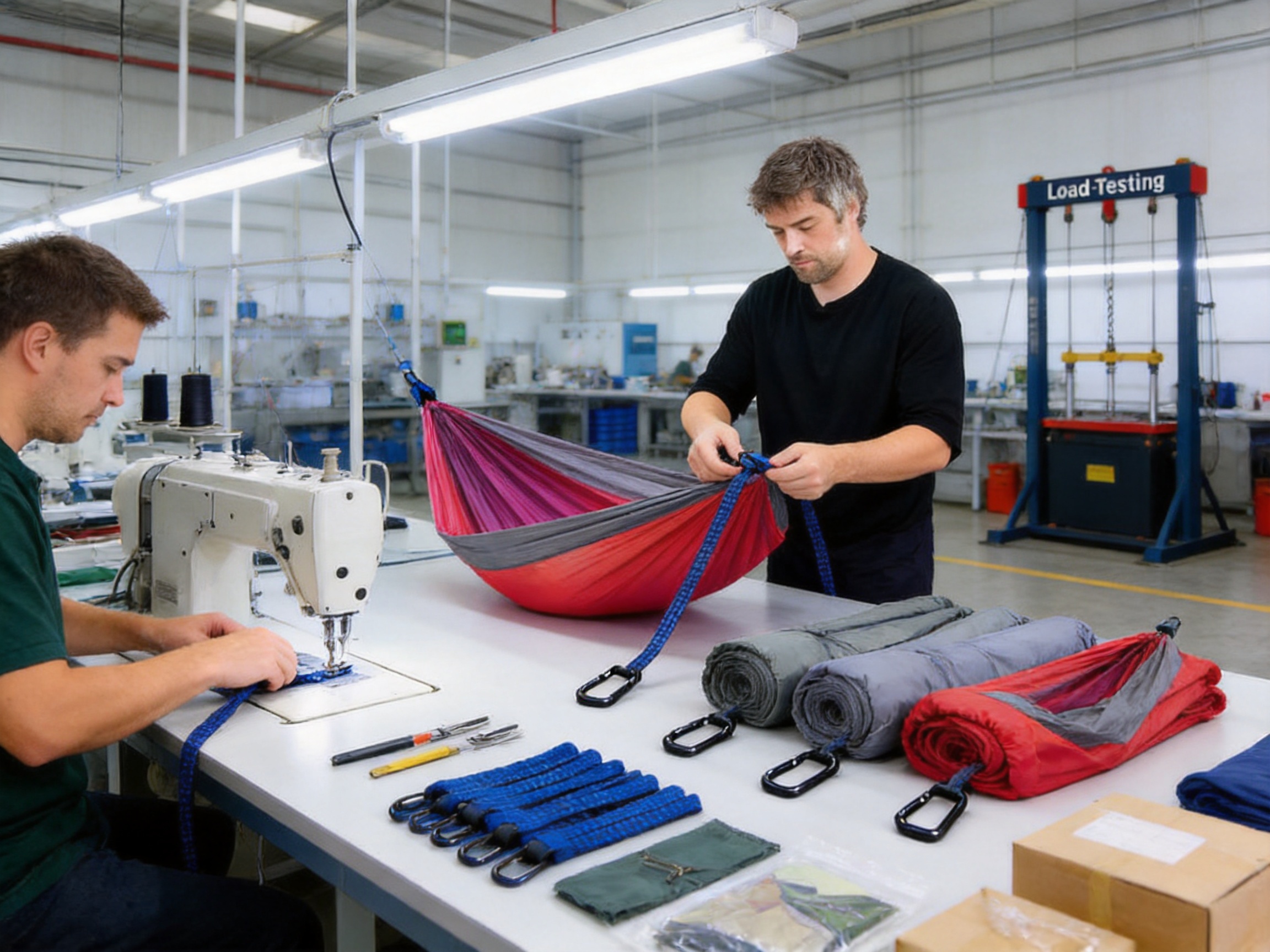
The performance of a hammock depends on more than the appearance of its fabric. Reliable results require coordinated control of materials, cutting, sewing, webbing attachment, hardware integration, inspection, packing, and shipment preparation.
Ningbo Zhenhai Tiansai Leisure Products Co., Ltd. operates a factory covering more than 13,000 square meters. This scale provides a foundation for organized production and product development. A dedicated manufacturing site can support material storage, pattern preparation, sewing operations, assembly, quality inspection, packaging, and order coordination under a connected management structure.
The company specializes in the design, production, and sales of tents and outdoor leisure products. This product background is relevant to hammock manufacturing because many of the same technical disciplines apply: lightweight textile engineering, reinforced seams, webbing systems, load distribution, packability, weather exposure, and field-oriented design.
Design and Engineering Process
Product development begins with identifying the intended use. For a portable hammock, key requirements include low weight, comfortable body support, reliable attachment points, compact storage, ease of setup, and resistance to repeated outdoor handling.
The design team can evaluate fabric dimensions, body shape, seam placement, strap length, carabiner positioning, carry-bag structure, and color or branding requirements. A product intended for backpacking may prioritize minimum weight and compact packing, while a resort or retail product may emphasize distinctive colors, enhanced packaging, or customized branding.
Design decisions should be reviewed through prototypes and sample testing. A prototype allows the team to observe how the fabric distributes load, how the straps connect, whether users can understand the setup process, and whether the packed product meets the target dimensions.
The company has developed products associated with appearance patents and utility model patents. Such experience indicates an emphasis on product innovation and design ownership. For buyers seeking differentiated outdoor products, design development and intellectual property awareness can be valuable advantages over suppliers that simply copy existing market products.
Material and Sewing Control
Textile product quality begins with incoming material control. Fabric rolls, webbing, thread, hardware, and packaging components should be checked against purchase specifications. Consistent material width, color, weight, weave, and surface condition help reduce variations between production batches.
During cutting, accurate patterns support even load distribution and consistent dimensions. Poor cutting may create uneven edges, distorted shapes, or unnecessary waste. Controlled cutting also improves repeatability when the same hammock model is manufactured in larger quantities.
Sewing is particularly important around high-load areas. The main body seams, strap attachment points, and carabiner connection zones require suitable thread, stitch density, reinforcement, and workmanship. A robust appearance alone is not enough; the construction must be consistent throughout the production run.
Production workers should be trained to identify skipped stitches, uneven seam allowances, loose threads, fabric damage, and incorrect component placement. In-process inspection can identify issues earlier than final inspection, reducing rework and preventing defective units from moving further through the line.
Assembly and Hardware Integration
The straps and carabiners form the connection between the hammock body and its anchor points. Their compatibility and correct installation are therefore essential. Assembly procedures should verify that the correct strap type, loop configuration, and hardware are used for each product version.
Hardware should be inspected for visible damage, sharp edges, deformation, and closure function. The connection area should be checked for accurate stitching and proper reinforcement. Product instructions and packaging should clearly explain safe connection and intended use.
A coordinated assembly process also benefits customers by reducing setup confusion. When the hammock, straps, carabiners, and carry bag are packed as a complete kit, the end user does not need to purchase separate suspension accessories or determine compatibility independently.
Quality Management and Testing Approach
The company states that it implements a quality management system intended to ensure that products meet international standards. For a portable hammock, quality management should cover the complete product life cycle, from design requirements and supplier selection to production inspection and customer feedback.
Load-related evaluation is a central part of hammock development. Testing may include static load assessment, repeated loading, inspection of seams and connection points, and evaluation of the straps and carabiners. Testing conditions should be defined consistently so that results can be compared between samples and production batches.
Field testing can add information that laboratory-style checks may not reveal. Outdoor enthusiasts can comment on setup time, carrying comfort, fabric feel, entry and exit, packing convenience, strap adjustment, and overall usability. The company reports that it collaborates with professionals and invites outdoor enthusiasts to participate in testing. This feedback-oriented approach helps connect engineering decisions with actual user experience.
Customer feedback is also useful after commercial launch. Retailers and distributors may identify recurring questions about setup, packaging, sizing, color, or care. Manufacturers can use this information to update instructions, improve accessories, revise packaging, or develop new versions.
Potential Quality Checkpoints
| Production Stage | Quality Focus | Value to the Customer |
|---|---|---|
| Material receiving | Fabric, webbing, thread, and hardware consistency | Helps maintain stable product performance |
| Cutting | Pattern accuracy and clean edges | Supports consistent dimensions and appearance |
| Sewing | Stitch quality, reinforcement, and seam alignment | Improves structural reliability |
| Assembly | Correct straps, carabiners, and connection points | Reduces setup errors |
| Load evaluation | Performance under specified loading conditions | Supports confidence in the rated capacity |
| Final inspection | Appearance, accessories, labels, instructions, and packaging | Ensures a complete and saleable product |
| Pre-shipment review | Carton quantity, documentation, and order accuracy | Helps reduce delivery and inventory problems |
Advantages for Outdoor Brands and Wholesale Buyers
The hammock is suitable for businesses that want to offer a compact, broadly appealing outdoor product. Its applications extend beyond specialist mountaineering. Retailers can position it as a camping accessory, travel item, backyard leisure product, beach accessory, or gift for outdoor enthusiasts.
Its simple product architecture can help reduce consumer education requirements. The main benefits are easy to communicate: lightweight construction, generous weight capacity, adjustable tree straps, compact storage, and multiple outdoor uses. Clear product photography and straightforward instructions can further improve online and in-store conversion.
For wholesale buyers, packaging and private-label options may be important. Outdoor brands may request custom colors, woven labels, printed logos, instruction sheets, carry-bag branding, barcode labels, carton markings, or retail packaging. These requirements should be discussed during the sampling stage so that the factory can confirm feasibility, minimum order quantities, lead times, and production costs.
The manufacturer’s experience in overseas markets is useful for buyers serving customers in different regions. Export-oriented production requires attention to packing efficiency, order documentation, communication, shipment coordination, and consistent product specifications.
Ningbo’s position as a major port city also supports international logistics planning. A port-oriented location can simplify coordination for export shipments, although actual shipping time and cost will depend on destination, order volume, shipping method, customs requirements, and seasonal conditions.
OEM and Product Customization Possibilities
A manufacturer with an internal design team can offer more than basic contract production. OEM cooperation may begin with an existing hammock design and proceed to adjustments in color, labels, packaging, or accessory configuration. More extensive development may involve changes to dimensions, fabric weight, suspension systems, storage bags, or product combinations.
Customization should be managed through approved samples and documented specifications. Buyers should confirm the exact fabric, color standard, logo position, strap length, hardware type, packaging method, carton size, and inspection requirements before mass production.
For brands developing a broader collection, the hammock can be coordinated with tents, shelters, camping accessories, and other leisure products. Shared color systems and packaging styles can create a consistent retail identity. A factory experienced in multiple outdoor product categories may also help brands evaluate complementary items.

Environmental Considerations and Responsible Outdoor Use
Outdoor products should support responsible enjoyment of nature. Users should select anchor points carefully, avoid damaging trees, and follow local regulations in parks, forests, campsites, and protected areas. Wide tree straps are generally preferable to narrow ropes when they help distribute pressure over a larger area, but users should still follow local tree-protection guidance.
The product’s lightweight design can reduce the material and transport burden associated with larger rigid equipment. Its durability may also support longer use when the hammock is properly cared for. A product that remains functional over many trips can reduce the need for frequent replacement.
Responsible use includes packing out all waste, avoiding vegetation damage, keeping the hammock away from fire, and removing it from public or natural areas after use. Users should not leave the hammock installed overnight in locations where it could create a hazard for wildlife, other visitors, or maintenance workers.
The company has expressed an interest in lightweight and environmentally friendly materials as part of its future research and development direction. Material sustainability can involve many factors, including fiber selection, product life, repairability, packaging reduction, manufacturing efficiency, and end-of-life management. These considerations should be evaluated using specific product data rather than general environmental claims.
Who Should Choose This Hammock?
This product is particularly suitable for backpackers who want a comfortable rest system without a heavy frame. It is also useful for campers who prefer elevated relaxation, travelers who need compact leisure equipment, and families seeking a convenient backyard or park accessory.
It can be a practical gift for people who enjoy hiking, camping, nature observation, fishing trips, road travel, beach visits, or outdoor reading. The included straps and carabiners make it more complete than a hammock body sold without suspension accessories.
It may be less suitable for users who have no access to secure anchor points, require a rigid upright seat, or need a product specifically certified for specialized professional applications. Buyers should match the product to the intended use and follow the stated capacity and safety instructions.
Ideal User Profiles
| User | Reason the Product May Be Suitable |
|---|---|
| Backpacker | Low weight and compact packing support efficient travel |
| Weekend camper | Quick setup creates a comfortable campsite rest area |
| Beach visitor | Elevated fabric surface avoids direct contact with sand |
| Backyard user | Provides convenient seasonal relaxation at home |
| Outdoor gift buyer | Combines practical accessories with broad recreational appeal |
| Outdoor retailer | Offers a versatile product for camping and leisure categories |
| Private-label brand | Can potentially be adapted through colors, labels, and packaging |
Frequently Asked Questions
1. How much does the hammock weigh?
The hammock weighs approximately 1.5 pounds. The final packed weight may vary slightly depending on the straps, carabiners, carry bag, packaging, and any customized accessories included in a particular order.
2. What is the maximum supported weight?
The stated maximum supported weight is up to 500 pounds. This limit includes all people and items placed in the hammock. Users should not exceed the rated capacity and should remember that sudden movement can create forces greater than static body weight.
3. Can two people use the hammock?
The product can be suitable for two people when their combined weight remains within the rated capacity and the hammock is installed on secure, appropriate anchor points. Users should enter carefully, avoid sudden movements, and confirm that the fabric and suspension system are designed for the intended arrangement.
4. Are tree straps included?
Yes. The product description includes heavy-duty tree straps and carabiners. The adjustable straps are intended to simplify installation and allow users to control the hanging height and tension.
5. Can the hammock be used without trees?
It may be used between other sturdy, suitable anchor points if those points can safely support the load and are compatible with the straps. Users should never attach the hammock to weak, unstable, sharp, or unverified structures.
6. Is the hammock suitable for backpacking?
Yes. Its approximate 1.5-pound weight, flexible construction, and compact carry bag make it suitable for many backpacking and hiking situations. Users should consider whether their route provides appropriate anchor points.
7. Is the fabric comfortable?
The ripstop nylon fabric is designed to be soft against the skin while providing outdoor durability. Comfort also depends on the suspension height, strap tension, user position, weather, and personal preference.
8. How should the hammock be stored?
Allow the hammock and straps to dry completely before placing them in the carry bag. Remove dirt and debris, inspect the seams and hardware, and store the product in a cool, dry location away from direct heat, chemicals, and sharp objects.
9. Can the hammock be customized for a brand?
Potential customization options may include colors, logos, labels, carry-bag branding, instructions, retail packaging, and carton markings. Specific options, minimum order quantities, sample requirements, and production timelines should be confirmed with the manufacturer.
10. What makes the manufacturer suitable for outdoor product cooperation?
The manufacturer has experience in outdoor product design, production, and export. Its factory covers more than 13,000 square meters, and the company reports having a professional design team, a quality management system, patent-related product development experience, outdoor testing cooperation, and service capabilities for global brands.
11. Is the hammock a replacement for a tent?
No. The hammock is primarily a suspended resting and relaxation product. It does not provide the same enclosed protection, weather coverage, privacy, or sleeping environment as a tent unless it is used as part of a separate hammock shelter system designed for those purposes.
12. What should users inspect before every trip?
Users should inspect the fabric, stitching, strap loops, tree straps, carabiners, carry bag, and anchor points. Any significant damage, fraying, deformation, or uncertainty should be addressed before use.
Conclusion
The Lightweight Portable Camping Hammock with Tree Straps for Outdoors Backpacking offers a strong combination of comfort, portability, and practical outdoor performance. Its ripstop nylon construction keeps the product light while supporting a rated load of up to 500 pounds. The adjustable tree straps and carabiners simplify setup, and the compact carry bag makes transportation and storage convenient.
Compared with conventional folding chairs, cots, and ground-based rest products, the hammock provides a distinctive advantage: it creates an elevated relaxation platform with minimal packed volume and no rigid frame. It is useful across a wide range of activities, including hiking, camping, beach trips, park visits, backyard relaxation, and travel.
Its manufacturing value is supported by the capabilities of Ningbo Zhenhai Tiansai Leisure Products Co., Ltd. The company combines outdoor product experience, a factory exceeding 13,000 square meters, internal design resources, testing cooperation, quality management practices, patent-related development experience, and export-oriented service. These strengths can benefit both individual customers seeking dependable outdoor equipment and businesses looking for OEM or wholesale solutions.
For consumers, proper installation, regular inspection, responsible tree use, and careful storage are essential to safe and long-lasting performance. For outdoor brands and distributors, the product provides a versatile platform that can be adapted through color, branding, packaging, and accessory decisions.
As outdoor recreation continues to move toward lightweight and multifunctional equipment, a well-designed portable hammock remains a compelling addition to any camping or leisure collection. It offers a simple way to pause, rest, and enjoy nature without carrying unnecessary bulk.
References
1. Product information supplied for the Lightweight Portable Camping Hammock with Tree Straps for Outdoors Backpacking.
2. Company information supplied for Ningbo Zhenhai Tiansai Leisure Products Co., Ltd., including factory scale, product development experience, export activity, and quality management practices.
3. General principles of outdoor textile product design, including ripstop fabric construction, webbing reinforcement, seam engineering, and portable equipment development.
4. General outdoor equipment safety practices concerning load limits, anchor-point selection, equipment inspection, and responsible use in natural environments.
5. General principles of product quality management, prototype evaluation, field testing, material inspection, assembly control, and final production inspection.
Product: Lightweight Portable Camping Hammock with Tree Straps for Outdoors Backpacking

Message Us Right Now!
-
Mp: +86-18858091910
E-mail: sales@tenplaytent.com
ADD: No. 529, Guangyuan Road, Xiepu Town, Zhenhai District, Ningbo City, Zhejiang Province, China
-
Quick Links
Home Products About Us Advantage News Contact Us -
Product
Inflatable & Air Tents Glamping & Resort Tents Backpacking & Trekking Tents Automatic & Pop-Up Tents Family & Camping Tents Specialty Tents & Shelters Kids Tents Pet Tents Humanitarian & Large Tents Hammock -
Get Connected
 Camping Tent Manufacturer in China