


 English
 عربى


Large 12-Person Instant Pop-Up Glamping Tent with Two Separate Bedrooms
Modern outdoor travelers increasingly expect more from a tent than simple weather protection. Families, organized groups, glamping operators, event planners, and outdoor retailers are looking for shelters that combine generous interior space, practical privacy, fast installation, reliable weather resistance, and convenient transportation. The large 12-person instant pop-up glamping tent with two separate bedrooms has been designed to answer these needs in one spacious cabin-style structure.
With a recommended capacity of approximately four to twelve people, this oversized family tent creates a flexible outdoor living environment rather than a single sleeping compartment. Its two separate bedrooms provide privacy, while the central living room gives families and groups room to sit, organize equipment, change clothes, share meals, or enjoy indoor activities during poor weather. The automatic pop-up design further reduces the effort normally associated with erecting a large shelter.
This product is manufactured by Ningbo Zhenhai Tiansai Leisure Products Co., Ltd., a China-based tent manufacturer with experience in product design, production, export, and OEM cooperation. The company operates a factory of more than 13,000 square meters in Ningbo, Zhejiang Province, an important Chinese port area with convenient access to international logistics networks. Its manufacturing capabilities support the production of family camping tents, glamping tents, backpacking tents, inflatable tents, specialty shelters, and other outdoor products.
A Spacious Shelter for Families and Groups
The defining advantage of this tent is its capacity. Many conventional instant tents are designed for two to six people and provide only one undivided sleeping area. Although they may be convenient for short trips, they can become crowded when used by larger families or groups. A 12-person cabin tent offers a different experience by treating the shelter as a temporary outdoor residence.
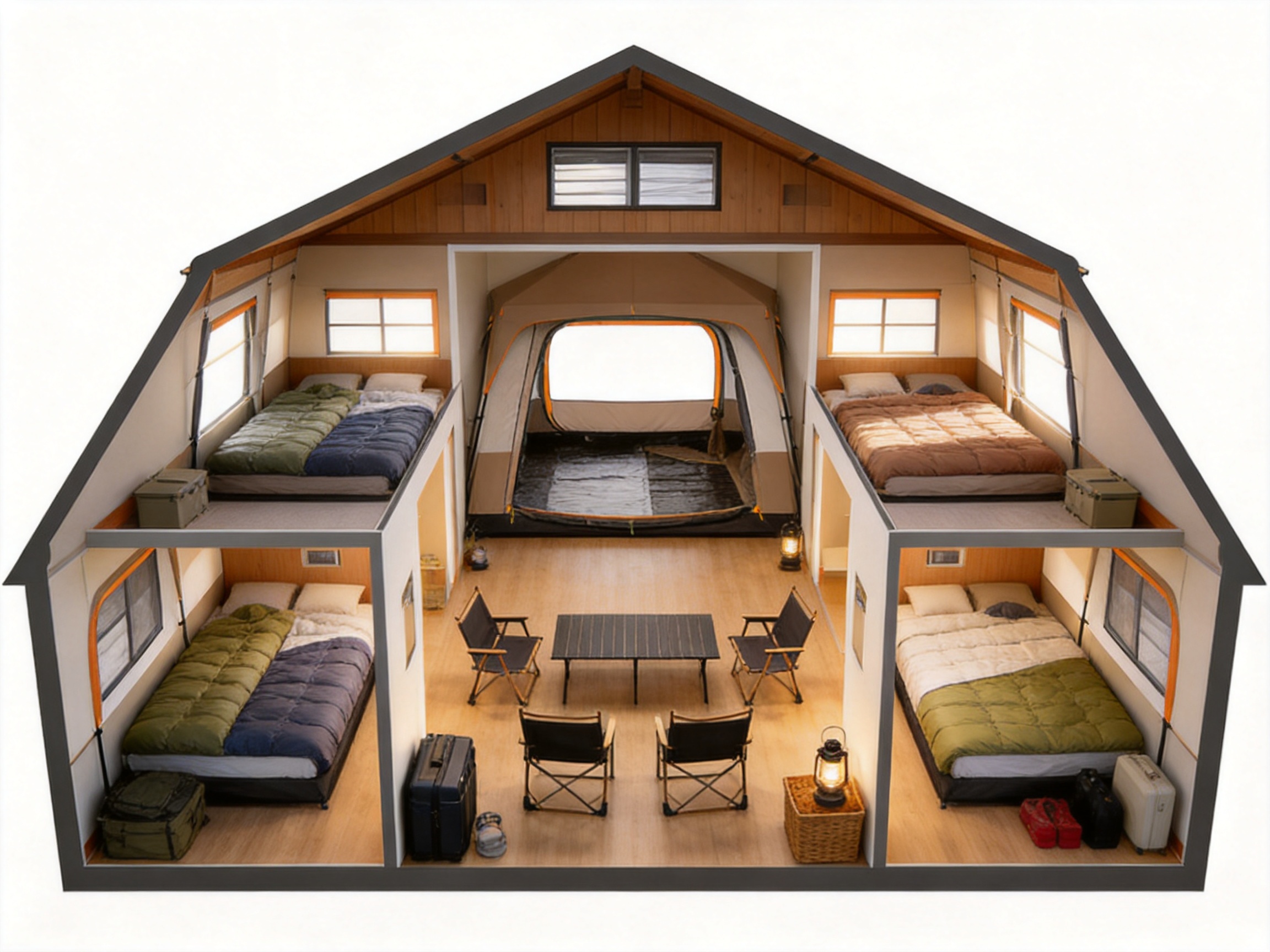
The interior is organized into three practical zones: two separate bedrooms and one large central living room. This arrangement makes the tent suitable for families with children, groups of friends, camping clubs, fishing teams, and glamping guests who value both social space and personal privacy.
The two bedrooms can be used for sleeping, changing clothes, or storing personal belongings. Families may assign one room to adults and the other to children. Groups can divide the sleeping areas by gender or by individual travel parties. In a commercial glamping setting, the rooms can also provide a more comfortable and organized guest experience than a single-room tent.
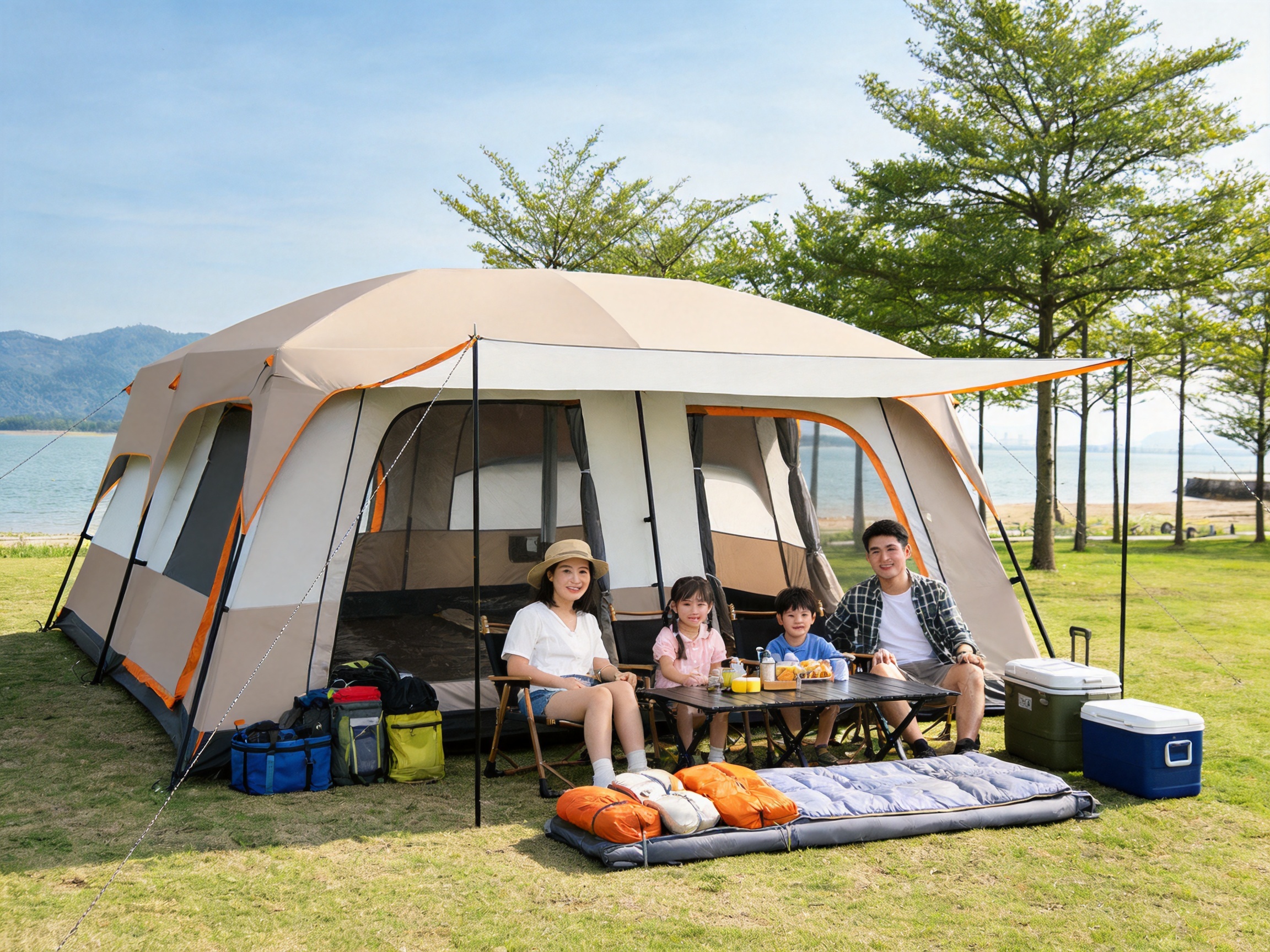
The central living room serves as a multipurpose area. During the day, it can accommodate folding chairs, a low table, luggage, coolers, cooking accessories, and recreational equipment. In bad weather, it gives occupants a sheltered place to talk, read, play games, or plan activities. This extra shared space helps prevent the feeling of congestion that is common in basic family tents.
| Feature | Practical Benefit | Typical Use |
|---|---|---|
| Two separate bedrooms | Improved privacy and sleeping organization | Families, couples, children, and group camping |
| Large central living room | Additional space for relaxing, storing equipment, and socializing | Rainy-day activities, meals, and indoor recreation |
| Capacity for approximately 4–12 people | Flexible use for different group sizes | Family trips, events, fishing outings, and glamping |
| Automatic pop-up structure | Faster installation with less manual assembly | Weekend camping, frequent travel, and rental operations |
| Folding carry-bag design | More convenient storage and transportation | Road trips, seasonal storage, and wholesale distribution |
Automatic Pop-Up Setup for Faster Camping
Large tents can be challenging to install because they usually require multiple poles, lengthy sleeve assembly, and several people working together. The automatic instant pop-up system is intended to simplify this process. Instead of constructing the entire frame piece by piece, users can unfold the packed tent, position it, pull the setup cord or activate the opening mechanism, and allow the structure to expand.
This system is particularly valuable for families who do not want to spend the first part of a trip struggling with complicated instructions. It is also useful for older campers, occasional outdoor users, event staff, and commercial operators who may need to establish several shelters in a limited time. Faster setup means more time for enjoying the destination and less time spent on campsite preparation.
The instant mechanism does not eliminate the need for proper anchoring. A large shelter should always be secured with suitable stakes, guy lines, and tie-down points according to the ground conditions and weather. However, by reducing the amount of frame assembly, the design makes the most demanding part of installation more manageable.
Quick deployment is an advantage over many traditional large cabin tents. Conventional structures may require two or more people to connect poles, feed them through sleeves, and lift the roof into position. The instant pop-up configuration is designed to reduce these steps, making the tent more practical for spontaneous trips, short stays, and repeated commercial use.
After use, the folding system allows the tent to be compressed into a carry bag. Users should follow the folding sequence carefully, because large automatic frames may require the structure to be collapsed in a specific direction. Correct folding protects the frame, fabric, and hinges while also making future setup easier.
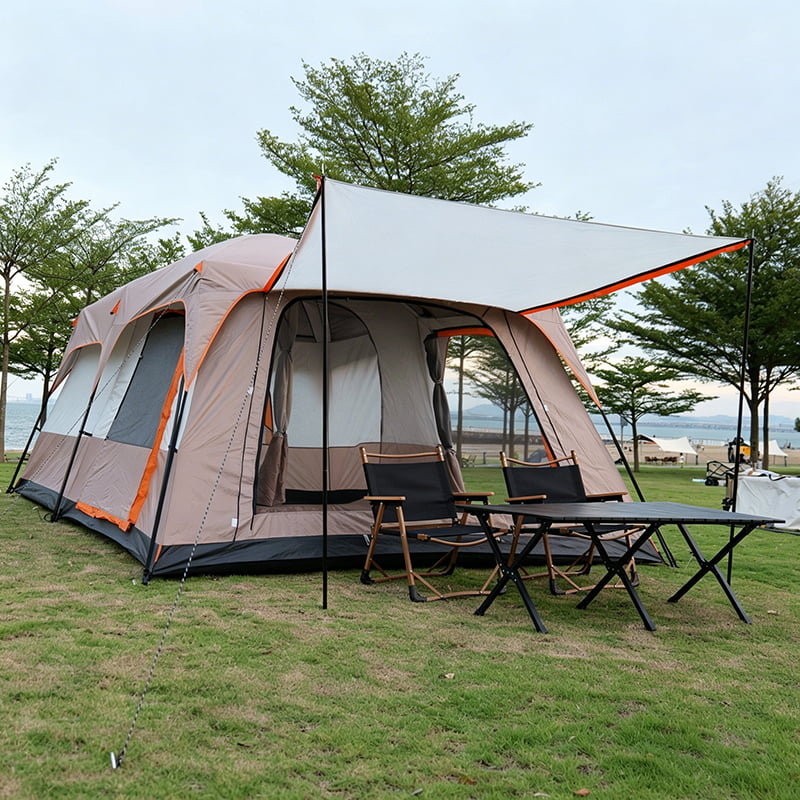
Large 12-Person Instant Pop-Up Glamping Tent with 2 Separate Bedrooms
Cabin-Style Interior Design
The cabin-style profile gives the tent a more usable interior than many low-slope dome tents. A taller central structure creates a greater sense of openness and makes it easier for occupants to move around, sit upright, organize belongings, and use the living area comfortably. This is especially important during extended stays, when people spend more time inside the tent.
Traditional small tents often force occupants to keep sleeping bags, clothing, food containers, and outdoor equipment beside them on the ground. With a large central area and separate rooms, this model provides more opportunities to organize gear. Sleeping spaces can remain dedicated to rest, while the living room can accommodate luggage and shared equipment.
The room separation also supports better daily routines. Parents can prepare children for sleep without disturbing adults. Early risers can use the central living room while other occupants remain in their bedrooms. Glamping guests can enjoy a more residential layout, and groups can establish clear areas for sleeping, relaxing, and storing personal items.
Although the tent is spacious, users should avoid overloading the interior with heavy furniture or equipment. The most comfortable arrangement normally leaves circulation space between the bedrooms, living room, and entrance. Lightweight folding furniture is generally better suited to the structure than bulky household items.
Weather Protection for Extended Outdoor Use
A family tent must provide more than visual comfort. Rain, wind, damp ground, and changing temperatures can quickly affect the outdoor experience. This model uses thickened, high-strength waterproof fabric and reinforced seams to provide dependable protection in wet conditions when the shelter is correctly installed and maintained.
The rainproof construction helps create a dry interior during ordinary camping conditions and heavy rainfall. The roof and walls are designed to direct water away from the living area, while reinforced seam construction helps reduce the risk of leakage at stitched connections. Users should still choose elevated or well-drained ground and avoid placing the tent in natural depressions where water may collect.
Water resistance depends on several factors, including fabric condition, seam treatment, correct tension, zipper closure, and installation angle. No fabric shelter should be regarded as completely immune to extreme weather. The tent is intended to deliver reliable protection during appropriate outdoor use, but campers should monitor weather forecasts and evacuate or relocate when severe storms, flooding, lightning, or dangerous winds are expected.
The thickened material also contributes to durability. Compared with very lightweight summer tents, a heavier family shelter can offer a stronger and more substantial feel. This makes it suitable for longer family stays, beach camping, fishing weekends, and glamping applications in which comfort and robust construction are more important than ultralight backpacking weight.
Reinforced Seams and Fabric Performance
Seams are among the most important areas in any waterproof tent. They join separate fabric panels and therefore require careful stitching and reinforcement. The manufacturing approach for this tent focuses on high-strength materials and reinforced seam construction to improve resistance to water penetration and everyday stress.
During normal use, occupants should avoid pulling aggressively on fabric panels, leaning heavy objects against walls, or storing wet equipment against the interior. After a trip, the tent should be dried completely before long-term storage. These simple practices preserve waterproof performance and reduce the risk of mildew, odor, and material deterioration.
Wind-Resistant Structural Design
The combination of thickened fabric and a sturdy frame system supports wind resistance in normal camping environments. The cabin structure is designed to remain stable when properly erected and anchored. Its broad footprint and multiple support points help distribute tension across the shelter rather than placing all stress on one central pole.
Wind performance depends heavily on installation. All available guy lines should be used in breezy locations, and stakes should be selected according to the soil. Soft sand, loose gravel, hard ground, and forest soil require different anchoring approaches. Doors and windows should be closed when wind increases, and users should remove loose objects from around the tent.
The tent is best understood as a durable recreational shelter, not as an emergency shelter for hurricanes, typhoons, tornadoes, or extreme alpine storms. Responsible site selection and weather awareness remain essential regardless of the quality of the materials.
Advantages over Conventional Competitor Designs
The large instant glamping tent competes in a market that includes traditional family tents, simple pop-up tents, cabin tents, inflatable shelters, and large event structures. Each type has advantages, but this model combines several benefits that are not always available in one product.
More Privacy than Single-Room Tents
A single-room family tent can accommodate several people, but everyone shares the same sleeping area. This arrangement may be acceptable for short trips, yet it offers limited privacy and can make movement difficult. Two enclosed bedrooms provide a clearer separation between occupants and allow families to organize the interior more effectively.
More Living Space than Compact Pop-Up Tents
Small automatic tents are easy to install, but their compact design limits storage, standing room, and group comfort. This large model preserves the convenience of instant setup while adding a central living room and two bedrooms. It is therefore better suited to extended stays and larger groups than a basic two-person or four-person pop-up shelter.
Less Assembly Work than Traditional Cabin Tents
Traditional cabin tents can provide spacious interiors, but their pole systems may require considerable assembly. The automatic frame reduces setup complexity and can lower the labor required at campsites, events, and glamping locations. This advantage is especially meaningful for buyers who value repeatable deployment.
More Flexible than Dedicated Glamping Structures
Permanent glamping cabins and fixed canvas structures can offer excellent comfort, but they are difficult to move and usually require a prepared site. A folding family glamping tent provides a more mobile alternative. It can be transported for seasonal events, moved between campsites, or stored when not in use.
More Comfortable than Ultralight Backpacking Tents
Ultralight backpacking tents are optimized for low weight and compact packing. They are not intended to provide multiple bedrooms, a large living room, or extensive group comfort. This model serves a different purpose: family camping and spacious outdoor living. Its value comes from capacity, structure, privacy, and convenience rather than minimal pack weight.
| Competing Tent Type | Typical Strength | Potential Limitation Compared with This Model |
|---|---|---|
| Small pop-up tent | Very quick setup and low storage volume | Limited sleeping capacity and little living space |
| Traditional cabin tent | Spacious layout and tall walls | Usually requires more manual frame assembly |
| Single-room family tent | Simple interior organization | Less privacy and more crowding |
| Ultralight trekking tent | Low weight for long-distance carrying | Not designed for large groups or extended living |
| Inflatable tent | Flexible air-beam setup and comfortable structure | Requires an inflation system and may have different maintenance needs |
| Permanent glamping cabin | High residential comfort at a fixed location | Limited portability and greater site investment |
| Large instant glamping tent | Capacity, room separation, fast setup, and portability | Requires careful anchoring, folding, and storage |
Suitable Applications and Market Opportunities
The product is suitable for a wide range of personal, commercial, and institutional applications. Its large capacity and room layout make it more versatile than a tent designed for only one type of user.
Family Camping
Families can use the tent for weekend camps, school holidays, road trips, and extended outdoor vacations. The separate bedrooms offer parents and children a practical sleeping arrangement, while the central room supports meals, games, and relaxation.
Glamping Resorts
Glamping operators can use the tent as a portable accommodation unit or seasonal shelter. Its cabin-style interior provides a more organized guest environment than a basic camping tent. Operators may equip the living room with suitable low-profile furniture, lighting, storage baskets, and soft furnishings while maintaining appropriate fire and electrical safety standards.
Outdoor Events and Parties
The spacious interior can provide cover for small outdoor gatherings, family celebrations, recreational activities, and informal parties. The tent can function as a sheltered lounge, changing room, rest area, or temporary hospitality space. Event organizers should consider local regulations, fire safety, emergency exits, and weather conditions before using it for public events.
Fishing and Hunting Basecamps
Fishing groups and outdoor teams often need a dependable basecamp where equipment can be organized and people can rest between activities. The living room provides a shared planning and storage area, while the bedrooms create dedicated sleeping zones.
Beach and Lakeside Camping
The tent is appropriate for beach and lakeside trips when it is properly anchored. Sand-specific stakes, strong guy lines, and protection from direct water exposure are important in these environments. Users should also remove sand before folding the tent to reduce abrasion and protect zippers and moving components.
Retail and Wholesale Distribution
For outdoor retailers, the product offers a clear selling proposition: a large-capacity family tent with instant setup and two bedrooms. Its combination of visual scale, privacy, and convenience can appeal to customers who have outgrown smaller tents but do not want the complexity of a traditional large shelter.
Wholesale buyers can position the product within family camping, premium outdoor equipment, glamping, seasonal travel, and recreational hospitality categories. The manufacturer’s OEM and product development capabilities may also support market-specific packaging, color selection, labeling, and product configuration discussions, subject to project requirements and production confirmation.
Manufacturing Strengths of the Factory
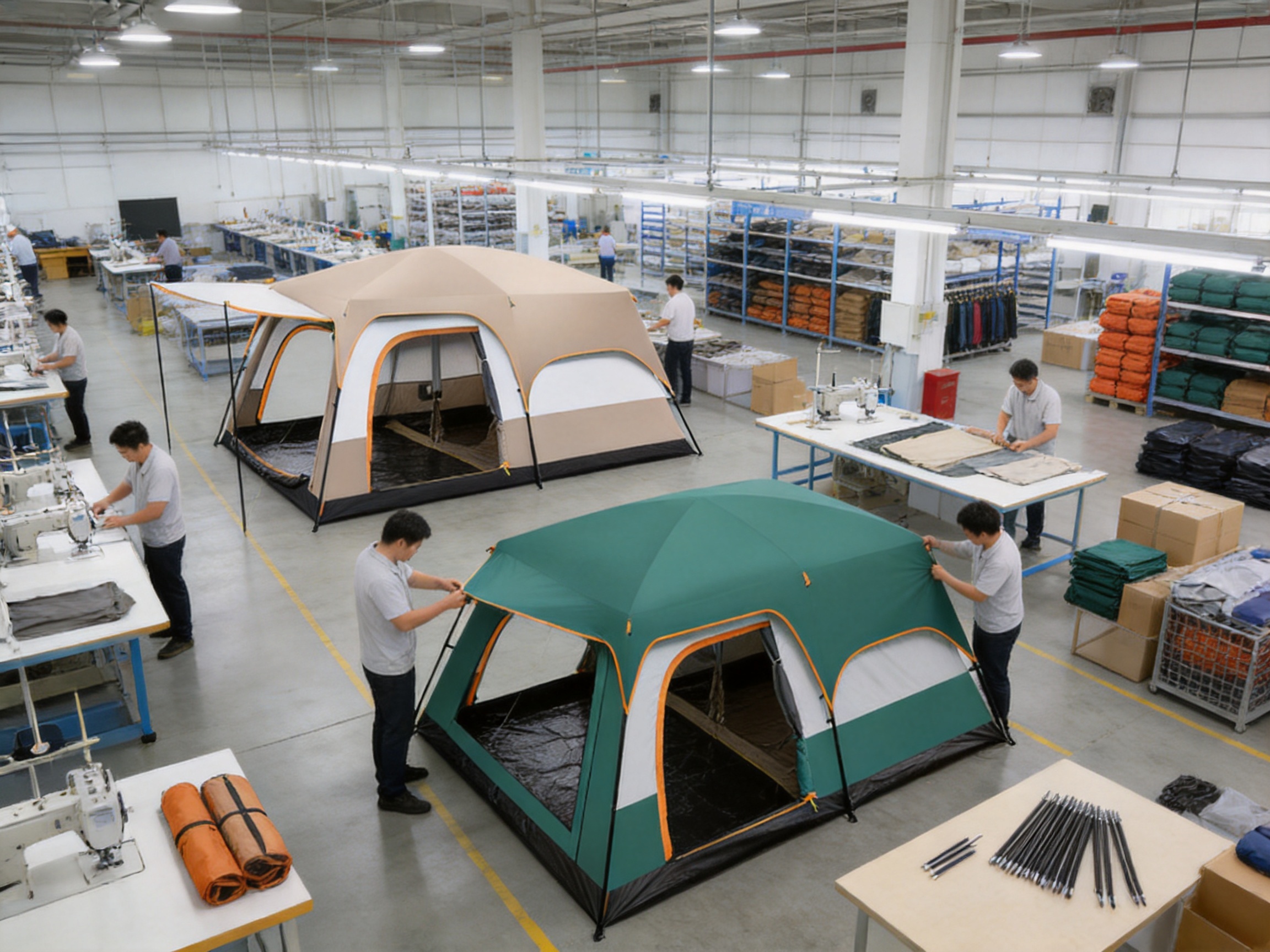
The performance of an outdoor tent depends not only on its design but also on the consistency of the manufacturing process. A spacious structure includes a large amount of fabric, multiple stitched panels, frame components, zippers, webbing, reinforcements, and packaging materials. Each part must work together accurately for the finished product to perform as intended.
Ningbo Zhenhai Tiansai Leisure Products Co., Ltd. operates a factory covering more than 13,000 square meters. This scale provides a foundation for organized material handling, production planning, quality inspection, sample development, and finished-goods preparation. A dedicated manufacturing environment is important for maintaining consistency across wholesale orders and repeat production.
The company specializes in the design, production, and sales of tents and related outdoor products. Its product range includes outdoor tents, backpacking tents, glamping tents, inflatable tents, family tents, and custom OEM camping tent solutions. This broad category experience helps the factory understand the different requirements of lightweight trekking products, large family shelters, and specialized commercial structures.
Professional Product Design
The company maintains a professional design team that develops products from the perspectives of practicality and comfort. For a large family tent, product design involves more than choosing attractive colors. Designers must consider room proportions, entrance placement, frame movement, packed dimensions, user circulation, fabric tension, storage requirements, and the relationship between privacy and ventilation.
Product development also benefits from cooperation with outdoor professionals and feedback from outdoor enthusiasts. Field testing can reveal issues that are difficult to identify from drawings alone, such as the ease of opening a door with full hands, the convenience of organizing sleeping rooms, the stability of the frame during changing wind, or the amount of time required for folding.
Continuous optimization based on customer feedback supports practical improvements. For international markets, feedback may also concern packaging instructions, translation requirements, product photography, replacement parts, retail presentation, and compatibility with local camping habits.
Material Selection and Component Coordination
A large shelter requires coordinated selection of fabric, thread, webbing, zippers, poles, joints, stakes, carry bags, and reinforcement patches. Material selection influences waterproofing, tear resistance, folding behavior, color stability, packed size, and overall product weight.
The fabric must be strong enough for repeated handling while remaining flexible enough to fold. Frame elements must provide support without making deployment unnecessarily difficult. Zippers should operate smoothly under fabric tension, and high-stress points should receive appropriate reinforcement. Carry bags must be large enough to accept the folded product without forcing users to compress it excessively.
Because the product is intended for family and glamping use, the design balances durability and comfort rather than pursuing the lowest possible weight. This positioning differentiates it from ultralight trekking shelters and allows the structure to use a more substantial fabric and frame system.
Production Process and Quality Control
Manufacturing a large tent commonly involves several controlled stages. These may include incoming material inspection, fabric cutting, panel preparation, sewing, reinforcement installation, frame integration, functional assembly, appearance inspection, packing, and shipment preparation. Consistent process control helps reduce variation between units.
Incoming inspection can identify issues in fabric color, coating, thickness, width, hardware, and frame components before they enter production. Accurate cutting is important because even small dimensional differences can affect panel alignment and fabric tension. Sewing quality must be monitored at seams, corners, doors, windows, attachment points, and stress areas.
Assembly inspection confirms that the automatic opening mechanism, frame, fabric body, room dividers, zippers, and carry bag work together correctly. A finished tent should be examined for loose threads, misaligned panels, damaged hardware, incomplete stitching, and visible defects. Packaging inspection helps ensure that the correct accessories, instructions, labels, and components are included.
The company states that it strictly implements a quality management system and works to ensure that products meet international standards. Specific testing requirements can vary by destination market, product configuration, and customer contract, so wholesale buyers should confirm applicable compliance documents and testing arrangements before placing an order.
Patents and Product Development Experience
Tiansai Leisure has designed products covered by a number of appearance patents and utility model patents. Design protection and technical development experience can help a manufacturer create products with distinctive visual features and practical structural solutions. For buyers, this may provide access to original product concepts rather than relying entirely on generic market designs.
The company has also become the sole global designated supplier of the British company TENTSILE. This relationship indicates experience in serving an international outdoor brand and working within the expectations of overseas product development and supply chains. It also reflects the company’s specialization in outdoor equipment and its ability to support professional customers.
OEM and Wholesale Cooperation
Outdoor brands and distributors often require more than an off-the-shelf product. They may need customized colors, private labels, packaging formats, instruction manuals, carton markings, fabric specifications, or regional product variations. A manufacturer with in-house design and production experience can help buyers evaluate which changes are practical and which may affect cost, lead time, durability, or minimum order quantity.
For this two-bedroom family tent, wholesale discussions may include the preferred capacity description, retail packaging, logo placement, fabric color, accessory combinations, carry-bag design, spare parts, and instruction language. Buyers should provide detailed technical requirements at the quotation stage so that the factory can assess feasibility accurately.
A professional wholesale process should also cover sample approval, pre-production confirmation, production scheduling, inspection standards, packaging approval, shipping documents, and after-sales procedures. Clear communication at every stage reduces misunderstandings and supports consistent delivery.
The factory’s location in Ningbo is advantageous for export-oriented business. Ningbo is an important port city with established logistics infrastructure and access to international shipping services. This can help coordinate container loading, export documentation, and delivery to overseas markets, although actual shipping schedules and costs depend on the destination, season, order volume, and transportation conditions.
Practical Installation Guidelines
Before setup, select a level campsite that is free of sharp stones, branches, standing water, and unstable ground. Avoid locations beneath dead trees, near river channels, or in exposed areas where water may accumulate. Check the weather forecast and identify a safe evacuation route when camping in areas with rapidly changing conditions.
Remove the tent from its carry bag and place it on the ground in the intended orientation. Identify the entrance, bedrooms, and central living area before fully expanding the structure. Follow the supplied setup instructions for the automatic mechanism, because the correct sequence may vary according to the frame design.
Once the tent has opened, inspect the frame joints and fabric panels. Secure the corners with suitable stakes, attach the guy lines, and adjust the tension evenly. Do not rely solely on the weight of luggage inside the tent to hold it in place. Proper anchoring is especially important for large high-profile shelters.
Keep ventilation openings available when weather permits. Good airflow reduces condensation caused by breathing, wet clothing, temperature changes, and damp ground. During heavy rain, close openings as needed while maintaining safe ventilation whenever possible.
Do not use open flames, charcoal stoves, fuel-burning heaters, or other combustion devices inside the tent. Fabric shelters can ignite quickly, and combustion can also produce dangerous carbon monoxide. Cooking should take place outside in a safe, well-ventilated area and in accordance with local regulations.
Care, Storage, and Long-Term Durability
Proper care has a direct effect on the useful life of a large tent. After every trip, remove soil, sand, leaves, and debris from the fabric and frame. If the tent becomes wet, set it up or spread it out in a ventilated location until completely dry. Packing a damp tent can encourage mold, mildew, unpleasant odors, and coating damage.
Inspect the tent before storage. Check seams, zippers, webbing, guy lines, stakes, frame joints, and the automatic opening mechanism. Small issues are easier to repair before the next trip than after the tent is already deployed in bad weather.
Fold the structure according to the recommended procedure. Avoid forcing the frame or sharply bending components in an unintended direction. Keep the packed tent in a dry, cool location away from direct sunlight, chemicals, rodents, and excessive heat. Do not place heavy objects on top of the carry bag for long periods.
During transport, protect the bag from sharp tools, fuel containers, and equipment that could puncture the fabric. In beach environments, remove sand from zippers and joints before folding. In coastal areas, salt residue should be cleaned away because it can contribute to corrosion of metal components over time.
Who Should Choose This Tent?
This product is a strong fit for customers who prioritize space, comfort, privacy, and setup convenience. It is especially suitable for families who camp several times each year, groups that want a shared indoor area, and glamping businesses seeking a portable multi-room accommodation product.
It is less suitable for hikers who carry all equipment over long distances and require the lightest possible shelter. It may also be more capacity than necessary for solo travelers or couples who prefer a compact two-person tent. Choosing the correct tent depends on the balance between group size, transport method, camping duration, expected weather, and desired comfort.
Retailers should present the tent honestly as a large recreational shelter requiring suitable anchoring and responsible weather use. Clear product education can improve customer satisfaction. Buyers should understand that the stated capacity is flexible and depends on sleeping arrangements, furniture, luggage, and personal comfort preferences.
Frequently Asked Questions
How many people can use the tent?
The tent is designed to accommodate approximately four to twelve people, depending on sleeping arrangements and how much furniture or equipment is placed inside. Twelve people represent the upper capacity range, while smaller groups will have more generous personal and living space.
Does the tent have separate bedrooms?
Yes. The layout includes two separate bedrooms and a large central living room. This arrangement provides more privacy and organization than a single-room family tent.
How quickly can it be installed?
The automatic pop-up system is designed for rapid deployment with minimal manual assembly. Actual setup time depends on user familiarity, ground conditions, anchoring requirements, and the number of people assisting. The tent should always be fully secured after it expands.
Is the tent waterproof?
The tent uses thickened waterproof fabric and reinforced seams for rainproof performance during appropriate outdoor use. Waterproofing also depends on correct installation, closed zippers, fabric condition, seam maintenance, site selection, and weather intensity.
Can it withstand strong wind?
The sturdy frame and thickened materials provide wind resistance when the tent is properly installed and anchored. It is not intended for hurricanes, tornadoes, typhoons, extreme storms, or other dangerous weather. Users should follow local safety guidance and leave the area when severe conditions are expected.
Is it suitable for glamping businesses?
Yes. Its large floor plan, two-bedroom layout, central living area, folding design, and visual presence make it suitable for seasonal glamping, outdoor hospitality, and rental applications. Commercial operators should confirm local requirements for fire safety, sanitation, electrical equipment, occupancy, and emergency access.
Can the tent be customized?
The manufacturer provides OEM camping tent wholesale solutions and may discuss customization options such as colors, labels, packaging, and product specifications. Customization depends on technical feasibility, order quantity, materials, tooling, and production scheduling.
Is it suitable for backpacking?
The tent is designed primarily for family camping, glamping, road trips, fishing, beach outings, and group use. Because of its large capacity and robust construction, it is not intended to compete with ultralight backpacking tents carried over long distances.
How should the tent be stored?
Dry the tent completely, remove dirt and sand, inspect the frame and fabric, fold it according to the supplied instructions, and store it inside the carry bag in a cool, dry place. Avoid long-term exposure to sunlight, moisture, chemicals, and excessive heat.
What makes this design different from a traditional large tent?
Its main differentiators are the automatic pop-up setup system, two separate bedrooms, spacious central living room, heavy-duty waterproof construction, wind-resistant frame design, and portable folding format. These features combine convenience and capacity in one structure.
Conclusion
The large 12-person instant pop-up glamping tent with two separate bedrooms is designed for outdoor users who want the comfort of a spacious cabin shelter without the complexity of a traditional large-tent assembly process. Its multi-room layout provides privacy and organization, while the central living room creates a practical shared environment for relaxing, storing equipment, and spending time indoors.
Its thickened waterproof materials, reinforced seams, sturdy frame, and folding carry-bag design support use in family camping, glamping, fishing trips, beach outings, group travel, and outdoor events. Compared with smaller pop-up tents, it offers substantially more living space. Compared with traditional cabin tents, it aims to reduce setup effort. Compared with permanent glamping structures, it provides greater portability and deployment flexibility.
The product is supported by the manufacturing capabilities of Ningbo Zhenhai Tiansai Leisure Products Co., Ltd., a specialized Chinese tent manufacturer with a factory exceeding 13,000 square meters, professional design resources, international export experience, product development expertise, and OEM cooperation capabilities. Its quality-focused manufacturing approach, material coordination, testing practices, and attention to outdoor usability make it a practical sourcing option for retailers, distributors, glamping operators, and outdoor brands.
For personal campers, the tent can serve as a comfortable basecamp for family memories. For commercial buyers, it offers a clear combination of capacity, privacy, convenience, and market versatility. When properly installed, cared for, and used within suitable weather conditions, it can become a dependable and comfortable shelter for extended outdoor experiences.
References
1. Ningbo Zhenhai Tiansai Leisure Products Co., Ltd. Product information for the large automatic family glamping tent with two separate bedrooms.
2. Ningbo Zhenhai Tiansai Leisure Products Co., Ltd. Corporate information concerning factory capacity, product development, quality management, OEM services, and international distribution.
3. General outdoor equipment practices for tent site selection, anchoring, ventilation, waterproofing, maintenance, and safe weather use.
4. General principles of textile product manufacturing, stitched-seam reinforcement, frame integration, material inspection, and finished-goods quality control.
Product: Large 12-Person Instant Pop-Up Glamping Tent with 2 Separate Bedrooms

Message Us Right Now!
-
Mp: +86-18858091910
E-mail: sales@tenplaytent.com
ADD: No. 529, Guangyuan Road, Xiepu Town, Zhenhai District, Ningbo City, Zhejiang Province, China
-
Quick Links
Home Products About Us Advantage News Contact Us -
Product
Inflatable & Air Tents Glamping & Resort Tents Backpacking & Trekking Tents Automatic & Pop-Up Tents Family & Camping Tents Specialty Tents & Shelters Kids Tents Pet Tents Humanitarian & Large Tents Hammock -
Get Connected
 Camping Tent Manufacturer in China