


 English
 عربى


Double-Layer Waterproof Pickup Truck Bed Camping Tent: A Practical Guide to Comfortable Mobile Camping
Pickup truck camping offers an appealing combination of mobility, flexibility, and direct access to the outdoors. Instead of towing a trailer or carrying a large freestanding shelter, travelers can convert the bed of a pickup truck into an elevated sleeping area with a purpose-built truck bed tent. The double-layer waterproof pickup truck bed camping tent described in this article is designed for that exact purpose. It creates a protected, comfortable, and portable shelter for camping trips, fishing excursions, road tours, family holidays, and extended outdoor travel.
Unlike a conventional ground tent, a truck bed tent uses the vehicle as its foundation. This raises the sleeping area above wet soil, mud, uneven terrain, and many of the small inconveniences associated with ground-level camping. The result is a more organized campsite that can be assembled wherever the pickup truck can safely park. For users who want the freedom of a mobile shelter without the weight, cost, or complexity of a camper trailer, this type of tent provides a practical alternative.
1. Turning a Pickup Truck into a Mobile Campsite
A pickup truck is already designed to transport equipment, supplies, and outdoor gear. However, the open truck bed is not naturally suited for sleeping. It may expose users to rain, wind, insects, dust, and temperature changes. A truck bed tent addresses these limitations by creating a dedicated enclosure that is secured directly to the vehicle.
The tent forms a sheltered living space above the ground while preserving the vehicle’s mobility. Campers can use the truck for transportation during the day, then convert it into a sleeping shelter at night. This makes the product especially useful for travelers who do not want to set up a separate tent on every trip or who regularly camp in locations where the ground is unsuitable for sleeping.
The design is also beneficial for short-notice trips. A traveler can keep the tent packed in the vehicle, drive to a scenic location, and establish a campsite without transporting a bulky cabin-style tent. When the journey is over, the shelter can be removed, folded, and stored until the next adventure.
For families, the elevated sleeping platform can make camping feel more organized and secure. For individual travelers and couples, it provides a compact private shelter with a clear separation between sleeping equipment and the surrounding campsite. For anglers, hunters, photographers, and road-trip enthusiasts, the tent can function as a dependable base camp that moves with the vehicle.
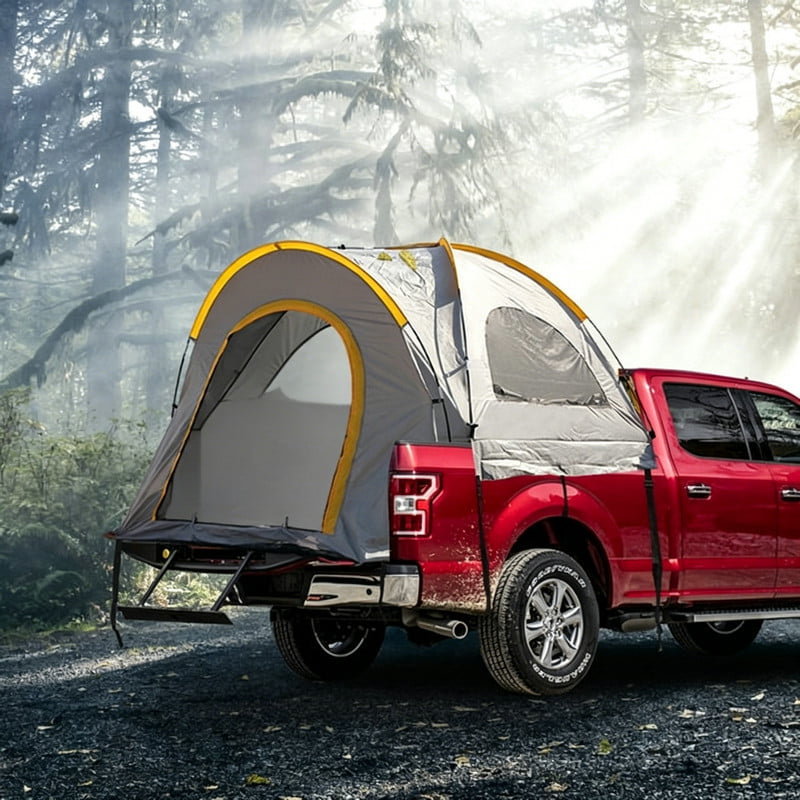
Double Layer Waterproof Pickup Truck Bed Camping Tent Portable SUV Sleeping Shelter
2. Product Overview and Intended Use
This product is a double-layer waterproof pickup truck bed camping tent developed for use with most standard pickup truck beds. Its primary function is to convert a truck bed into a weather-ready sleeping and living space. The structure includes an inner tent layer and an external waterproof rainfly, supported by poles and secured through multiple attachment points.
The tent is suitable for recreational camping, fishing trips, weekend getaways, family travel, long-distance road tours, outdoor photography, and other activities that require a portable shelter. It is also appropriate for users who want to reduce the amount of ground equipment they carry while maintaining a dedicated sleeping area.
The product is not limited to one type of outdoor enthusiast. New campers may appreciate its relatively direct setup and elevated design, while experienced campers may value its efficient use of vehicle space and improved protection from the ground. Small businesses, travel operators, outdoor retailers, and private-label brands may also consider this type of tent for wholesale or OEM product programs.
Although the product is designed around pickup truck beds, compatibility should always be verified before use. Truck bed length, width, sidewall shape, wheel-well position, tailgate configuration, and attachment clearance can vary by vehicle. Correct fit is essential for safety, weather resistance, and user comfort.
3. Double-Layer Construction for Improved Protection
One of the most important advantages of this shelter is its double-layer construction. The inner tent creates the primary enclosed sleeping area, while the rainfly forms an additional protective barrier above and around the inner structure. This layered approach is more versatile than relying on a single fabric shell.
The outer rainfly helps shield the inner tent from rain and ultraviolet exposure. When precipitation begins, water is directed away from the main sleeping compartment rather than falling directly onto the inner fabric. The air space between the two layers can also help reduce direct heat transfer from sunlight and support a more comfortable internal environment.
The inner layer provides an enclosed area for sleeping, storing personal belongings, and organizing camping equipment. Depending on how the product is configured and used, the inner material may also support ventilation and insect protection. The separation between the outer fly and inner tent is valuable because it allows the shelter to perform multiple functions at once: weather defense outside, comfort and livability inside.
Compared with a single-layer truck bed cover, a double-layer design offers a stronger balance between protection and practicality. A single layer may be lighter, but it can expose the interior more directly to condensation, solar heating, and rain impact. The double-layer structure provides another surface for managing these conditions while preserving the portability expected from a vehicle tent.
For users who camp in changing weather, this layered construction provides additional peace of mind. A sunny afternoon, cool evening, unexpected rain shower, and windy morning may all occur during one trip. The tent is designed to address these changing conditions without requiring a complete change of shelter.
Waterproofing Considerations
Water resistance depends on several connected factors, including fabric treatment, seam construction, rainfly coverage, correct installation, and site selection. The product’s waterproof rainfly is intended to help keep precipitation away from the interior. Reinforced seams and a properly tensioned structure further support weather protection.
Users should install the rainfly correctly and ensure that it does not press directly against the inner layer in a way that allows water to transfer inward. The truck should also be parked in a location that does not collect standing water. Even a well-designed shelter performs best when it is installed according to its intended use.
Protection from Wind and Ultraviolet Exposure
Wind can place stress on tent fabric, poles, attachment straps, and seams. This truck bed tent incorporates strong supporting poles, reinforced seams, and multiple attachment points to help maintain stability. The vehicle itself adds a firm foundation, while the attachment system helps prevent the shelter from shifting during normal outdoor conditions.
The rainfly also helps reduce direct exposure to sunlight. Extended ultraviolet exposure can weaken outdoor fabrics over time, so the outer layer acts as a valuable first line of defense. Proper storage after use is equally important. The tent should be completely dry before packing whenever possible, because storing damp fabric can lead to odor, mildew, or material deterioration.
4. Elevated Sleeping Comfort
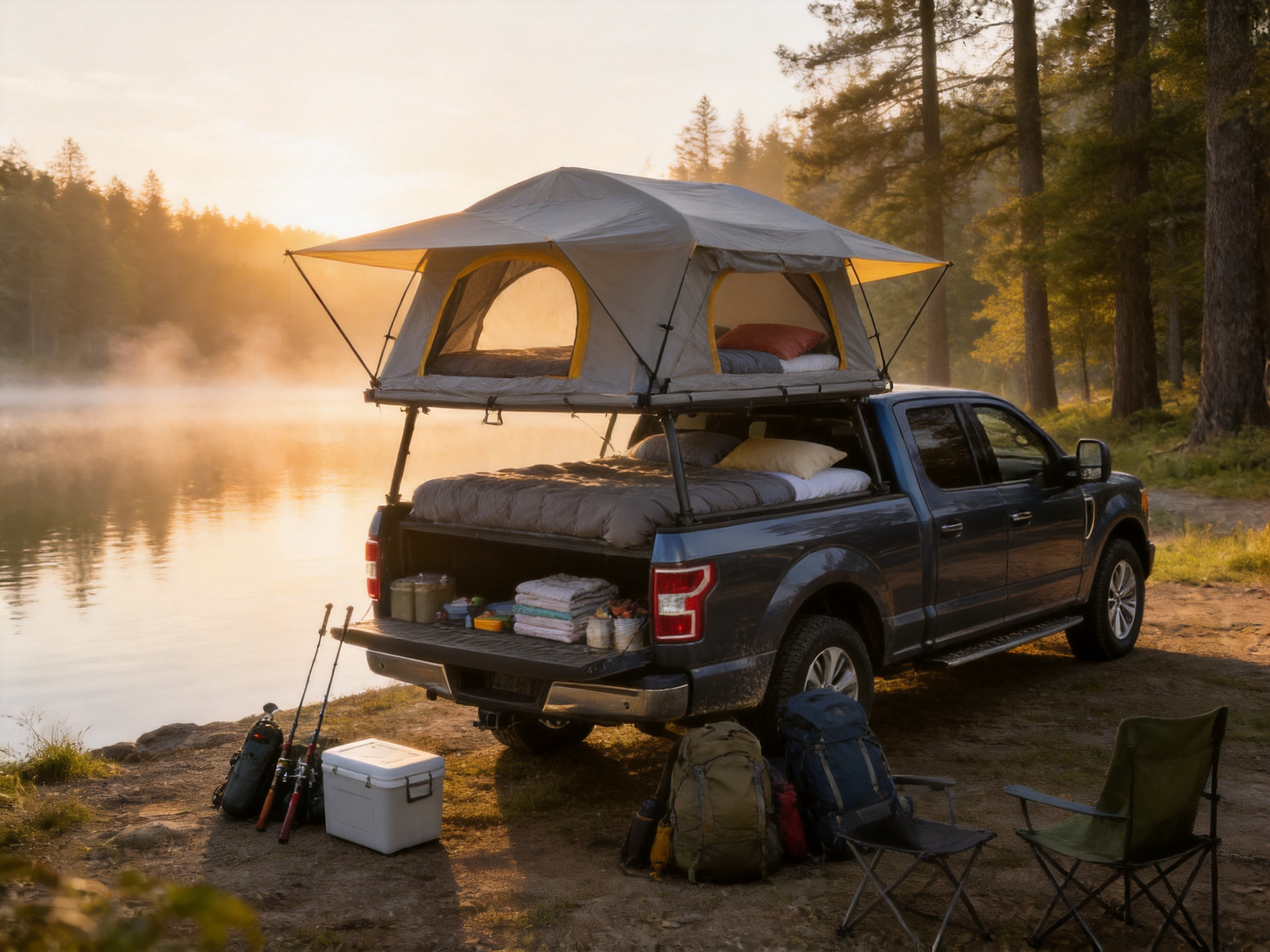
Ground camping can be uncomfortable when the soil is hard, rocky, wet, uneven, or covered with roots. It can also require additional equipment, such as thick sleeping pads, ground tarps, and moisture barriers. By using the truck bed as the sleeping platform, the product provides an elevated alternative.
Elevation can improve the overall camping experience in several ways. It separates the sleeping area from wet ground and reduces direct contact with mud, sand, and small debris. It also creates a clear boundary between the shelter and the surrounding campsite. For many campers, this makes it easier to keep bedding, clothing, and personal items clean.
The raised position can be particularly valuable during rainy conditions. Water flowing across the ground may pass beneath the vehicle rather than directly under the sleeping area. However, elevation does not eliminate the need for responsible site selection. The vehicle should never be parked in a flood-prone area, beneath unstable trees, or on ground that presents a risk of sliding or rollover.
Comfort also comes from organization. A truck bed tent creates a defined room rather than requiring users to spread sleeping equipment across the ground. Campers can arrange sleeping bags, pillows, clothing, and small personal items inside the enclosure. The surrounding truck and campsite remain available for cooking equipment, chairs, coolers, and other supplies.
For long-distance travelers, this separation can make a major difference. A vehicle may carry food, tools, outdoor equipment, and luggage, but the tent establishes a dedicated area for rest. After a long day of driving, hiking, fishing, or sightseeing, users can settle into a prepared sleeping space without searching for a hotel or assembling a large freestanding shelter.
5. Compact Storage and Transport Efficiency
Outdoor equipment must be useful not only when it is deployed but also when it is being transported. A truck bed tent is designed to pack down into a compact form for storage. This helps users preserve cargo space when the shelter is not in use and makes it easier to include the product in a broader travel kit.
Traditional family tents can occupy considerable space in a vehicle, particularly when they include large poles, multiple rooms, extended vestibules, or heavy flooring systems. A truck bed shelter uses the existing vehicle structure, which can reduce the amount of separate ground equipment required. This may be especially helpful for travelers who need to carry fishing rods, bicycles, tools, cooking equipment, or recreational supplies.
Compact storage also supports spontaneous travel. The tent can remain available in the vehicle without taking up the entire cargo area. When a suitable overnight location is found, the shelter can be deployed. After the trip, it can be folded and stored in a garage, storage room, vehicle compartment, or other dry location.
To preserve the product’s service life, users should remove dirt before folding, allow all components to dry, and avoid compressing wet fabric. Poles and straps should be checked before long-term storage. A simple maintenance routine helps preserve waterproof performance and reduces the likelihood of damage during future setup.
6. Quick Setup and Practical Installation
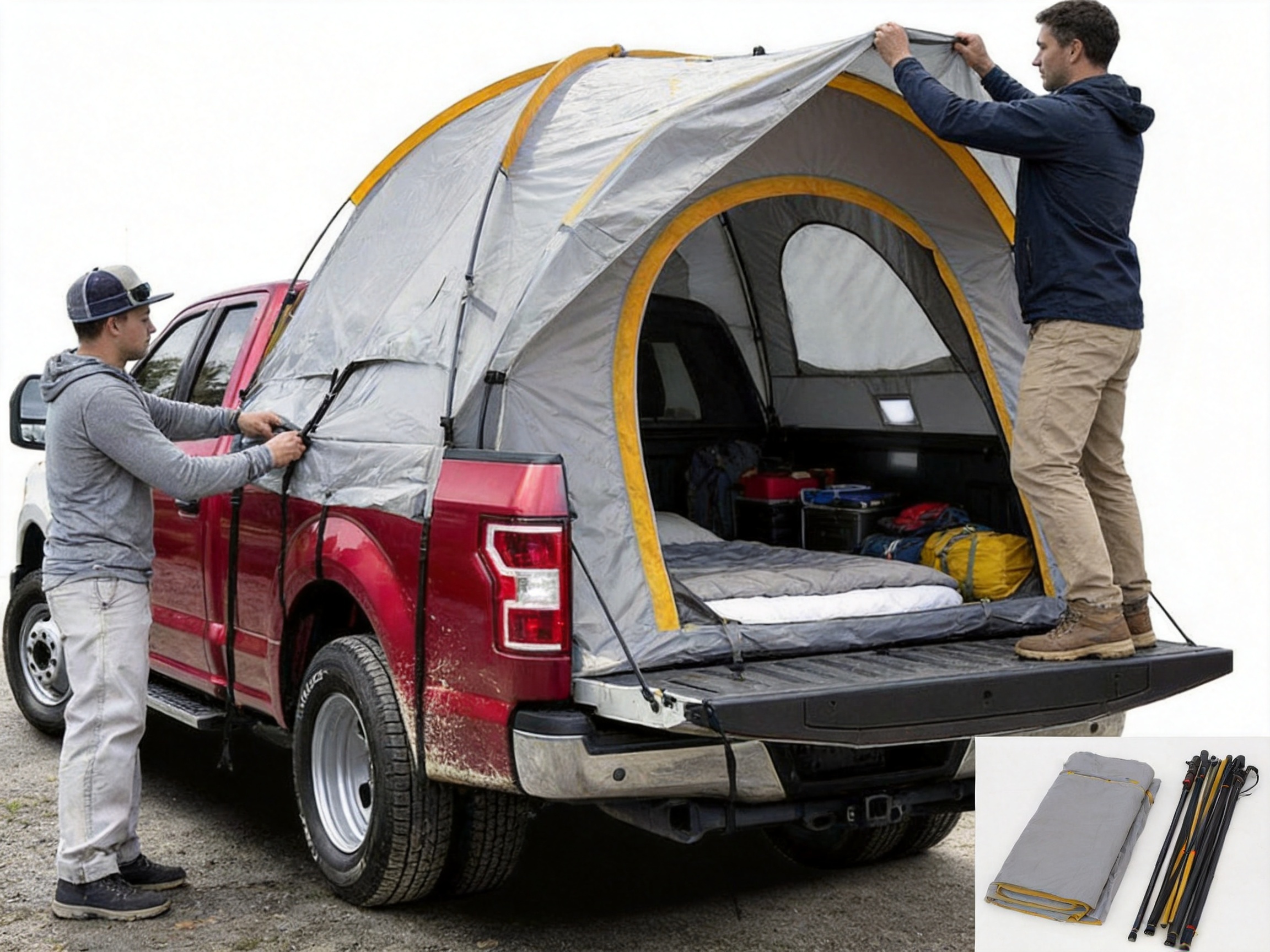
A major reason to choose a truck bed tent is the convenience of using the vehicle as the shelter’s structural base. The product is designed for direct installation onto the truck bed, avoiding the need to construct a separate ground platform. While setup time depends on the user’s experience, weather, and vehicle configuration, the basic process is straightforward.
First, the truck should be parked on stable, reasonably level ground. The parking brake should be engaged, and the vehicle should be positioned away from hazards such as falling branches, unstable slopes, flood channels, or active traffic areas. The truck bed should be cleared of sharp tools, loose objects, and debris that could damage the tent floor.
Next, the inner tent can be placed and aligned with the truck bed. The supporting poles are assembled according to the product instructions and inserted into the appropriate sleeves or attachment points. The tent should be extended evenly so that the fabric is not unnecessarily twisted or overstretched.
The attachment straps or securing points are then connected to suitable sections of the truck. These connections should be firm but not excessively tightened. Over-tensioning may place avoidable stress on fabric loops, seams, or buckles. Once the inner tent is stable, the rainfly is positioned over the top and secured at its designated points.
Before entering the shelter, users should inspect the installation from all sides. The rainfly should provide adequate coverage, the poles should be seated correctly, and the straps should not interfere with doors, tailgate movement, exhaust areas, or other vehicle components. A short inspection after the first few minutes of wind or rain can identify adjustments that improve stability.
Setup Advantages over Conventional Ground Tents
A conventional ground tent requires a suitable patch of soil, careful placement of a groundsheet, selection of stake locations, and sometimes extensive clearing of rocks or vegetation. A truck bed tent eliminates many of these steps because the sleeping area is already elevated on the vehicle.
Ground tents can also become difficult to use when the soil is too hard for stakes, too wet for comfortable sleeping, or uneven enough to create pressure points. Although a truck bed tent still requires a safe parking area, the user does not need to prepare a full sleeping surface on the ground. This can make arrival and departure more efficient.
The product is also less dependent on the condition of a campsite’s tent pad. At established campgrounds, the truck may be parked in a designated area while the tent remains above the ground. At dispersed campsites, users can take advantage of the vehicle’s mobility while maintaining a more structured sleeping arrangement.
7. Stability in Outdoor Conditions
Stability is central to the performance of any portable shelter. A truck bed tent must resist movement while remaining flexible enough to accommodate normal outdoor conditions. This product uses reinforced seams, strong poles, and multiple attachment points to support a stable structure.
Reinforced seams are important because tent fabric experiences concentrated stress at corners, pole sleeves, strap locations, and rainfly connection points. Strengthening these areas helps distribute tension more effectively. Strong poles maintain the tent’s shape, while multiple attachment points reduce the possibility that one connection must absorb all wind force.
The truck itself provides a substantial and stable base compared with a lightweight ground tent. Nevertheless, the shelter should not be treated as an all-weather emergency structure. In severe storms, extreme winds, lightning, flooding, or heavy snowfall, users should follow local safety guidance and seek a more appropriate protected location.
Correct tension is also part of stability. A tent that is too loose may flap excessively, while one that is over-tightened may experience unnecessary stress. The ideal installation creates a smooth, supported profile in which the rainfly sheds water and the inner structure remains properly aligned.
For retailers and professional buyers, stability-related construction details are important selling points. Customers want to understand not only that a product is described as windproof or stable, but also why it can provide dependable performance. Reinforced seams, pole strength, and attachment design offer tangible explanations of the product’s construction advantages.
8. Ventilation, Livability, and Interior Organization
A tent should do more than block rain. It should provide a reasonably comfortable environment for rest. The double-layer structure creates space between the rainfly and the inner layer, which can support airflow and help manage the temperature difference between the interior and exterior.
Ventilation is important because occupants naturally produce moisture while breathing, and damp equipment can add more humidity inside the shelter. Good airflow helps reduce condensation on the inner surface. Users should avoid blocking ventilation openings with sleeping bags, clothing, or luggage. When weather permits, openings can be adjusted to improve air exchange while maintaining protection from insects and rain.
The truck bed layout also supports efficient organization. Sleeping equipment can be placed toward the center, while shoes, small bags, and other items can be arranged along the sides. Campers should avoid placing sharp objects against the tent fabric and should keep heavy equipment from pressing on poles or seams.
Because the shelter is elevated, users should be mindful when entering and exiting, especially at night. A small light, organized footwear location, and clear access path can improve convenience and reduce accidents. Children should be supervised when using the tent, and pets should be introduced carefully to prevent scratching or chewing of the fabric.
9. Applications for Different Outdoor Users
Weekend Campers
For occasional campers, the truck bed tent provides a simple way to turn a regular vehicle into an overnight shelter. It avoids the commitment of purchasing a trailer or permanently modifying the pickup. The product can be used for short trips, seasonal camping, or spontaneous weekends in nature.
Fishing and Hunting Trips
Fishing and hunting trips often require early starts, equipment storage, and access to remote areas. A truck bed tent allows users to sleep close to their vehicle and keep essential gear nearby. The elevated design can be more convenient than placing bedding on damp or muddy ground.
Road Tours
Long-distance road travelers can use the tent as a flexible alternative to hotels. It allows overnight stops at appropriate campgrounds and outdoor destinations without requiring a fixed accommodation schedule. The compact packed size helps preserve vehicle capacity for luggage and travel supplies.
Family Outdoor Travel
Families may use the shelter as a dedicated sleeping area while organizing chairs, cooking equipment, and activities around the vehicle. The product offers an alternative to a large family tent when the family already travels with a pickup truck. Parents should confirm dimensions and sleeping capacity before purchase, and younger children should always be supervised around the elevated truck bed.
Photography and Field Work
Outdoor photographers, survey teams, and field workers sometimes need a mobile rest area near a working location. The tent can provide a temporary shelter without requiring a trailer or permanent installation. Its portability makes it suitable for changing locations during a multi-day assignment.
10. Advantages over Competing Shelter Options
The outdoor shelter market includes conventional ground tents, rooftop tents, vehicle awnings, camper shells, trailers, and inflatable shelters. Each option has its own strengths, but a pickup truck bed tent occupies a useful position between lightweight camping equipment and more permanent vehicle systems.
Compared with Ground Tents
The most obvious advantage over a ground tent is elevation. Users do not need to sleep directly on wet, rocky, or uneven ground. The truck bed provides a prepared platform, while the tent’s rainfly and inner layer create a more structured enclosure.
A truck bed tent may also require less campsite preparation. Ground tents often need stakes and a carefully selected tent pad. The pickup shelter relies primarily on the vehicle and its attachment system. This can save time during both arrival and departure.
Another advantage is the separation of the sleeping space from the surrounding campsite. Mud, insects, and water on the ground are less likely to come into direct contact with bedding. However, a ground tent may offer more freedom in terms of placement and may provide greater interior room depending on its design.
Compared with Rooftop Tents
Rooftop tents are elevated and can provide excellent views, but they often require a roof rack with sufficient load capacity. They may also add height to the vehicle, affect garage clearance, and remain installed during everyday driving. A truck bed tent avoids many of these concerns because it is installed in the pickup bed rather than on the roof.
The lower installation position can make entry and exit easier for some users. It also allows the vehicle roof to remain available for other equipment. When the trip is finished, the truck bed tent can be removed and stored rather than becoming a permanent vehicle accessory.
Compared with Camper Shells and Trailers
Camper shells and trailers can provide more rigid protection and additional amenities, but they generally involve greater cost, weight, maintenance, and storage requirements. A truck bed tent is a lighter and more flexible option for users who want occasional sleeping capability without converting the pickup into a permanent camper.
Trailers also reduce maneuverability and may require dedicated parking or towing equipment. The tent preserves the pickup’s normal driving characteristics when removed and does not require a separate registration or towing process in the same way a trailer may.
Compared with Vehicle Awnings
An awning provides shade and rain cover but does not necessarily create a complete sleeping enclosure. The truck bed tent is designed specifically as a shelter for overnight use. Its inner layer offers a more private sleeping environment, while the rainfly supplies additional weather protection.
11. Manufacturing Strengths and Product Development Capability
The product is manufactured by Ningbo Zhenhai Tiansai Leisure Products Co., Ltd., an outdoor-products enterprise based in Ningbo, Zhejiang Province, China. The company specializes in the design, production, and sales of tents and related outdoor equipment. Its factory covers more than 13,000 square meters, providing a substantial foundation for product development, production coordination, quality management, and export operations.
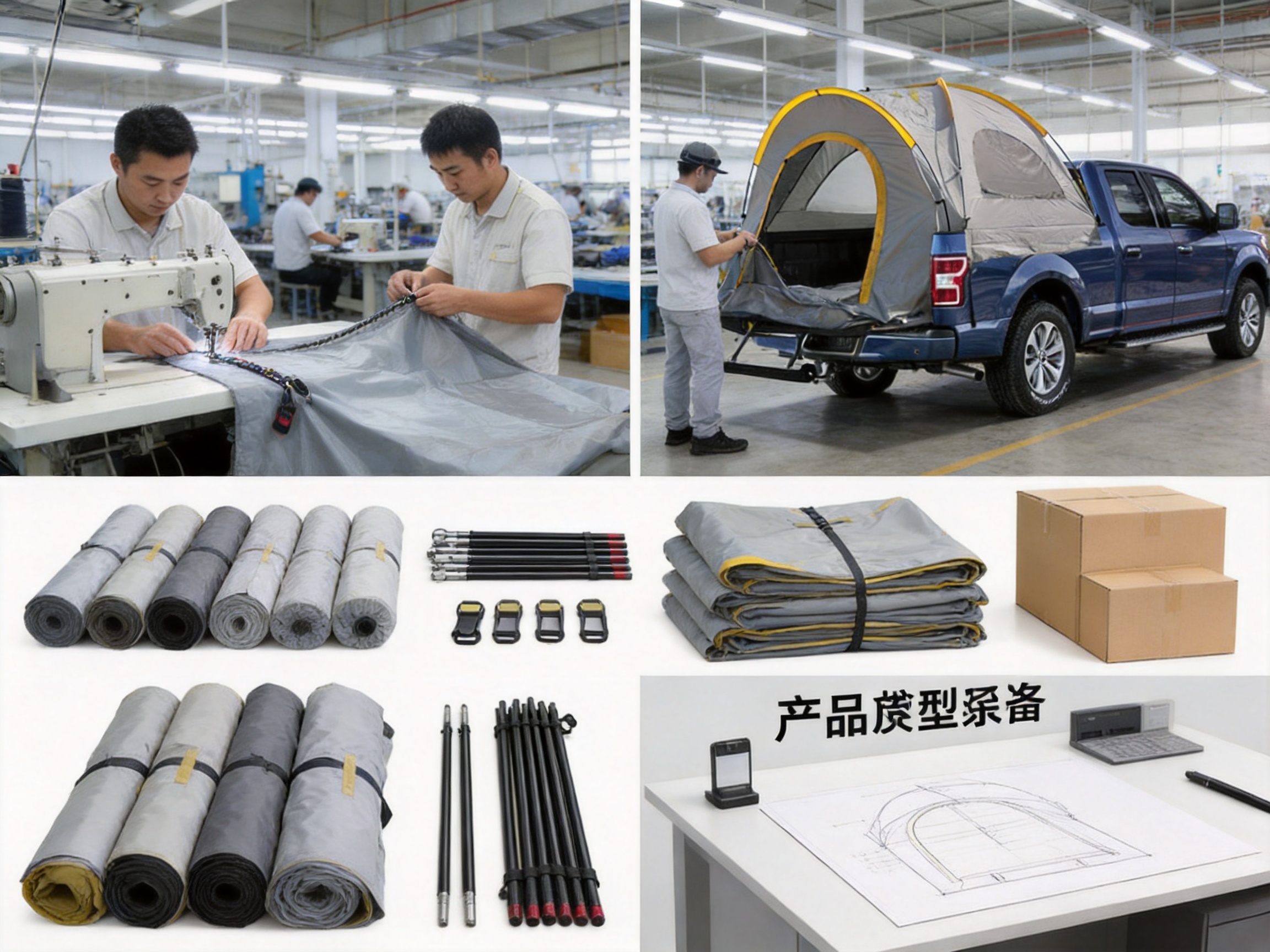
A factory of this scale can support multiple stages of the manufacturing process under coordinated management. These stages may include material preparation, fabric cutting, sewing, seam reinforcement, pole and accessory preparation, assembly inspection, packing, and shipment organization. Integrated production planning helps maintain consistency between product specifications and finished goods.
The company’s location in Ningbo provides access to an important international port environment. This is valuable for an export-oriented manufacturer serving customers in North America, Europe, Asia, and other regions. Efficient logistics support can help international buyers manage production scheduling, container loading, documentation, and delivery planning.
Design-Led Product Development
Outdoor equipment must balance multiple requirements at the same time. A tent needs to be protective but not unnecessarily heavy, stable but not difficult to install, spacious but still compact when packed, and durable without losing practical convenience. Tiansai Leisure maintains a professional design team focused on these competing needs.
The company develops products from the perspectives of practicality and comfort. This approach is particularly relevant to truck bed tents, because vehicle compatibility, attachment convenience, sleeping comfort, ventilation, storage, and weather resistance all influence the user experience. A product that performs well in only one of these areas may still disappoint customers. Balanced design is therefore a significant competitive advantage.
Product development also benefits from collaboration with professionals and feedback from outdoor enthusiasts. Field testing can reveal problems that are difficult to identify in a factory or showroom, such as awkward strap placement, difficult pole insertion, poor rainfly tension, or inconvenient storage. Continuous refinement based on real use helps improve the final product.
Patents and Technical Experience
The company has designed products that have received appearance patents and utility model patents. These achievements indicate an ongoing emphasis on product innovation and design protection. For wholesale customers and outdoor brands, this can provide confidence that the supplier has experience creating differentiated products rather than simply copying standard market designs.
The company’s core team includes experienced outdoor-product specialists with more than ten years of involvement in research and development, production, and overseas operations. That background is important for products intended for international markets, where buyers may require consistent quality, clear communication, packaging coordination, and support with customized specifications.
12. Advanced Manufacturing Process
The quality of a tent depends heavily on production details that may not be visible in a product photograph. The manufacturing process must preserve fabric alignment, seam strength, pole fit, attachment accuracy, and final package completeness. For this reason, a reliable factory treats production as a sequence of controlled operations rather than a simple assembly task.
Material Selection and Preparation
The process begins with the selection and preparation of fabrics, webbing, thread, pole components, buckles, zippers, and other accessories. Materials should be checked for visible defects, color consistency, dimensional accuracy, and suitability for the intended construction. Fabric rolls are commonly inspected before cutting so that damaged sections can be identified and managed.
For a double-layer truck bed tent, material preparation must account for the different functions of the inner tent and outer rainfly. The rainfly requires appropriate weather-resistant performance, while the inner layer must support enclosure, comfort, and practical ventilation. Accessories such as straps and buckles must be compatible with the expected attachment forces.
Computer-Assisted Cutting and Pattern Accuracy
Accurate cutting is essential for a tent because many panels must join together at specific angles and dimensions. Pattern errors can create wrinkles, uneven tension, poor pole alignment, or inadequate rainfly coverage. A professional production system uses standardized patterns and controlled cutting procedures to improve repeatability.
Consistent cutting also helps reduce material waste and supports stable production costs. For OEM and wholesale orders, repeatable pattern control is particularly important because the buyer expects units from different production batches to maintain the same dimensions and appearance.
Sewing and Seam Reinforcement
Sewing is one of the most important stages in tent manufacturing. Seams connect fabric panels and transfer tension throughout the shelter. Stress points around pole sleeves, corners, straps, zippers, and attachment loops require careful construction.
Reinforcement can include additional fabric layers, stronger stitching patterns, or carefully positioned support patches. The objective is to distribute force over a broader area rather than allowing one small section of fabric to absorb all the tension. Consistent stitch density and accurate seam alignment contribute to the durability and appearance of the finished tent.
Workers must also manage the relationship between fabric layers. If the inner tent and rainfly are not aligned correctly, the finished shelter may be difficult to assemble or may not provide balanced coverage. Production guidelines and inspection procedures help reduce these risks.
Pole and Attachment-System Preparation
Poles provide the framework that creates interior volume and supports the rainfly. Each pole section must be checked for proper connection, length, finish, and compatibility with the corresponding sleeve or clip. A pole that is too long, too short, or incorrectly matched can affect the shape and stability of the entire tent.
Attachment straps and connection points also require accurate positioning. Their location determines how the shelter sits on the truck bed and how tension is distributed during use. Careful assembly helps ensure that the product can be installed without unnecessary strain on the fabric or vehicle.
Assembly Inspection and Functional Testing
Finished tents should be inspected for sewing quality, fabric defects, missing components, zipper operation, pole fit, strap attachment, and package completeness. Where appropriate, samples can be opened and assembled to confirm that the parts work together as intended.
Quality management is most effective when it is applied throughout production rather than only at the final packing stage. Incoming material checks, in-process inspections, and final product reviews create multiple opportunities to identify and correct problems. This approach supports more consistent performance for both individual customers and large wholesale orders.
Packaging and Export Readiness
Packaging must protect the product during handling, storage, and international transportation. The tent should be folded in a manner that minimizes unnecessary creasing and should be packed with its poles, straps, rainfly, and instructions. Carton labeling and packing lists must correspond with the order requirements.
For global customers, export readiness includes communication about product specifications, carton dimensions, order quantities, delivery schedules, and customization needs. An experienced supplier can help coordinate these details as part of a complete service process.
13. Quality Management and International Service
Tiansai Leisure states that it strictly implements a quality management system and works to ensure that its products meet international standards. For a camping tent manufacturer, quality management involves more than checking the final appearance. It includes the reliability of materials, consistency of construction, performance of hardware, and accuracy of product information.
International customers often require dependable communication across the entire purchasing process. This may include product selection, sample confirmation, artwork or label approval, packaging decisions, production updates, inspection arrangements, and shipping coordination. A supplier with overseas operations experience can help reduce misunderstandings and improve order efficiency.
The company serves as a one-stop partner for global outdoor brands and supports OEM camping tent wholesale solutions. OEM capability may include adjustments to color, branding, packaging, labels, accessories, or selected product details, subject to technical and order requirements. Buyers should confirm customization options, minimum order quantities, lead times, and testing documentation directly with the manufacturer.
Efficient service is particularly important for vehicle tents because compatibility and customer expectations must be communicated clearly. Product listings should provide accurate dimensions, suitable truck-bed ranges, material information, setup guidance, care instructions, and safety recommendations. Clear information helps retailers reduce returns and gives end customers greater confidence before purchase.
14. Sustainability and Future-Oriented Development
The outdoor industry is increasingly focused on lightweight construction, long service life, repairability, and environmentally responsible materials. A durable tent can support sustainability by remaining useful for many seasons rather than requiring frequent replacement. Proper care, repair, and responsible storage all contribute to longer product life.
Tiansai Leisure has identified lightweight and environmentally friendly materials as areas for continued research and development. For truck bed tents, lightweight design can improve handling, packed storage, and transportation efficiency. However, weight reduction must be balanced with fabric strength, seam reliability, pole durability, and weather resistance.
Environmental responsibility also involves reducing avoidable production waste and improving packaging efficiency. Accurate cutting patterns, controlled inventory, durable construction, and appropriate carton design can support more efficient use of resources. Buyers interested in sustainability should request specific material and packaging information when evaluating products for their own markets.
15. Buyer Guidance for Retailers and Wholesale Customers
Retailers considering this product should evaluate both its consumer appeal and its operational requirements. The strongest selling points include the conversion of a pickup truck into a mobile campsite, double-layer weather protection, elevated sleeping comfort, compact storage, quick installation, and suitability for multiple outdoor activities.
Product presentation should explain what the tent does without making unrealistic claims. Weather resistance is not the same as protection from every possible storm, and fit may vary among vehicles. Clear compatibility information is essential. Retailers should ask for product dimensions, recommended truck-bed configurations, packed size, gross weight, materials, available colors, and included accessories.
Wholesale customers may also wish to confirm production capacity, sample policy, inspection procedures, carton details, logo options, instruction manual languages, and shipping arrangements. If the product will be sold under a private label, buyers should discuss artwork requirements and packaging approval before production begins.
Customer support materials should include setup instructions, care guidance, safe-use warnings, and recommendations for drying and storage. These resources help users obtain better performance and reduce misuse. A well-supported product generally produces stronger customer satisfaction than a product sold with limited guidance.
16. Safe and Responsible Use
Users should inspect the tent before every trip. Check the fabric for tears, examine seams and reinforcement points, confirm that poles are not bent or cracked, and ensure that straps and buckles are in good condition. Damaged components should be repaired or replaced before use.
The pickup should be parked on stable ground with the engine turned off while the tent is occupied. Avoid installing the shelter near open flames, hot exhaust components, electrical hazards, unstable trees, or areas at risk of sudden flooding. Cooking, fuel storage, and portable heaters should be kept away from the tent fabric and used only according to their safety instructions.
Never exceed the truck’s load capacity. The combined weight of occupants, bedding, equipment, and cargo must remain within the vehicle manufacturer’s limits. The tent itself does not increase the truck’s payload rating. Users should also confirm that the tailgate and truck-bed structure are suitable for the intended setup.
In strong wind, lightning, extreme rain, heavy snow, or other severe conditions, users should consider leaving the tent and moving to a safer shelter. A portable recreational tent is not intended to replace an emergency building or a certified severe-weather shelter.
17. Care, Cleaning, and Storage
Routine care helps preserve waterproofing and structural performance. After use, shake out loose dirt and remove leaves, sand, and debris. If the fabric becomes muddy, clean it with water and a mild product appropriate for outdoor textiles. Harsh chemicals, abrasive brushes, and aggressive scrubbing may damage coatings or fabric fibers.
The tent should be dried completely before long-term storage. If rain prevents immediate drying, unpack the shelter as soon as practical and allow it to dry in a ventilated area. Folding a wet tent can encourage mildew and unpleasant odors, and it may reduce the life of the waterproof treatment.
Poles should be stored without unnecessary bending or impact. Straps and buckles should be kept free from tangles, while zippers should be closed or protected from dirt during storage. The packed tent should be placed in a cool, dry location away from direct sunlight, rodents, sharp tools, and excessive heat.
Before the next trip, users should perform a complete setup inspection. This confirms that all components are present and allows small issues to be addressed at home rather than at a remote campsite.
18. Frequently Asked Questions
What type of vehicle is this tent designed for?
The product is designed primarily for pickup trucks with suitable truck-bed dimensions and attachment clearance. It may fit many standard pickup beds, but users should confirm vehicle compatibility before purchase. Truck-bed length, width, wheel wells, tailgate design, and sidewall shape can affect installation.
What does double-layer construction mean?
Double-layer construction means that the shelter includes an inner tent and a separate outer rainfly. The rainfly helps protect the inner compartment from rain and sunlight, while the inner layer provides the enclosed sleeping area. The space between the layers can also support ventilation and comfort.
Is the tent completely waterproof?
The waterproof rainfly and reinforced construction are designed to provide strong protection from normal rain. However, waterproof performance depends on correct installation, closed openings, intact seams, suitable site selection, and weather conditions. No portable tent should be considered suitable for every extreme-weather situation.
Can one person set it up?
The product is designed for quick and practical installation, and many users may be able to set it up independently after becoming familiar with the process. Assistance may be helpful during the first setup, in strong wind, or when installing the shelter on a larger vehicle.
Does the tent require ground stakes?
Because the shelter is attached directly to the pickup truck bed, it does not rely on a conventional ground-tent layout. However, users must follow the supplied attachment method and ensure that all straps, poles, and connection points are correctly secured.
Can the truck still be used after the tent is installed?
The truck can remain parked as the base of the shelter, but users should not drive with the tent deployed unless the product instructions specifically permit it. Before driving, remove or fully secure the tent and ensure that no straps, poles, or fabric can contact wheels, exhaust components, or moving parts.
Is this tent suitable for family camping?
The tent is promoted for family use and provides an elevated shelter with useful sleeping space. Families should check the actual dimensions and recommended capacity before ordering. Occupants should distribute weight appropriately and supervise children when entering or leaving the truck bed.
Can it be used for fishing and road trips?
Yes. Fishing trips, road tours, weekend camping, and long-distance travel are among the product’s intended applications. Its compact packed form allows it to remain part of a vehicle-based travel kit.
How should the tent be stored after a rainy trip?
Allow the inner tent and rainfly to dry completely before long-term storage. Remove dirt and debris, inspect the poles and straps, fold the fabric carefully, and keep the packed product in a cool, dry location.
What should wholesale buyers ask the manufacturer?
Wholesale buyers should request product dimensions, compatible vehicle information, materials, packed size, gross weight, available colors, included components, sample terms, minimum order quantity, lead time, inspection standards, packaging specifications, OEM options, and shipping arrangements.
Can the product be customized?
The manufacturer provides OEM camping tent wholesale solutions and may support selected customization options. Buyers should discuss branding, colors, labels, packaging, accessories, order quantities, and technical limitations with the factory before confirming production.
19. Why This Product Is a Strong Market Choice
The double-layer waterproof pickup truck bed camping tent responds to several major consumer needs at once. It provides a portable sleeping shelter, uses an existing vehicle platform, reduces dependence on ground conditions, packs compactly, and supports a broad range of outdoor activities. These advantages give it a clear position within the camping and vehicle-accessory market.
Its strongest competitive distinction is the combination of elevated comfort and flexible ownership. A rooftop tent may require permanent mounting equipment, a trailer may involve high expense and reduced maneuverability, and a conventional ground tent may expose users to difficult terrain. The truck bed tent offers a middle path that is more mobile than a trailer, more accessible than many rooftop systems, and more elevated than a ground shelter.
The double-layer design further strengthens the product’s appeal. Consumers increasingly expect outdoor equipment to perform in changing weather while remaining easy to transport. A waterproof rainfly, robust inner layer, reinforced seams, strong poles, and multiple attachment points address these expectations in a practical way.
The manufacturer’s design experience, production facility, international export background, patent achievements, quality-management focus, and OEM capabilities also add value for commercial buyers. These strengths can help brands and distributors build a product range that combines practical consumer benefits with dependable manufacturing support.
20. Conclusion
The double-layer waterproof pickup truck bed camping tent provides an efficient way to transform a pickup truck into a comfortable mobile campsite. By combining an elevated sleeping platform with a waterproof rainfly, inner enclosure, reinforced seams, strong poles, and multiple attachment points, it offers a practical shelter for camping, fishing, road travel, and outdoor exploration.
Its advantages over many competing options include reduced contact with wet or uneven ground, compact storage, flexible installation, no need for a separate trailer, and convenient integration with an existing pickup truck. The product is designed to balance weather protection, stability, livability, and portability rather than focusing on only one feature.
Behind the product is Ningbo Zhenhai Tiansai Leisure Products Co., Ltd., a specialized tent manufacturer with a factory of more than 13,000 square meters, an experienced outdoor-product team, international market reach, design and patent experience, quality-management procedures, and OEM wholesale capabilities. These manufacturing strengths support the development of outdoor shelters intended for both individual users and global outdoor brands.
For consumers, the tent offers a more organized and comfortable way to camp from a pickup truck. For retailers and wholesale customers, it represents a versatile product category with clear practical benefits and broad application potential. With correct vehicle matching, responsible installation, regular inspection, and proper storage, it can become a dependable part of a mobile outdoor equipment system.
References
1. Product information supplied for the double-layer waterproof pickup truck bed camping tent, including its construction, intended applications, setup characteristics, and storage benefits.
2. Company information supplied for Ningbo Zhenhai Tiansai Leisure Products Co., Ltd., including its manufacturing facility, design capabilities, export experience, patent achievements, quality-management practices, and OEM services.
3. General outdoor shelter principles concerning waterproof layers, seam reinforcement, ventilation, wind stability, fabric care, and safe campsite selection.
4. General vehicle-based camping considerations concerning pickup-bed compatibility, payload awareness, attachment inspection, and responsible outdoor use.
Product: Double Layer Waterproof Pickup Truck Bed Camping Tent Portable SUV Sleeping Shelter

Message Us Right Now!
-
Mp: +86-18858091910
E-mail: sales@tenplaytent.com
ADD: No. 529, Guangyuan Road, Xiepu Town, Zhenhai District, Ningbo City, Zhejiang Province, China
-
Quick Links
Home Products About Us Advantage News Contact Us -
Product
Inflatable & Air Tents Glamping & Resort Tents Backpacking & Trekking Tents Automatic & Pop-Up Tents Family & Camping Tents Specialty Tents & Shelters Kids Tents Pet Tents Humanitarian & Large Tents Hammock -
Get Connected
 Camping Tent Manufacturer in China