


 English
 عربى


Inflatable Car Rear Double-Layer Awning Tent: A Smarter Portable Basecamp for SUV Camping
Modern outdoor travel is no longer limited to carrying a conventional freestanding tent and searching for a level campsite. For families, road-trippers, van travelers, and outdoor enthusiasts, the vehicle itself can become the center of a flexible camping system. A rear-mounted vehicle tent creates a sheltered connection between the car and the outdoors, extending usable living space without requiring a large trailer, permanent rooftop structure, or complicated construction process.
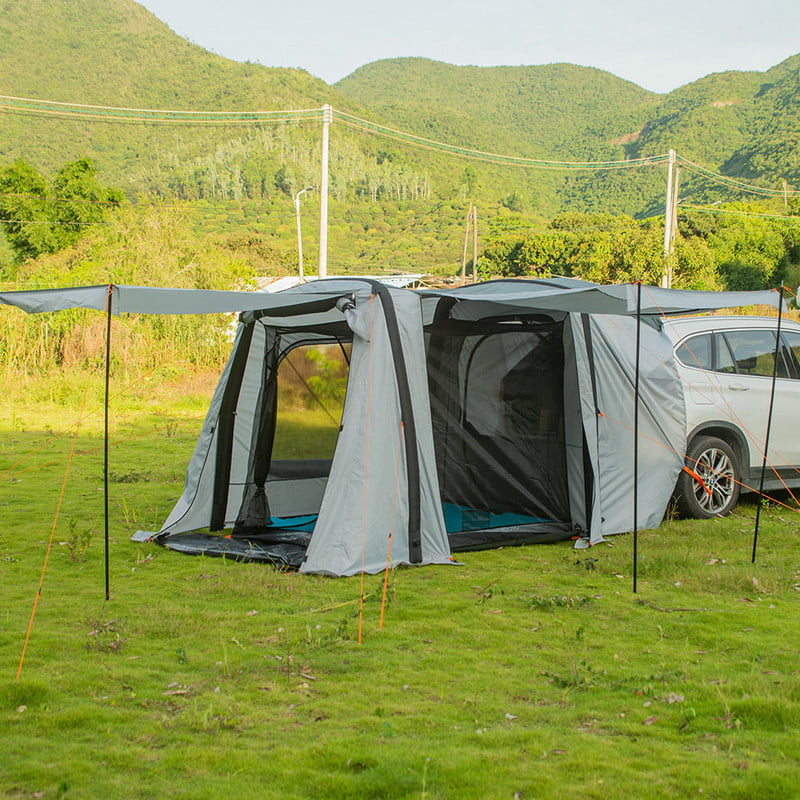
The inflatable car rear double-layer awning tent is designed for exactly this purpose. It connects with the rear area of an SUV, MPV, hatchback, van, or truck and creates a practical outdoor room for resting, cooking, dining, changing clothes, organizing equipment, and enjoying shade beside the vehicle. Its inflatable beam structure, double-layer protection, built-in awning, and portable design make it particularly suitable for family camping, weekend travel, road trips, festivals, leisure touring, and mobile basecamp applications.
Unlike a basic tailgate cover or a simple vehicle awning, this product is designed as a more complete shelter. It combines the protective benefits of an enclosed tent with the open-air comfort of an awning. When attached correctly to a compatible vehicle, it helps transform unused space behind the tailgate into an organized and comfortable extension of the vehicle.
Turning the Vehicle into a Practical Outdoor Living Room
One of the most important advantages of a vehicle rear tent is the way it uses space that campers already have. The vehicle provides a convenient anchor point, while the tent extends outward to create additional covered area. This arrangement is especially useful when the vehicle is being used as a mobile basecamp and campers need more room than the vehicle interior can provide.
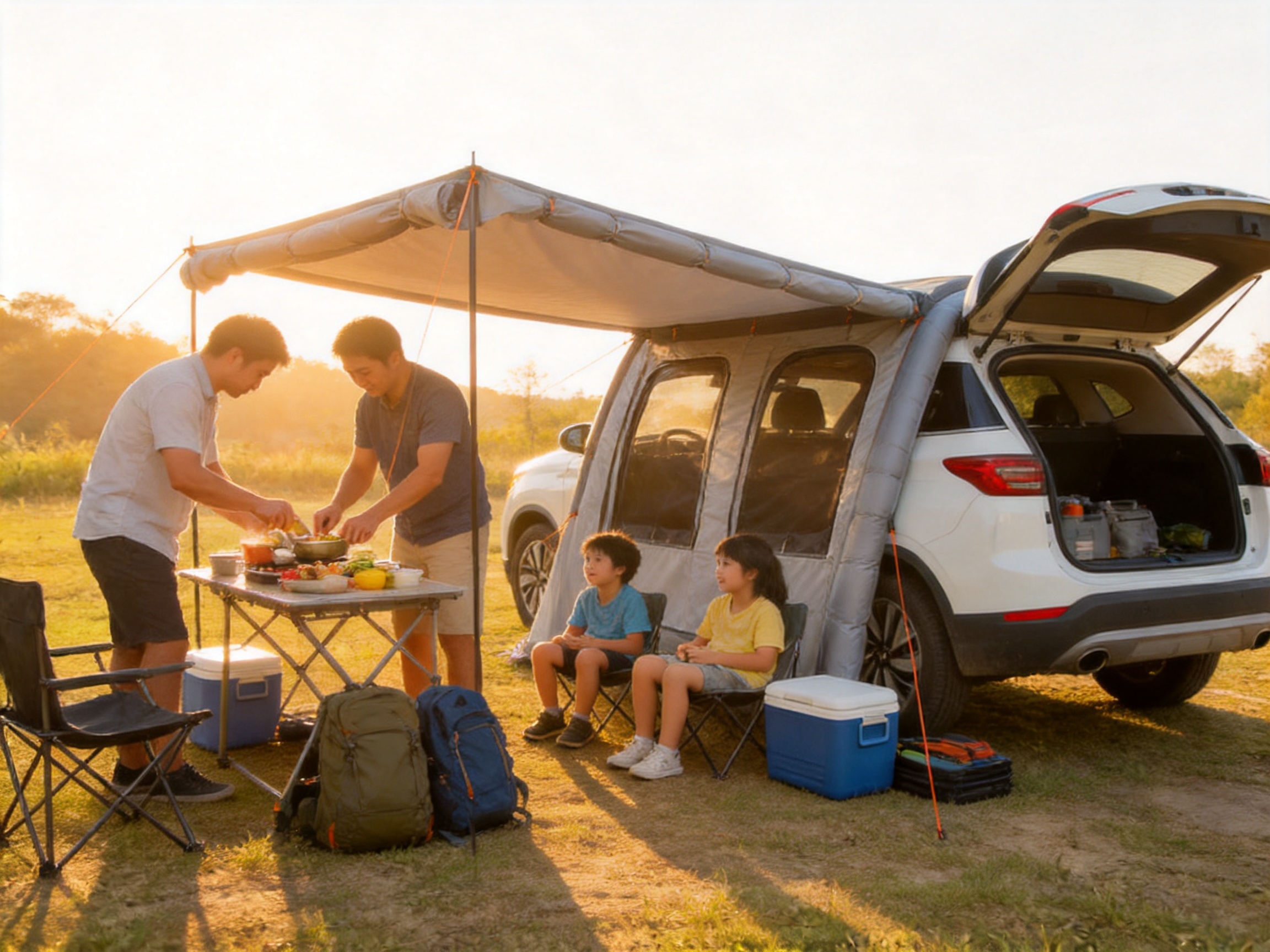
The inflatable car rear double-layer awning tent can support a wide range of outdoor activities. Families can use it as a shaded dining area during the day and as a protected sitting area in the evening. Travelers can place chairs, a compact table, coolers, cooking equipment, or storage containers beneath the awning. Campers may also use the enclosed section for changing clothes, relaxing, taking a break from insects, or organizing equipment before continuing a journey.
The rear connection also offers a practical transition between the vehicle and the tent. The tailgate area can remain accessible, making it easier to retrieve food, bedding, clothing, or camping equipment. Instead of repeatedly walking between a distant tent and the vehicle, users can keep frequently used items close at hand.
This type of setup is particularly valuable at campsites where space is limited. A traditional family tent may require a large footprint and several people to position and tension. A vehicle rear tent can make better use of the area immediately behind the car. It provides shelter while preserving flexibility for parking, cooking, and moving around the campsite.
Key Product Features
Inflatable Beam Architecture
The product uses inflatable beams rather than a conventional collection of rigid poles. This design can simplify installation, reduce the number of separate structural components, and make packing more convenient. Once the beams are inflated, they create the primary framework needed to support the shelter.
For users, the main benefit is a more straightforward setup process. Instead of sorting multiple poles and matching each section to a sleeve or connector, campers can focus on positioning the tent, attaching it to the vehicle, and inflating the structural tubes. The inflatable system is also suitable for travelers who want to reduce the amount of loose hardware carried in the vehicle.
Inflatable structures can provide useful flexibility in outdoor environments. When properly inflated and secured with appropriate guy lines and anchoring points, the air beams form a stable support system while maintaining a relatively light and compact package when deflated. This is especially beneficial for road travelers who need to manage luggage, sports equipment, children’s gear, and other camping accessories inside the vehicle.
Double-Layer Construction
The double-layer structure is one of the product’s most important performance features. The outer rainfly is designed to provide the first line of defense against rain, wind, and direct exposure to the elements. The inner layer contributes to the enclosed living environment and helps create additional separation between the occupants and outside conditions.
Compared with a single-layer shelter, a double-layer design can offer several practical advantages. It can help improve weather resistance, reduce direct contact between the interior and the outer fabric, and support a more comfortable internal environment. The space between layers can also contribute to improved ventilation and condensation management when the tent is used correctly.
Weather protection depends on proper setup, fabric condition, seam construction, anchoring, ventilation, and the severity of the environment. Nevertheless, the double-layer concept gives the product a stronger foundation for all-weather use than a simple fabric canopy or open-sided vehicle awning.
Integrated Awning and Sunshade
The built-in awning expands the practical value of the shelter beyond the enclosed tent area. It provides a covered outdoor zone where users can sit, prepare food, eat meals, store footwear, or enjoy the view while remaining protected from direct sunlight and light rain.
This arrangement is particularly useful for families. Children can play under the shaded area while adults prepare meals or organize equipment. During hot weather, the awning creates a cooler place to sit outside the vehicle. In changeable conditions, it can help campers continue everyday activities without moving entirely inside the vehicle or tent.
A built-in awning can also reduce the need to carry a separate canopy. This saves storage space and simplifies the equipment list. Instead of transporting a tent, an independent sunshade, additional poles, and multiple sets of stakes, users can carry one coordinated shelter system.
Portable and Space-Conscious Design
Although the tent is designed to create a large sheltered area, it remains intended for portable use. Once deflated and packed, the inflatable structure is easier to store and transport than many rigid-frame alternatives. This makes it appropriate for vehicles with limited cargo capacity as well as larger family vehicles.
Portability is not only about total weight. It also involves packing efficiency, the number of components, setup organization, and the ability to move from one location to another without excessive effort. A vehicle traveler may set up at a campsite in the afternoon, pack early the next morning, and continue to another destination. A compact inflatable shelter supports this style of travel more effectively than a complex permanent or semi-permanent structure.
Advantages over Conventional Camping Solutions
Compared with Basic Tarps and Canopies
A tarp or open canopy can provide shade, but it normally offers limited protection from wind-driven rain, insects, and changing weather. It may also require several poles, ropes, and carefully selected anchor points. The inflatable car rear double-layer awning tent offers a more integrated solution, combining an enclosed area, a vehicle connection, an outer rainfly, and a covered awning.
A canopy is often useful for daytime shade, but it may not provide the same sense of enclosure or privacy. The vehicle rear tent can be configured as a more complete living space while still retaining an open awning area. This combination allows users to select between enclosed comfort and open-air use according to the weather and activity.
Compared with Traditional Pole Tents
Traditional pole tents remain popular because of their familiar design and broad range of sizes. However, pole-based systems often involve several separate components that must be assembled in the correct order. Long poles may be awkward to transport, and damaged or misplaced poles can make setup difficult.
The inflatable beam system reduces dependence on a large collection of rigid poles. It is designed to make setup more approachable for users who want a convenient shelter for road trips and short camping stays. The reduced number of structural parts can also make packing and inventory management easier.
Another difference is the direct relationship with the vehicle. A standard tent usually functions as a separate shelter. The rear awning tent is intended to work as an extension of the vehicle, giving travelers a connected basecamp rather than two entirely independent spaces.
Compared with Rooftop Tents
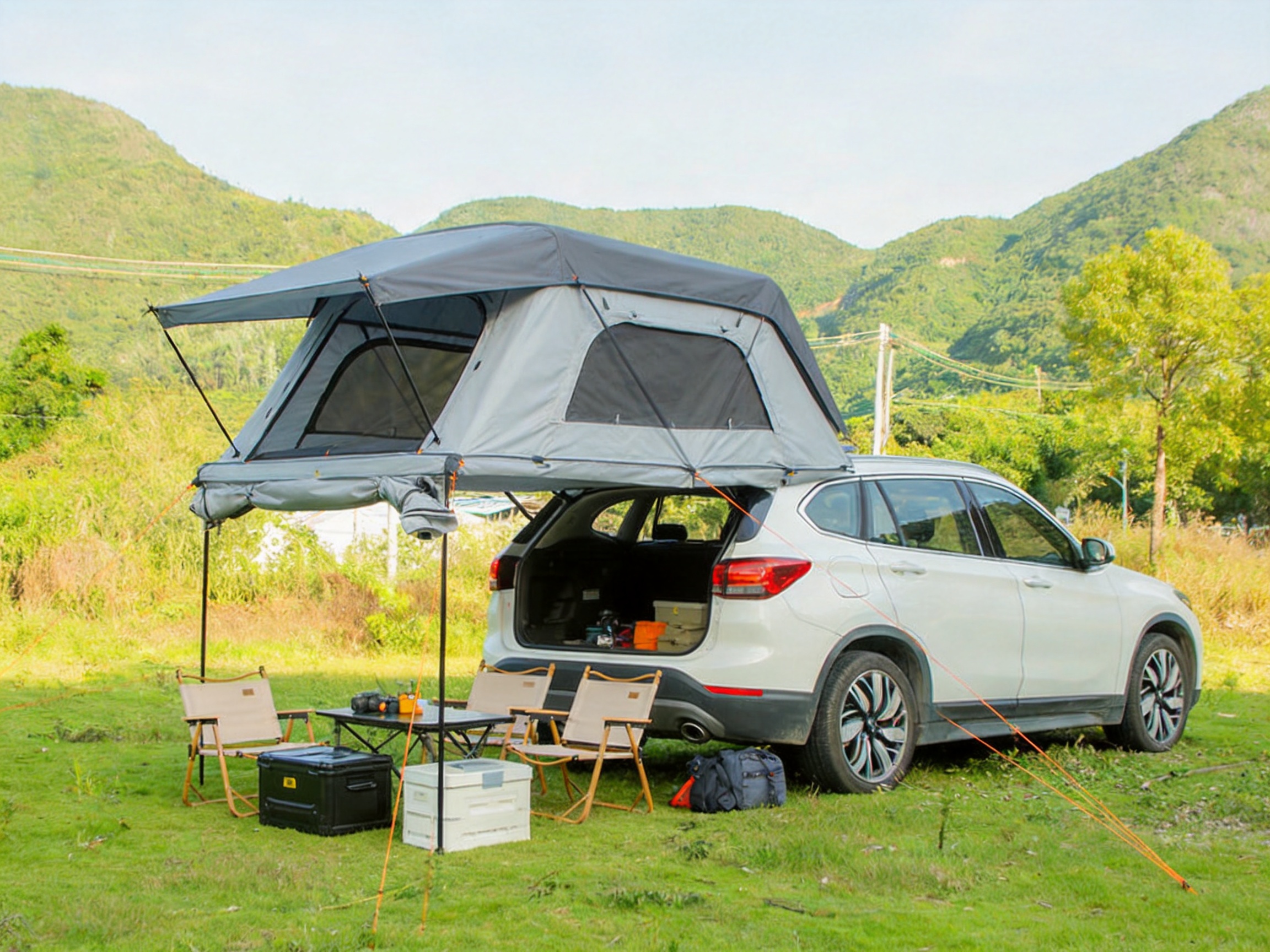
Rooftop tents offer elevated sleeping platforms and can be useful where ground conditions are difficult. However, they usually require roof compatibility, lifting or folding mechanisms, and additional care when the vehicle is being driven or parked. They may also provide limited standing or living space at ground level.
A rear vehicle tent is installed at ground level and focuses on creating a flexible living extension behind the vehicle. It can be more convenient for families with children, campers who prefer ground-level access, and travelers who want an awning area for dining or socializing. It also avoids the need for a roof rack or rooftop load-bearing system.
Compared with Independent Family Tents
A large independent family tent can provide sleeping capacity, but it may consume substantial campsite space and require more time to pitch. It also separates the shelter from the vehicle, which can make access to stored equipment less convenient.
The vehicle rear tent is not intended to replace every type of family tent. Instead, it offers a different form of flexibility. It can function as an extension, changing room, shaded lounge, cooking shelter, or temporary family basecamp. For many road trips, this multifunctional role can be more useful than a shelter designed only for sleeping.
Inflatable Car Rear Double-Layer Awning SUV Camping Tent Portable Basecamp
Weather Protection and Outdoor Comfort
Outdoor comfort depends on more than keeping rain outside. A successful shelter should help users manage sun, wind, moisture, temperature changes, privacy, and everyday movement. The double-layer inflatable rear tent addresses several of these needs in one design.
The rainfly creates an external protective surface that takes the first impact of rain and weather exposure. The inner layer provides a more comfortable interior boundary. When the shelter is properly tensioned, the outer fabric can shed water efficiently, while the separation between layers helps reduce the likelihood of the inner surface touching wet outer fabric.
The awning adds another layer of climate control. In sunny conditions, it creates a shaded area that can make the space around the vehicle more comfortable. In light rain, it provides a covered zone for preparing food or entering the vehicle without standing directly in the weather.
Wind performance depends on correct anchoring and responsible use. Users should deploy all appropriate guy lines, stakes, and attachment points, and they should select a campsite that is reasonably protected from extreme exposure. No portable tent should be treated as a permanent structure or used in conditions beyond its intended design.
Ventilation is equally important. Even a weather-resistant shelter needs airflow to reduce condensation and maintain a comfortable atmosphere. Users should make use of the tent’s available openings and ventilation features while keeping them positioned appropriately for current weather conditions. Good campsite selection, controlled cooking practices, and avoiding wet equipment inside the tent can further improve comfort.
Setup and Operating Experience
Preparing the Campsite
Before installation, users should select a relatively level area behind the vehicle and remove sharp stones, branches, and other objects that could damage the fabric or floor area. The vehicle should be parked securely, with enough room behind it for the tent to extend fully.
It is helpful to organize the tent, pump, stakes, ropes, and connection components before beginning. A clean and orderly setup area reduces the possibility of losing small parts and helps the user identify whether every necessary component is available.
Connecting the Tent to the Vehicle
The rear connection should be arranged according to the vehicle’s shape and the tent’s intended attachment method. The upper connection area should be positioned carefully so that the tent sits evenly around the tailgate or rear opening. Users should avoid forcing fabric against sharp edges or placing excessive stress on one attachment point.
Vehicle compatibility can vary according to body style, rear height, tailgate design, and available attachment space. The shelter may work with SUVs, MPVs, hatchbacks, vans, and trucks, but customers should confirm dimensions and attachment conditions before purchase, particularly when using unusual vehicle shapes or aftermarket accessories.
Inflating the Structural Beams
After the tent is positioned and loosely secured, the inflatable beams can be filled using a suitable pump. The beams should be inflated evenly and checked during the process. The objective is to create a firm and stable framework without exceeding the recommended pressure or damaging valves and seams.
Inflatable equipment should be treated carefully during setup. Users should keep the pump and valves clean, prevent sand from entering connection points, and avoid dragging the tent over abrasive ground. Once the beams are formed, the shelter can be adjusted so that the fabric is distributed evenly and the awning is properly extended.
Securing the Tent
Anchoring is essential for safety and performance. Stakes and guy lines should be installed at suitable angles, with enough tension to stabilize the shelter without distorting the fabric. The tent connection to the vehicle should also be checked before occupants enter or equipment is placed inside.
A final inspection should include the beam pressure, guy-line tension, vehicle connection, awning position, door operation, ventilation openings, and clearance around the tent. This short inspection can improve stability and help prevent avoidable damage during use.
Packing After Use
Before packing, the tent should be shaken or brushed free of loose dirt and allowed to dry whenever possible. Packing wet fabric for an extended period can encourage mildew and unpleasant odors. If weather conditions make complete drying impossible, the tent should be unpacked and dried promptly after returning home.
The beams should be deflated according to the valve design, and the fabric should be folded or rolled without sharp creases that could place unnecessary stress on coated surfaces. Components should be stored together so that the tent is ready for the next trip.
Manufacturing Strengths Behind the Product
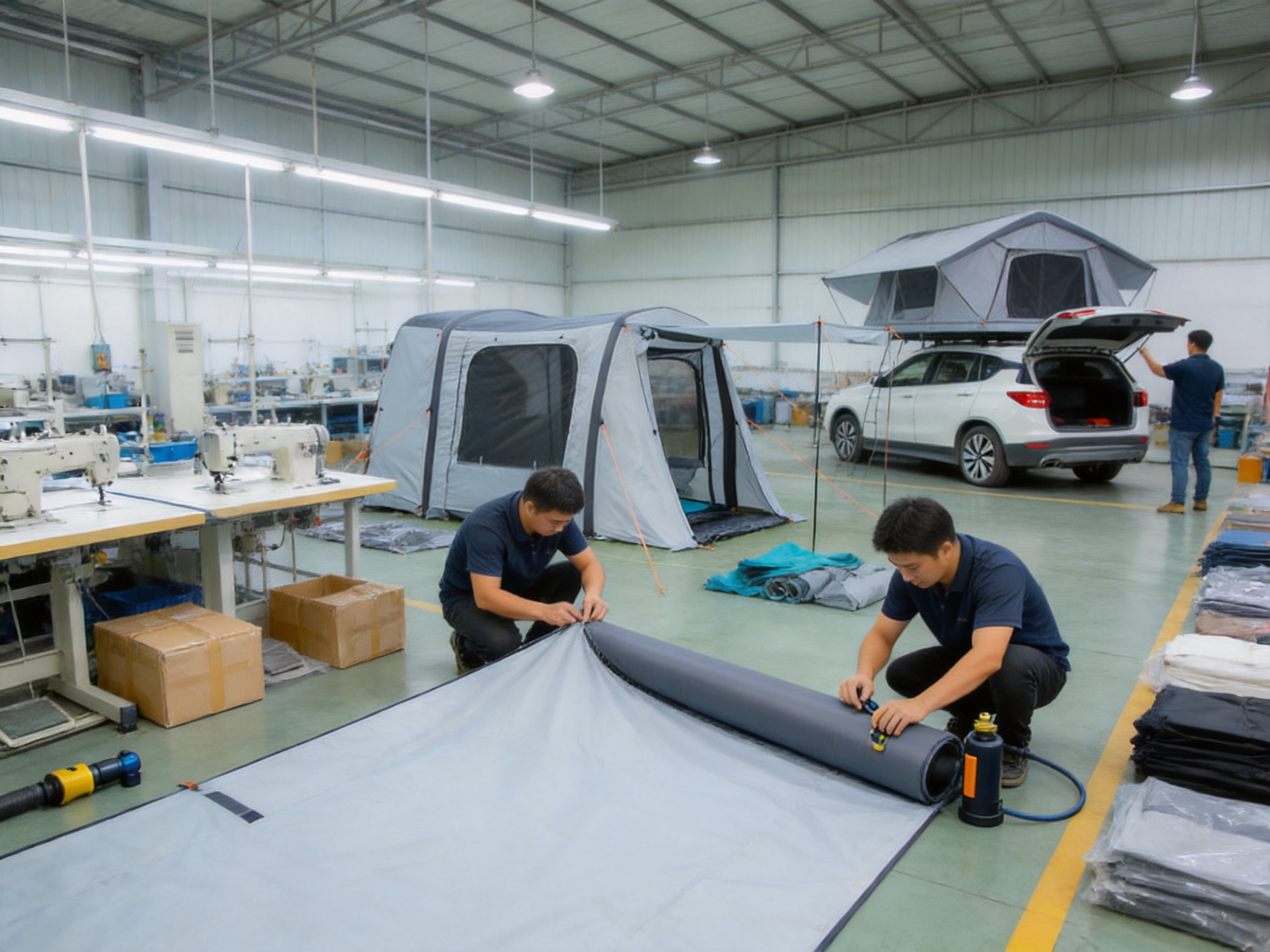
The performance of an inflatable vehicle tent depends not only on its visible design but also on the manufacturing processes behind it. Ningbo Zhenhai Tiansai Leisure Products Co., Ltd. specializes in the design, production, and sales of tents and outdoor equipment. Its production facility covers more than 13,000 square meters, providing a substantial base for organized manufacturing, quality control, product development, and order coordination.
A factory environment of this scale can support multiple stages of product creation, including material preparation, cutting, sewing, assembly, inspection, packing, and shipment. For wholesale and OEM customers, integrated production capabilities can simplify communication and improve consistency between prototypes, samples, and production orders.
The company’s location in Ningbo provides access to an important port city and an established manufacturing network. This geographic position supports international logistics and gives the company practical advantages when serving customers in North America, Europe, Asia, and other markets.
Product Design and Development
Effective tent design requires more than attractive appearance. Designers must consider fabric behavior, load distribution, waterproofing, airflow, usability, packed dimensions, attachment methods, and the real needs of outdoor users. The company maintains a professional design team that develops products from both practical and comfort-oriented perspectives.
The design process is strengthened by cooperation with professionals and feedback from outdoor enthusiasts. Product testing and user feedback can reveal details that may not be obvious in a drawing or prototype. These details may include the ease of attaching a vehicle connection, the accessibility of doors, the usefulness of an awning, the arrangement of storage space, or the amount of effort required during packing.
Continuous improvement is especially important for inflatable shelters. Beam geometry, valve placement, seam design, fabric tension, and attachment points all influence the final user experience. A factory with experience in outdoor product development can refine these elements through repeated testing and production evaluation.
Material and Fabrication Considerations
A durable vehicle tent requires materials selected for outdoor exposure and practical handling. The fabric must balance strength, weight, flexibility, coating performance, and packability. The inflatable beams require suitable airtight materials and reliable seams. Attachment points need reinforcement because they transfer forces between the vehicle, the tent, and the ground anchors.
Manufacturing quality depends on controlled cutting and sewing. Accurate panels help the tent assemble correctly and distribute tension evenly. Consistent seam work supports durability and helps maintain resistance to water penetration. Reinforced stress points are important at corners, connection sections, beam sleeves, guy-line points, and areas that may be handled repeatedly.
Because the product combines textile construction with inflatable structural components, production coordination is particularly important. The fabric shell must fit the beam system, valves must be positioned for access, and the completed shelter must pack efficiently. Quality management therefore needs to consider the entire product rather than isolated parts.
Quality Management
The company states that it strictly implements a quality management system intended to ensure that products meet international standards. In practical terms, a structured quality approach may include incoming material checks, production process controls, seam and component inspection, finished-product review, packing checks, and documentation management.
For professional buyers, quality consistency is as important as individual product performance. Retailers, distributors, outdoor brands, and project purchasers need products that maintain similar appearance, function, and packaging across production batches. A documented quality system helps create repeatable processes and provides a foundation for addressing defects or customer feedback.
Quality control for this type of tent should include attention to airtight beam performance, valve function, seam condition, fabric coating, zipper operation, attachment strength, awning stability, and final packed dimensions. These checks help reduce the likelihood of problems appearing after the product reaches the end user.
Experience in International Cooperation
Ningbo Zhenhai Tiansai Leisure Products Co., Ltd. has developed international experience through export activity and cooperation with overseas outdoor businesses. The company has served as the sole global designated supplier of British company TENTSILE and has designed products that received appearance patents and utility model patents.
International cooperation can strengthen a manufacturer’s understanding of different market requirements. Customers in different regions may have distinct expectations regarding packaging, labeling, dimensions, materials, climate performance, documentation, and compliance. Experience across multiple markets helps a factory communicate more effectively with global buyers.
The company’s core team includes outdoor-product professionals with more than ten years of experience in research and development, production, and overseas operations. Such experience is valuable when managing the complete product chain, from concept and sampling to manufacturing, inspection, shipment, and after-sales communication.
Why This Product Is Suitable for OEM and Wholesale Buyers
Retailers and outdoor brands increasingly seek products that offer a clear use case and distinguish themselves from standard camping equipment. A vehicle rear tent with an inflatable structure and integrated awning presents a strong product story: it expands vehicle space, supports family travel, reduces setup complexity, and provides multiple functions in one portable package.
For wholesale buyers, the product can fit several market segments. It may appeal to family campers, SUV owners, road-trip travelers, van-life customers, festival users, fishing enthusiasts, leisure-tourism operators, and outdoor rental businesses. Its broad vehicle compatibility also gives retailers an opportunity to market it to more than one vehicle category.
OEM cooperation may involve adjustments to color, branding, packaging, labeling, accessory combinations, dimensions, or selected materials, subject to production feasibility and order requirements. A manufacturer with in-house design and production capabilities can help brands evaluate these changes more efficiently than a trading company that depends entirely on unrelated factories.
For distributors, the product’s multifunctional positioning can support different sales messages. It can be promoted as a family camping shelter, a tailgate extension, a road-trip awning, an outdoor lounge, or a portable vehicle basecamp. This flexibility may help retailers reach customers with different priorities while using the same core product.
Practical Applications
Family Camping
Families often need more than a sleeping space. They need somewhere to prepare meals, store bags, change clothes, take breaks, and shelter children from sun or light rain. The rear tent and awning create a flexible family zone close to the vehicle, allowing parents to keep essential supplies nearby.
Road Trips
Road travelers frequently change locations and may not want to spend long periods assembling equipment. An inflatable vehicle tent is appropriate for travelers who value efficient setup and compact storage. It can be used at campsites, rest areas where camping is permitted, and temporary outdoor stops with suitable conditions.
Weekend Leisure Travel
For short trips, a shelter that serves multiple purposes is especially attractive. Users may not need a large sleeping tent for every outing, but they may still want shade, rain protection, privacy, and a comfortable place to relax. The rear awning tent can provide these functions without requiring a full traditional campsite setup.
Outdoor Events and Festivals
At outdoor events, the awning can provide a recognizable gathering space and protection from direct sun. The enclosed section can be useful for storing personal items or creating a more private area. Users should always follow event rules concerning vehicle access, anchoring, fire safety, and shelter dimensions.
Fishing and Recreational Activities
Anglers and recreational travelers often carry equipment that benefits from organized shelter. The tent can provide a protected place for changing clothes, preparing food, taking a break, or storing gear away from light weather exposure. Its connection to the vehicle makes it convenient to access coolers, tackle, clothing, and other supplies.
Care, Maintenance, and Long-Term Use
Proper maintenance helps preserve the performance of any outdoor shelter. After each trip, users should inspect the fabric, seams, zippers, valves, beams, ropes, stakes, and vehicle connection areas. Small problems are easier to address before they develop into major failures.
The fabric should be cleaned using methods suitable for the material and coating. Harsh chemicals, abrasive brushes, and excessive heat may damage protective finishes. Dirt should be removed before storage, especially around zippers, valves, and connection points.
Inflatable beams should be stored without unnecessary sharp folds or pressure on the valves. If an air leak is suspected, the affected area should be identified and repaired using an appropriate repair method. Users should follow the product’s care instructions and avoid improvising repairs that could weaken the beam or create an unsafe condition.
Storage should take place in a cool, dry environment away from direct sunlight, moisture, rodents, and sharp objects. The tent should not remain compressed while damp. Periodic inspection during long-term storage is advisable, particularly before a major trip.
Care also includes responsible use. The shelter should not be exposed to flames, stoves, heaters, or combustible materials without appropriate safety controls. Cooking should be managed carefully, and users should maintain adequate ventilation. Severe storms, lightning, flooding, and dangerous wind conditions require users to prioritize safety and seek a more secure location.
Comparison of Product Benefits
| Product characteristic | Inflatable rear double-layer awning tent | Basic canopy | Traditional pole tent | Rooftop tent |
|---|---|---|---|---|
| Vehicle integration | Designed to connect with the rear of a vehicle | Usually independent | Usually independent | Mounted on the vehicle roof |
| Structural system | Inflatable beams | Poles or frame | Rigid poles | Rigid folding structure |
| Weather protection | Double-layer shelter with rainfly and inner layer | Primarily shade and limited rain coverage | Varies by model and construction | Enclosed elevated sleeping area |
| Outdoor living area | Enclosed area plus integrated awning | Open covered area | Enclosed area, usually without vehicle connection | Often limited ground-level living space |
| Storage convenience | Deflatable and designed for portable storage | Generally compact, depending on frame | Rigid poles may require more storage space | Remains attached or requires roof storage |
| Best suited to | Road trips, families, vehicle-based camping, and flexible basecamps | Simple shade and short outdoor stops | Independent camping and sleeping | Elevated sleeping and compact rooftop camping |
How the Product Supports Sustainable Outdoor Habits
A portable shelter that serves several functions may help users carry fewer separate products. One integrated system can provide shade, enclosure, vehicle access, and outdoor living space. Reducing duplicate equipment can make travel more efficient and may reduce the material and packaging requirements associated with purchasing multiple independent shelters.
Durable products also have the potential to remain in use for longer periods, reducing the frequency of replacement. Longevity depends on material quality, manufacturing consistency, proper care, and responsible use. The manufacturer’s stated focus on lightweight and environmentally friendly materials reflects the importance of improving product performance while considering resource efficiency.
Responsible outdoor use remains essential. Campers should follow local regulations, use established campsites when available, avoid damaging vegetation, manage waste properly, and leave the area clean. A convenient vehicle shelter should support low-impact travel rather than encourage careless occupation of sensitive environments.
Choosing a Reliable Manufacturing Partner
When purchasing vehicle tents for retail, distribution, or private-label programs, buyers should evaluate more than the product photographs. Important questions include whether the factory controls production directly, whether the design can be adapted, how quality is inspected, what materials are available, how samples are approved, and whether the supplier can communicate effectively during production.
A manufacturer specializing in tents is generally better positioned to understand the technical requirements of outdoor shelters. Experience with inflatable structures, coated fabrics, seams, rainflies, awnings, and vehicle attachments can help reduce design risks. A company with its own design team can also respond more efficiently when buyers request product improvements or market-specific changes.
Production capacity matters as well. The company’s factory area of more than 13,000 square meters indicates a substantial manufacturing base for tent development and production. Buyers should still confirm specific capacity, lead times, minimum order quantities, packaging requirements, inspection procedures, and shipping arrangements for each project.
International experience provides additional value. A supplier serving customers across North America, Europe, Asia, and other regions is familiar with the importance of communication, export documentation, packaging protection, and product consistency. Long-term partnerships depend on transparent expectations and reliable execution from the first sample to repeated orders.
Positioning the Tent in the Outdoor Market
The strongest market position for this product is convenience without sacrificing shelter performance. Customers are not simply purchasing fabric and inflatable beams. They are purchasing additional usable space for a vehicle-based lifestyle. The product answers a practical question: how can travelers gain a comfortable outdoor room without carrying a large collection of separate camping structures?
Its competitive distinction comes from the combination of features rather than one isolated component. An inflatable design alone is not enough to define the product. A vehicle connection alone is not enough either. The double-layer construction, built-in awning, portable package, and multifunctional layout create a more complete system for outdoor travel.
For online retailers, product education can focus on setup logic, vehicle compatibility, use scenarios, packed portability, and weather protection. For physical stores, the product can be demonstrated as a complete campsite extension. For outdoor brands, it can become part of a broader vehicle-camping collection that includes sleeping systems, storage, lighting, cooking, and travel accessories.
Q&A
What type of vehicle can use this rear tent?
The tent is designed for use with SUVs, MPVs, hatchbacks, vans, and trucks. Compatibility depends on the rear dimensions, tailgate design, vehicle height, and attachment conditions. Buyers should confirm measurements and connection requirements before ordering.
Does the tent require traditional poles?
The primary structure uses inflatable beams, which reduces reliance on a large set of rigid poles. Users still need to use the supplied anchoring and support components correctly to stabilize the shelter.
What is the purpose of the double-layer construction?
The outer rainfly provides a weather-resistant barrier, while the inner layer helps create a more comfortable enclosed environment. The two-layer arrangement can improve protection and support better separation between occupants and outside conditions.
Can the awning be used separately from the enclosed area?
The integrated awning is designed to provide an additional covered outdoor zone connected to the tent. Its exact configuration depends on the setup arrangement, weather, and the user’s vehicle. It is suitable for shade, light rain protection, dining, cooking preparation, and relaxation.
Is the tent suitable for family camping?
Yes. The spacious extension, covered awning, vehicle access, and multifunctional layout make it suitable for family camping and road trips. Families should select a campsite with enough room for the complete setup and should follow safe practices around cooking, children, weather, and vehicle movement.
How long does setup take?
Setup time depends on the user’s experience, vehicle type, campsite conditions, anchoring requirements, and pump used. The inflatable structure is intended to simplify the process, but users should still allow enough time to connect the tent, inflate the beams, install anchors, and inspect the completed shelter.
Can it be used in heavy rain or strong wind?
The double-layer construction and rainfly are intended to provide weather protection, but no portable tent should be considered immune to severe conditions. Correct anchoring, suitable campsite selection, ventilation, and responsible judgment are essential. In dangerous weather, users should move to a safer location.
How should the tent be stored?
The tent should be cleaned and dried before long-term storage. It should be deflated, packed without unnecessary stress on the fabric or valves, and stored in a cool, dry place away from sharp objects and direct sunlight.
Can the product be used for private-label or OEM programs?
The manufacturer specializes in tent design and production and can discuss OEM or wholesale requirements with qualified buyers. Possible project elements may include branding, colors, packaging, labeling, dimensions, and accessory configurations, depending on order volume and production feasibility.
What makes this product different from a simple car awning?
A simple awning generally provides open shade. This product combines a vehicle connection, an enclosed double-layer tent area, an inflatable structural system, and an integrated awning. It therefore offers a broader range of uses, including privacy, changing, equipment organization, and more complete weather protection.
Is the inflatable structure durable?
The inflatable beams are designed to support the tent when correctly inflated, secured, and maintained. Durability depends on proper handling, avoiding sharp objects, maintaining suitable pressure, protecting valves, and following the manufacturer’s care instructions.
Does the tent replace a sleeping tent?
It can serve different roles depending on the vehicle, interior arrangement, user preferences, and product configuration. It is primarily a vehicle extension and outdoor living shelter. Buyers should evaluate whether they require a dedicated sleeping compartment for their intended use.
Conclusion
The inflatable car rear double-layer awning tent offers a practical way to expand a vehicle into a flexible outdoor basecamp. Its design combines inflatable beams, double-layer weather protection, a built-in awning, and portable storage in one coordinated system. These features make it more versatile than a basic canopy and more vehicle-oriented than a conventional independent tent.
For families and road travelers, the product provides useful space for dining, relaxing, changing clothes, organizing equipment, and enjoying shade close to the vehicle. For retailers and outdoor brands, it offers a distinctive product category that responds to the growing interest in vehicle-based travel and convenient camping solutions.
The product is also supported by the manufacturing strengths of Ningbo Zhenhai Tiansai Leisure Products Co., Ltd., including specialized tent production, a factory covering more than 13,000 square meters, professional design capabilities, international cooperation experience, patented product development, and a quality-focused production system. The company’s experience in research and development, manufacturing, and overseas operations provides a foundation for both standard product supply and customized OEM cooperation.
As outdoor consumers continue to seek comfort, portability, and efficient use of vehicle space, a connected rear tent with an integrated awning presents a compelling solution. It allows travelers to spend more time enjoying the journey and less time managing complicated equipment, while giving outdoor brands a practical and adaptable product for the expanding camping market.
References
1. Manufacturer-provided product specifications for the inflatable car rear double-layer awning tent.
2. Manufacturer-provided company profile and production information for Ningbo Zhenhai Tiansai Leisure Products Co., Ltd.
3. General principles of outdoor shelter setup, campsite selection, ventilation, anchoring, and fabric care.
4. General product-development practices for inflatable structures, coated textiles, tent seams, and portable outdoor equipment.
5. General guidance for responsible camping, low-impact recreation, outdoor safety, and equipment maintenance.
Product: Inflatable Car Rear Double-Layer Awning SUV Camping Tent Portable Basecamp

Message Us Right Now!
-
Mp: +86-18858091910
E-mail: sales@tenplaytent.com
ADD: No. 529, Guangyuan Road, Xiepu Town, Zhenhai District, Ningbo City, Zhejiang Province, China
-
Quick Links
Home Products About Us Advantage News Contact Us -
Product
Inflatable & Air Tents Glamping & Resort Tents Backpacking & Trekking Tents Automatic & Pop-Up Tents Family & Camping Tents Specialty Tents & Shelters Kids Tents Pet Tents Humanitarian & Large Tents Hammock -
Get Connected
 Camping Tent Manufacturer in China