

 English
 عربى


Heavy-Duty Cotton Canvas Yurt Tent: A Premium Solution for Luxury Glamping and Outdoor Hospitality
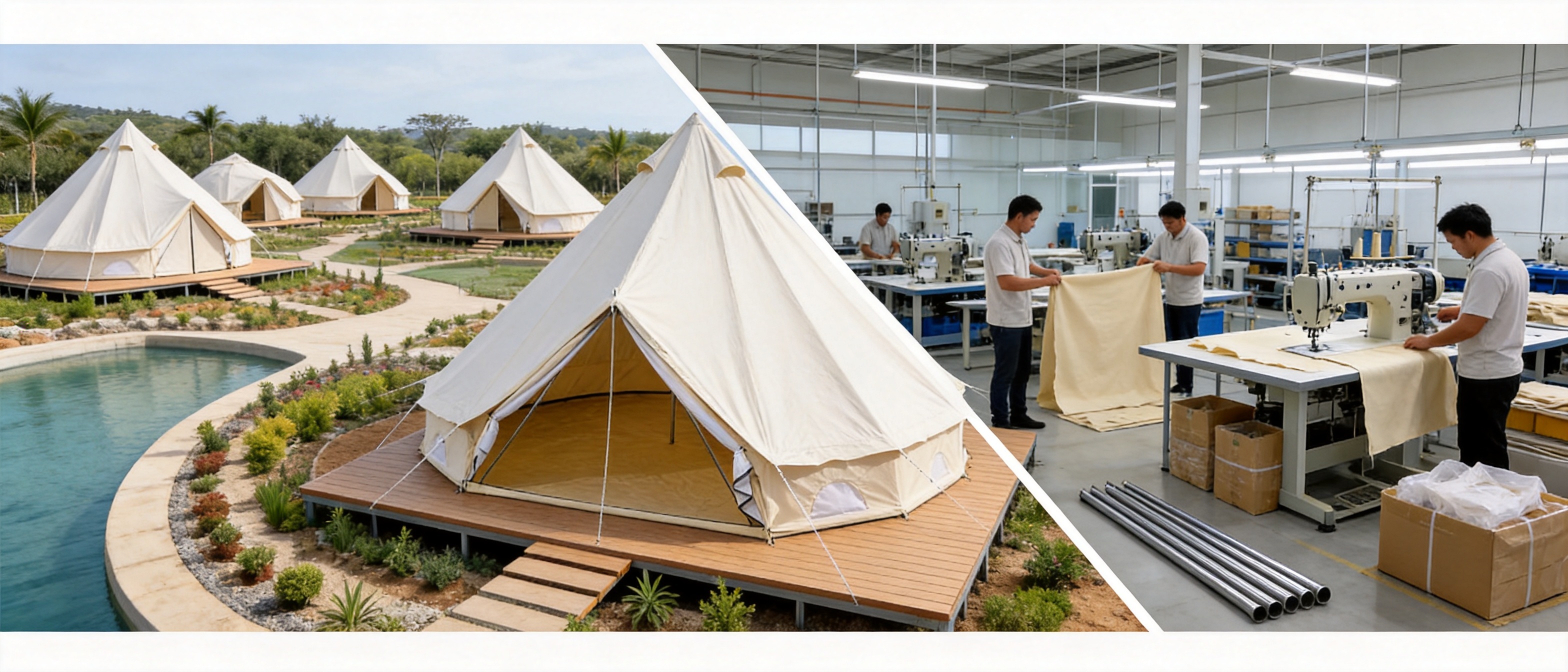
The modern outdoor hospitality market is moving beyond basic camping. Guests increasingly expect spacious accommodation, attractive architecture, reliable weather protection, and a comfortable connection with nature. For resort owners, eco-retreat developers, event organizers, and professional outdoor operators, the tent is no longer simply a temporary shelter. It is a central part of the guest experience, an important element of site design, and a long-term business investment.
The heavy-duty cotton canvas yurt glamping tent is designed to meet these expectations. Combining a spacious circular interior with breathable natural canvas, reinforced structural components, an integrated floor, and protective treatments against fire, water, and ultraviolet exposure, this type of yurt offers a practical and visually distinctive accommodation solution. It is suitable for high-end eco-resorts, boutique glamping destinations, luxury basecamps, outdoor events, and carefully planned private retreats.
Unlike lightweight recreational tents that prioritize portability above all else, this yurt is developed for comfort, durability, and repeated seasonal use. Its generous interior can be configured as a bedroom, lounge, dining space, wellness room, children’s activity area, or multi-purpose hospitality unit. The circular layout improves the use of interior space while creating a memorable architectural atmosphere for guests.
Manufactured by Ningbo Zhenhai Tiansai Leisure Products Co., Ltd., the tent reflects the company’s experience in outdoor product design, material selection, production management, and international supply. With a factory covering more than 13,000 square meters and a product development team experienced in outdoor equipment, the manufacturer is positioned to support both standard orders and professional OEM requirements.
A Purpose-Built Yurt for Premium Outdoor Accommodation
A yurt tent has a distinctive identity that separates it from conventional rectangular camping tents. Its circular floor plan encourages a natural flow through the interior, while the high central structure creates a greater sense of volume than many standard shelters. This combination of space and character makes it especially appealing in hospitality environments where design contributes directly to customer satisfaction.
The heavy-duty cotton canvas yurt is intended for use where guests need more than basic protection from the elements. The breathable fabric helps moderate the indoor atmosphere, while windows, wall vents, and mesh openings support cross-ventilation. The integrated zipped-in floor creates a more complete enclosure, improving cleanliness and reducing the exposure of the interior to damp ground, insects, and dust.
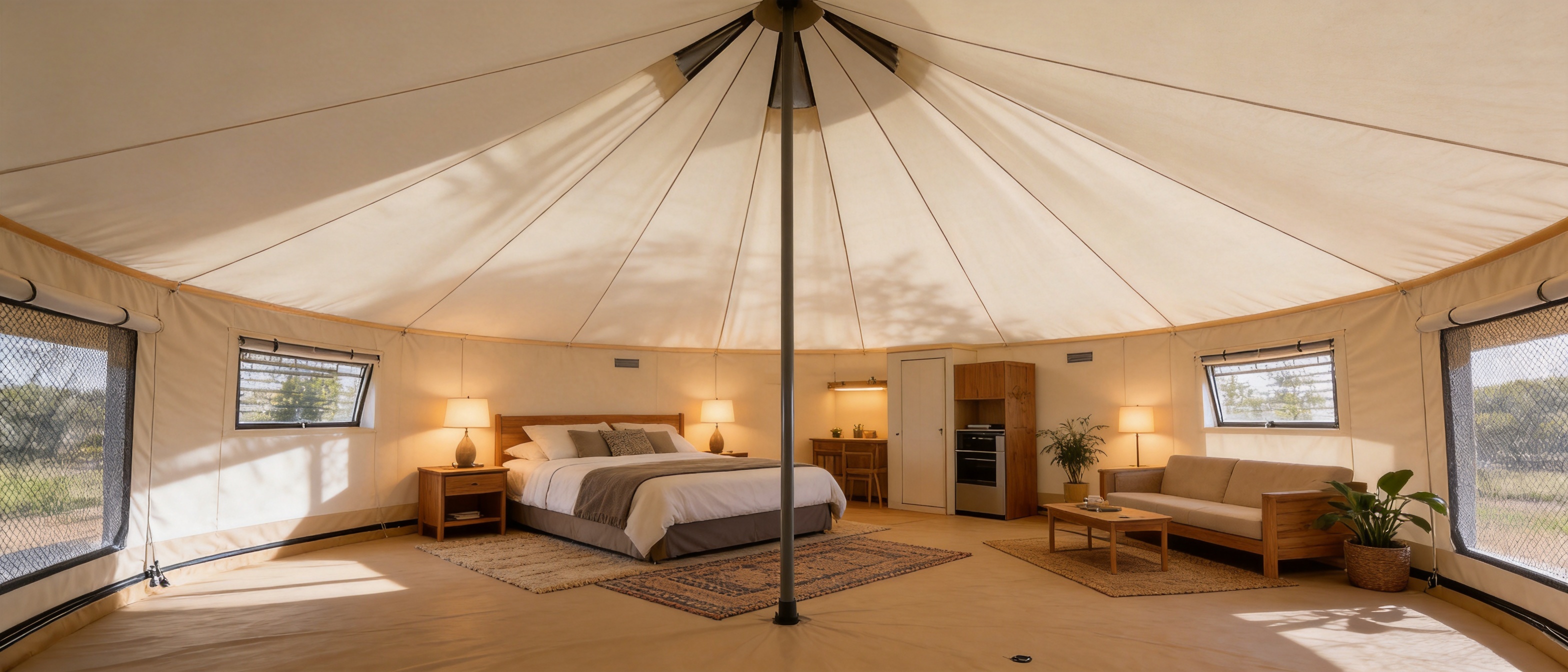
For resort operators, the structure can serve as a foundation for a wide range of layouts. A double bed, bedside furniture, storage cabinets, seating, lighting, and decorative features can be arranged within the circular space. Depending on the selected size and configuration, the same basic shelter concept can be adapted for couples, families, small groups, or commercial activity areas.
The visual impression is also important. Natural canvas has a warm, textured appearance that harmonizes with forests, mountains, grasslands, beaches, and rural landscapes. Compared with highly synthetic shelters, cotton canvas often creates a more refined and natural atmosphere. This helps operators develop a recognizable site style without relying on excessive decoration.
Key Product Advantages
Breathable High-Density Cotton Canvas
The main body of the yurt is made from high-density cotton canvas selected for strength, comfort, and breathability. Natural canvas allows a measured exchange of air through the fabric structure, helping reduce the heavy, enclosed feeling that can occur inside poorly ventilated synthetic shelters. This characteristic is particularly valuable in warm climates, where indoor comfort affects guest reviews and repeat bookings.
Breathability also contributes to condensation management. When warm, moist indoor air meets a cold, non-breathable surface, water droplets can form on the interior walls. Cotton canvas does not eliminate condensation under every condition, but its natural air exchange can help regulate moisture more effectively when combined with appropriate ventilation practices.
The fabric’s substantial weight gives the tent a stable and premium feel. It is less likely to flap excessively than lightweight recreational fabric, and its appearance remains appropriate for long-term hospitality installations. The fabric can also be maintained through proper cleaning, drying, inspection, and storage procedures, helping operators extend the useful life of the shelter.
Fire-Retardant Treatment for Greater Operational Confidence
Fire safety is a critical consideration for any accommodation or event structure. The canvas is treated with fire-retardant properties to reduce the speed at which flames can spread across the fabric. This feature does not make the tent fireproof, and it does not replace local fire regulations, fire extinguishers, safe heating practices, or emergency planning. However, it provides an important additional layer of protection compared with untreated fabric.
For professional operators, the fire-retardant treatment can support a more responsible risk-management program. Tents should still be positioned with suitable separation distances, and all heating, cooking, electrical, and lighting equipment should be installed and operated according to local requirements. Clear guest instructions are also recommended, particularly in sites where open flames, fire pits, or portable heaters are present.
When evaluating competing tents, buyers should examine whether fire-retardant treatment is included as part of the standard fabric specification or is available only as an optional upgrade. The integrated protection offered by this yurt makes it better suited to commercial environments where safety documentation and consistent material performance are important purchasing criteria.
Water-Resistant Protection for Variable Weather
Outdoor accommodation must perform in more than ideal weather. The canvas is treated to improve resistance to rain and surface moisture, helping protect guests, bedding, furnishings, and personal belongings during changing conditions. The sloped roof design encourages water to run away from the upper surface, while correct installation and tensioning help prevent water from collecting in low areas.
Water resistance is influenced by many factors, including fabric condition, seam quality, tent tension, site drainage, wind exposure, and maintenance. For that reason, the best results are achieved when the tent is installed on a well-drained platform or prepared ground surface. Operators should inspect seams, attachment points, zippers, and roof areas regularly, particularly before a new operating season or after severe weather.
Compared with low-cost tents made from thin fabrics, a heavy-duty canvas yurt offers a more substantial barrier against outdoor conditions. Its protective treatment and robust construction make it suitable for repeated use in professional settings, while its breathable nature helps preserve a more comfortable internal environment than many fully coated synthetic alternatives.
UV-Resistant Performance
Ultraviolet radiation gradually weakens many outdoor fabrics. Prolonged sun exposure can cause fading, fiber degradation, coating failure, and reduced tear strength. The yurt’s UV-resistant treatment is intended to help the canvas withstand regular exposure to sunlight, which is essential for resorts and camps operating throughout the warmer months.
UV resistance is particularly valuable in open landscapes where shade is limited. It helps the tent maintain its appearance and functional performance over time, although no fabric should be expected to remain unaffected by continuous exposure. Strategic site planning, natural shade, seasonal rotation, and protective storage during inactive periods can further reduce solar stress.
This feature gives the yurt an advantage over basic untreated canvas structures and inexpensive temporary shelters. For commercial customers, maintaining a consistent appearance across multiple accommodation units can strengthen the visual identity of a property and reduce the frequency of premature fabric replacement.

Heavy-Duty Cotton Canvas Yurt Glamping Tent with Fire-Retardant Waterproof UV Protection
Structural Design for Stability and Comfort
Reinforced Center Pole
The center pole is one of the most important structural components in a circular yurt tent. It supports the highest part of the roof and helps distribute loads across the frame. This model uses a reinforced heavy-duty center pole designed to provide reliable support during repeated outdoor use.
A well-designed center pole contributes to the spacious interior by creating a high central point without requiring a complicated network of internal supports. The result is a room that feels open and comfortable while remaining structurally organized. Furniture can be arranged around the perimeter, and the central area can be preserved for movement or used as a visual focal point.
Professional installation remains essential. The pole must be positioned correctly, the roof must be tensioned evenly, and all connections should be checked before occupancy. Operators should also consider regional wind and snow conditions when selecting a site and determining whether additional anchoring or engineering measures are necessary.
Integrated Zipped-In Floor
The integrated zipped-in floor is a major practical advantage for commercial glamping operations. Rather than treating the floor as a separate loose component, the design connects it to the main tent structure through a zipper system. This creates a more complete enclosure and simplifies the process of preparing the unit for guests.
A connected floor helps reduce drafts at ground level and makes it more difficult for insects, leaves, and dust to enter through gaps around the perimeter. It also provides a cleaner transition between the interior and the surrounding site. For operators managing several units, the integrated design can make routine setup, cleaning, inspection, and seasonal maintenance more efficient.
The floor should be installed over a suitable surface. A raised wooden platform, compacted gravel base, or another properly drained foundation may be appropriate depending on local conditions. A level base protects the tent from standing water and helps doors, zippers, and structural connections operate smoothly.
360-Degree Wall Ventilation
Air circulation is central to the comfort of a yurt. The design incorporates wall vents distributed around the structure, allowing air to enter and leave through multiple points. This supports natural ventilation and can help reduce internal heat buildup in sunny weather.
The circular arrangement of the vents is especially useful because it avoids concentrating ventilation in only one area. Operators can adjust openings according to wind direction, temperature, humidity, and occupancy. During cool or rainy weather, vents can be partially closed while still preserving a degree of air exchange.
Ventilation also supports the durability of the interior. Better airflow helps reduce the accumulation of moisture that can affect bedding, wood furniture, fabrics, and personal belongings. In hospitality settings, a fresh indoor atmosphere is important not only for comfort but also for housekeeping efficiency and odor control.
Mesh Windows and Panoramic Views
Mesh windows combine visibility, ventilation, and insect protection. They allow guests to enjoy views of the surrounding environment while reducing the need to keep the entire structure open. This is an important feature for destinations located near forests, wetlands, lakes, or other areas where insects may be active.
The windows can also enhance the feeling of connection with nature. Guests can observe changing light, weather, and landscapes without leaving the comfort of the accommodation. For resort operators, this visual relationship can become a central part of the property’s marketing story and guest experience.
When privacy is required, curtains or additional window coverings can be incorporated into the interior design. The combination of mesh, canvas, and optional coverings allows operators to balance openness during the day with privacy at night.
Why Cotton Canvas Can Outperform Lightweight Synthetic Alternatives
Every tent material involves trade-offs. Lightweight synthetic fabrics are often easier to transport and may dry quickly, while heavy-duty cotton canvas is generally chosen for comfort, atmosphere, and long-term outdoor use. The most suitable material depends on the intended application.
| Evaluation Area | Heavy-Duty Cotton Canvas Yurt | Lightweight Recreational Tent | Commercial Value |
|---|---|---|---|
| Interior comfort | Breathable and naturally temperature-regulating | May require greater dependence on vents and openings | Supports a more comfortable guest stay |
| Visual character | Warm, natural, premium appearance | Functional and often more utilitarian | Strengthens resort design and positioning |
| Space utilization | Circular, open, and suitable for furniture | Often optimized for sleeping equipment | Allows multiple hospitality layouts |
| Weather protection | Fire-retardant, water-resistant, and UV-resistant treatment | Performance varies by fabric and coating | Improves operational confidence |
| Structural design | Reinforced center pole and integrated floor | Usually lightweight poles and detachable floor | Better suited to semi-permanent placement |
| Commercial presentation | Designed for glamping, resorts, and events | Primarily designed for personal recreation | Supports premium accommodation pricing |
The comparison does not mean that one fabric is ideal for every activity. Backpackers and mobile campers may prefer low weight and compact packing. However, for resort accommodation, the priorities are different. Space, atmosphere, durability, safety features, and the ability to accommodate real furniture can be more important than minimizing packed weight.
The yurt’s advantage is therefore not based on a single material characteristic. It comes from the way the canvas, ventilation, structural design, floor system, and protective treatments work together as a complete hospitality solution.
Applications Across the Outdoor Hospitality Industry
Luxury Glamping Resorts
Luxury glamping resorts require accommodation that feels distinctive without losing the natural appeal of outdoor living. The circular yurt provides an architectural experience that can be enhanced with beds, rugs, lighting, furniture, and carefully selected decorative details. Its spacious interior makes it possible to create a comfortable room while preserving a connection with the surrounding landscape.
Operators may use the tents as premium guest rooms, honeymoon accommodations, family units, or seasonal suites. The circular design also offers opportunities for panoramic site orientation. Each unit can be positioned to face a lake, mountain, forest clearing, sunrise, sunset, or another natural feature.
Eco-Resorts and Nature Retreats
Natural cotton canvas aligns well with the visual language of eco-tourism and low-impact travel. Although responsible operation requires more than material selection, the use of a breathable, natural-looking fabric can support an environmentally conscious brand identity. The shelter can be installed with raised platforms, low-impact foundations, and carefully planned paths to reduce disturbance to the ground.
Eco-resorts can use the yurt for accommodation, meditation, yoga, wellness treatments, guided education, or communal activities. The design’s ability to function as both a guest room and a multi-purpose space provides useful flexibility as the business develops.
Boutique Basecamps
Remote tourism operators often need accommodation that can be transported to a location and assembled with professional support. A heavy-duty yurt is suitable for boutique basecamps serving adventure travelers, photographers, conservation groups, or guided expedition programs. Its stronger construction gives guests a more comfortable base than a standard expedition tent.
Because the structure can support furniture and organized interior services, it may be used for dining, reception, equipment storage, staff accommodation, or guest sleeping quarters. A coordinated group of yurts can create a complete temporary hospitality village while retaining a coherent visual identity.
Outdoor Events and Seasonal Installations
The yurt can also be used for weddings, cultural festivals, private celebrations, workshops, exhibitions, and seasonal markets. A spacious circular interior encourages gathering and can be configured with seating, displays, buffet tables, or activity stations.
Event planners can take advantage of the tent’s distinctive appearance to create a memorable setting. The natural canvas works with rustic, luxury, bohemian, and nature-inspired themes. When the event ends, the structure can be cleaned, inspected, and prepared for future use according to the operator’s storage and maintenance plan.
Private Retreats and Residential Guest Spaces
Private landowners may install the yurt as a guest room, studio, reading space, creative workshop, or seasonal retreat. Its enclosed floor and protective fabric make it more suitable for extended use than an ordinary festival tent, while its circular design creates an intimate and unusual interior environment.
As with all outdoor structures, local planning, foundation, fire, electrical, and occupancy requirements should be reviewed before installation. The tent provides the shelter system, but the overall site must be designed responsibly for its intended use.
Manufacturing Strengths and Production Capabilities
Experience in Outdoor Product Development
Ningbo Zhenhai Tiansai Leisure Products Co., Ltd. specializes in the design, production, and sales of tents and outdoor leisure products. The company’s experience covers multiple categories, including camping tents, glamping tents, inflatable tents, backpacking tents, family tents, specialty shelters, and related outdoor structures.
This broad product background supports the development of a yurt that addresses both user comfort and manufacturing practicality. Experience across different tent categories helps the design team understand fabric behavior, pole systems, seam construction, ventilation, packaging, installation, and field use.
The company states that its core team includes outdoor-product specialists with more than ten years of experience in research and development, production, and overseas operations. Such experience is valuable when adapting a product for different climates, customer requirements, packaging conditions, and international markets.
Factory Infrastructure
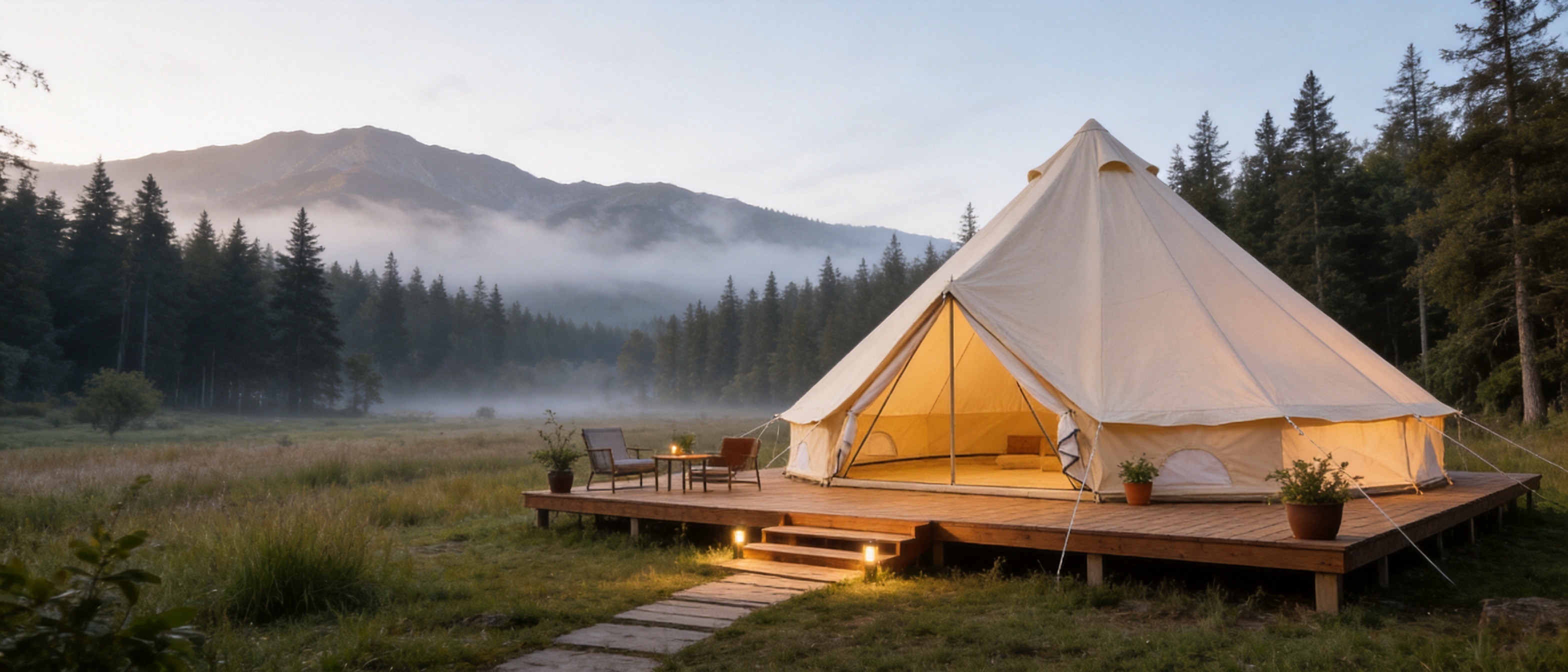
The company operates a factory covering more than 13,000 square meters in Zhenhai District, Ningbo, Zhejiang Province. This scale provides space for material handling, cutting, sewing, assembly, inspection, packing, product development, and order coordination.
A dedicated production facility can improve consistency by keeping important processes under organized management. It also allows the manufacturer to coordinate production schedules, carry out quality checks, manage components, and support larger wholesale or OEM orders more effectively than a small workshop with limited capacity.
Ningbo’s location as a major port city is another practical advantage for international supply. Efficient access to shipping services can assist with export documentation, container planning, delivery coordination, and communication with overseas customers. For buyers importing commercial quantities, logistics capability is an important part of supplier selection.
Material Selection and Cutting Accuracy
Heavy-duty canvas requires careful handling during production. The fabric must be inspected for consistency, defects, color variation, and surface condition before cutting. Pattern accuracy is important because large circular structures depend on coordinated panels and balanced tension.
Professional cutting processes help reduce waste and improve repeatability. Panels, doors, windows, vents, floor components, and reinforcement sections must be positioned correctly according to the approved design. Accurate cutting also supports better seam alignment during sewing and reduces stress caused by uneven dimensions.
Industrial Sewing and Reinforcement
The performance of a large tent depends heavily on seam construction. Industrial sewing equipment is used to join heavy fabric sections and reinforce high-stress areas. These areas may include pole contact points, guy attachment locations, door corners, zipper ends, window edges, and floor connections.
Reinforcement patches distribute loads over a wider area and help prevent localized tearing. The sewing process must be consistent across long seams, curved sections, openings, and transitions between different fabric components. Strong thread, suitable stitch density, and careful tension control all contribute to product reliability.
Zippers are also important. The integrated floor and entrances must operate smoothly despite the weight and stiffness of the canvas. Correct zipper installation helps reduce snagging, alignment problems, and unnecessary stress during daily use. Final inspection should confirm that doors and floor connections open and close properly before packing.
Protective Treatment and Process Control
Fire-retardant, water-resistant, and UV-resistant performance depends on the quality and consistency of fabric treatment. The manufacturing process should include controlled material sourcing, clear specifications, appropriate treatment procedures, and inspection against agreed requirements.
Buyers should communicate their intended market, climate, certification needs, and application before production. Commercial accommodation in one region may require different documentation or testing from an event shelter in another. By discussing these requirements at the quotation and sampling stage, the manufacturer can help align material specifications with the buyer’s operating conditions.
Prototype Development and Product Testing
Before large-scale production, a professional supplier can develop samples or prototypes for evaluation. A prototype allows the buyer to review dimensions, fabric appearance, window placement, ventilation, pole configuration, floor connection, packaging, and installation instructions.
Field testing is especially useful for a yurt because the product combines many interacting elements. The structure should be assembled in realistic conditions so that installers can verify tension, access, airflow, drainage, and user movement. Feedback from outdoor professionals and actual users can then be incorporated into future production improvements.
Tiansai Leisure describes a product development approach that includes cooperation with professionals, testing by outdoor enthusiasts, and continuous optimization based on customer feedback. This type of feedback loop can help bridge the gap between a design that looks attractive in a catalog and a product that performs effectively at a working resort.
Quality Management for Commercial Buyers
Commercial customers should evaluate more than the appearance of a sample. They should consider material specifications, seam construction, structural components, packaging, installation procedures, after-sales support, spare parts, and inspection records. A tent used by paying guests must be reliable, maintainable, and supported by clear operating guidance.
The manufacturer states that it implements a quality management system intended to ensure that products meet international standards. Buyers should confirm the specific standards, test reports, certificates, and inspection procedures applicable to their order. Requirements can vary according to destination market, use case, fabric treatment, and local regulations.
A practical quality-control program may include incoming material inspection, in-process sewing checks, dimensional review, hardware inspection, finished product assembly, water-resistance evaluation, zipper testing, visual inspection, and packing verification. For larger orders, buyers may also request pre-shipment inspection by an independent inspection company.
Documentation is another important element. A professional order file may include approved drawings, material details, color references, packing lists, installation instructions, maintenance recommendations, and replacement-part information. These documents help the buyer maintain consistent standards across multiple sites and future replenishment orders.
OEM and Customization Opportunities
Outdoor hospitality projects often require customization. The standard yurt may be adapted through changes to size, entrance arrangement, window layout, fabric color, logo application, packaging, interior accessories, or structural details. Customization should be discussed early because changes may affect tooling, testing, production time, minimum order quantity, and shipping volume.
For resort groups and outdoor brands, OEM production can support a consistent guest experience across several locations. Custom color combinations may align the tents with a brand identity, while private labeling can help establish a distinctive product range. Buyers should provide clear artwork, technical drawings, logo files, and target specifications when requesting customized production.
Customization is most successful when it preserves the structural logic of the tent. Ventilation must remain effective, load-bearing points must not be weakened, and new openings must be properly reinforced. A capable manufacturer can advise which modifications are practical and which may affect weather resistance or durability.
Installation and Site Planning Recommendations
A high-quality tent can perform poorly if it is installed on an unsuitable site. The ground should be stable, well drained, and free from sharp objects, branches, and depressions that could damage the floor or collect water. The location should also be evaluated for wind exposure, shade, access, emergency routes, and proximity to utilities.
The tent should be assembled according to the manufacturer’s instructions. The center pole must be positioned correctly, roof and wall sections should be aligned, and guy lines or anchoring points should be tensioned evenly. Uneven tension may create wrinkles, stress seams, reduce water runoff, or affect zipper operation.
For hospitality use, the surrounding site should include safe paths, suitable lighting, drainage management, waste facilities, and emergency access. Platforms and decks should be designed to support the expected loads and should not create sharp edges or trip hazards.
Heating and electrical systems deserve special attention. Fire-retardant fabric is an important safety feature, but heaters, stoves, cooking equipment, extension cables, and lighting must still be selected and installed responsibly. Open flames should be kept away from the canvas, and guests should receive clear safety instructions.
Maintenance for Long-Term Outdoor Service
Routine maintenance protects both the appearance and performance of the yurt. Operators should inspect the canvas, seams, zippers, floor, pole, vents, windows, guy lines, and anchor points on a regular schedule. Inspections should be more frequent after strong wind, heavy rain, unusual snowfall, or accidental contact with equipment.
The canvas should be cleaned using methods appropriate for treated cotton fabric. Harsh chemicals, abrasive brushes, and unapproved waterproofing products may damage the fabric or interfere with its protective treatment. Dirt and organic matter should be removed before they become embedded, and the structure should be allowed to dry fully before long-term closure.
Mildew prevention depends on ventilation and moisture control. A tent should never be packed or closed for extended storage while damp. If the canvas becomes wet, it should be opened and dried in a well-ventilated area. Interior bedding, mattresses, curtains, and furniture should also be removed or dried as needed during seasonal shutdown.
Zippers should be kept free from grit and operated without excessive force. Small problems should be repaired promptly before they develop into larger tears or alignment failures. Replacement components, repair materials, and professional service arrangements should be planned as part of the site’s operating budget.
With responsible installation, correct use, regular inspection, and proper storage, a heavy-duty yurt can provide many seasons of service. The manufacturer describes the materials and craftsmanship as suitable for a decade of outdoor service, but actual service life depends on climate, occupancy, maintenance, installation quality, and exposure conditions.
Business Benefits for Resort Operators
Premium Guest Positioning
The yurt’s distinctive architecture can help a property stand out in a crowded accommodation market. Guests are often attracted to experiences that combine comfort with novelty, and a circular canvas room offers a stronger identity than a generic temporary shelter.
Operators can position the tent as a premium room, nature suite, wellness unit, or romantic retreat. The final value depends on the site, interior furnishings, services, views, and overall guest journey, but the shelter provides a strong foundation for differentiated accommodation.
Flexible Interior Configuration
The open interior can be adapted as demand changes. A unit may begin as a bedroom and later be converted into a family room, activity space, dining room, or staff facility. This flexibility can help operators respond to seasonal demand and develop new revenue opportunities.
Consistent Visual Identity
Multiple yurts arranged across a resort can create a cohesive visual environment. Their natural canvas finish and circular form provide a recognizable design language that can be repeated across accommodation zones, event areas, and communal spaces.
Long-Term Asset Value
A heavy-duty tent should be evaluated as a long-term operational asset rather than a disposable seasonal product. Its value includes not only the initial purchase price but also guest appeal, usable floor area, maintenance requirements, expected service life, ease of repair, and supplier support.
For buyers comparing quotations, a lower-cost tent may not deliver the same value if it requires earlier replacement, offers less space, has weaker weather protection, or creates more maintenance work. Total cost of ownership is therefore a more useful comparison than unit price alone.
Frequently Asked Questions
Is this yurt suitable for year-round use?
The yurt is designed for demanding outdoor use and includes heavy-duty canvas, weather-resistant treatment, ventilation, and a reinforced structure. Year-round operation depends on the local climate, snow and wind loads, foundation, heating system, maintenance program, and compliance with local building or accommodation regulations. Buyers should request climate-specific guidance before permanent installation.
Does fire-retardant fabric make the tent fireproof?
No. Fire-retardant treatment helps slow flame spread but does not make the canvas fireproof. Safe placement, responsible use of heaters and cooking equipment, fire extinguishers, emergency planning, and compliance with local fire regulations remain essential.
How does cotton canvas control condensation?
The breathable structure of natural cotton canvas supports air exchange and can help regulate moisture more effectively than some fully coated fabrics. Condensation can still occur in cold, humid, or poorly ventilated conditions. Using the wall vents, mesh windows, and appropriate indoor heating and occupancy practices is important.
Can the floor be removed or replaced?
The design includes an integrated zipped-in floor. This creates a more complete enclosure and supports easier commercial operation. Replacement or customization options should be confirmed with the manufacturer based on the required size, zipper specification, and production arrangement.
Can the yurt be customized with a company logo?
OEM customization may be available for logos, colors, dimensions, packaging, and selected components. Buyers should provide artwork and technical requirements before production so that the manufacturer can evaluate feasibility, costs, minimum quantities, and testing needs.
What type of foundation is recommended?
A stable, level, and well-drained base is recommended. Depending on the site, this may be a raised timber platform, deck, compacted gravel area, or another professionally prepared surface. The foundation should suit local ground conditions and the expected loads.
Is the tent easy to install?
The structure is designed for organized assembly, but commercial installation should be completed by trained personnel or an experienced installation team. Correct positioning of the center pole, fabric tension, floor connection, windows, vents, and anchoring points is necessary for proper performance.
How should the tent be stored during the off-season?
The canvas must be completely dry before packing. It should be folded or rolled according to the manufacturer’s instructions and stored in a clean, dry, ventilated location away from rodents, chemicals, direct sunlight, and standing water. Poles, hardware, zippers, and fabric should be inspected before storage.
Can it be used in windy locations?
The reinforced center pole and heavy-duty construction provide a strong foundation, but wind performance depends on anchoring, site exposure, installation quality, and local weather conditions. In exposed areas, professional site assessment and additional anchoring or engineering measures may be required.
What makes this product different from a regular camping tent?
This yurt is designed for spacious, semi-permanent, and hospitality-oriented use. It combines a circular layout, breathable heavy-duty canvas, fire-retardant and weather-resistant treatments, an integrated floor, wall ventilation, mesh windows, and a reinforced center pole. A regular camping tent is generally optimized for portability and short-term personal recreation rather than guest accommodation and repeated commercial operation.
Why Choose an Experienced Manufacturing Partner?
Selecting the right tent is only part of a successful glamping project. The supplier’s ability to understand requirements, produce consistent goods, coordinate logistics, provide technical information, and respond to after-sales needs is equally important.
Ningbo Zhenhai Tiansai Leisure Products Co., Ltd. combines product development experience with a substantial manufacturing facility and international export capability. The company has supplied outdoor products to markets in North America, Europe, Asia, and other regions. It also reports experience as a designated global supplier for the British company TENTSILE and has developed multiple appearance and utility model patents.
These capabilities indicate an organization familiar with product differentiation, intellectual property, international customer requirements, and outdoor performance. For buyers considering a private-label program or a multi-unit resort project, a supplier with design and production resources can provide more value than a trading company that has limited control over manufacturing.
The company’s stated brand concept, “Explore Nature, Enjoy Outdoor,” is consistent with the purpose of this yurt. The product is not intended to separate guests from the environment; instead, it provides a comfortable and protected space from which they can experience nature. That balance between shelter and openness is at the heart of successful glamping design.
Conclusion
The heavy-duty cotton canvas yurt glamping tent is a premium shelter solution for businesses and individuals seeking greater comfort, visual appeal, and operational reliability in outdoor environments. Its breathable high-density canvas supports a more pleasant interior atmosphere, while fire-retardant, water-resistant, and UV-resistant treatments provide important protection for repeated outdoor use.
The reinforced center pole, integrated zipped-in floor, panoramic mesh windows, and 360-degree wall ventilation make the structure practical for commercial accommodation. Its circular layout can support bedrooms, lounges, activity rooms, wellness spaces, event areas, and other hospitality applications. Compared with lightweight recreational tents, it offers a stronger combination of space, atmosphere, durability, and professional presentation.
The manufacturing foundation behind the product is equally important. A factory of more than 13,000 square meters, experienced outdoor-product specialists, structured design development, quality management, international logistics access, and OEM capability provide a solid basis for professional purchasing. Buyers can further improve project results by confirming material specifications, testing requirements, installation conditions, local regulations, and maintenance procedures before placing an order.
For luxury glamping resorts, eco-retreats, boutique basecamps, seasonal events, and private nature accommodations, this yurt offers a durable and adaptable way to create memorable outdoor spaces. When supported by thoughtful site planning and responsible care, it can become more than a tent: it can serve as a long-term platform for comfortable, distinctive, and commercially valuable outdoor experiences.
References
1. International Organization for Standardization. Quality management principles and general quality-management guidance.
2. International Organization for Standardization. Textiles and textile-care guidance relating to performance, testing, and maintenance.
3. National Fire Protection Association. Outdoor event, temporary structure, and fire-safety planning guidance.
4. European Committee for Standardization. Guidance concerning temporary structures, tents, safety, and structural performance.
5. Cotton Incorporated. Technical information on cotton canvas, breathability, moisture behavior, and textile care.
6. Outdoor hospitality and glamping industry publications covering guest comfort, site planning, and resort operations.
7. Manufacturer-provided product information concerning heavy-duty cotton canvas yurt construction, treatments, components, and production capabilities.
Product: Heavy-Duty Cotton Canvas Yurt Glamping Tent with Fire-Retardant Waterproof UV Protection

Message Us Right Now!
-
Mp: +86-18858091910
E-mail: sales@tenplaytent.com
ADD: No. 529, Guangyuan Road, Xiepu Town, Zhenhai District, Ningbo City, Zhejiang Province, China
-
Quick Links
Home Products About Us Advantage News Contact Us -
Product
Inflatable & Air Tents Glamping & Resort Tents Backpacking & Trekking Tents Automatic & Pop-Up Tents Family & Camping Tents Specialty Tents & Shelters Kids Tents Pet Tents Humanitarian & Large Tents Hammock -
Get Connected
 Camping Tent Manufacturer in China