


 English
 عربى


Quick-Setup Inflatable Family Dome Tent: A Spacious Four-Season Air Cabin for Modern Camping
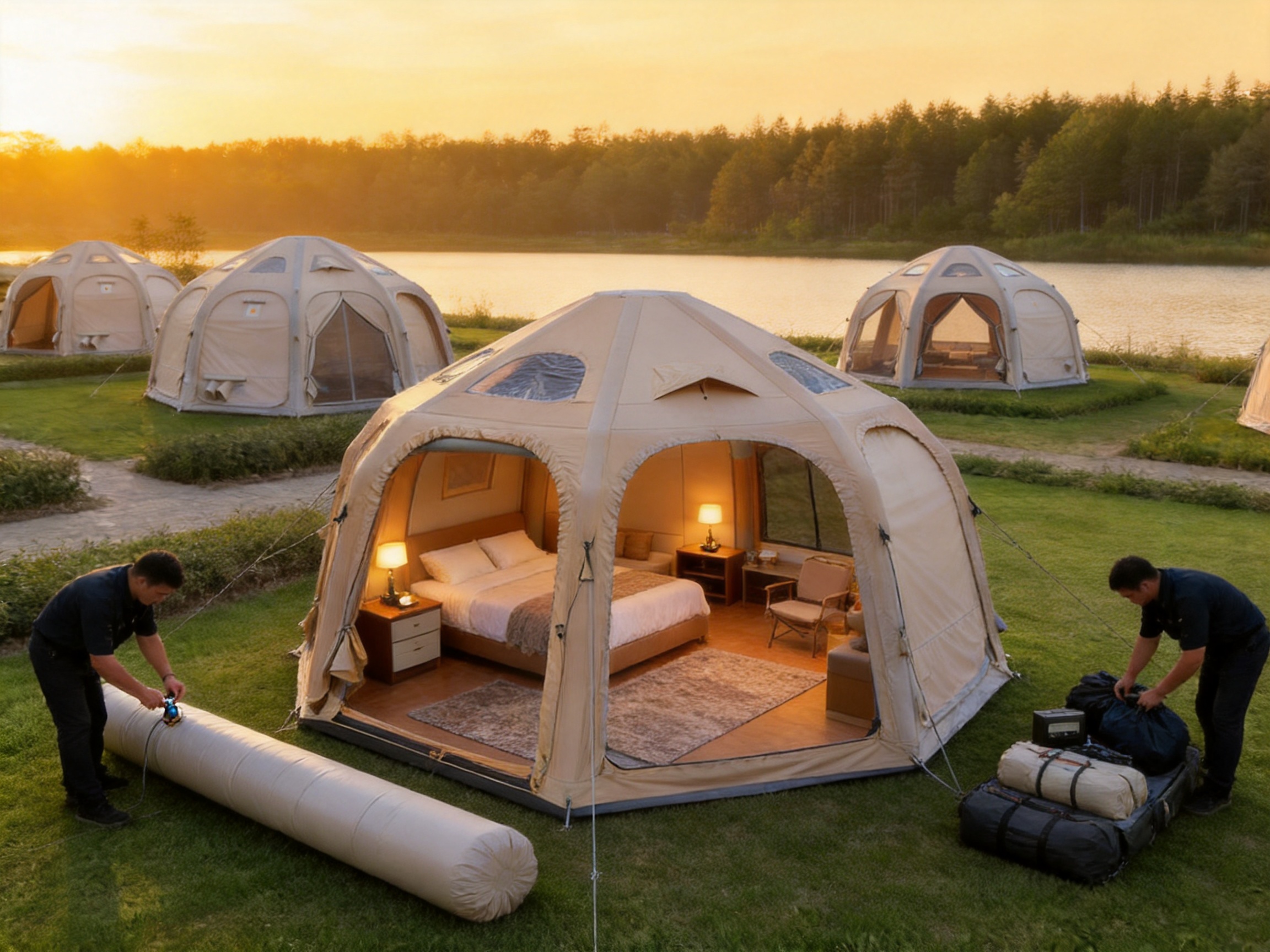
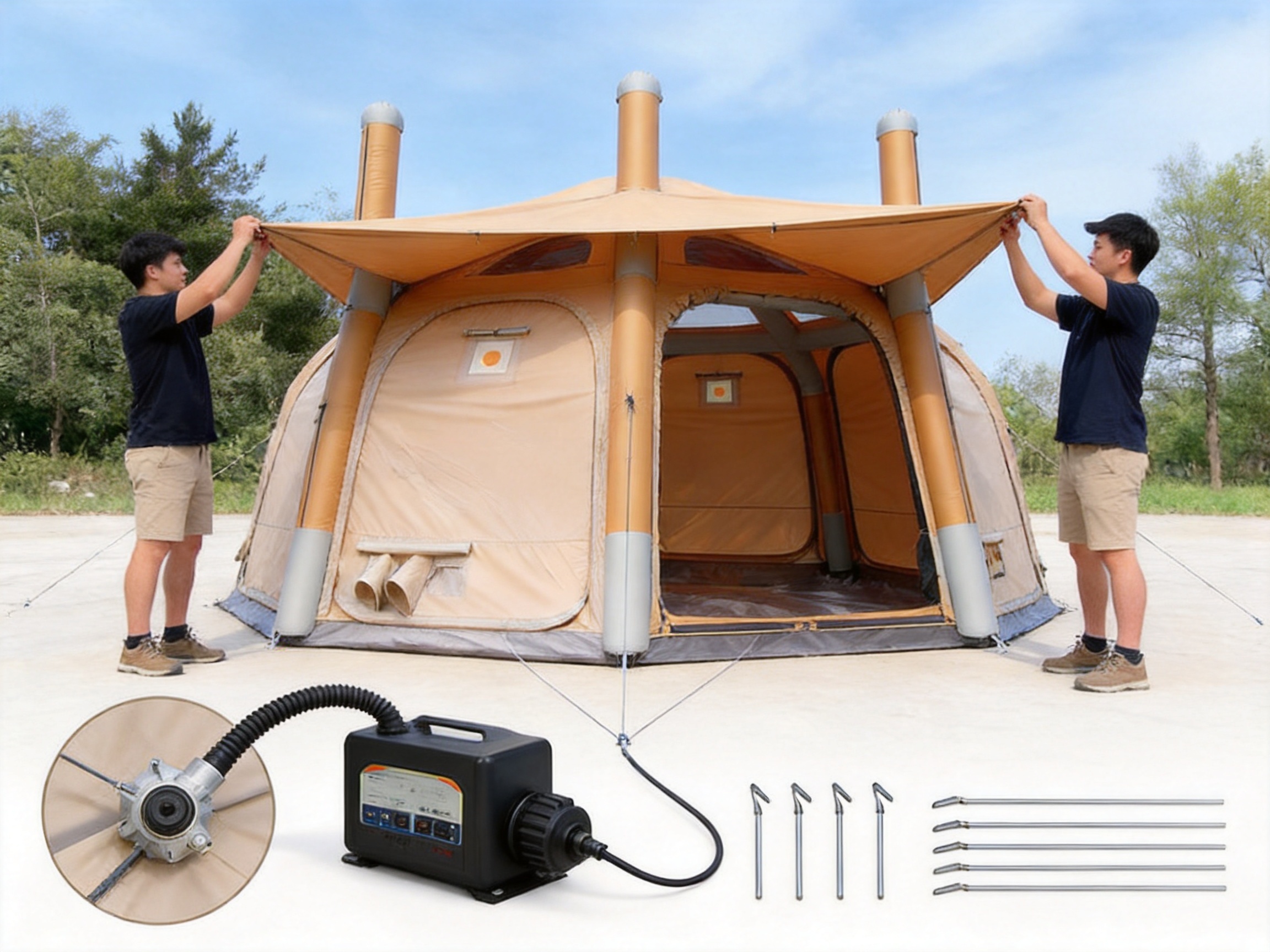
Outdoor accommodation has changed significantly in recent years. Campers increasingly expect more than a basic shelter with a low ceiling and complicated pole system. Families, group travelers, glamping operators, and outdoor-event organizers now look for tents that combine fast installation, dependable weather protection, generous living space, and easy transportation. The quick-setup inflatable family dome tent is designed to meet these expectations with an air-supported structure, a spacious cabin-style interior, and materials selected for repeated outdoor use.
This inflatable air cabin provides a practical alternative to conventional framed tents. Instead of relying on a large collection of rigid poles, the shelter uses reinforced PVC air columns and industrial-grade valves to create its structural skeleton. Once inflated, the air-frame supports the waterproof outer fabric and establishes a stable, comfortable interior. When the trip is over, the structure can be deflated, folded, and packed for transport.
The design is especially suitable for families and groups who want a comfortable basecamp without spending excessive time assembling equipment. Its tall interior, multi-room layout, weather-resistant construction, ventilation features, and flexible size options make it useful for weekend camping, long-stay outdoor accommodation, resort applications, temporary lodging, and commercial glamping projects.
Manufactured by Ningbo Zhenhai Tiansai Leisure Products Co., Ltd., the tent reflects the capabilities of a specialized Chinese outdoor-product manufacturer with experience in design, production, quality management, OEM development, and international supply. The company operates a factory of more than 13,000 square meters in Ningbo, an important port city with efficient access to global logistics networks.
1. A New Concept in Family Camping Accommodation
Traditional family tents often require multiple poles, sleeves, clips, and connectors. For larger models, the pitching process may require two or more people, careful alignment, and considerable physical effort. A mistake in the frame arrangement can delay setup or place stress on the fabric. The inflatable family dome tent addresses this challenge through an integrated air-beam architecture.
The air-frame system uses inflatable tubes in place of many conventional support poles. When the tubes are filled with air using a suitable high-pressure pump, they rise into position and form the main structural framework. The exterior flysheet is attached to this framework, allowing the tent to become functional in a comparatively short period.
This approach is valuable for families traveling with children, older campers, or limited setup assistance. It also benefits glamping operators and event organizers who need to install several units efficiently. Faster setup means less time spent handling components and more time available for arranging beds, furniture, cooking equipment, and personal belongings.
The cabin-style shape provides a more residential experience than a low-profile backpacking tent. A high ceiling gives occupants greater vertical clearance, while the broad floor plan allows sleeping areas and shared living space to be organized separately. The design can support three bedrooms and one living room, depending on the selected configuration and interior arrangement.
Unlike a small dome designed only for sleeping, this product is intended to function as a portable outdoor room. It can accommodate sleeping pads, inflatable mattresses, bags, tables, chairs, clothing, and other camping equipment. The additional volume is particularly useful during poor weather, when campers may need to remain indoors for extended periods.
2. Main Product Advantages Over Conventional Tents
2.1 Faster and More Efficient Installation
The most visible advantage is the simplified pitching process. Conventional family tents typically depend on long fiberglass or aluminum poles. These components must be connected, threaded through fabric sleeves, and secured at multiple points. Large tents can involve many separate parts, which increases the possibility of lost components or incorrect assembly.
An inflatable structure reduces the number of rigid parts that must be handled during installation. After the tent is positioned and anchored, the air tubes are inflated through their valves. The shelter gradually takes shape as the air pressure increases. This process is more intuitive for many users and can reduce setup fatigue.
The exact installation time depends on the pump, weather, ground conditions, tent size, and user experience. However, the air-beam principle is designed to make the overall process quicker and more straightforward than assembling an equivalent large pole tent. Users should always follow the supplied instructions, check the pressure requirements, and secure the tent with suitable stakes and guy lines.
2.2 Greater Interior Comfort
Many compact camping shelters prioritize low weight over interior livability. That is appropriate for backpackers, but families often require more room. The air cabin uses a high-ceiling configuration that promotes easier movement inside. Adults can enjoy greater standing and changing space, while children have room to move without constantly contacting the roof or sidewalls.
The available sizes include approximately 400 by 400 centimeters, 500 by 500 centimeters, and 600 by 600 centimeters. Combined configurations are also available in approximate 4-by-4-meter, 5-by-5-meter, and 6-by-6-meter formats. These options allow buyers to select a footprint according to group size, site conditions, transport requirements, and intended use.
A larger footprint does more than create additional sleeping space. It helps separate wet equipment from bedding, provides room for luggage organization, and makes it possible to create a central living zone. For glamping businesses, increased internal volume can support beds, rugs, lighting, storage, and decorative furnishings that transform the tent into a more complete guest accommodation.
2.3 Protection in Changing Weather
The tent is described as a four-season model and is built with waterproof fabric, heat-sealed construction details, and a full PVC waterproof bottom cloth. These features are intended to protect occupants from rain, ground moisture, splashing, and damp conditions. The waterproof floor creates a continuous barrier between the interior and the campsite surface, which is especially useful when the ground is wet.
The outer material is designed to resist routine outdoor wear while maintaining a balance between protection and portability. Waterproof fabric helps reduce water penetration through the canopy, while properly closed seams are important for minimizing leakage at fabric junctions. A full waterproof floor also helps prevent moisture from rising through the base during extended use.
Weather protection depends on correct installation. The tent must be fully inflated, properly tensioned, anchored at all appropriate points, and positioned on a suitable site. Before use in severe conditions, campers should inspect the fabric, valves, air tubes, seams, stakes, and guy lines. No temporary shelter should be treated as invulnerable to extreme wind, flooding, snow loading, or dangerous weather.
2.4 Better Ventilation and Condensation Management
Large waterproof shelters need effective ventilation because sleeping, cooking, and normal breathing introduce moisture into the air. Without sufficient airflow, condensation can collect on the inner surface of the canopy and make the interior feel damp.
The tent incorporates micro-mesh windows and adjustable vents to encourage air circulation while helping prevent insects from entering. Mesh panels allow air exchange and provide a degree of visibility, while the vents can be adjusted according to weather conditions. Keeping ventilation openings available during suitable conditions can make the interior feel fresher and help reduce condensation.
Ventilation is also important during warm-weather camping. A large family tent can become hot when exposed to direct sunlight, especially when multiple people are inside. Cross-ventilation through windows, doors, and upper vents can improve comfort. Campers should avoid blocking ventilation panels with luggage or bedding.
2.5 Strong and Flexible Air-Supported Construction
The inflatable frame uses upgraded PVC air columns with mesh support features. The tubes are described as puncture-resistant and are paired with industrial-grade valves. This combination is intended to provide a dependable structural system while preserving the folding and transport advantages associated with inflatable shelters.
An air beam can offer a degree of flexibility when exposed to moderate pressure from wind. Unlike a rigid pole that may bend or break at a single point, the air-frame distributes support through continuous inflated tubes. This does not eliminate the need for proper anchoring, but it contributes to a stable structure when the tent is correctly pitched.
The air tubes should be protected from sharp objects, excessive heat, abrasion, and improper handling. A repair kit and maintenance instructions are valuable accessories for long-term ownership. Routine inspection can identify slow leaks or valve issues before they affect a camping trip.
3. Product Structure and Accommodation Layout
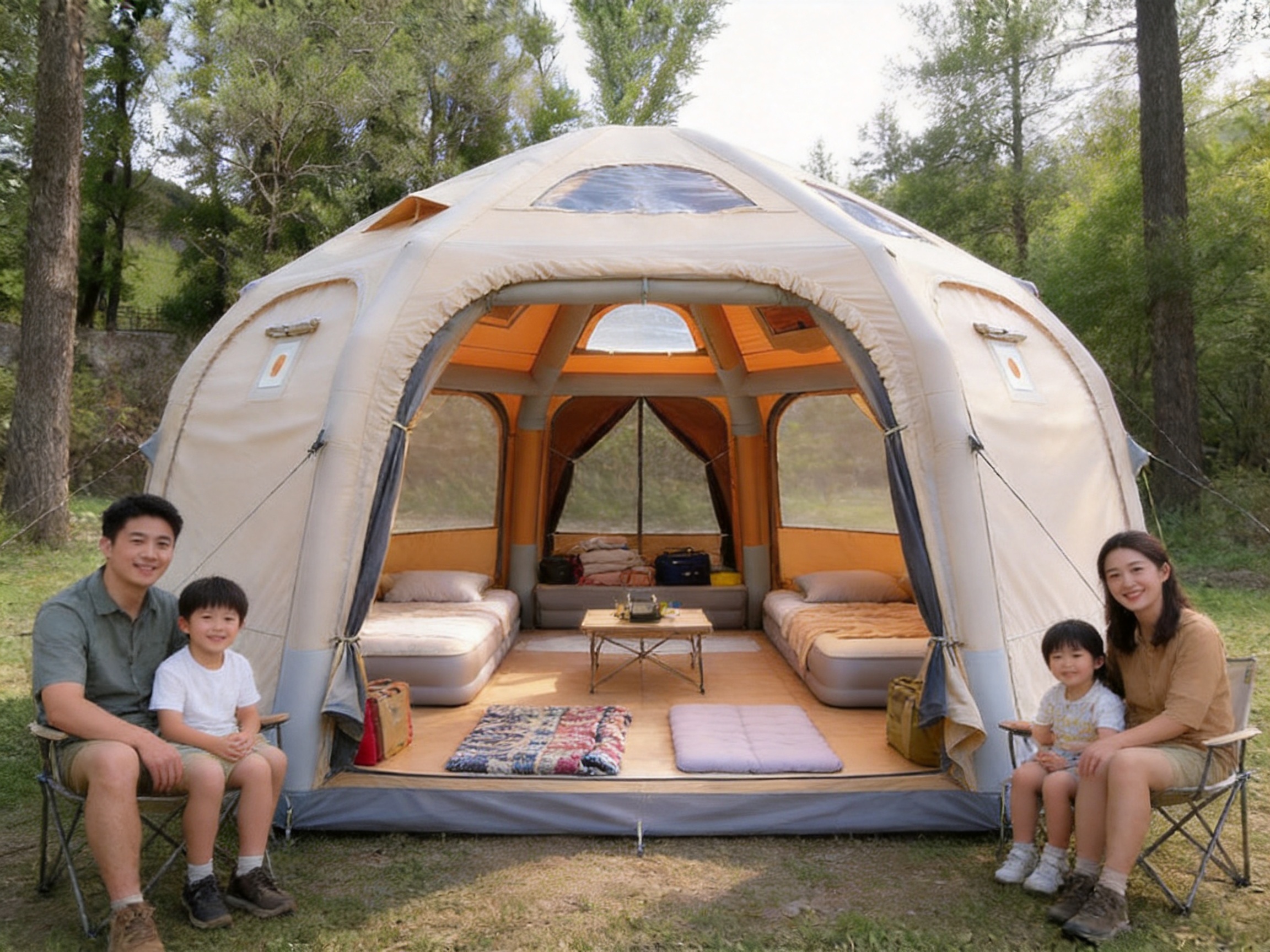
The listed configuration includes three bedrooms and one living room. This layout is intended to create a stronger division between sleeping and shared areas than a single-room family tent. Families can use the separate rooms for adults, children, guests, or equipment storage, depending on their needs.
Separate bedrooms can improve privacy and help organize personal belongings. They may also make it easier to maintain a comfortable sleeping schedule when different occupants go to bed or wake up at different times. The living room can serve as a gathering area for meals, conversation, reading, or indoor activities during rain.
The exact internal arrangement may vary according to the selected size and configuration. Buyers should confirm the floor plan, dimensions, door positions, window locations, bedroom dividers, and included accessories before placing an order. For commercial applications, the interior can potentially be adapted through OEM or ODM discussion.
The dome-inspired exterior combines visual appeal with functional geometry. Curved surfaces help create a recognizable silhouette and can reduce sharp wind-catching edges compared with some tall, box-shaped structures. The cabin profile retains useful vertical clearance while maintaining the rounded appearance associated with dome and glamping shelters.
For family camping, the interior can be arranged with sleeping mats on the floor or with suitable low-profile furniture. For resort or glamping use, the space may be fitted with beds, side tables, lighting, rugs, seating, and storage solutions. Any interior additions should be selected carefully so that they do not obstruct exits, ventilation openings, or structural components.
4. Materials Selected for Outdoor Performance
4.1 Waterproof Exterior Fabric
The outer tent fabric serves as the primary barrier against rain, wind, sunlight, dust, and general campsite exposure. The product information identifies waterproof fabric as a key material. The supplied product description also refers to high-density ripstop fabric, which is valued in outdoor equipment because its woven structure can help limit the spread of small tears.
Water resistance is not determined by fabric alone. Coating quality, seam construction, zipper design, panel overlap, tension, and maintenance all contribute to real-world performance. A properly pitched tent keeps the canopy taut, allowing water to run off rather than pool on the surface.
Users should dry the tent completely before long-term storage. Packing a damp tent can encourage mildew, unpleasant odors, coating deterioration, and fabric damage. Cleaning should generally be performed with mild soap, clean water, and a soft cloth, avoiding harsh chemicals that could weaken coatings or synthetic fibers.
4.2 Full PVC Waterproof Floor
The floor is specified as full PVC waterproof material. This type of base can offer strong resistance to ground moisture, mud, and repeated campsite contact. It is especially useful for family tents because children may spend time sitting or playing on the floor, increasing the importance of a durable and easy-to-clean base.
A waterproof floor also simplifies campsite management. Dirt and small spills can often be removed more easily from a coated PVC surface than from a thin textile floor. Nevertheless, users should clear the campsite of sharp stones, branches, and debris before pitching. A groundsheet or protective underlay can provide additional protection when the tent is used on rough terrain.
4.3 Reinforced Air Columns
The air columns are central to the tent’s performance. Their material must withstand repeated inflation, deflation, folding, transport, and exposure to changing temperatures. The product uses upgraded PVC air columns with mesh-related reinforcement and multi-layer puncture-resistant construction.
Valves are equally important. Industrial-grade valves help control inflation and deflation while supporting consistent operation over repeated use. During setup, users should ensure that valve caps are securely closed and that the connections are free from dirt or sand. A clean valve interface helps reduce the possibility of air loss.
4.4 Mesh and Ventilation Components
Micro-mesh panels support airflow while providing a barrier against mosquitoes and other insects. They are useful during warm nights when occupants want fresh air without fully opening the tent. Mesh also allows daylight into the living area and can improve visibility around the campsite.
Mesh should be handled carefully because it is lighter and more delicate than the main canopy fabric. Zippers should be operated smoothly, and overloaded pockets or furniture should not press against the panels. Small tears should be repaired promptly to prevent them from expanding.
5. Performance Benefits for Different Users
5.1 Families and Recreational Campers
Families benefit from the combination of speed, capacity, and comfort. Parents can spend less time connecting poles and more time organizing the campsite. Children have a more spacious environment for sleeping and indoor activities. Multiple rooms allow personal items to be distributed instead of accumulating in one central area.
The four-season positioning provides versatility across spring, summer, autumn, and winter conditions, subject to appropriate site selection and safe-weather practices. In warm weather, ventilation and mesh openings support airflow. In rainy weather, the waterproof canopy and floor help maintain a drier interior. In cooler seasons, the double-layer design can provide an additional buffer between occupants and external conditions.
Families should select the size according to the number of occupants and the amount of equipment they intend to bring. A tent filled entirely with beds and luggage may feel less spacious than its floor dimensions suggest. Choosing a larger model can improve comfort for long stays or glamping-style use.
5.2 Glamping Resorts and Outdoor Hospitality
Glamping operators need tents that combine visual appeal, guest comfort, transportability, and manageable installation. The round or dome-inspired inflatable format can create a distinctive accommodation experience while avoiding the permanent construction costs associated with cabins and rooms.
The large interior can be furnished in a variety of ways. Operators may install sleeping platforms, mattresses, seating, lighting, storage, and decorative features. The tent can be used for seasonal accommodation, private family units, outdoor retreats, and nature-based tourism projects.
Inflatable construction may also provide logistical advantages when a resort changes its layout or operates on leased land. Units can be deflated, relocated, and stored more easily than fixed structures. Commercial operators should establish inspection schedules, cleaning procedures, emergency plans, and weather policies before hosting guests.
5.3 Outdoor Events and Temporary Facilities
The spacious air cabin can be suitable for temporary event accommodation, activity spaces, hospitality areas, and support facilities. Its relatively simple installation process can help organizers respond to changing site requirements.
For event use, the layout can be adapted to the purpose of the installation. It may serve as a lounge, registration area, staff shelter, family rest space, or temporary exhibition room. Appropriate anchoring and local safety compliance are essential, particularly when the unit is placed in an open area or used by the public.
5.4 Emergency, Humanitarian, and Field Applications
Although this model is presented primarily as a family and outdoor accommodation tent, inflatable structures can also be considered for selected field applications. Their folding format, spacious interior, and rapid deployment characteristics may be useful where transport volume and installation time are important.
Humanitarian and institutional buyers should conduct application-specific testing before deployment. Requirements may include fire performance, sanitation, insulation, accessibility, extreme-weather resistance, repairability, and compliance with procurement standards. Custom configurations can be discussed with the manufacturer where suitable.
6. Manufacturing Strengths Behind the Product
6.1 Specialized Outdoor-Product Experience
The manufacturer, Ningbo Zhenhai Tiansai Leisure Products Co., Ltd., specializes in the design, production, and sale of tents and outdoor equipment. Its factory covers more than 13,000 square meters, providing a dedicated base for product development, material handling, assembly, inspection, and packing.
Specialization matters because inflatable tents combine several technical disciplines. A successful product requires knowledge of coated fabrics, sewing, seam treatment, air-pressure systems, valve installation, structural design, folding, packaging, and field usability. A company focused on outdoor products can integrate these areas more effectively than a general textile supplier with no experience in complete shelter systems.
6.2 Design and Product Development
The company maintains a professional design team that develops products from the perspectives of practicality and comfort. This approach is reflected in the air cabin’s combination of a high ceiling, multiple rooms, ventilation openings, waterproof base, and transportable structure.
Product development can involve collaboration with professionals, feedback from outdoor enthusiasts, and repeated optimization based on testing. This process is especially important for large tents because small design decisions can have a significant impact on pitching, airflow, internal movement, packing, and durability.
The manufacturer has also designed products associated with appearance patents and utility model patents. Intellectual property development indicates an effort to create differentiated outdoor products rather than simply copying existing market designs. For buyers seeking private-label or custom solutions, this design capability can support more distinctive product lines.
6.3 Quality Management
The company states that it strictly implements a quality management system to help ensure that products meet international standards. For inflatable tents, quality management should cover incoming materials, fabric inspection, sewing accuracy, air-column assembly, valve performance, seam integrity, finished dimensions, appearance, packing, and documentation.
Quality control is particularly important for air-supported structures because small defects can affect pressure retention or overall stability. Inspection of air tubes and valves should be integrated into production rather than performed only at the final packing stage. Finished units may also benefit from inflation checks, dimensional checks, and visual inspections for loose threads, incomplete seams, scratches, stains, and fabric damage.
Buyers importing tents for retail or commercial projects should clarify inspection procedures, sampling standards, test reports, warranty terms, spare-part availability, and packaging requirements. Clear technical documentation helps align expectations between the manufacturer and the buyer.
6.4 OEM and ODM Capability
The product information identifies OEM and ODM customization as acceptable. This can be valuable for distributors, camping brands, resorts, event companies, and outdoor retailers that require product differentiation.
Customization may involve color, printed branding, room layout, doors, windows, ventilation details, floor plans, packaging, accessories, labels, and product documentation. More substantial changes may require new pattern development, prototype approval, material confirmation, engineering review, and production testing.
A responsible customization process should begin with a written specification. The specification may include target dimensions, fabric requirements, air-column pressure, valve type, color references, logo placement, packaging format, shipping marks, expected operating conditions, and inspection criteria. Prototype approval is recommended before mass production.
6.5 Ningbo Supply-Chain and Export Advantages
The factory is located in Ningbo, Zhejiang Province, China. Ningbo is a major port city with strong manufacturing infrastructure and international logistics connections. This location can support the sourcing of textiles, PVC materials, hardware, packaging, pumps, and other related components.
For overseas customers, proximity to an established port can simplify export coordination and container planning. The manufacturer’s experience supplying customers across North America, Europe, Asia, and other regions also provides a foundation for international business communication and shipment preparation.
Export readiness includes more than transportation. It may involve commercial documentation, product labeling, carton specifications, quality inspection, loading plans, spare parts, and after-sales communication. Buyers should confirm all requirements in advance, especially when shipping to markets with specific consumer-product or fire-safety regulations.
7. Product Specifications at a Glance
| Item | Specification or Description |
|---|---|
| Product type | Inflatable family dome tent and air cabin |
| Recommended category | Inflatable and air tents |
| Season positioning | Four-season tent, subject to safe installation and weather limitations |
| Layer | Double-layer construction |
| Layout | Three bedrooms and one living room configuration |
| Available approximate sizes | 400 × 400 cm, 500 × 500 cm, and 600 × 600 cm |
| Combined options | Approximately 4 × 4 m, 5 × 5 m, and 6 × 6 m combinations |
| Air-frame material | Upgraded PVC air columns with mesh-related reinforcement |
| Floor material | Full PVC waterproof bottom cloth |
| Key protection features | Waterproof fabric, waterproof floor, heat-sealed construction details, and weather-resistant design |
| Ventilation | Micro-mesh windows and adjustable vents |
| Primary use | Outdoor camping, family travel, glamping, resorts, and temporary accommodation |
| Model number | DYI-222 |
| Brand designation | DY |
| Reference packed size | Approximately 90 × 50 × 50 cm |
| Reference gross weight | Approximately 82 kg |
Dimensions, weight, layout, included accessories, and final specifications should be confirmed with the manufacturer before purchase. Product configurations may vary according to size, fabric selection, customization, and packaging requirements.

Quick Setup Inflatable Family Dome Tent Waterproof Air Cabin Basecamp
8. Setup Procedure and Best-Practice Use
8.1 Select the Campsite Carefully
Choose level, stable ground with adequate drainage. Avoid depressions where rainwater may collect, locations beneath dead branches, exposed ridges during strong winds, and areas near rivers or streams that could rise unexpectedly. Remove stones, sticks, glass, and other sharp objects before laying out the tent.
Consider the direction of sunlight and prevailing wind. Positioning doors and ventilation openings thoughtfully can improve comfort. Leave enough clearance around the tent for guy lines, access, drainage, and safe movement.
8.2 Unpack and Inspect the Components
Lay out the tent, air tubes, valves, stakes, guy lines, pump, repair materials, and any bedroom dividers or accessories. Confirm that the fabric is not twisted and that all major components are present. Inspect the ground-contact area for sharp debris before beginning inflation.
Check the valves for dirt, sand, or visible damage. Make sure the air tubes are correctly positioned and that no fabric panel is trapped in a way that could create excessive stress during inflation.
8.3 Anchor Before Full Inflation
Depending on the instructions, it may be useful to place preliminary stakes or anchor points before the frame reaches full pressure. Anchoring helps prevent the tent from shifting as the air columns rise. All major corners and designated guy-line positions should be secured according to the supplied manual.
Never rely on the weight of the fabric alone to hold the shelter in place. A large tent presents a substantial surface area to wind, and proper anchoring is essential for stability.
8.4 Inflate the Air Frame Correctly
Use a compatible pump and inflate each air column according to the recommended pressure or firmness. Do not exceed the manufacturer’s stated pressure. Excessive pressure can place unnecessary stress on seams, valves, and fabric, particularly when temperatures rise during the day.
As inflation progresses, check that the structure rises evenly. Walk around the tent to inspect the shape, alignment, connection points, and contact with the ground. Correct any twists or folds before the structure reaches full pressure.
8.5 Attach and Tension the Canopy
Once the air frame is properly inflated, attach or tension the outer canopy as instructed. The fabric should be firm enough to shed rain without being overstretched. Guy lines should be adjusted to support the structure while leaving sufficient flexibility for normal movement.
After installation, inspect zippers, doors, windows, vents, and floor edges. Confirm that ventilation openings can be operated and that emergency exits are not blocked by furniture or luggage.
8.6 Deflate and Store Properly
At the end of the trip, remove dirt and moisture before packing. Open the valves and allow the air columns to deflate fully. Fold the fabric according to the recommended pattern to reduce unnecessary creasing and make repacking easier.
Store the tent in a cool, dry location away from direct sunlight, chemicals, rodents, and sharp objects. Long-term storage in a damp or overheated environment can reduce the service life of fabric coatings and PVC components.
9. Maintenance and Long-Term Durability
Regular maintenance helps preserve waterproofing, air retention, appearance, and user safety. After each trip, inspect the canopy for abrasion, pinholes, loose stitching, damaged zippers, and contamination. Check the air columns for unusual softness or slow pressure loss.
If a leak is suspected, inflate the relevant air tube and listen for escaping air. A mild soapy-water solution may help identify small leaks because bubbles can form at the damaged area. Any repair should follow the manufacturer’s instructions and use compatible patches or adhesive.
Do not drag the inflated or deflated tent across rough ground. Dragging can abrade the floor, damage seams, and place stress on attachment points. When moving a packed tent, use the supplied bag or a suitable protective container.
Keep cooking equipment away from the fabric. Open flames, hot stoves, lanterns, cigarettes, fireworks, and heated exhaust can damage synthetic textiles and PVC components. Fire safety is especially important in a large enclosed tent because occupants may have limited escape routes.
Ventilation should be maintained whenever people are inside for extended periods. Never operate fuel-burning appliances in the tent without appropriate safety measures and ventilation. Carbon monoxide is odorless and potentially fatal, so cooking and heating practices must follow recognized outdoor-safety guidance.
10. Comparison with Other Tent Categories
10.1 Compared with Pole-Supported Family Tents
The inflatable model’s primary advantage is simplified structural assembly. Pole tents may be lighter in some configurations and can be familiar to experienced campers, but larger versions can require more labor and contain more separate components. The inflatable tent offers a different balance: more emphasis on setup convenience and spacious accommodation, with the trade-off of a larger packed weight and the need for a pump.
10.2 Compared with Backpacking Tents
Backpacking tents prioritize compact weight and portability for users carrying equipment over long distances. The inflatable family cabin is designed for car camping, resort use, and basecamp applications rather than long-distance carrying. It offers far more interior volume and residential comfort, but it is not intended to replace an ultralight trekking tent.
10.3 Compared with Permanent Cabins
A cabin or fixed lodge provides greater rigidity and may offer stronger insulation, utilities, and year-round infrastructure. However, permanent structures require land, construction, permits, maintenance, and significant investment. An inflatable air cabin can be deployed with less site commitment and can be moved or stored when not required.
10.4 Compared with Traditional Glamping Domes
Rigid geodesic domes and permanent glamping pods can offer distinctive architecture and high durability, but they are often more difficult to transport and install. The inflatable dome-style tent provides a flexible alternative for seasonal operators and projects that need movable accommodation. The best choice depends on the expected duration, climate, guest expectations, local regulations, and budget.
11. Why Manufacturer Capability Matters to Buyers
A large outdoor shelter is not simply a piece of sewn fabric. It is a coordinated system involving structural geometry, material engineering, air retention, seam workmanship, floor construction, ventilation, packing, and user instructions. The manufacturer’s production experience directly affects the consistency of these elements.
Buyers should evaluate whether a supplier can provide stable materials, repeatable dimensions, reliable valves, appropriate testing, professional packaging, and responsive after-sales support. A factory with its own design and production capabilities can typically communicate more effectively about modifications than a trading company that depends entirely on unrelated subcontractors.
The company’s focus on product innovation, professional design, outdoor testing, quality systems, patents, and international markets supports its position as a potential one-stop partner for outdoor brands. Its OEM and ODM capability can help customers develop products for particular retail channels, resort projects, or regional requirements.
For wholesale customers, production capacity and supply-chain organization are also important. A tent may perform well as a single sample but require different controls during mass production. Consistent cutting, sewing, welding or sealing, inspection, folding, and packing are necessary to maintain quality across a complete order.
12. Purchasing Considerations for Wholesale and Commercial Buyers
Before ordering, buyers should define the intended application. A private family camper may prioritize convenience and interior volume, while a resort may focus on appearance, cleanability, replacement parts, and guest turnover. An event organizer may prioritize installation speed and transport. A distributor may require specific packaging, labeling, manuals, and branding.
Important questions include the final floor plan, fabric specification, waterproof performance, air-column design, recommended pressure, pump compatibility, included repair kit, warranty conditions, spare-parts policy, carton dimensions, gross weight, and minimum order quantity.
Buyers should request a complete packing list. The list may include the tent body, air tubes, pump, stakes, guy lines, storage bag, bedroom dividers, repair materials, instructions, and any optional accessories. Missing components can delay installation and increase operational costs.
For commercial sites, buyers should also consider cleaning and replacement procedures. High-turnover accommodation may require additional floor protection, spare air tubes, extra valves, replacement mesh panels, and standardized repair materials. A maintenance plan should be established before the first guest arrives.
Customization is best managed through approved drawings and samples. Color and logo placement should be confirmed with physical or standardized references when possible. For structural modifications, buyers should request engineering review rather than assuming that a visual change will have no effect on stability or ventilation.
13. Sustainability and Responsible Outdoor Use
Durability is one part of responsible product use. A tent that remains serviceable for many seasons can reduce the need for frequent replacement. Proper maintenance, repair, careful transport, and correct storage all contribute to a longer product life.
Manufacturers and buyers can also consider material efficiency, repairability, packaging reduction, and recyclable components where practical. The company has stated an intention to increase research and development in lightweight and environmentally friendly materials. Continued progress in these areas can support more sustainable outdoor-product development.
Users should follow leave-no-trace principles when camping. Select established sites where possible, manage wastewater responsibly, pack out all waste, and avoid damaging vegetation. A comfortable tent should enhance contact with nature without increasing unnecessary environmental impact.
14. Frequently Asked Questions
Q1: What is the main advantage of this inflatable family tent?
The main advantage is the combination of rapid air-frame setup and generous family-sized living space. It replaces much of the conventional pole assembly process with inflatable PVC air columns while providing a high ceiling, multiple rooms, and a shared living area.
Q2: Is the tent suitable for four-season camping?
The product is identified as a four-season tent and includes waterproof fabric, a waterproof PVC floor, double-layer construction, ventilation, and a reinforced air frame. However, four-season positioning does not mean that the tent is suitable for every extreme condition. Users must consider snow load, wind speed, temperature, site exposure, anchoring, and local weather warnings.
Q3: How many people can use the tent?
Capacity depends on the selected size, room configuration, sleeping equipment, and desired comfort level. The three-bedroom and one-living-room layout is designed for family or group use, but buyers should confirm the exact floor plan and recommended occupancy for the chosen model.
Q4: What sizes are available?
Reference sizes include approximately 400 × 400 centimeters, 500 × 500 centimeters, and 600 × 600 centimeters. Combined configurations are listed at approximately 4 × 4 meters, 5 × 5 meters, and 6 × 6 meters. Final dimensions should be confirmed before ordering.
Q5: Does the tent require special equipment for setup?
A compatible pump is required to inflate the air columns. The appropriate pump type and pressure depend on the product configuration. Users should use the recommended equipment and avoid exceeding the stated pressure.
Q6: Is the floor waterproof?
The product information identifies the bottom cloth as full PVC waterproof material. This design is intended to protect against ground moisture and wet campsite conditions. The tent should still be pitched on suitable ground, and sharp objects should be removed to prevent punctures.
Q7: How does the tent reduce condensation?
Micro-mesh windows and adjustable vents support airflow while helping keep insects outside. Users can improve condensation management by opening suitable ventilation points, avoiding blocked vents, and drying the tent thoroughly after use.
Q8: Can the product be customized?
OEM and ODM customization are identified as acceptable. Potential options may include colors, logos, layouts, dimensions, packaging, and selected components. Custom designs should be confirmed through drawings, samples, technical specifications, and production approval.
Q9: Is it suitable for a glamping resort?
Yes, the spacious dome-style air cabin is suitable for consideration in glamping and resort projects. Its interior can accommodate beds, furniture, lighting, and decorative elements. Commercial operators should confirm local regulations, guest-safety requirements, fire precautions, sanitation procedures, and weather policies.
Q10: What should be checked before purchase?
Buyers should confirm the final size, layout, fabric, air-column system, pressure requirements, pump, accessories, packing details, gross weight, warranty, spare parts, customization options, lead time, inspection standards, and shipping documentation.
Q11: How should the tent be stored?
Deflate the air columns completely, clean the fabric, dry every part, fold it carefully, and store it in a cool, dry place away from sunlight, chemicals, sharp objects, and pests. Avoid long-term storage while damp.
Q12: What makes the manufacturer suitable for international buyers?
The manufacturer operates a factory of more than 13,000 square meters, maintains design and production capabilities, serves international markets, develops outdoor products, supports OEM and ODM projects, and is located in Ningbo, a major Chinese port city with established export infrastructure.
15. Conclusion
The quick-setup inflatable family dome tent offers a compelling solution for campers and businesses seeking more comfort without the complexity of a permanent structure. Its air-supported frame simplifies installation, while the high-ceiling cabin design creates a practical environment for sleeping, relaxing, storing equipment, and spending time indoors during changing weather.
Waterproof fabric, a full PVC floor, reinforced PVC air columns, industrial-grade valves, mesh windows, adjustable vents, and a double-layer structure support its role as a versatile outdoor shelter. Size options from approximately 4-by-4 meters to 6-by-6 meters allow the product to serve both family camping and larger glamping applications.
Its greatest competitive distinction is the balance between mobility and livability. Backpacking tents are easier to carry but much smaller. Permanent cabins offer more infrastructure but require greater investment and commitment. Conventional family tents may be less expensive in some cases but often demand more assembly. The inflatable air cabin occupies a useful middle ground for users who want a portable, spacious, and comparatively efficient shelter.
The manufacturer strengthens this proposition through dedicated outdoor-product experience, a factory exceeding 13,000 square meters, design and testing capabilities, quality-management practices, OEM and ODM support, patent development, and international supply-chain experience. These capabilities are important for buyers who need more than a single camping product and are looking for a long-term outdoor-equipment partner.
When correctly installed, maintained, ventilated, anchored, and stored, this inflatable family dome tent can support comfortable weekends, extended basecamp trips, seasonal glamping operations, outdoor events, and customized hospitality projects. It represents a modern approach to portable accommodation: fast to deploy, spacious enough for real living, and adaptable to the evolving needs of outdoor users.
References
1. Product specification and technical information supplied for the inflatable family dome tent, model DYI-222.
2. Manufacturer-provided information concerning materials, dimensions, packaging, applications, OEM and ODM services, and quality assurance.
3. General outdoor shelter principles concerning waterproofing, ventilation, anchoring, condensation control, and campsite safety.
4. General guidance on textile tent maintenance, air-beam inspection, storage, repair, and responsible outdoor use.
5. Manufacturer profile information concerning product design, factory operations, international supply, outdoor-product development, and quality-management practices.
Product: Quick Setup Inflatable Family Dome Tent Waterproof Air Cabin Basecamp

Message Us Right Now!
-
Mp: +86-18858091910
E-mail: sales@tenplaytent.com
ADD: No. 529, Guangyuan Road, Xiepu Town, Zhenhai District, Ningbo City, Zhejiang Province, China
-
Quick Links
Home Products About Us Advantage News Contact Us -
Product
Inflatable & Air Tents Glamping & Resort Tents Backpacking & Trekking Tents Automatic & Pop-Up Tents Family & Camping Tents Specialty Tents & Shelters Kids Tents Pet Tents Humanitarian & Large Tents Hammock -
Get Connected
 Camping Tent Manufacturer in China