


 English
 عربى


10-Person Stormproof Geodesic Inflatable Yurt Air Cabin Glamping Tent
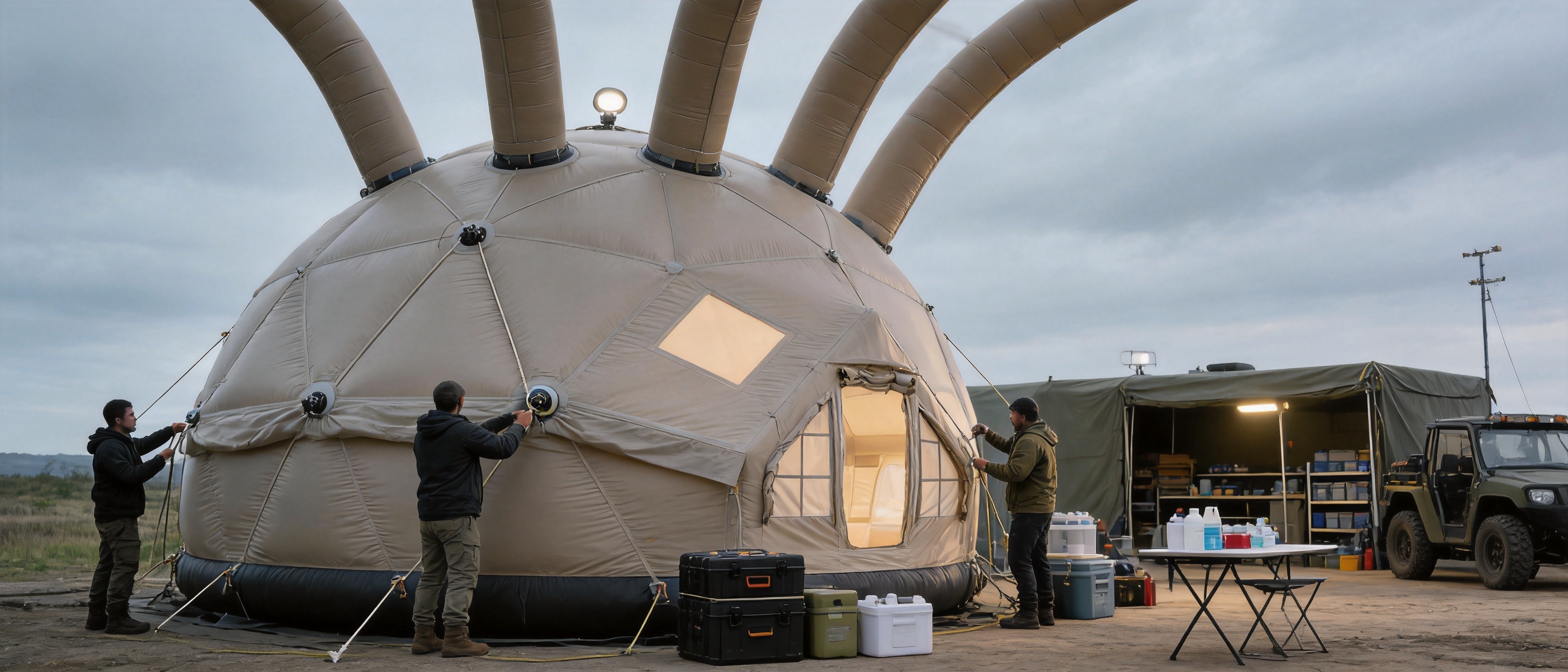
Outdoor accommodation is evolving rapidly. Campers, resort operators, event organizers, relief agencies, and expedition teams increasingly need shelters that combine the comfort of a room with the flexibility of a tent. Traditional camping tents can be lightweight and economical, but many large models require complicated assembly, numerous support poles, and considerable labor. Permanent cabins provide comfort but are expensive, difficult to relocate, and unsuitable for temporary or rapidly changing outdoor projects.
The 10-Person Stormproof Geodesic Inflatable Yurt Air Cabin Glamping Tent is designed to bridge this gap. It provides the spacious interior and visual appeal expected from a premium glamping structure while retaining the portability and deployment flexibility of an inflatable shelter. Its circular yurt-inspired form, geodesic structural concept, high-pressure air beams, heavy-duty fabric, panoramic windows, and rapid-inflation system create a versatile platform for luxury camping, resort accommodation, festivals, weddings, emergency housing, medical support, and other demanding applications.
Manufactured by Ningbo Zhenhai Tiansai Leisure Products Co., Ltd., the tent represents the company’s focus on practical outdoor innovation, robust materials, user-centered design, and scalable production. With a factory covering more than 13,000 square meters, an experienced professional team, and an established export background, the manufacturer is positioned to support wholesale buyers, outdoor brands, hospitality groups, and project-based procurement.
Product Overview
This high-capacity air cabin is intended to accommodate up to 10 people, depending on the interior arrangement and intended use. Its yurt-style layout creates a naturally open central space, making it suitable for sleeping areas, lounge furniture, dining arrangements, reception functions, treatment stations, or temporary workspaces. Unlike narrow tunnel tents or conventional rectangular shelters, the circular plan encourages efficient movement and offers a more social interior environment.
The product combines several important characteristics:
• A geodesic-inspired structural configuration for improved load distribution and stability.
• High-pressure inflatable air beams that replace a large number of rigid poles.
• A one-key rapid-inflation system designed to simplify installation.
• Triple-layer heavy-duty Oxford fabric for durability and weather resistance.
• Reinforced waterproof sealing intended to reduce the risk of water penetration.
• Large screen windows that support natural lighting, ventilation, and panoramic views.
• A large interior suitable for accommodation, hospitality, events, and emergency applications.
• A portable structure that can be packed, transported, deployed, and relocated more easily than a permanent cabin.
The result is a shelter that can function as a premium guest room, a resort suite, a temporary event venue, a field command post, a medical support space, or a comfortable family camping unit.

10-Person Stormproof Geodesic Inflatable Yurt Air Cabin Glamping Tent
Why the Yurt and Geodesic Concept Matters
The design draws from two proven architectural ideas: the yurt and the geodesic structure. Traditional yurts are recognized for their circular floor plans, efficient use of interior space, and ability to create a comfortable central living environment. A geodesic structure, meanwhile, distributes forces across multiple interconnected sections rather than concentrating stress at only a few points.
Combining these ideas creates a practical shape for a large inflatable shelter. The circular configuration reduces unused corners and supports a more flexible furniture layout. Beds, tables, chairs, storage units, and activity zones can be positioned according to the needs of a resort, event, family, or relief organization. The open plan also makes the interior feel larger than a conventional tent with the same approximate footprint.
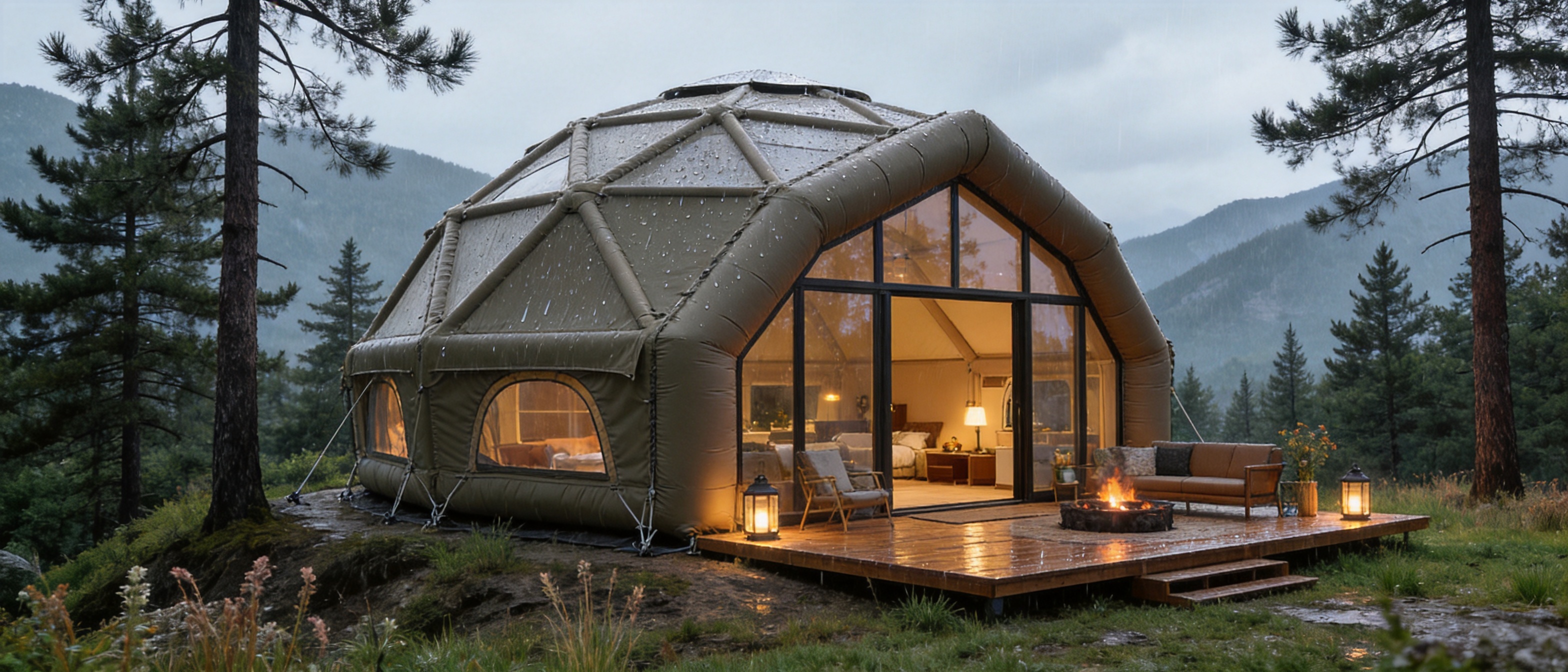
The geodesic approach is particularly valuable in exposed environments. Wind does not affect every part of a rounded shelter in the same way that it affects a large flat wall. The curved profile can help reduce abrupt wind loads, while the interconnected air-beam arrangement helps distribute structural forces throughout the frame. Actual performance will depend on correct anchoring, inflation pressure, site conditions, and weather limits, but the design is intended to provide greater stability than many basic recreational tents.
For glamping operators, the shape also offers a strong visual identity. Guests often choose premium outdoor accommodation because it feels distinctive and memorable. A yurt-style air cabin can create a recognizable accommodation unit that stands apart from ordinary dome tents, rectangular family tents, and simple inflatable shelters. Its form can complement forests, beaches, deserts, mountain sites, festival grounds, and resort landscapes.
Inflatable Architecture for Faster Deployment
One of the most important advantages of the product is its inflatable support system. Conventional large tents commonly rely on long poles, segmented frames, or multiple steel connectors. As the structure becomes larger, the number of components increases. Assembly may require several people, careful sequencing, and considerable time. Misplaced poles or incorrectly connected joints can delay installation and create avoidable safety concerns.
The air-beam design simplifies this process by using inflation to create the main supporting framework. After the tent is positioned and its anchoring points are prepared, the user can connect the inflation system and begin raising the structure. The one-key inflation concept is intended to make rapid setup possible with fewer manual steps. This is especially useful when a shelter must be deployed by a small team or when several units need to be installed at the same site.
Rapid deployment provides benefits beyond convenience. It can lower labor costs for hospitality operators, shorten the time needed to prepare an event venue, and improve response speed in emergency situations. It can also reduce the likelihood of assembly errors because users do not need to manage a large collection of rigid components.
Inflatable construction may also improve transport efficiency. Air beams can be deflated and folded, allowing the packed shelter to occupy less volume than an equivalent rigid-frame cabin. This makes it easier to move units by vehicle and can simplify storage during the off-season. For mobile operators, the same tent can be transported from one site to another as demand changes.
Operational Benefits of the Inflation System
The inflation system is designed around straightforward operation. A practical deployment sequence generally includes selecting a suitable site, clearing sharp objects, laying out the folded tent, connecting the inflation equipment, raising the air beams, extending the fabric, securing the structure, and checking the interior and exterior before use.
Operators should always follow the manufacturer’s instructions for inflation pressure, anchoring, maintenance, and weather use. The shelter should not be treated as an all-weather permanent building. Like any temporary structure, its performance depends on correct installation and responsible operation.
For professional buyers, the simplified process can support standardized site procedures. Staff members can be trained to use the same installation checklist for every unit. This can be valuable for resorts, rental companies, event contractors, disaster-response organizations, and outdoor education providers that need repeatable deployment across multiple locations.
Stormproof Design and Weather Resistance
Weather resistance is central to the performance of a large outdoor shelter. A spacious tent is only useful when its occupants can remain comfortable and protected during changing conditions. This model is developed with a focus on wind resistance, waterproofing, fabric durability, and controlled ventilation.
The geodesic-inspired inflatable structure is intended to provide stability in strong wind conditions. Its rounded profile and interconnected air beams can help distribute pressure across the shelter. However, no portable tent should be described as immune to extreme weather. The structure must be properly anchored, and users should observe local weather warnings and evacuate when conditions exceed the product’s intended operating limits.
The fabric system uses triple-layer heavy-duty Oxford material. Oxford fabric is widely used in outdoor products because of its balance of strength, flexibility, abrasion resistance, and coating compatibility. A multilayer construction can improve the overall barrier against moisture and environmental wear when the layers are correctly engineered and sealed.
Reinforced waterproof sealing is another important feature. Water often enters a tent not through the center of the fabric but through seams, connection points, zippers, corners, and areas where different materials meet. Reinforced sealing in these locations can reduce leakage risk during rain. For long-term field use, regular inspection remains important because abrasion, folding, ultraviolet exposure, and repeated deployment can eventually affect seals.
The design is therefore suitable for many outdoor environments, including wet camping grounds, exposed resort sites, dry desert locations, festival fields, and temporary emergency areas. Its stormproof positioning reflects an emphasis on structural stability and weather protection, while responsible installation and site management remain essential to safe operation.
Interior Comfort and Panoramic Visibility
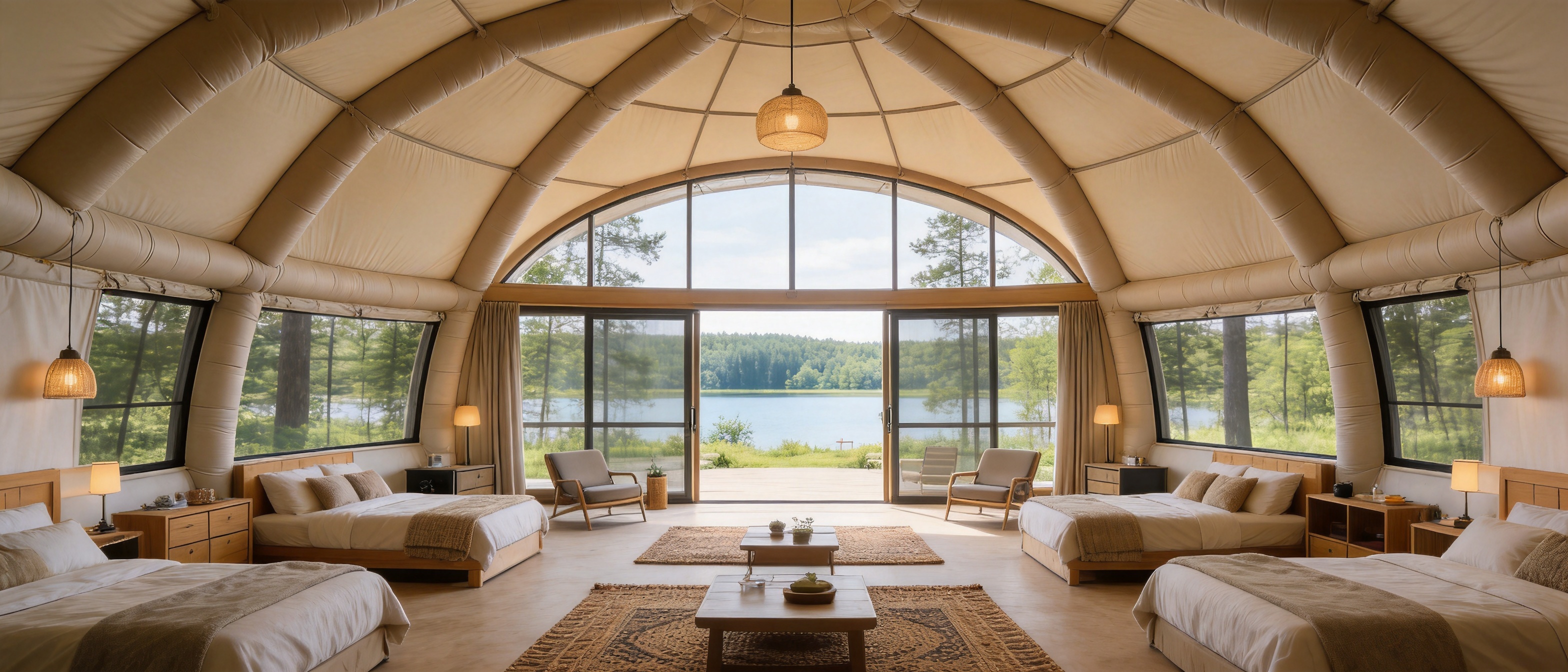
A major difference between a basic shelter and a premium glamping tent is the quality of the interior experience. The 10-person air cabin is designed as more than a place to sleep. Its large volume can support social activities, furniture, lighting, decoration, storage, and guest services.
The circular floor plan offers 360-degree visual openness. Multiple large screen windows bring natural light into the interior and help occupants remain connected to the surrounding environment. This is particularly attractive in scenic destinations where guests want to see forests, lakes, coastlines, deserts, or mountain landscapes without leaving the comfort of the tent.
Screen windows also support airflow. Cross-ventilation can help reduce heat buildup and improve comfort, especially in warm climates. Users can manage openings according to wind, rain, temperature, insect activity, and privacy requirements. When the weather becomes less favorable, the openings can be closed to create a more protected interior.
For resort operators, natural light and views can contribute to a premium guest experience. The tent can be furnished with beds, low tables, lounge seating, rugs, solar lighting, decorative textiles, and storage solutions. Its appearance can be adapted to a rustic, minimalist, luxury, family-friendly, or expedition-inspired theme.
The interior can also support functions beyond accommodation. It may serve as a temporary dining room, private event space, yoga studio, staff lounge, reception area, children’s activity room, or wellness space. In humanitarian operations, the large open area can be arranged as a registration point, rest area, treatment room, supply station, or temporary living unit.
Comparison with Conventional Tent Categories
The product occupies a distinctive position between ordinary camping tents and semi-permanent accommodation structures. Its advantages become clearer when compared with several common alternatives.
| Feature | Conventional Pole Tent | Rigid Cabin or Modular Room | Standard Inflatable Tent | Geodesic Inflatable Yurt Air Cabin |
|---|---|---|---|---|
| Deployment | Requires multiple poles and manual assembly | Usually requires construction or heavy installation | Generally quick to deploy | Designed for rapid inflation and simplified setup |
| Transportability | Portable but may include bulky frame parts | Limited portability | Highly portable | Portable and packable after deflation |
| Interior shape | Often rectangular or tunnel-shaped | Room-like and fixed | Varies by model | Open circular yurt-style layout |
| Large-group capacity | Available, but assembly complexity increases with size | High, but with higher logistics and cost | Varies widely | Designed for high-capacity use of up to 10 people |
| Structural concept | Rigid poles and fabric shell | Permanent or semi-permanent frame | Inflatable support system | Geodesic-inspired interconnected air beams |
| Guest experience | Functional camping environment | High comfort but less flexible | Comfort depends on design | Panoramic, spacious, and suitable for premium glamping |
| Application range | Camping and events | Hospitality and fixed accommodation | Camping and temporary use | Glamping, resorts, events, expeditions, and emergency shelter |
Compared with a conventional pole tent, the air cabin can reduce the number of rigid components and simplify the installation process. Compared with a permanent cabin, it offers far greater flexibility and lower relocation complexity. Compared with a small inflatable camping tent, it provides a larger, more versatile interior and a stronger hospitality-oriented identity.
Its key competitive advantage is not one isolated feature. Instead, it combines capacity, rapid deployment, structural ambition, weather-focused materials, visual appeal, and adaptable use in one product. Buyers looking for a simple two-person shelter may not require these capabilities. Buyers looking for a flexible 10-person accommodation or event structure, however, may find the combination particularly valuable.
Applications in Glamping and Resort Development
Glamping businesses require accommodation that is visually attractive, comfortable, operationally efficient, and adaptable to different landscapes. The air cabin addresses these needs by functioning as a flexible guest unit without the construction commitment associated with permanent buildings.
Resort operators can install the tents on platforms, prepared ground, landscaped sites, or temporary seasonal areas, subject to local planning and safety requirements. They can be used as individual guest rooms, family units, shared lodging, premium suites, or themed accommodation. Furniture and interior décor can be changed to suit the target market.
The large capacity allows operators to create family-oriented accommodation where parents and children can stay together. It may also be suitable for group retreats, outdoor training programs, corporate activities, and wellness events. In a resort setting, several units can be arranged to create a small village, with shared dining, sanitation, recreation, and reception facilities positioned nearby.
The tent’s appearance can help create a memorable marketing identity. Guests are often drawn to accommodation that offers an experience rather than simply a bed. A panoramic circular shelter can provide a stronger sense of place and can be integrated into nature-focused tourism concepts.
Seasonal flexibility is another commercial benefit. A resort can use the tents during peak travel periods and relocate or store them during low seasons. This can allow businesses to test a new destination or expand capacity without immediately committing to permanent construction. Any commercial operation must still consider local regulations, fire safety, occupancy rules, sanitation, insurance, and site permissions.
Events, Weddings, and Festival Hospitality
Temporary events often require attractive spaces that can be installed quickly and removed after the program ends. The air cabin can serve as a hospitality suite, VIP lounge, changing room, dining area, ceremony support space, or private meeting room.
For weddings, its circular interior can be decorated with soft lighting, fabric draping, floral arrangements, lounge furniture, or dining tables. Large windows can frame the surrounding landscape and bring daylight into photography and guest areas. The structure can also be used as a private preparation room or sheltered gathering area during outdoor ceremonies.
At festivals, the tent may function as a guest lounge, staff base, first-aid support room, merchandise area, or premium accommodation unit. Rapid deployment is valuable when event contractors operate under strict setup and dismantling schedules. The portable form also supports temporary venues where permanent buildings are unavailable.
Event planners should evaluate ground conditions, anchoring requirements, crowd movement, electrical equipment, fire-safety provisions, emergency exits, and weather forecasts. The product’s large interior is an advantage, but a responsible event plan must ensure that capacity is managed according to the specific use rather than relying only on the nominal maximum occupancy.
Expedition, Desert, and Remote-Site Use
Remote projects place special demands on shelter systems. Equipment may need to be carried over long distances, transported over uneven roads, or deployed by small teams. A deflatable air cabin can be advantageous because it avoids a heavy rigid frame and can be packed for transport.
In expedition environments, the shelter may provide sleeping space, a mess area, a communication station, equipment storage, or a planning room. Its panoramic windows can help occupants observe the surrounding environment while the enclosed structure provides protection from wind, dust, insects, and changing temperatures.
Desert operations benefit from a large interior and ventilation options, but site selection and anchoring are critical. Sand, intense ultraviolet exposure, sudden wind events, and temperature changes can all affect a temporary shelter. Operators should use suitable ground anchors, inspect fabric and seams regularly, and avoid leaving the structure unattended in dangerous weather.
For film crews, scientific teams, outdoor instructors, and field researchers, the tent can serve as a temporary base that offers more usable space than a collection of small backpacking tents. It may also provide a cleaner and more organized environment for equipment, meals, briefings, and rest periods.
Humanitarian and Emergency Shelter Potential
The product’s rapid inflation, large capacity, and flexible interior make it relevant to humanitarian and emergency applications. It can be used as a temporary accommodation unit, medical support space, triage area, registration center, supply distribution room, or community shelter.
In emergency response, speed matters. A shelter that can be transported in a compact form and raised without a complex frame may help organizations establish functional space quickly. The circular interior can be divided with temporary partitions or arranged for shared use. Large windows may support ventilation and daylight during operations where electrical infrastructure is limited.
Medical and relief organizations must evaluate the product against their own procurement standards, regional climate conditions, sanitation requirements, infection-control procedures, accessibility needs, and fire-safety regulations. The tent should be regarded as a flexible shelter platform rather than a complete emergency system. Flooring, heating, cooling, lighting, power, sanitation, partitions, and medical equipment may need to be supplied separately.
Its potential value lies in its adaptability. A single design can support different functions as a response situation develops. The same unit could begin as a registration shelter, later become a supply room, and eventually be used for temporary accommodation or community services.
Manufacturing Strengths and Production Capability
Ningbo Zhenhai Tiansai Leisure Products Co., Ltd. specializes in the design, production, and sale of tents and outdoor equipment. Its factory covers more than 13,000 square meters, providing a substantial base for material handling, cutting, sewing, assembly, inspection, packing, and product development.
A factory of this scale can support the coordinated production of multiple tent categories, including outdoor camping tents, backpacking tents, glamping structures, inflatable tents, family tents, specialty shelters, and other recreational products. This broad category experience is valuable because large air cabins require knowledge of fabric engineering, seam construction, structural layout, inflation systems, packaging, and outdoor usability.
Manufacturing quality begins with material selection. Heavy-duty Oxford fabric must be evaluated for strength, coating consistency, flexibility, abrasion resistance, color stability, and suitability for repeated folding. Air-beam materials require reliable airtight construction and compatible joining methods. Mesh screens, zippers, webbing, buckles, reinforcement patches, valves, and anchor points all contribute to the performance of the finished product.
Production precision is equally important. Large fabric panels must be cut accurately so that the completed structure maintains its intended geometry. Sewing lines need consistent tension, while high-stress areas require appropriate reinforcement. Seams and connection points must be inspected because small defects can become more serious after repeated inflation, folding, and exposure to wind or rain.
The company’s product development process includes professional design work, collaboration with outdoor specialists, product testing with outdoor enthusiasts, and ongoing optimization based on customer feedback. This approach helps connect factory production with actual field use. A tent may look impressive in a design drawing, but its commercial success depends on practical details such as setup time, packing, cleaning, ventilation, repairability, comfort, and user confidence.
Design and Engineering Approach
The company has developed appearance patents and utility model patents, reflecting an emphasis on original product design and structural development. Intellectual property alone does not guarantee product performance, but it indicates that the manufacturer invests in differentiated solutions rather than relying exclusively on standard market patterns.
For an inflatable yurt air cabin, engineering decisions affect every stage of use. The position of air beams influences internal headroom and load distribution. Window placement affects ventilation and visibility. Door design affects access and furniture placement. Reinforcement details influence durability. Packing dimensions affect shipping and storage. These choices must be considered together.
The company’s design philosophy emphasizes practicality and comfort. Professional outdoor experience can help identify problems that may not be obvious during initial development, such as difficult zipper access, insufficient storage, poor airflow, awkward anchoring, or excessive setup steps. Continuous testing and customer feedback allow these details to be refined over time.
Quality Management and International Supply
The manufacturer states that it strictly implements a quality management system and develops products for international markets. Its location in Ningbo provides access to an important port city and supports overseas logistics. Products are exported to multiple regions, including North America, Europe, Asia, and other international markets.
For wholesale customers, export experience can simplify communication about packaging, documentation, shipping coordination, product specifications, and repeat orders. A professional supplier should be able to discuss production lead times, inspection procedures, spare parts, packaging options, replacement components, and after-sales support before an order is confirmed.
International buyers should also clarify the product requirements of their destination market. These may include labeling, material declarations, fire-performance expectations, electrical safety for inflation equipment, customs documentation, local installation rules, and commercial insurance requirements. Early communication helps prevent delays and ensures that the product is matched to the intended application.
Materials, Construction, and Durability
Durability is the result of a complete construction system rather than a single fabric specification. The main shell, air beams, seams, window screens, zippers, straps, anchor points, and packed configuration all affect the useful life of the tent.
Triple-layer Oxford fabric provides a substantial material base for an outdoor shelter. The multilayer arrangement is intended to improve resistance to rain, abrasion, and general outdoor use. Reinforced waterproof sealing supports protection at vulnerable joining areas. The fabric should still be dried thoroughly before storage, cleaned according to the manufacturer’s guidance, and protected from prolonged unnecessary exposure to ultraviolet radiation.
Air beams require special attention because their structural function depends on maintaining air pressure. Users should inspect valves, connectors, beam surfaces, and seams before each deployment. Sharp objects should be removed from the site, and the tent should not be dragged across abrasive ground. A repair kit and appropriate patching materials are useful for professional operators.
Anchoring components also deserve regular inspection. Wind resistance depends not only on the tent’s shape but also on the connection between the shelter and the ground. Stakes, ropes, webbing, buckles, and anchor points should be checked for wear, deformation, or damage. In challenging conditions, operators should use anchoring methods suitable for the soil type and expected wind load.
Installation and Care Recommendations
Before installation, select level ground with adequate drainage. Remove stones, branches, glass, sharp metal, and other objects that could damage the fabric or air beams. Avoid locations under unstable trees, near flood channels, or in areas exposed to falling debris.
Lay out the tent carefully and identify the entrance, inflation points, anchor points, and major structural sections. Inflate the air beams according to the supplied instructions. Once the structure begins to rise, check that the fabric is not twisted and that the beams are positioned correctly. Secure the tent before use, even in apparently calm weather.
After inflation, inspect seams, zippers, windows, valves, and anchor lines. Confirm that doors open and close properly and that ventilation openings can be operated. Interior furniture should be positioned so that it does not press against the walls, block exits, or interfere with air circulation.
During use, monitor weather conditions. Heavy rain, strong wind, lightning, flooding, and falling snow may create hazards beyond the intended use of a temporary tent. If severe weather is forecast, close openings, secure equipment, and relocate or dismantle the shelter when appropriate.
After use, remove all furniture and accessories. Clean dirt and moisture from the fabric, allow the tent to dry completely, deflate the air beams, fold the structure without forcing sharp creases, and store it in a dry, ventilated area. Proper storage can help preserve fabric coatings, reduce mildew risk, and extend the life of the product.
Commercial Value for Wholesale Buyers
For distributors and outdoor brands, the product offers several opportunities. Its distinctive form can expand a product portfolio beyond ordinary camping tents. The 10-person capacity makes it relevant to customers seeking group accommodation, while the premium appearance supports higher-value positioning.
Resort developers may purchase multiple units for phased expansion. Event companies may use them for recurring festivals, weddings, exhibitions, and corporate gatherings. Rental companies can offer them as premium shelters for private parties and outdoor experiences. Relief organizations may include them in emergency-response inventories. Outdoor retailers can present them as a bridge between recreational camping and hospitality accommodation.
The manufacturer’s OEM and wholesale orientation can also be useful for buyers that require customized branding, color coordination, packaging, accessories, or project-specific configurations. Exact customization options, minimum order quantities, lead times, and technical specifications should be confirmed directly during the purchasing process.
Product education is important for successful resale. Dealers should explain that the shelter requires correct inflation, anchoring, maintenance, and weather management. They should also help customers understand the difference between nominal capacity and comfortable commercial occupancy. Clear instructions improve customer satisfaction and reduce misuse.
Advantages at a Glance
The product’s main advantages can be summarized as follows:
• High capacity: The interior is designed for groups of up to 10 people, depending on layout and use.
• Distinctive architecture: The yurt-style circular form creates a memorable alternative to ordinary rectangular tents.
• Structural stability: The geodesic-inspired arrangement and interconnected air beams are intended to improve performance in windy outdoor conditions.
• Rapid deployment: The one-key inflation concept reduces manual assembly and supports installation by a small team.
• Weather-focused construction: Triple-layer Oxford fabric and reinforced waterproof sealing support outdoor protection.
• Panoramic experience: Large screen windows provide natural light, ventilation, and broad views.
• Flexible use: The same structure can support glamping, resort accommodation, events, expeditions, emergency response, and temporary workspaces.
• Portable operation: Deflation and folding make relocation and seasonal storage more practical than with a rigid cabin.
• Manufacturer support: A large production base, professional design team, export experience, patents, and customer-feedback development contribute to supply reliability.
Q&A
What is the intended capacity of this air cabin?
The tent is designed as a 10-person high-capacity shelter. Actual comfort depends on whether it is used for sleeping, dining, events, medical support, storage, or another purpose. Furniture, partitions, equipment, and local occupancy requirements should be considered when planning the interior.
How is the tent different from a standard yurt?
A traditional yurt commonly uses a rigid or semi-rigid framework, while this product uses inflatable air beams within a portable fabric structure. It combines the circular visual character and open layout of a yurt with the rapid setup and packability of an inflatable tent.
What does the geodesic design contribute?
The geodesic-inspired form is intended to distribute structural forces across interconnected sections and improve stability. Its rounded profile can also reduce the effect of direct wind pressure compared with a large flat-sided shelter. Correct anchoring and responsible weather management remain essential.
Can one person install the tent?
The one-key rapid-inflation system is designed to simplify deployment and may allow installation by one trained person under suitable conditions. In practice, two or more people may be preferable for positioning, anchoring, inspection, and safe handling of a large shelter.
Is the tent suitable for heavy rain?
The product uses heavy-duty Oxford fabric and reinforced waterproof sealing to support protection during wet weather. It must be installed correctly, with doors and windows closed as appropriate and the structure properly anchored. Users should not exceed the manufacturer’s stated weather limits.
Can the tent be used in strong wind?
It is designed with wind-resistant and storm-focused characteristics, including a rounded geodesic-inspired structure and high-pressure air beams. Wind performance depends on inflation, anchoring, ground conditions, maintenance, and local weather. Severe-weather procedures should always take priority.
What can the large windows provide?
The screen windows can provide natural light, panoramic visibility, and ventilation. They allow guests to enjoy the surrounding landscape and can help improve interior comfort when operated according to the weather conditions.
What businesses can use this product?
Potential users include glamping resorts, outdoor hospitality operators, event companies, wedding planners, festival organizers, rental businesses, expedition teams, humanitarian organizations, medical-response groups, and outdoor education providers.
Can the interior be furnished?
Yes. The spacious open layout can accommodate beds, seating, tables, storage, lighting, rugs, and decorative elements. Furniture should be arranged without blocking entrances, ventilation openings, or emergency access routes.
How should the tent be stored?
It should be cleaned, completely dried, deflated, folded carefully, and stored in a dry, ventilated location. Avoid packing the tent while it is wet or dirty, as this can encourage mildew and damage coatings over time.
What should buyers confirm before placing a wholesale order?
Buyers should confirm dimensions, packed size, weight, capacity guidance, inflation equipment, fabric details, available colors, customization, minimum order quantities, production schedule, packaging, spare parts, warranty terms, shipping arrangements, and documentation for the destination market.
Does the product replace a permanent building?
No. It is a portable temporary shelter designed for outdoor and project-based applications. Commercial users must evaluate local planning, construction, fire, occupancy, sanitation, accessibility, and insurance requirements before operating the tent as guest accommodation or an event facility.
Conclusion
The 10-Person Stormproof Geodesic Inflatable Yurt Air Cabin Glamping Tent offers a compelling combination of capacity, rapid deployment, weather-focused construction, panoramic comfort, and architectural character. Its circular yurt-inspired interior makes efficient use of space, while the geodesic-style inflatable framework is designed to support stability in demanding outdoor environments.
Compared with conventional pole tents, it can simplify setup and reduce rigid components. Compared with permanent cabins, it provides mobility and lower installation complexity. Compared with basic inflatable shelters, it delivers a larger hospitality-oriented space with stronger visual appeal and broader commercial potential.
Its applications extend from luxury resorts and family glamping to festivals, weddings, expeditions, desert operations, medical support, and humanitarian relief. This versatility is strengthened by the manufacturer’s production capabilities, professional design process, factory infrastructure, international supply experience, and commitment to continual product improvement.
For buyers seeking a flexible shelter that can function as both an outdoor accommodation unit and a multipurpose temporary room, this air cabin provides a practical and distinctive solution. Its long-term value will depend on correct installation, careful maintenance, suitable site selection, and responsible operation, but its underlying concept is well aligned with the growing demand for portable, comfortable, and visually memorable outdoor spaces.
References
1. Product information for the 10-Person Stormproof Geodesic Inflatable Yurt Air Cabin Glamping Tent.
2. Manufacturer information concerning tent design, production capacity, export experience, and product development.
3. General principles of inflatable outdoor shelter construction and air-beam structural design.
4. General guidance on outdoor fabric performance, seam sealing, waterproofing, and maintenance.
5. General principles of temporary-structure planning, anchoring, weather monitoring, and outdoor event safety.
6. General considerations for glamping accommodation, expedition shelters, emergency facilities, and portable hospitality structures.
Product: 10-Person Stormproof Geodesic Inflatable Yurt Air Cabin Glamping Tent

Message Us Right Now!
-
Mp: +86-18858091910
E-mail: sales@tenplaytent.com
ADD: No. 529, Guangyuan Road, Xiepu Town, Zhenhai District, Ningbo City, Zhejiang Province, China
-
Quick Links
Home Products About Us Advantage News Contact Us -
Product
Inflatable & Air Tents Glamping & Resort Tents Backpacking & Trekking Tents Automatic & Pop-Up Tents Family & Camping Tents Specialty Tents & Shelters Kids Tents Pet Tents Humanitarian & Large Tents Hammock -
Get Connected
 Camping Tent Manufacturer in China