


 English
 عربى


Indoor and Outdoor Portable Camping Hammock: Comfort, Portability, and Reliable Suspension for Everyday Escape
A hammock can transform an ordinary space into a personal place to rest, read, nap, or enjoy the outdoors. The Indoor Outdoor Portable Camping Hammock with Tree Straps is designed for people who want that flexibility without purchasing separate equipment for home use, travel, and camping. Its practical design combines breathable fabric, a supportive structure, compact storage, and a complete suspension system in one portable product.
Unlike a fixed porch swing or a permanently installed indoor hammock, this model is intended to move wherever relaxation is needed. It can be used between suitable trees in a garden, between posts on a balcony, on compatible indoor beams, or at another secure location. When the day is over, it can be packed into its carrying bag and stored in a closet, vehicle, travel case, or camping supply box.
The product is suitable for a wide range of users, including casual campers, backpackers, garden owners, apartment residents, families, travelers, and anyone who wants a comfortable rest area without carrying bulky furniture. With a stated weight capacity of up to 500 pounds, it also provides a generous load rating for individual relaxation or shared use when the suspension point and product instructions are followed correctly.
Manufactured by Ningbo Zhenhai Tiansai Leisure Products Co., Ltd., the hammock reflects the company’s experience in designing and producing outdoor leisure equipment. The manufacturer operates a factory covering more than 13,000 square meters and serves international customers across North America, Europe, Asia, and other markets. Its background in product development, quality management, export operations, and outdoor equipment manufacturing supports a practical approach to comfort, durability, and usability.
One Hammock for Indoor and Outdoor Living
Many hammocks are designed exclusively for outdoor use, while some indoor relaxation products are too large or too specialized to transport easily. This portable model is positioned between those categories. It offers the relaxed shape and suspended comfort associated with a traditional hammock while maintaining the portability needed for travel and outdoor recreation.
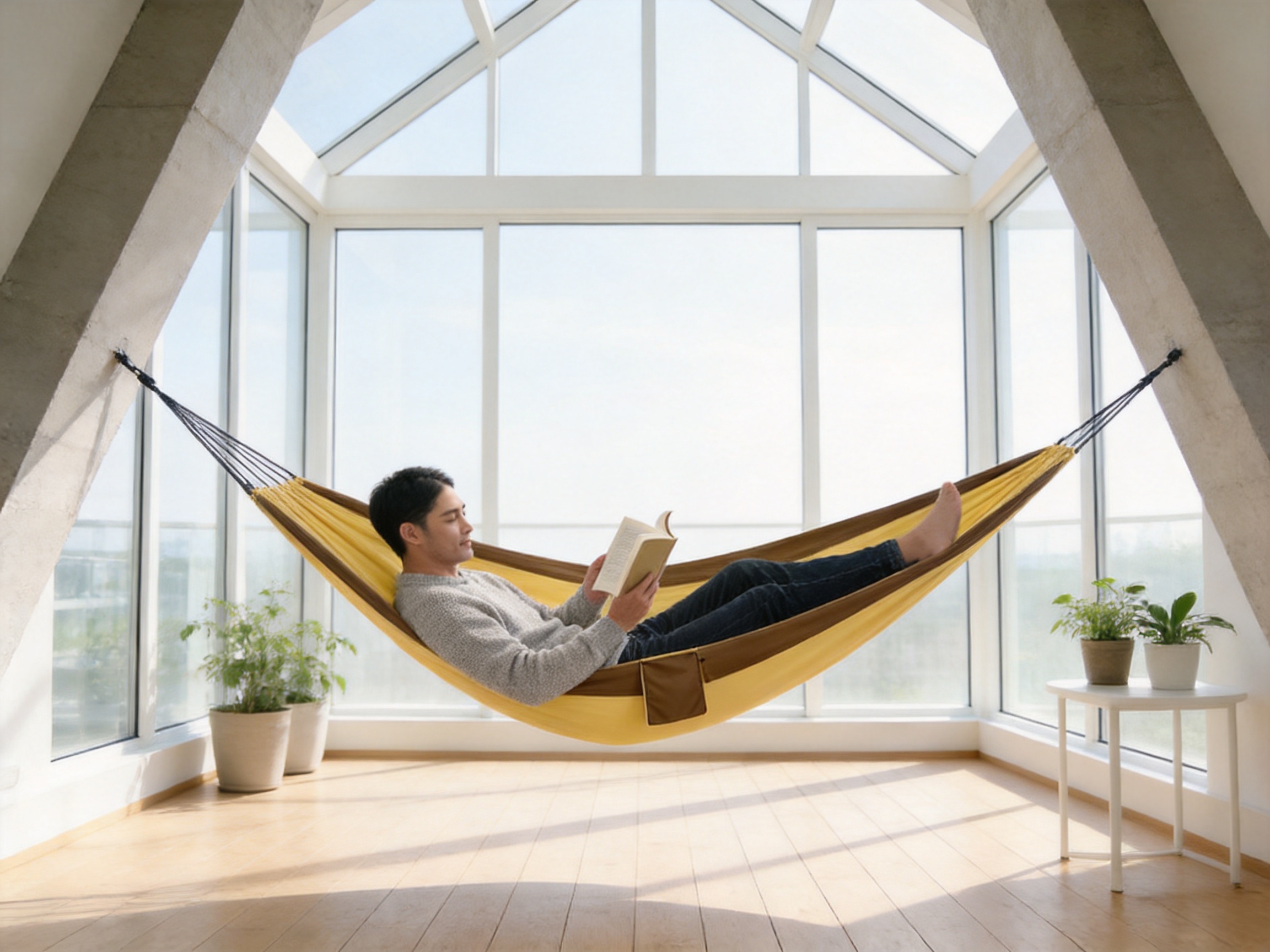
At home, the hammock can create a quiet reading corner in a bedroom, living room, sunroom, or covered balcony, provided that the installation point is structurally suitable. It can also become a flexible alternative to a lounge chair in a patio or garden. Because it does not require a heavy frame, it can help users create a temporary relaxation area without permanently changing the layout of a room or outdoor space.
For camping and travel, the hammock provides a lightweight rest option that can be carried with other equipment. Campers may use it during the day as a place to rest after hiking, as a comfortable reading spot, or as a convenient way to enjoy scenery away from the main campsite. Its compact carrying format makes it easier to transport than rigid outdoor furniture.
This multi-environment capability is one of the product’s main advantages. A consumer does not need to buy one hammock for the garden and another for travel. The same product can support different daily routines, seasonal activities, and destinations, helping improve value over products that are limited to one setting.

Indoor Outdoor Portable Camping Hammock with Tree Straps for Home Travel
Comfort Built Around Breathable Fabric
The fabric is one of the most important elements in any hammock because it determines how the product feels against the body, how air moves through the material, and how well the hammock responds to repeated use. This model uses high-quality, breathable fabric intended to provide a gentle and supportive resting surface.
Breathability is especially valuable in warm weather. A hammock that permits airflow can feel more comfortable than a heavily padded seat or an enclosed fabric lounger. When used outdoors, the open construction allows air to circulate around the user. Indoors, it creates a softer and more relaxed alternative to a conventional chair or sofa.
The fabric is also designed to balance comfort with durability. A hammock must flex under body weight while maintaining its overall shape. If the material is too rigid, it may feel uncomfortable. If it is too loose or poorly constructed, it may offer inconsistent support. The product’s design aims to provide a stable resting surface that conforms naturally to the body without becoming unnecessarily complicated.
For consumers comparing this hammock with inexpensive alternatives, fabric quality is an important distinction. Some low-cost hammocks prioritize minimum price and may use thin material, weak stitching, or poorly finished edges. A product intended for frequent indoor and outdoor use requires more careful attention to material selection, sewing, load distribution, and finishing. These elements help influence comfort and service life.
Breathable fabric also contributes to easier handling. Unlike products built with thick cushions, metal frames, or rigid components, the hammock can be folded or compressed for transport. This makes it convenient for people who have limited storage space or who regularly move between home, vehicle, campsite, and vacation destination.
Supportive Capacity for Everyday Relaxation
The hammock has a stated load capacity of up to 500 pounds. This rating gives users a broad level of support for personal relaxation and allows the product to accommodate a variety of body types. The capacity is a useful advantage when compared with narrow or lightly constructed models that may be intended only for smaller users.
As with any suspended product, the stated capacity must be considered together with the strength and condition of the installation points. A hammock can only perform safely when the trees, posts, beams, straps, carabiners, and connection points are appropriate for the load. Users should inspect all components before installation and follow the product’s recommended setup practices.
Load distribution is another important part of hammock performance. The body weight is transferred through the fabric to the suspension points. Strong straps and secure carabiners help spread and manage that force. A thoughtfully designed suspension system can make the installation more predictable than improvised ropes, unsuitable cords, or unverified hardware.
The product’s broad capacity also improves versatility for families. One person may use it for reading or sleeping, while another may use it as a place to relax outdoors. In every case, users should respect the manufacturer’s instructions, avoid exceeding the stated capacity, and ensure that the hammock is not used in a location where a fall could result in serious injury.
Tree Straps and Carabiners for Faster Setup
One of the most practical advantages of this hammock is the inclusion of tree straps and carabiners. A hammock that does not include a suitable suspension system may require users to purchase additional accessories, learn complicated knots, or rely on materials that could damage trees or compromise stability. By including the basic connection components, this product is designed to make setup more accessible.
Tree straps are especially useful because they can be wrapped around suitable trees without requiring permanent hardware. When used correctly, wide straps can provide a more practical and tree-conscious alternative to thin rope or improvised wire. They also allow the hammock to be adjusted between different trees with minimal effort.
Carabiners provide a simple connection between the hammock and the straps. Their use can make installation and removal faster than tying and untying knots each time. For travelers and campers, this convenience matters because equipment may need to be set up after arrival, moved to another location, or packed quickly before departure.
Compared with fixed-frame hammocks, a strap-based design also reduces the amount of equipment that must be transported. A rigid stand can be useful in certain yards or patios, but it is heavy, takes up storage space, and is not practical for hiking or road travel. The portable suspension system offers a more flexible solution for users who already have appropriate trees, posts, or structural mounting points available.
Users should always inspect straps for cuts, abrasion, fraying, or other damage. The carabiners should close securely, and the connection points should be correctly positioned before anyone enters the hammock. Installation should be performed on stable supports that can safely hold the combined load and movement of the user.
Portable Design for Home, Travel, and Camping
Portability is central to the product’s design. The hammock is lightweight and can be moved from room to room, from a patio to a garden, or from a vehicle to a campsite. This makes it useful for consumers who want outdoor comfort without investing in large furniture that remains in one location.
The included carrying bag supports convenient transportation and storage. When packed, the hammock takes up substantially less space than a reclining chair, outdoor bench, or framed swing. It can be kept in a closet during the off-season, stored with camping equipment, or placed in a vehicle for spontaneous outdoor trips.
Compact storage also helps protect the product when it is not being used. Outdoor fabric should not be left exposed to unnecessary moisture, dirt, or prolonged sunlight. Packing the hammock after it has been cleaned and fully dried can help maintain its appearance and condition over time.
Travelers may appreciate the hammock as a flexible piece of recreational equipment. It can be carried on road trips, used at a vacation property, or taken to a campsite where suitable suspension points are available. It may also serve as a convenient rest station during a garden project, outdoor event, or afternoon at a park, subject to local rules and safe installation conditions.
For apartment residents, the portable design is particularly helpful. People who cannot keep large outdoor furniture may still be able to enjoy a temporary relaxation area on a balcony or in a shared outdoor space. Any indoor installation must be made only to verified structural supports and should never rely on weak decorative fixtures, drywall, curtain rods, or unsuitable furniture.
Comparing the Hammock with Competing Product Types
Consumers evaluating hammocks often compare several different categories: budget rope hammocks, padded fabric hammocks, hammock chairs, framed hammocks, and specialized camping hammocks. Each category has strengths, but this product is designed to provide a balanced combination of portability, comfort, setup convenience, and multi-location use.
| Product Type | Typical Strength | Common Limitation | Advantage of This Portable Hammock |
|---|---|---|---|
| Fixed-frame hammock | Stable standalone placement | Heavy, bulky, and difficult to transport | Uses a compact strap suspension system and does not require a large frame |
| Basic rope hammock | Low purchase cost and traditional appearance | May provide less fabric coverage and inconsistent comfort | Uses breathable fabric for a more supportive resting surface |
| Padded lounge hammock | Soft cushioning | Often heavier and slower to dry or pack | Offers lightweight portability and compact storage |
| Hammock chair | Upright seating position | Limited full-body lounging space | Provides a broader suspended surface for reclining |
| Specialized camping hammock | Designed for outdoor travel | May be less suitable for indoor daily relaxation | Balances camping portability with home and patio use |
The strongest competitive advantage is versatility. Many products are optimized for one activity, but this hammock can serve as a home relaxation product and an outdoor travel accessory. Its fabric construction avoids the weight of a frame, while the included straps and carabiners help reduce the need for separate setup purchases.
Another advantage is the combination of capacity and portability. Some compact travel hammocks focus heavily on reducing weight and packed size, which may result in a narrower or less generous design. This model is intended to maintain a comfortable and supportive user experience while remaining easy to carry.
The product also offers an approachable setup experience. New hammock users may feel uncertain about suspension methods, knots, and accessory compatibility. Including the primary straps and carabiners makes the product easier to understand and more convenient to use than a hammock sold with fabric only.
Designed for Different Environments
Indoor Use
Indoors, the hammock can become a quiet retreat for reading, listening to music, resting, or taking a short nap. It can bring a relaxed atmosphere to a living room, bedroom, sunroom, or other appropriate area. Because it can be removed when necessary, it does not require the permanent presence of a large lounge chair or swing.
Indoor installation requires careful attention to structure. The hammock should be attached only to verified beams, posts, or other supports designed to withstand the relevant load. Users should not assume that a ceiling, wall, decorative beam, or architectural feature is strong enough without confirmation. If there is any uncertainty, professional advice should be obtained before installation.
Balcony and Patio Use
A balcony or patio can be an ideal place for a portable hammock because it combines fresh air with the convenience of home. The product can provide a comfortable place to enjoy morning coffee, read outdoors, or relax after work. It can be installed temporarily and removed before severe weather or when the space is needed for another activity.
Outdoor users should check the distance between supports and the condition of posts, railings, or trees. A balcony railing may not be an appropriate anchor point, particularly if it is decorative, loose, or not designed for dynamic loads. The surface beneath the hammock should also be considered. A safer location is one with adequate clearance and a ground surface that reduces injury risk in the event of a fall.
Garden Use
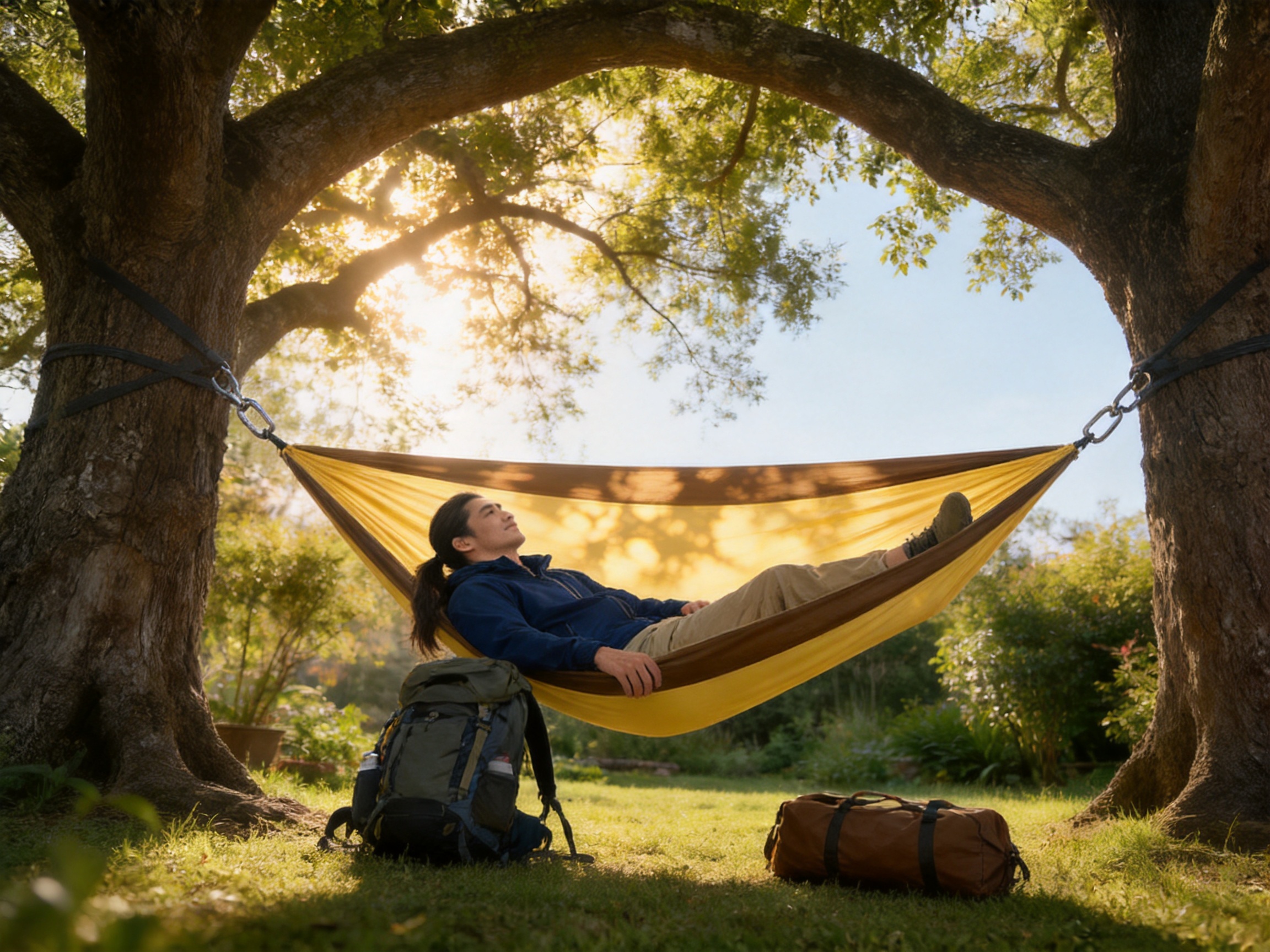
In a garden, suitable trees can provide a natural and attractive location for the hammock. The portable straps make it possible to select a shaded area during hot weather or a sunnier location during cooler seasons. The hammock can be repositioned as the user’s needs change.
Tree health and strength are important. Users should select mature, stable trees with appropriate trunk diameter and avoid damaged, diseased, or unstable branches and trunks. Straps should be positioned to protect the tree and prevent contact with sharp bark, nails, or abrasive surfaces.
Camping and Outdoor Travel
For campers, the hammock provides an easy way to add comfort without carrying a chair or bulky cot. It can be used during rest periods, at a base camp, or beside a suitable trail location where local regulations permit. Its carrying bag allows it to travel with other compact outdoor equipment.
Outdoor conditions can change quickly, so the hammock should be taken down if there is strong wind, lightning, flooding, falling branches, or another safety concern. It is not a substitute for a complete weather shelter when protection from rain, cold, insects, or severe conditions is required. Its primary purpose is comfortable suspended relaxation rather than full environmental protection.
Manufacturing Experience and Product Development
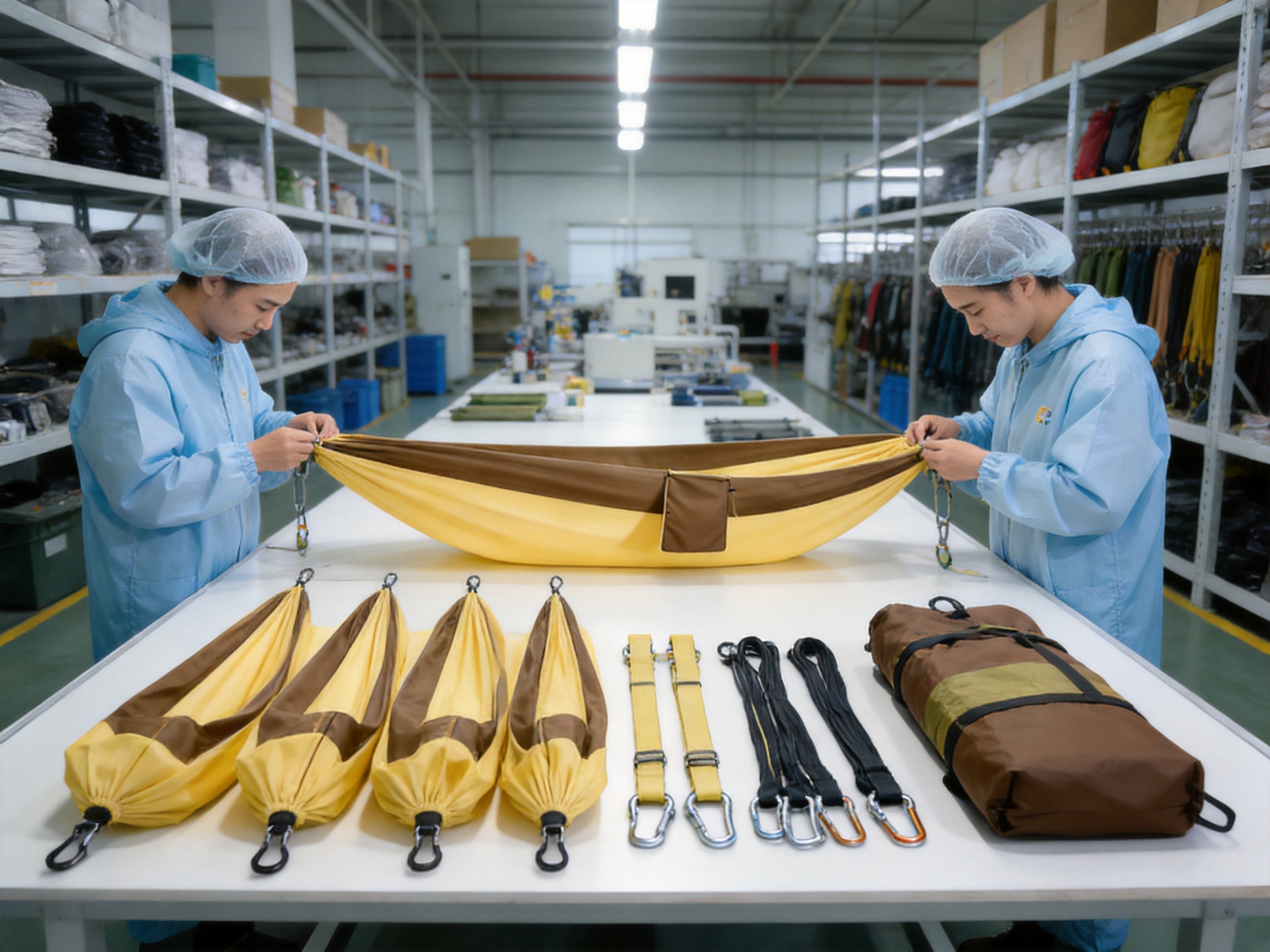
The performance of an outdoor leisure product depends not only on its visible design but also on the manufacturing system behind it. Ningbo Zhenhai Tiansai Leisure Products Co., Ltd. specializes in the design, production, and sales of tents and related outdoor leisure equipment. Its factory covers more than 13,000 square meters, providing a dedicated base for manufacturing, quality control, product development, and order coordination.
The company’s location in Ningbo offers access to an important international port environment. This geographic advantage can support the movement of raw materials and finished products, as well as export coordination for customers in different countries and regions. For wholesale buyers and outdoor brands, dependable production and logistics planning are important parts of supplier performance.
The company has developed experience serving international markets and is described as the sole global designated supplier of the British company TENTSILE. It has also designed products associated with appearance patents and utility model patents. These activities indicate an emphasis on product development rather than relying only on standard, undifferentiated designs.
For a hammock, product development includes many details that are not always obvious from photographs. Engineers and designers need to consider fabric behavior, seam placement, edge finishing, suspension geometry, connector compatibility, packed size, user comfort, and repeated handling. These elements must work together to create a product that is practical in real-world use.
A professional design process can also help manufacturers respond to different customer requirements. Retailers may seek a particular color range, packaging format, logo application, or material specification. Outdoor brands may require private-label production or product adjustments for different markets. A manufacturer with design and production capabilities is better positioned to manage these requests than a trading company with limited control over the factory process.
Quality Management and Production Strengths
Quality management is essential for suspended products because fabric, seams, straps, and hardware all contribute to user safety and service life. The company states that it strictly implements a quality management system so that its products meet international standards. While buyers should request product-specific documentation for their own compliance needs, a formal quality focus is an important foundation for manufacturing reliability.
Production quality begins with incoming material control. Fabrics should be reviewed for consistency, strength, appearance, and defects. Webbing and straps require attention to width, weaving quality, stitching compatibility, and resistance to abrasion. Metal hardware should be checked for correct dimensions, surface condition, and smooth operation.
During sewing and assembly, quality depends on accurate cutting, consistent seam allowances, reinforced stress points, and appropriate thread selection. The suspension areas experience concentrated forces, so these locations deserve particular inspection. Finished products should also be checked for loose threads, incomplete seams, incorrect labels, packaging errors, and other issues that could affect customer experience.
Testing and inspection procedures help identify problems before products reach the market. Depending on the product specification and destination market, evaluations may include static load testing, repeated loading, strap strength testing, hardware inspection, dimensional checks, and visual examination. Buyers seeking wholesale or OEM production should discuss the exact testing program, acceptance criteria, and documentation with the manufacturer.
The company’s stated commitment to research and development, lightweight materials, and environmentally conscious materials also aligns with current outdoor market trends. Consumers increasingly want equipment that is easier to transport, less wasteful to package, and durable enough to remain in use for an extended period. Product longevity can reduce the need for frequent replacement and support better overall value.
Professional Design and Practical Innovation
Innovation in outdoor equipment does not always require complex electronics or unusual mechanisms. Often, the most valuable improvements are practical refinements that make a product easier, safer, and more comfortable to use. This hammock demonstrates that approach through its multi-purpose construction, compact storage, breathable fabric, and included suspension components.
The company reports that its professional design team develops products from the perspectives of practicality and comfort. It collaborates with professionals, invites outdoor enthusiasts to participate in testing, and uses customer feedback to optimize product performance. This type of feedback cycle can help identify everyday problems that may not appear during a purely theoretical design process.
For example, users may reveal that a carrying bag is difficult to pack, that a strap adjustment is confusing, or that a fabric edge causes discomfort after extended use. Designers can respond by improving dimensions, labels, packaging, stitching, or instructions. These refinements may appear small individually, but together they can significantly improve satisfaction and repeat use.
The company’s experience in outdoor product development also supports a broader understanding of how equipment performs in changing conditions. Outdoor users expect products to be portable, durable, simple to maintain, and adaptable to different locations. A hammock intended for both home and travel must meet all of these expectations without becoming unnecessarily complicated.
Benefits for Wholesale and OEM Buyers
For distributors, retailers, camping brands, and online sellers, a portable hammock can fit several product categories at once. It may be marketed as a camping accessory, garden relaxation product, travel item, outdoor gift, or home comfort product. This broad positioning can make it easier to present the item to different customer segments.
The product also has strong seasonal flexibility. It can be promoted during spring and summer outdoor campaigns, holiday gift periods, travel seasons, and home improvement promotions. Because the use cases extend beyond camping, retailers do not need to depend entirely on the short peak season for outdoor recreation.
OEM customers may be interested in adapting colors, labels, packaging, instruction materials, or other commercial details. Requirements vary by market, so buyers should confirm minimum order quantities, sample procedures, lead times, packaging specifications, testing reports, inspection arrangements, and shipping terms during the quotation process.
A supplier with its own manufacturing base may offer better communication between design, production, quality control, and export teams. This can be valuable when a buyer needs product adjustments or has a detailed quality standard. It may also reduce the communication gaps that sometimes occur when product development and manufacturing are handled by unrelated companies.
Retailers should present the product accurately. Marketing should explain that installation requires suitable supports and that the hammock is not a complete weather shelter. Clear instructions about capacity, inspection, storage, and safe use can improve customer confidence and reduce preventable misuse.
Care, Storage, and Long-Term Use
Proper care can help preserve the hammock’s fabric, straps, and hardware. Before each use, customers should examine the fabric for holes, tears, excessive stretching, or damaged stitching. Straps should be checked for cuts, fraying, abrasion, and signs of weakening. Carabiners should be inspected to ensure that they close and connect correctly.
The hammock should be kept away from sharp edges, rough metal, broken branches, hot surfaces, and chemicals that could weaken fabric or webbing. It should not be dragged across abrasive ground. If it becomes wet, it should be allowed to dry completely before being packed into the carrying bag.
Long periods of direct sunlight can affect outdoor fabrics over time. Although the hammock is designed for outdoor use, it is good practice to remove and store it when it is not needed, especially during severe weather or extended periods of non-use. Clean storage can reduce exposure to dirt, moisture, insects, and unnecessary ultraviolet radiation.
When packing the hammock, users should avoid forcing wet or dirty fabric into a tightly closed bag. Following the care instructions supplied with the product is the best approach because cleaning methods may vary according to the final fabric specification and finishing process.
Safe use also includes responsible behavior. The hammock is intended for resting and relaxation, not for jumping, swinging violently, climbing, or attaching unauthorized accessories. Children should use it only with appropriate supervision. The product should be removed if the supports become unstable or if environmental conditions make use unsafe.
Why This Hammock Is a Strong Everyday Choice
The Indoor Outdoor Portable Camping Hammock stands out because it addresses several common weaknesses found in competing products. It is not limited to one environment, does not depend on a bulky frame, and includes the core suspension accessories needed for convenient setup. Its breathable fabric supports comfort, while its compact carrying bag supports travel and storage.
The 500-pound stated capacity gives it a broad user range, and the lightweight design helps make regular movement practical. The hammock can become part of a home relaxation routine, a garden setup, a patio arrangement, or a camping kit. This range of applications improves its value for consumers who want one adaptable product instead of several specialized items.
From a manufacturing perspective, the product is supported by an established outdoor equipment company with a substantial factory, international market experience, design resources, and a stated quality management system. The company’s focus on research, user testing, patents, lightweight materials, and environmentally conscious development provides additional strength for customers seeking a capable long-term supplier.
For individuals, the product offers an easy way to create a comfortable place to rest. For retailers and outdoor brands, it offers a commercially flexible item that can be positioned across camping, travel, garden, home, and gift categories. Its combination of comfort, portability, and suspension convenience makes it a practical solution for modern indoor and outdoor lifestyles.
Q&A
What is the primary purpose of this hammock?
The hammock is designed for comfortable relaxation indoors and outdoors. It can be used at home, on a patio or balcony, in a garden, or during camping and travel when suitable suspension points are available.
How much weight can the hammock hold?
The stated load capacity is up to 500 pounds. Users must also confirm that the trees, posts, beams, straps, carabiners, and connection points are appropriate for the load. The stated capacity should never be exceeded.
Are tree straps included?
Yes. The product is supplied with tree straps and carabiners as part of its suspension system. This helps simplify setup compared with hammocks that are sold without connection accessories.
Can the hammock be installed indoors?
It may be used indoors when attached to suitable structural supports. Installation should never be made to weak decorative fixtures, curtain rods, drywall, unstable furniture, or unverified beams. Professional advice is recommended if the strength of a support is uncertain.
Is the hammock suitable for camping?
Yes. Its lightweight construction, compact carrying format, straps, and carabiners make it suitable for camping and outdoor travel. Users must choose stable suspension points and follow local regulations regarding tree straps and outdoor equipment.
Does it require a metal stand?
No metal stand is required when suitable trees, posts, or structural supports are available. This is one reason the product is easier to transport than a framed hammock. A stand may be used only if it is compatible with the hammock and rated for the required load.
Why is breathable fabric beneficial?
Breathable fabric allows air to circulate around the user and can feel more comfortable in warm conditions. It also provides a soft, flexible resting surface while helping the hammock remain lighter and easier to pack than heavily padded alternatives.
Can two people use the hammock at the same time?
Use should follow the product’s instructions and capacity limitations. The combined weight must not exceed the stated rating, and the suspension points must be suitable for dynamic movement. Users should avoid sudden movements, jumping, or any behavior that increases stress on the fabric and supports.
How should the hammock be stored?
It should be cleaned as recommended, dried completely, folded carefully, and placed in its carrying bag. It is best to store it in a dry location away from sharp objects, chemicals, excessive heat, and prolonged direct sunlight.
What should buyers ask when ordering wholesale quantities?
Wholesale buyers should confirm product specifications, materials, colors, packaging, labeling, minimum order quantities, sample approval, production lead time, quality inspections, testing documents, shipping terms, and any OEM requirements. These details should be agreed upon before mass production begins.
What makes the manufacturer suitable for outdoor product cooperation?
The manufacturer has experience in outdoor leisure product design, production, and sales. It operates a factory of more than 13,000 square meters, serves international markets, maintains a professional design team, and states that it follows a quality management system. These capabilities can support product development and supply cooperation.
Is this hammock a replacement for a tent?
No. The hammock is a suspended relaxation product and does not provide the complete weather protection, insect protection, enclosed sleeping area, or storage functions of a tent. It can complement camping equipment but should not be treated as a full shelter unless used with separately designed compatible accessories.
Conclusion
The Indoor Outdoor Portable Camping Hammock offers a practical combination of comfort, portability, capacity, and flexible installation. Its breathable fabric creates a pleasant resting surface, while the included tree straps and carabiners make setup more convenient. The compact carrying bag supports home storage, road travel, camping, and seasonal use.
Its strongest advantage over more specialized competitors is the ability to move easily between indoor and outdoor environments. It can serve as a personal relaxation space at home, a comfortable garden accessory, a patio lounge, or a portable camping item. At the same time, its development is supported by a manufacturer with substantial outdoor product experience, international market knowledge, professional design resources, and dedicated factory capabilities.
For customers seeking a versatile hammock for everyday relaxation and outdoor escape, this product provides a balanced and adaptable solution. For commercial buyers, it offers broad market positioning and the potential for OEM or wholesale cooperation through an experienced outdoor equipment manufacturer.
References
1. Product specification and descriptive materials for the Indoor Outdoor Portable Camping Hammock with Tree Straps.
2. Company information for Ningbo Zhenhai Tiansai Leisure Products Co., Ltd., including manufacturing, design, export, and quality management details.
3. General principles of hammock suspension, load distribution, tree strap use, and outdoor equipment inspection.
4. General product development practices for camping, leisure, and portable outdoor equipment.
5. General consumer guidance concerning safe installation, fabric care, hardware inspection, and storage of suspended recreational products.
Product: Indoor Outdoor Portable Camping Hammock with Tree Straps for Home Travel

Message Us Right Now!
-
Mp: +86-18858091910
E-mail: sales@tenplaytent.com
ADD: No. 529, Guangyuan Road, Xiepu Town, Zhenhai District, Ningbo City, Zhejiang Province, China
-
Quick Links
Home Products About Us Advantage News Contact Us -
Product
Inflatable & Air Tents Glamping & Resort Tents Backpacking & Trekking Tents Automatic & Pop-Up Tents Family & Camping Tents Specialty Tents & Shelters Kids Tents Pet Tents Humanitarian & Large Tents Hammock -
Get Connected
 Camping Tent Manufacturer in China