


 English
 عربى


Why a 2-Person A-Frame Technical Cotton Tent Excels in Camping and Emergency Shelter Applications
Choosing the right tent involves more than comparing floor area, packed size, or retail price. A reliable shelter must create a comfortable interior environment, withstand changing weather, deploy without unnecessary difficulty, and remain dependable after repeated use. For travelers, outdoor retailers, hospitality operators, relief organizations, and private-label brands, the 2-Person A-Frame TC Cotton Cabin Tent offers a balanced solution that combines traditional shelter design with modern technical-cotton construction.
Designed for two people, this tent is suitable for self-driving trips, nature retreats, seasonal camps, and selected emergency-relief applications. Its A-frame profile gives it a recognizable cabin-tent appearance while supporting efficient water runoff and a stable structural layout. Its technical cotton fabric is intended to provide a more comfortable balance between breathability, weather resistance, and durability than many basic synthetic camping tents.
The product is manufactured by Ningbo Zhenhai Tiansai Leisure Products Co., Ltd., a China-based tent producer with a factory covering more than 13,000 square meters. The manufacturer specializes in the design, production, and sales of outdoor tents and related camping equipment. Its experience includes product development, international supply, patent design, outdoor testing, and OEM cooperation for global customers.
This article examines the tent’s construction, performance advantages, practical applications, manufacturing strengths, quality considerations, and suitability for wholesale or customized projects. It also explains where a technical-cotton A-frame shelter can offer meaningful advantages over ordinary pop-up tents, lightweight backpacking tents, and low-cost polyester camping models.

2-Person A-Frame TC Cotton Cabin Tent Rapid Deploy Emergency Shelter
Product Overview
The 2-Person A-Frame TC Cotton Cabin Tent is a compact shelter designed around a classic A-shaped structure. The term “TC” generally refers to a technical cotton or cotton-blend fabric developed to combine the natural comfort characteristics of cotton with improved outdoor performance. In this product, the fabric is positioned as a breathable, UV-resistant, and rainproof material for extended outdoor use.
The tent is intended for two occupants and is particularly appropriate for self-driving campers who can transport a shelter without the severe weight restrictions associated with long-distance backpacking. It can also be considered for glamping properties, small resort accommodations, outdoor events, temporary field use, and emergency shelter deployments where rapid pitching and a more comfortable indoor climate are important.
Unlike a highly compact trekking tent, the product emphasizes livability and material comfort. Unlike a large family tent, it remains focused on manageable capacity and relatively straightforward setup. Unlike a disposable emergency cover, it is designed with repeat outdoor use and a stronger overall build in mind.
| Product characteristic | Practical value |
|---|---|
| Two-person capacity | Suitable for couples, individual travelers seeking extra room, or compact temporary accommodation |
| A-frame cabin structure | Provides a familiar layout, effective roof drainage, and a stable geometric form |
| Technical cotton fabric | Supports breathability, reduced condensation, seasonal comfort, and weather resistance |
| Rapid deployment design | Helps users pitch the shelter efficiently during camping or urgent field operations |
| UV-resistant and rainproof construction | Supports longer service life in exposed outdoor environments |
| Emergency-shelter potential | Can serve selected relief and temporary accommodation needs when used according to deployment requirements |
Because the product is positioned between recreational camping equipment and emergency shelter equipment, buyers should evaluate the intended use carefully. For ordinary camping, the tent offers a combination of comfort and practicality. For humanitarian or disaster-response projects, procurement teams should confirm fabric specifications, fire performance, wind ratings, packing requirements, sanitation standards, and relevant local regulations before placing a large order.
How the A-Frame Structure Supports Outdoor Performance
The A-frame is one of the most recognizable shelter configurations in outdoor equipment. Its two sloping sides meet at a ridge, producing a triangular cross-section. This geometry has remained popular because it is simple, efficient, and relatively easy to understand during setup.
One of the primary advantages of a sloped roof is water management. Rain is encouraged to run down the fabric rather than collect in broad, nearly horizontal areas. This does not eliminate the need for correct pitching, tensioning, seam care, or drainage planning, but it can reduce the risk of standing water on the roof. A well-pitched A-frame also presents a clear profile to changing weather conditions.
The shape provides usable sleeping space while maintaining a compact footprint. Two occupants can position sleeping equipment along the length of the shelter, while personal bags and smaller equipment can be organized around the side or end areas. The design is especially suitable for travelers who need a comfortable base but do not require multiple rooms or a tall standing interior.
The cabin-tent character also contributes to visual appeal. Many campers and resort operators prefer shelters that feel warmer and more distinctive than standard dome tents. The technical cotton exterior, combined with an A-shaped silhouette, creates a vintage-inspired appearance without relying entirely on traditional materials or outdated construction methods.
Structural simplicity is also valuable in urgent situations. A shelter that uses a familiar configuration can be easier to explain to new users, field staff, or temporary installation teams. Rapid deployment does not mean that every installation can be completed without instructions; correct anchoring, pole placement, tensioning, and site selection remain important. However, the A-frame layout can reduce the learning curve compared with more complex multi-room or mechanically elaborate shelter systems.
Weather Management Through Geometry
A tent’s weather performance depends on more than its fabric. Roof angle, seam construction, floor design, ventilation, guy points, stakes, and installation quality all influence the final result. The A-frame profile contributes by directing rain away from the ridge and side panels when the tent is properly tensioned.
The sloping walls can also reduce the exposure of large vertical fabric sections to wind. This is not a guarantee of severe-weather safety, and the shelter should not be used beyond its tested conditions. Nevertheless, the geometry offers a practical starting point for a stable camping shelter, particularly when supported by appropriate anchoring and a carefully selected campsite.
Users should avoid low-lying areas that may collect water, exposed ridges that receive excessive wind, and locations beneath dead branches or unstable trees. In flood-related situations, the tent should only be deployed in areas assessed as safe by responsible authorities or relief professionals. A water-resistant shelter cannot protect occupants from fast-moving floodwater, contaminated ground, landslides, or other major hazards.
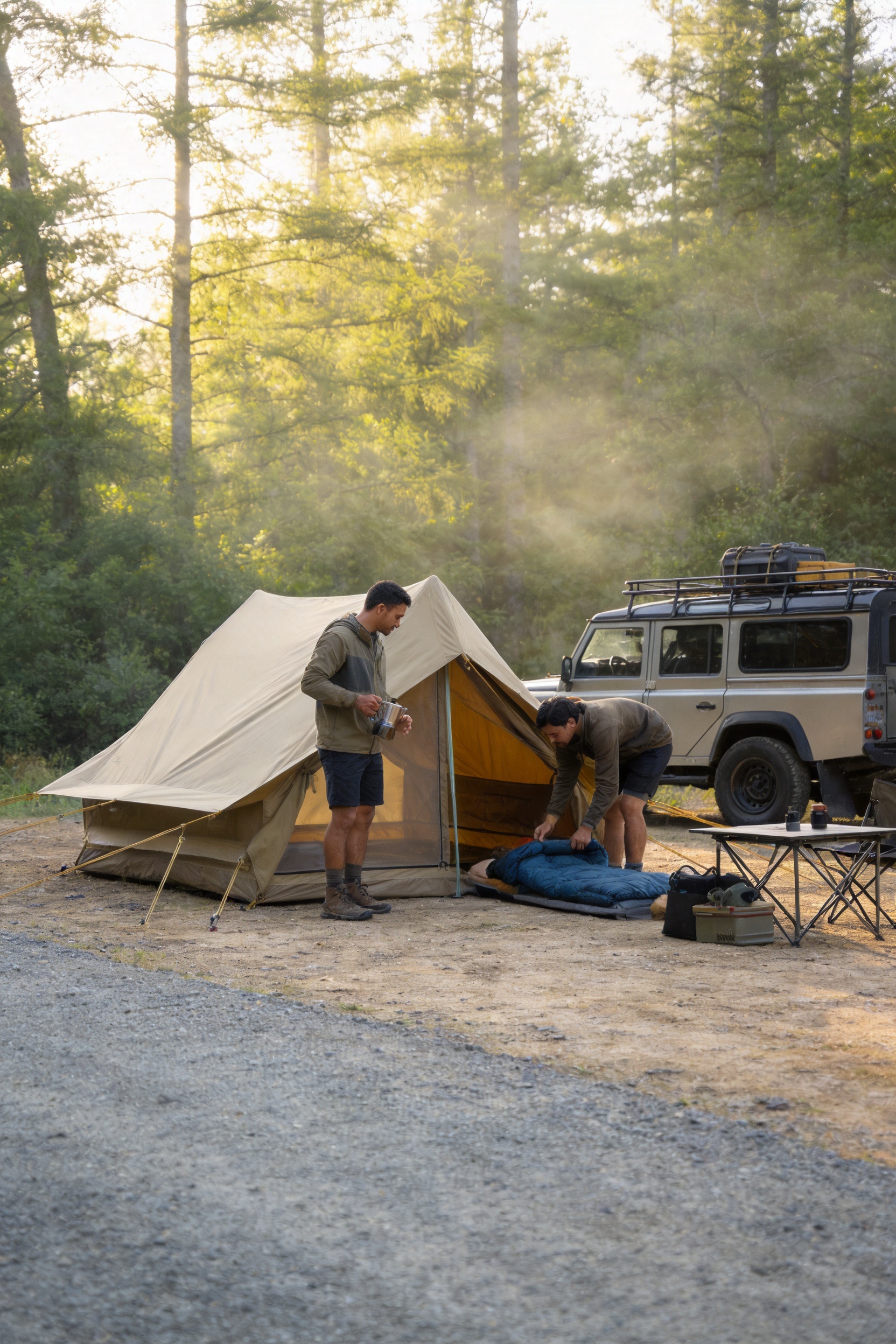
Technical Cotton: Comfort Beyond Basic Synthetic Fabric
Fabric selection is one of the most important distinctions between a basic camping tent and a more comfort-oriented cabin shelter. Many entry-level tents use lightweight polyester because it is affordable, easy to process, and relatively compact. Polyester remains useful for backpacking and budget products, but it may provide a different interior climate from a breathable technical-cotton shelter.
Technical cotton fabric is intended to combine the natural feel and breathability associated with cotton with enhanced outdoor performance. The material used in a tent must be engineered or treated to cope with moisture, sunlight, abrasion, and repeated handling. The result is a fabric suited to users who value a less enclosed and less plastic-like interior atmosphere.
Breathability and Condensation Control
Condensation occurs when warm, moisture-laden air inside a tent encounters a cooler surface. Sleeping, cooking, wet clothing, damp ground, and large changes in outdoor temperature can all increase interior humidity. No fabric can completely eliminate condensation under every condition, but breathable materials can help manage moisture when combined with ventilation and suitable use practices.
The technical cotton construction of this tent is designed to support a more balanced interior climate. Compared with a simple impermeable fabric system, a breathable textile can help reduce the feeling of trapped humidity. This is especially beneficial during overnight camping, when two occupants naturally release moisture into a small interior volume.
The product description emphasizes the ability to remain cooler in summer and warmer in winter. This should be understood as a comfort advantage rather than a replacement for insulation, heating, or climate-control equipment. Actual performance depends on outdoor temperature, wind, sunlight, ventilation, sleeping gear, ground conditions, and the number of occupants.
For glamping operators, breathability can be particularly valuable. Guests often expect a tent interior to feel comfortable for extended periods, not merely to provide a place to sleep. A material that offers a softer visual and tactile environment can support a more premium experience than a thin, highly reflective synthetic shell.
Rainproof and UV-Resistant Performance
Outdoor fabric must manage two competing demands: it should allow a degree of air exchange and comfort, while also resisting rain. The technical cotton fabric used for this shelter is promoted as rainproof and UV-resistant. These properties help the tent perform during normal camping exposure, seasonal accommodation, and repeated outdoor operation.
Rainproof performance depends on the complete product system. Fabric treatment is important, but seams, zippers, floor-to-wall connections, roof tension, and installation all contribute to water protection. A tent pitched loosely may develop folds where water can remain. A tent placed on poorly drained ground may experience water entry from below even when the roof performs correctly.
Ultraviolet exposure can weaken textiles over time, especially when a shelter is left outdoors for long periods. UV resistance helps slow the effects of sunlight, but it does not make the tent immune to aging. Operators should dry the shelter fully before storage, avoid unnecessary permanent exposure, and follow the manufacturer’s maintenance instructions.
Comfort Compared with Lightweight Backpacking Fabrics
Lightweight backpacking tents are designed primarily around portability. Their fabrics are often selected to minimize packed weight and bulk, which is ideal for hikers carrying equipment over long distances. A technical-cotton cabin tent follows a different design priority: it offers a more substantial shelter experience for users who can transport equipment by vehicle or use it at a fixed site.
The comparison is therefore not simply about which product is better. A trekking tent may be preferable for a long mountain route, while the A-frame TC tent may be preferable for a weekend road trip, glamping site, family campsite, or temporary field station. Matching the product to the use case is central to obtaining value from the purchase.
Rapid Deployment for Camping and Urgent Shelter Needs
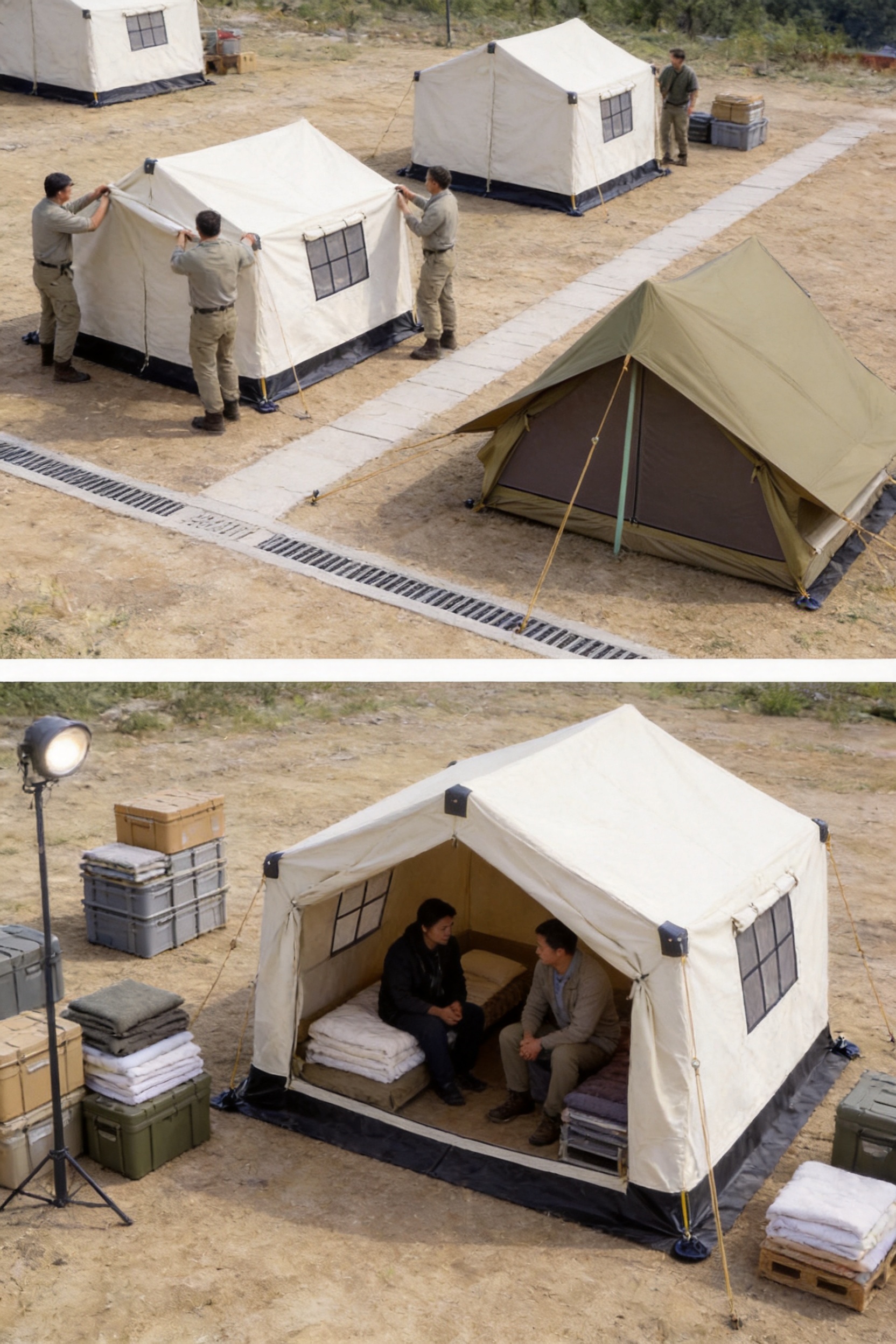
Rapid deployment is a key feature of the product. For recreational users, quick pitching means less time spent on setup and more time available for travel, cooking, exploration, or rest. For organizations, fast installation can improve the efficiency of temporary accommodation projects, event operations, and selected emergency-relief activities.
A rapid-deployment tent should be evaluated through the entire workflow rather than by setup time alone. The process includes unpacking, identifying components, selecting a safe site, assembling the support structure, attaching or tensioning the fabric, securing the base, and inspecting the final installation. Clear instructions and organized components can make a substantial difference, particularly when several shelters must be deployed at once.
The A-frame configuration provides a logical assembly sequence. Users can establish the main support line, position the sloping sides, tension the shelter, and secure the base. In a professional deployment, teams may assign one person to prepare the site and components while others handle the structure and anchoring. This approach can improve consistency and reduce avoidable setup errors.
For emergency use, transport and storage are as important as pitching speed. Relief organizations may require compact packaging, clear identification, manageable unit weight, and standardized packing procedures. They may also need to coordinate the tent with flooring, blankets, lighting, sanitation equipment, heating, and other field supplies. The shelter is one component of a larger response system.
Rapid deployment should never be confused with unrestricted deployment. Flood zones, unstable ground, strong winds, extreme heat, and contaminated environments may require specialized shelters or professional installation. Before using the tent in a disaster scenario, organizations should conduct site assessments and confirm whether the product meets their operational and regulatory requirements.
Advantages Over Common Competing Tent Types
Compared with Basic Pop-Up Tents
Pop-up tents are popular because they are convenient and easy for casual users. Their automatic frames can shorten setup time, making them suitable for festivals, beach visits, short daytime activities, and occasional recreational use. However, many pop-up tents prioritize speed and low cost over fabric comfort, long-term durability, and a distinctive accommodation experience.
The A-frame TC cabin tent offers a more substantial material profile and a more traditional shelter feel. Its technical-cotton fabric can provide improved breathability compared with thin, highly enclosed synthetic pop-up designs. The cabin appearance may also be more attractive for resort operators and private-label brands seeking a premium outdoor image.
Pop-up mechanisms can include moving joints and integrated frame components that require careful handling. The A-frame concept is more visibly structured and can be easier to inspect, repair, or explain during organized deployment. The appropriate choice depends on whether the buyer values automatic opening above all else or wants a more durable, comfortable, and serviceable shelter format.
Compared with Lightweight Backpacking Tents
Backpacking tents are optimized for carrying. They generally use lighter fabrics, smaller packed dimensions, and designs that minimize every unnecessary gram. This makes them highly suitable for trekking, cycling tours, and remote travel on foot.
The 2-person TC cabin tent competes in a different category. Its strengths are breathable comfort, visual character, robust outdoor construction, and suitability for vehicle-supported travel. A self-driving traveler can accept a larger packed volume in exchange for a more pleasant basecamp environment and a fabric that feels more substantial over repeated use.
The technical-cotton shelter can also appeal to glamping businesses that do not need guests or staff to carry the tent over long distances. In such settings, interior atmosphere, appearance, weather protection, and service life may matter more than ultralight weight.
Compared with Large Family Tents
Large family tents can provide multiple rooms and generous floor area, but their size may increase setup time, storage demands, and transport requirements. A two-person shelter avoids the complexity of a large multi-room layout while retaining a comfortable cabin-style identity.
For couples, solo users who want extra living space, or resort operators creating small private units, a two-person format can be easier to allocate and manage. It may also reduce unused capacity. Buyers can deploy several small shelters across a site rather than relying on one large structure, allowing greater flexibility in layout and occupancy planning.
Compared with Low-Cost Polyester Tents
Low-cost polyester tents are accessible and practical for occasional users, but they may be more limited in breathability, tactile comfort, durability, or perceived value. The TC cotton construction gives this product a stronger differentiation in a crowded marketplace.
For wholesalers and retailers, material differentiation can support a clearer product story. Customers can understand why a technical-cotton cabin shelter occupies a different price and performance position from a simple entry-level tent. The vintage-inspired A-frame form further supports a premium presentation for outdoor lifestyle channels.
| Comparison point | TC cotton A-frame tent | Basic pop-up tent | Lightweight trekking tent | Large family tent |
|---|---|---|---|---|
| Main priority | Comfort, durability, appearance, and practical deployment | Fast casual setup | Low carrying weight | Maximum capacity and separate living areas |
| Typical user | Vehicle-based campers, glamping operators, field users, and private-label buyers | Occasional leisure users | Hikers and long-distance travelers | Families or larger groups |
| Interior atmosphere | Breathable and cabin-like | Functional but often more enclosed | Compact and performance-oriented | Varies by fabric and ventilation design |
| Transport expectation | Vehicle or managed-site transport | Short-distance transport | Carried by the user | Usually vehicle transport |
| Visual positioning | Premium, vintage-inspired, and resort-friendly | Casual and convenience-oriented | Technical and minimalist | Family-oriented and spacious |
Applications in Camping, Glamping, and Resort Operations
The product is well suited to self-driving trips, where users can bring a more comfortable shelter without the severe space restrictions of backpacking. It can serve as a sleeping cabin during road travel, a private retreat at a campsite, or a compact guest unit at a seasonal outdoor property.
For glamping and resort operators, the tent’s appearance is an important commercial advantage. Guests often select outdoor accommodation based on atmosphere as well as basic shelter performance. An A-frame profile and natural-looking technical textile can help create a warm, nostalgic, and visually consistent site design.
Operators may use the tents as individual accommodation units, staff shelters, activity bases, or seasonal overflow capacity. Their two-person size supports a more private arrangement than a large shared tent. The units can be spaced to provide privacy, circulation paths, and scenic orientation.
Before commercial installation, operators should consider local planning requirements, fire-safety rules, accessibility, drainage, electrical systems, guest protection, and seasonal wind conditions. The tent should be integrated into a professionally managed site rather than treated as a standalone substitute for all building or hospitality requirements.
Outdoor education providers can also use the shelters for camps, workshops, and nature programs. The recognizable structure is useful for teaching basic shelter principles, while the more substantial fabric can create a comfortable environment for short-term programs. Event organizers may deploy them as rest areas, staff stations, information points, or small private spaces.
Potential Use in Humanitarian and Emergency Relief Projects
The product description identifies the tent as suitable for emergency relief and flood or disaster scenarios. This positioning reflects its rapid deployment, weather-resistant fabric, and two-person capacity. In a relief context, a compact shelter can support temporary privacy, sleeping, storage, first-aid administration, or family accommodation, depending on the operational plan.
However, emergency procurement requires a higher level of verification than ordinary retail camping. Relief organizations should request detailed technical documentation covering fabric composition, waterproof testing, seam performance, flame behavior, wind resistance, UV exposure, floor construction, repair procedures, packaging, and expected service life. They should also check whether the product complies with the standards required in the destination country or by the contracting organization.
A two-person shelter can be valuable when response teams need modular capacity. Rather than moving a single large shelter, teams may distribute several units across a site, providing flexibility for different household sizes or functional uses. The smaller footprint can help when land availability is limited, although spacing, fire lanes, drainage, and access routes must be planned carefully.
For flood-related deployment, location is critical. A tent must not be pitched in active floodwater, on saturated unstable soil, or in an area likely to experience renewed flooding. The shelter can provide temporary protection only after the site is judged safe. Ground sheets, raised platforms, drainage channels, and sanitation measures may be needed depending on conditions.
The product may be more appropriate for organized temporary accommodation than for immediate high-risk rescue operations. Search-and-rescue teams working in severe weather, snow, high winds, chemical exposure, or extreme temperatures may require specialized technical shelters. The A-frame TC tent should be selected according to a documented risk assessment.
Manufacturing Strengths and Product Development Capabilities
Ningbo Zhenhai Tiansai Leisure Products Co., Ltd. operates from Zhenhai District in Ningbo, Zhejiang Province, China. The company’s factory covers more than 13,000 square meters, providing a substantial production base for tent development and manufacturing. Ningbo’s position as an important port city also supports international logistics and export operations.
The manufacturer specializes in tents, including outdoor camping tents, backpacking tents, glamping tents, inflatable tents, and other shelter categories. This product range gives the company exposure to different design requirements, material systems, assembly methods, and customer expectations.
Its manufacturing strength is supported by a combination of product design, production management, quality control, and overseas business experience. Rather than treating a tent as a simple fabric item, the company approaches shelter development through practical use, comfort, testing, and feedback. This broader process is important because tent performance depends on the relationship between textiles, poles, seams, hardware, packaging, and instructions.
Design-Led Development
The company has established a professional design team that develops products from the perspectives of practicality and comfort. Outdoor enthusiasts and professionals are involved in testing and evaluation, while customer feedback is used to improve later designs.
This approach is relevant to the TC cotton A-frame tent because fabric comfort and structural usability must work together. A breathable fabric cannot compensate for poor ventilation planning, and an attractive structure cannot succeed if it is difficult to pitch. Design-led development helps align appearance, function, installation, and user experience.
The manufacturer has also designed products that have received appearance patents and utility model patents. Patents do not automatically prove that every product is superior, but they demonstrate an emphasis on original development and formal protection of design concepts. For OEM customers, this can provide a foundation for discussing differentiated product configurations instead of relying only on generic catalog designs.
Quality Management
The company states that it strictly implements a quality management system to help ensure products meet international standards. In practical manufacturing, quality management should extend across incoming materials, cutting, sewing, treatment, assembly, inspection, packaging, and shipment.
For a technical-cotton tent, important quality checkpoints may include fabric weight and consistency, coating or treatment uniformity, color stability, seam alignment, reinforcement strength, zipper operation, pole fit, webbing attachment, stake points, and final packing. Small defects in any of these areas can affect water resistance, durability, or ease of use.
International buyers can strengthen quality assurance by agreeing on approved samples, inspection criteria, tolerance levels, packaging requirements, labeling, carton marks, and pre-shipment inspection procedures. A clear technical specification helps both the factory and buyer evaluate the same product standard.
Experience with International Customers
The company’s products are exported to many countries and regions, including markets in North America, Europe, and Asia. International supply experience requires attention to communication, documentation, packaging, shipping schedules, destination requirements, and after-sales support.
For wholesalers and private-label companies, a manufacturer with export experience can be valuable because the project may involve more than production alone. Product images, instruction manuals, carton information, barcode placement, color references, inspection coordination, and shipment consolidation may all affect a successful launch.
The company has also served as the sole global designated supplier for the British company TENTSILE. This relationship indicates experience working with an international outdoor brand and supporting requirements associated with specialized product supply. Buyers should still conduct their own due diligence for every project, but established international cooperation can be a positive indicator of manufacturing capability.
OEM and Wholesale Advantages
Outdoor product businesses increasingly seek differentiated shelters rather than generic products that compete only on price. A technical-cotton A-frame tent gives distributors an opportunity to build a clearer product position around comfort, natural aesthetics, seasonal use, and premium outdoor living.
As an OEM or wholesale supplier, the manufacturer can potentially support projects involving custom branding, packaging, colors, labels, product assortments, and market-specific configurations. Exact customization options, minimum order quantities, lead times, and tooling requirements should be confirmed during the quotation process.
The product can fit several sales channels. Outdoor retailers may present it as a comfortable two-person cabin shelter. Glamping suppliers may position it as a compact guest or staff unit. Relief distributors may assess it for modular temporary accommodation. Vehicle and camping lifestyle brands may include it in a broader travel equipment collection.
Wholesale buyers should define their target market before requesting modifications. A European resort customer may prioritize appearance, fire-related documentation, and seasonal weather performance. A North American retailer may focus on packaging, customer instructions, and warranty expectations. A humanitarian buyer may prioritize field repairability, pallet efficiency, standardized components, and testing documentation.
The factory’s product development background can help customers move from a general idea to a manufacturable product. Early discussions should cover occupancy, footprint, fabric preference, seasonality, climate, transport method, installation labor, color, branding, accessories, and expected annual volume.
Manufacturing Process Considerations
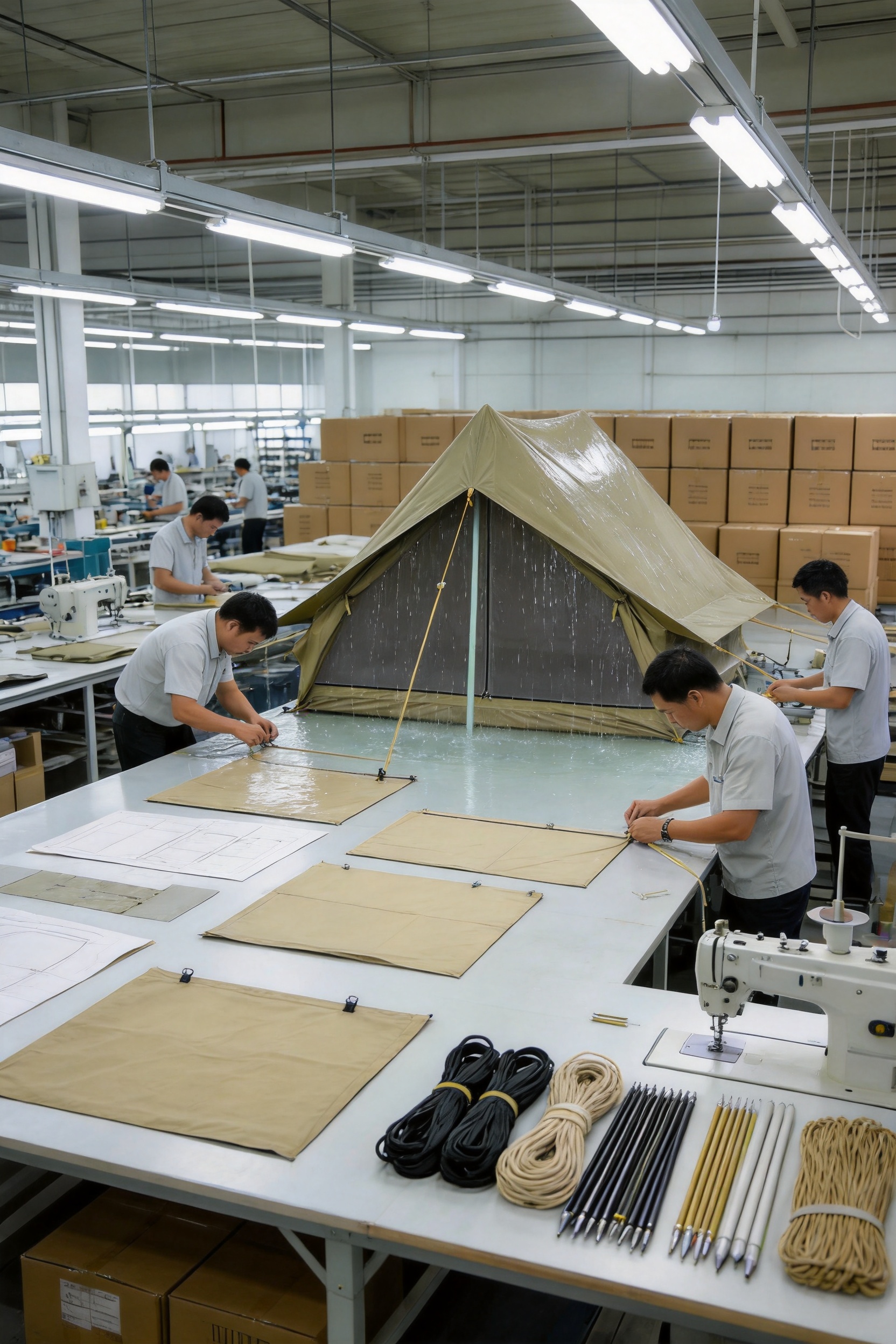
A high-quality tent begins with controlled material selection. Technical cotton fabric must be reviewed for its intended weight, weave, treatment, color, moisture behavior, and compatibility with the product’s construction. Other materials, including floor fabrics, webbing, mesh, zippers, buckles, ropes, poles, and stakes, must be selected as part of a complete system.
Pattern development determines how the fabric panels fit together. Accurate digital or physical patterns can reduce waste and improve consistency between production batches. For an A-frame shelter, the ridge line, side panels, end panels, door openings, floor connections, and reinforcement points require careful coordination.
Cutting quality affects both appearance and performance. Misaligned panels can lead to uneven tension, while inconsistent cutting can create difficulties during sewing. Production teams should maintain clear cutting instructions and verify the dimensions of key components before assembly.
Sewing is another critical stage. Seams must be strong enough to withstand normal tension and repeated handling. High-stress areas, such as guy-point attachments, pole sleeves, door corners, and base connections, may require reinforcement. Thread selection and stitch consistency influence the long-term integrity of the shelter.
After sewing, the tent may require seam treatment or other water-resistance procedures depending on the design. Inspection should include visual checks, dimensional review, hardware operation, and, where specified, water-resistance testing. The final product should be folded and packed in a way that protects the fabric and makes future setup easier.
| Manufacturing stage | Key objective | Why it matters to buyers |
|---|---|---|
| Material selection | Choose suitable technical textiles and structural components | Influences comfort, durability, weather resistance, and product positioning |
| Pattern development | Coordinate panel shapes, openings, seams, and reinforcement zones | Supports accurate assembly and consistent appearance |
| Cutting | Produce correctly sized and aligned fabric components | Reduces fitting problems and material waste |
| Sewing and reinforcement | Create durable seams and strengthen high-stress areas | Improves service life and reliability during setup and use |
| Inspection and testing | Review dimensions, workmanship, hardware, and weather-related performance | Helps maintain batch consistency and reduce customer complaints |
| Packaging | Protect the product and organize components for transport | Supports efficient warehousing, shipping, and end-user setup |
Installation and Use Recommendations
Users should select level ground with adequate drainage before pitching the tent. Remove sharp stones, branches, and other objects that could damage the floor or create discomfort. In hot conditions, natural shade can reduce interior heat, but the tent should not be placed beneath hazardous trees or unstable branches.
Lay out the components before assembly and identify the fabric body, support elements, ropes, stakes, and accessories. Following the supplied instructions can reduce mistakes and help users understand the intended tension points. If the tent is being deployed by a team, assigning clear roles can improve speed and consistency.
Once the main structure is standing, secure the base and adjust the fabric evenly. Uneven tension can create wrinkles that collect water or place unnecessary stress on particular seams. Guy lines should be used when supplied or recommended, especially in exposed locations.
Ventilation should be maintained whenever conditions allow. Opening designated vents or doors can improve air circulation and help manage interior moisture. Users should not block ventilation with luggage, bedding, or hanging materials.
Cooking inside a tent is generally unsafe because of fire, carbon monoxide, heat, and fabric damage risks. Heating equipment should only be used when specifically approved for the shelter and installed according to safety instructions. Open flames should be kept away from the fabric and all combustible materials.
After use, the tent should be dried completely before storage. Folding and packing damp fabric can encourage mildew and unpleasant odors. If the shelter becomes dirty, use appropriate cleaning methods and avoid harsh chemicals that may affect fabric treatments. Inspect poles, ropes, seams, zippers, and anchor points before the next trip.
Maintenance and Service-Life Protection
Technical cotton can provide a comfortable and durable shelter, but maintenance remains essential. Repeated exposure to rain, dirt, ultraviolet radiation, abrasion, and improper storage can reduce performance over time. A basic maintenance routine protects the investment and improves reliability.
Routine inspection should focus on areas exposed to repeated tension. Check the ridge and support interfaces, door corners, guy attachments, floor edges, and any points where hardware contacts fabric. Loose stitching or small tears should be addressed promptly before they become larger problems.
When cleaning, users should follow the manufacturer’s care instructions. Aggressive scrubbing, unsuitable detergents, or high-temperature drying may damage the textile or reduce its water-repellent properties. The safest approach is usually gentle cleaning, thorough rinsing when appropriate, and complete air drying in a controlled environment.
Long-term storage should take place in a dry, ventilated area away from direct sunlight, chemicals, rodents, and excessive heat. Do not store the shelter compressed while wet. If the product is used in a commercial or relief fleet, maintain a simple inspection record for each unit, including deployment dates, repairs, cleaning, and storage status.
How Buyers Can Evaluate the Product Before Ordering
Wholesale and institutional buyers should request a complete specification sheet before confirming a purchase. The document should identify the fabric composition, dimensions, packed size, product weight, included components, color options, treatment information, and available tests. If the tent will be marketed for emergency use, buyers should also identify any required humanitarian or local compliance documents.
Sample evaluation is strongly recommended. A buyer should pitch the sample, assess the quality of the instructions, inspect interior comfort, operate all openings, review the fabric surface, test the packed configuration, and observe how quickly a trained and untrained user can complete setup.
For commercial applications, buyers should consider the total cost of ownership rather than only the initial unit price. A product that is easier to clean, simpler to repair, more attractive to guests, and less likely to generate complaints may provide better long-term value.
Questions about customization should be discussed early. Changing fabric color, adding logos, modifying doors, adjusting windows, altering packaging, or creating a special accessory kit may affect pattern work, materials, production scheduling, and minimum order quantities. Early technical communication helps prevent misunderstandings during mass production.
Why the Product Is Competitive in the Outdoor Shelter Market
The strongest competitive advantage of this tent is its combination of characteristics. Many products specialize in only one benefit: a pop-up tent emphasizes convenience, a backpacking tent emphasizes low weight, a family tent emphasizes capacity, and a traditional canvas shelter emphasizes natural material comfort. The TC cotton A-frame tent brings several of these market values together in a two-person format.
Its breathable technical fabric supports a more comfortable interior than many low-cost synthetic alternatives. Its A-frame form provides a recognizable and commercially attractive appearance. Its rainproof and UV-resistant construction supports regular outdoor use. Its rapid-deployment concept makes it practical for both recreational and organized applications. Its compact two-person capacity helps buyers create flexible accommodation plans.
The product also benefits from being manufactured by a company with a broad outdoor-product background. Design capability, factory scale, international export experience, quality management, patent development, and outdoor testing all support a stronger supply proposition than an unverified trading source.
For retailers, the tent offers a story that can be communicated clearly: a comfortable cabin-style shelter for people who want more than a basic overnight cover. For resorts, it provides a visually distinctive unit that can support a natural, premium guest experience. For organizations, it offers a modular shelter concept that may be adapted to planned temporary accommodation after technical verification.
Q&A
What type of tent is this product?
It is a two-person A-frame cabin tent made with technical cotton fabric. It belongs to the glamping and resort tent category but is also suitable for vehicle-based camping, outdoor events, and selected temporary shelter applications.
Is the tent suitable for backpacking?
The tent is designed more for self-driving and managed-site use than for long-distance backpacking. Buyers who must carry every item over long distances should compare its packed weight and volume with dedicated trekking tents before making a decision.
What does TC cotton mean?
TC generally refers to a technical cotton or cotton-blend textile used to balance breathability, comfort, and outdoor resistance. The exact composition and treatment should be confirmed in the manufacturer’s technical specification for the selected model.
Can the tent be used in winter?
The breathable fabric is promoted as helping the tent remain more comfortable in different seasons, including cooler weather. However, the shelter is not automatically a four-season or extreme-winter tent. Snow load, freezing temperatures, strong winds, heating, insulation, and ventilation requirements should be evaluated separately.
Does the fabric eliminate condensation?
No tent can guarantee zero condensation in every environment. The technical cotton fabric can help manage interior moisture, but condensation also depends on ventilation, outdoor humidity, occupant breathing, wet equipment, ground moisture, and temperature differences.
Can it be used as an emergency shelter?
It can serve as a potential temporary shelter for selected emergency-relief situations because it is designed for rapid deployment and weather-resistant outdoor use. Institutional buyers must verify its technical performance, safety characteristics, and compliance with project requirements before using it in a formal disaster-response program.
Is it appropriate for flood areas?
It may be used in an organized response after a site has been assessed as safe and outside active floodwater. The tent must never be treated as protection against fast-moving water, contaminated floodwater, unstable ground, or renewed flooding.
What makes it different from a pop-up tent?
The product emphasizes technical-cotton comfort, a more substantial cabin-style structure, weather resistance, and longer-term outdoor use. A pop-up tent may still be preferable when the primary requirement is automatic opening and minimal setup for occasional casual use.
What makes it different from a lightweight trekking tent?
A trekking tent is optimized for low carrying weight and compact packing. The TC cotton A-frame tent is optimized more for comfort, visual appeal, durability, and vehicle-supported or fixed-site use.
Can the product be customized?
The manufacturer provides OEM and outdoor-product development services, so customization may be possible depending on the project. Buyers should discuss branding, colors, fabric options, dimensions, packaging, accessories, minimum order quantities, and lead times directly with the factory.
What should a wholesale buyer request?
A buyer should request product specifications, component lists, available testing information, packaging details, sample approval procedures, quality standards, inspection arrangements, production schedules, and warranty or after-sales policies.
How should the tent be stored?
It should be completely dry before packing and stored in a cool, dry, ventilated location. Periodic inspections are recommended, especially for commercial or emergency fleets that may remain in storage between deployments.
Who manufactures the tent?
The product is manufactured by Ningbo Zhenhai Tiansai Leisure Products Co., Ltd., an outdoor shelter producer based in Ningbo, Zhejiang Province, China. The company operates a factory of more than 13,000 square meters and supplies products to international markets.
Conclusion
The 2-Person A-Frame TC Cotton Cabin Tent occupies a useful position between lightweight recreational shelters, traditional canvas accommodation, and temporary field tents. Its technical cotton construction is intended to improve breathability and seasonal comfort, while its rainproof and UV-resistant properties support regular outdoor use. The A-frame profile adds structural simplicity, efficient roof drainage, and a distinctive cabin appearance.
For self-driving campers, the product offers a comfortable basecamp without the complexity of a large family tent. For glamping and resort operators, it provides a visually appealing shelter format that can enhance an outdoor guest experience. For wholesale and OEM customers, it offers a differentiated product story supported by a manufacturer with design, production, testing, export, and quality-management experience.
Its emergency-shelter potential is also meaningful, provided that organizations conduct proper technical verification and site-risk assessment. It should be considered one element of a complete relief solution rather than a universal substitute for specialized disaster-response shelters.
The manufacturer’s factory scale, professional design team, patent development, international cooperation, and focus on material innovation provide a strong foundation for product reliability and customization. When matched with the correct market and maintained properly, this A-frame technical-cotton tent can deliver a compelling combination of comfort, appearance, deployment efficiency, and outdoor practicality.
References
1. Product information supplied for the 2-Person A-Frame TC Cotton Cabin Tent Rapid Deploy Emergency Shelter.
2. Company information supplied for Ningbo Zhenhai Tiansai Leisure Products Co., Ltd., including manufacturing capacity, export experience, design activities, and quality-management statements.
3. General principles of tent fabric breathability, condensation management, waterproof construction, and ultraviolet exposure in outdoor shelters.
4. General outdoor-camping guidance concerning site selection, ventilation, anchoring, storage, cleaning, and safe use of temporary shelters.
5. General humanitarian-shelter procurement principles concerning technical verification, deployment planning, site safety, documentation, and local compliance.
Product: 2-Person A-Frame TC Cotton Cabin Tent Rapid Deploy Emergency Shelter

Message Us Right Now!
-
Mp: +86-18858091910
E-mail: sales@tenplaytent.com
ADD: No. 529, Guangyuan Road, Xiepu Town, Zhenhai District, Ningbo City, Zhejiang Province, China
-
Quick Links
Home Products About Us Advantage News Contact Us -
Product
Inflatable & Air Tents Glamping & Resort Tents Backpacking & Trekking Tents Automatic & Pop-Up Tents Family & Camping Tents Specialty Tents & Shelters Kids Tents Pet Tents Humanitarian & Large Tents Hammock -
Get Connected
 Camping Tent Manufacturer in China