


 English
 عربى


Luxury Inflatable Camping Tent for Large-Family Glamping and Outdoor Living
A successful outdoor shelter must do more than keep rain away. For families, resort operators, event organizers, and experienced campers, a tent should provide reliable weather protection, comfortable living space, practical organization, attractive design, and a setup process that does not consume an entire day. The Luxury Inflatable Camping Tent Large Family Glamping Cabin Shelter is designed around this broader definition of outdoor comfort.
Developed as a spacious inflatable accommodation solution, this four-season-style shelter combines a pneumatic air-beam structure, waterproof fabric construction, large-scale interior volume, two-bedroom planning, ventilation features, and a refined appearance. It is intended for customers who want more than a basic sleeping tent but still require the portability and flexibility of a temporary outdoor structure.
With several available size options, including approximately 300 × 300 cm, 400 × 400 cm, 500 × 500 cm, 600 × 600 cm, and 700 × 700 cm configurations, the product can support different uses. It may serve as a family camping shelter, a private glamping cabin, a hospitality unit, a temporary outdoor lounge, a resort accommodation module, or a spacious basecamp for extended stays.
The product is supplied by Ningbo Zhenhai Tiansai Leisure Products Co., Ltd., a China-based tent manufacturer with experience in product design, production, export, and OEM/ODM cooperation. The company operates a factory of more than 13,000 square meters and develops a broad range of outdoor shelters, including camping tents, inflatable tents, glamping tents, backpacking products, and customized structures.
A More Comfortable Alternative to Conventional Family Tents
Traditional family tents commonly depend on multiple metal or fiberglass poles. While these systems can be dependable, they often require several people to assemble them correctly. Heavy pole sections must be connected, sleeves must be threaded, tension must be balanced, and the completed structure may need repeated adjustment before it becomes stable.
An inflatable tent replaces much of this process with air beams. Instead of building a rigid framework from numerous separate components, the user unfolds the tent, positions it, secures the anchoring points, and inflates the integrated pneumatic structure with the matching pump. The air-filled beams create the primary support system, allowing the shelter to rise in a short period when the recommended setup procedure is followed.
This design is particularly valuable for families with children, older campers, hospitality teams, and commercial users who may need to install several shelters at the same location. Fewer loose structural components also mean fewer parts to organize, transport, clean, and store after use.
The product is not positioned as a lightweight backpacking shelter. Its purpose is different. It prioritizes interior room, livability, visual appeal, and long-duration comfort. The approximately 40-kilogram gross weight and packed dimensions of about 80 × 30 × 35 cm reflect its large, durable construction. In return for carrying a heavier package, users gain an accommodation-style shelter with substantially more usable space than a compact trekking tent.
Designed as an Outdoor Living Space
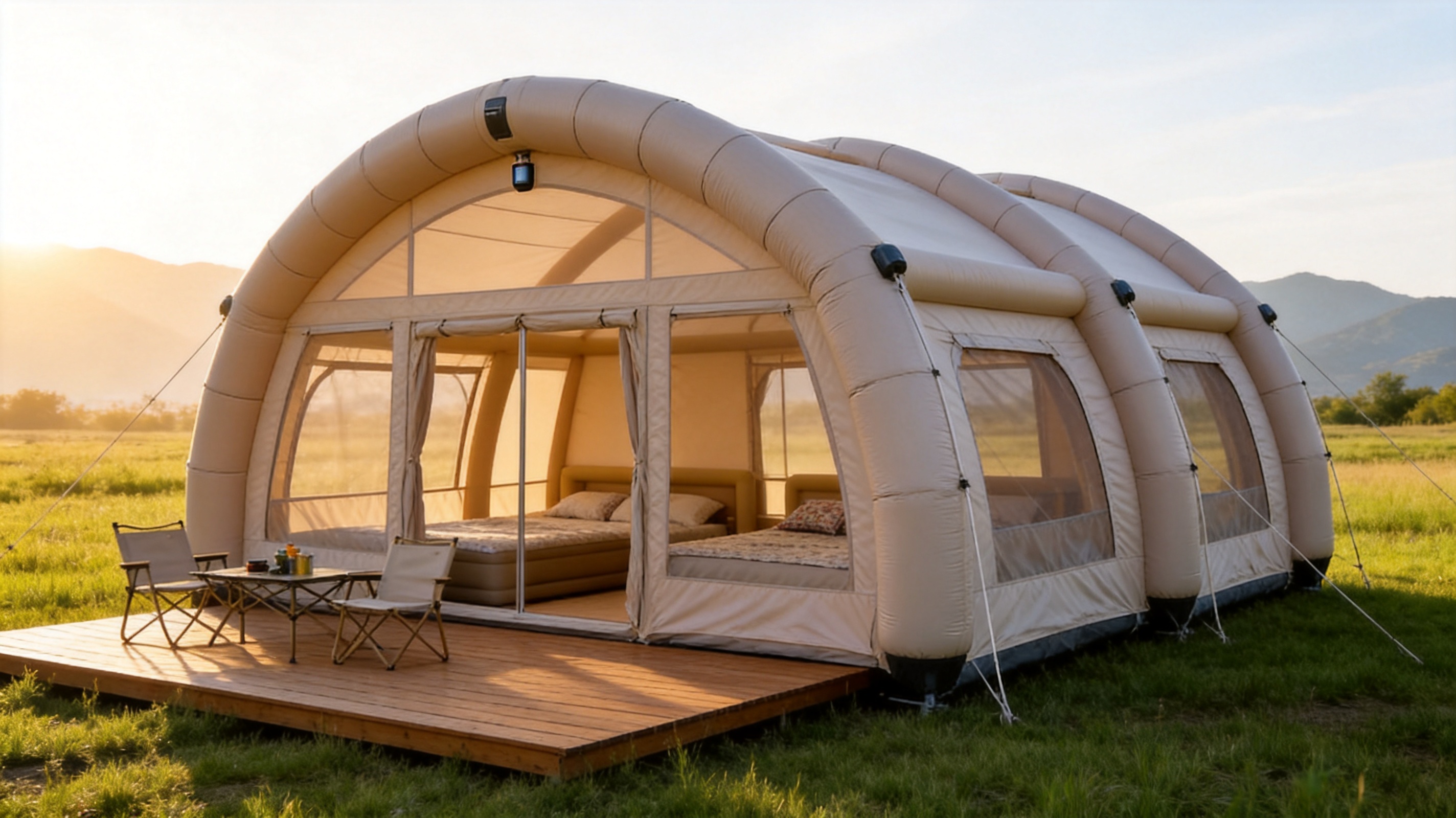
The defining characteristic of this inflatable cabin shelter is its large interior volume. The high-clearance design creates a more natural standing and moving environment, reducing the crouching and crawling commonly associated with low-profile tents. This makes everyday activities such as changing clothes, preparing meals, arranging luggage, and spending time indoors more comfortable.
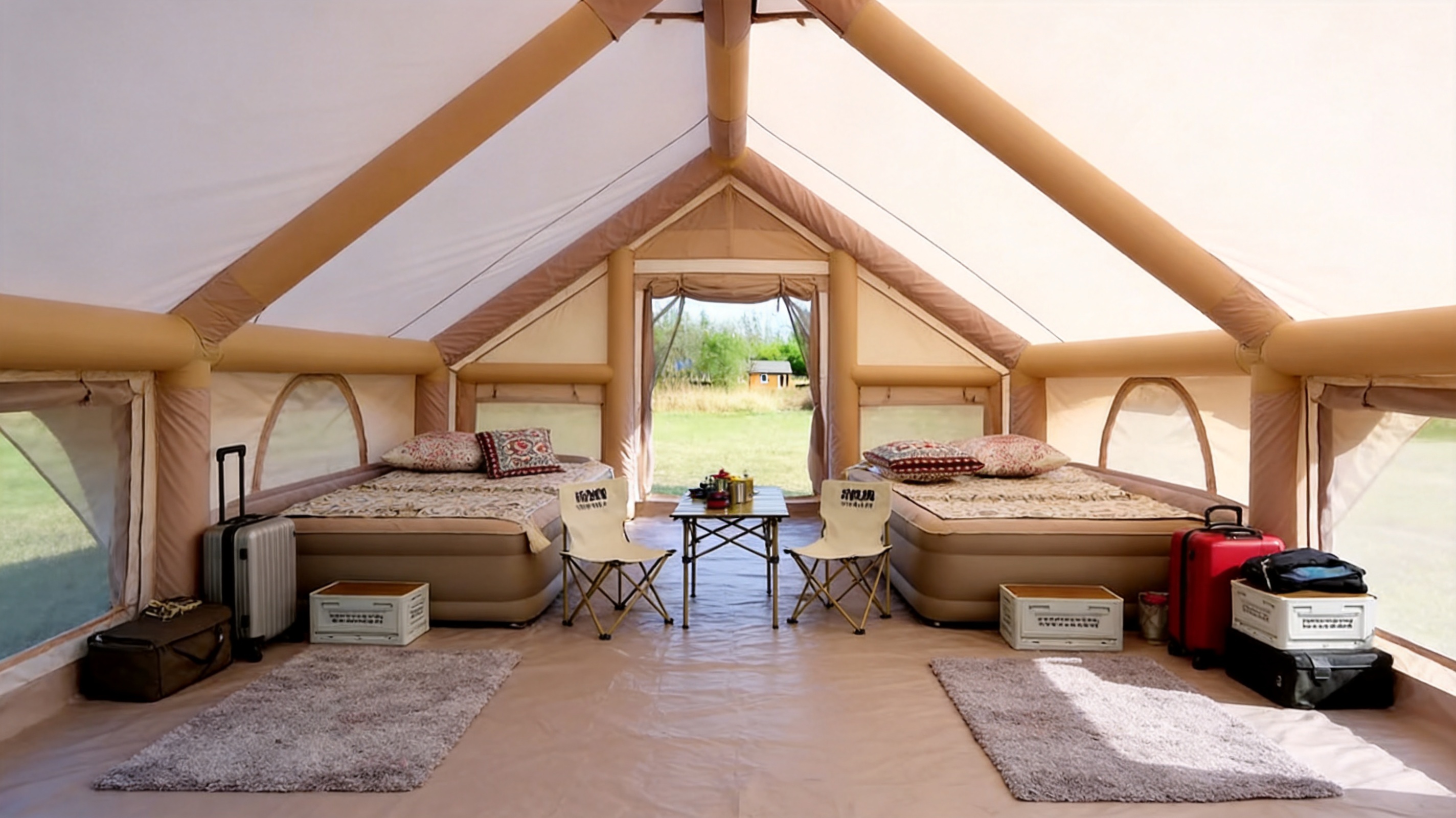
The two-bedroom configuration is another important advantage. Rather than treating the entire tent as one undivided sleeping area, the layout can provide a greater sense of privacy and order. Families may use separate sleeping areas for adults and children, while glamping operators can organize the interior into sleeping and living zones. Depending on the selected size and configuration, the central area may accommodate chairs, a small table, storage furniture, luggage, or leisure equipment.
A spacious shelter also improves the camping experience during poor weather. Rainy afternoons, strong sunlight, cool evenings, or unexpected changes in conditions can force campers to spend more time inside. A small tent quickly becomes crowded when people, clothing, food, and equipment share the same floor area. A larger cabin-style shelter gives occupants room to sit, move, organize personal belongings, and maintain a more comfortable daily routine.
The design is therefore suitable for customers who view camping as temporary outdoor living rather than simply overnight sleeping. It can support family holidays, extended weekend trips, private glamping sites, outdoor retreats, seasonal events, and resort accommodations where guests expect a residential atmosphere.

Luxury Inflatable Camping Tent Large Family Glamping Cabin Shelter
Inflatable Air-Beam Construction
The air-beam system is central to the product’s convenience and appearance. The reinforced pneumatic skeleton provides the shape and support required for a large shelter while eliminating the visual clutter of a complex external pole network. This contributes to a cleaner cabin-like profile that is especially suitable for luxury camping and hospitality environments.
High-pressure valves are incorporated into the inflatable structure to support controlled inflation. When used with the matching pump, the air columns can be filled efficiently. The stated setup target is approximately five minutes under suitable conditions, although actual installation time may vary according to the selected size, wind conditions, ground surface, user experience, anchoring method, and whether the shelter is being erected for the first time.
Inflatable construction also provides practical packing benefits. The air beams can be deflated and folded with the tent body, reducing the need to carry long rigid poles. This makes vehicle transport, warehouse storage, and seasonal handling more straightforward. For resorts and event companies, compact packed dimensions can improve logistics when multiple units must be delivered or stored.
Users should follow the supplied instructions carefully. The matching pump should be used, and the tent should not be over-inflated or inflated with unsuitable equipment. Correct pressure helps preserve the performance of the air-beam system and reduces the risk of damage caused by improper inflation. Before use, the air columns, valves, seams, guy lines, anchors, doors, and windows should be checked.
Why Air-Beam Structures Appeal to Commercial Users
For a private family, rapid deployment means more time for recreation. For a commercial operator, it can directly improve labor efficiency. A shelter that can be erected without assembling a large pole frame may reduce installation time and simplify staff training. This can be useful when preparing a seasonal campsite, changing a resort layout, supporting an outdoor exhibition, or creating temporary accommodation for a special event.
Air-beam structures may also reduce the likelihood of losing individual pole sections during repeated use. A conventional pole system consists of numerous separate parts that can be misplaced, bent, or damaged. The integrated inflatable frame keeps the primary support structure connected to the tent body, although valves, pumps, repair materials, and anchoring equipment still require proper maintenance.
The system offers an attractive combination of convenience and visual refinement. It is more substantial than a simple pop-up tent and less mechanically complicated than a framed cabin. This makes it a strong option for buyers seeking a balance between residential comfort and mobile outdoor practicality.
Materials Engineered for Outdoor Use
The shelter uses waterproof fabric together with a full PVC waterproof bottom cloth. This layered approach addresses two major sources of moisture: precipitation from above and ground moisture from below. A reliable floor is essential in a large family shelter because occupants may remain inside for long periods and may place bedding, luggage, furniture, and electrical accessories on the interior surface.
The waterproof floor also helps separate occupants from damp soil, morning dew, and minor surface water. Nevertheless, site selection remains important. The tent should be installed on ground that is reasonably level, free of sharp stones and branches, and not located in a depression where water may collect. No fabric shelter should be treated as a substitute for proper drainage and responsible weather judgment.
Heat-sealed construction is intended to strengthen water resistance around fabric joins and seams. Seam quality is especially important in a large shelter because the total surface area and number of connection points are greater than those of a small dome tent. Properly sealed seams help reduce the chance of water penetration during ordinary rain and improve the overall serviceability of the structure.
The fabric is also described as UV resistant. Exposure to sunlight can gradually weaken textile fibers, fade colors, and reduce the lifespan of outdoor materials. UV-resistant treatment helps the tent withstand regular outdoor exposure, while shade, ventilation, proper drying, and careful storage remain necessary for long-term performance. When the shelter is not being used, it should be fully dry before packing to help prevent mildew and odor.
Protection from Wind, Rain, Snow, and Insects
The product is designed with a reinforced air-beam frame and weather-resistant fabric to provide stability in changing outdoor conditions. Its stated functional features include water resistance, wind resistance, UV resistance, snow resistance, and insect resistance. The high-density mesh used in ventilation areas helps keep insects outside while allowing air to circulate through the interior.
These features make the tent appropriate for a broad range of outdoor seasons. However, “four-season” should be understood as a product classification rather than a guarantee of safety in every extreme environment. Heavy snow loading, severe storms, hurricanes, extreme mountain winds, freezing conditions, and prolonged exposure to harsh weather require additional planning and may exceed the intended use of a temporary inflatable shelter.
For the best experience, the manufacturer recommends using the shelter in suitable weather conditions. Campers should always evaluate local forecasts, wind direction, ground conditions, temperature, and emergency access before setting up. All guy lines and anchoring points should be used as instructed, and the tent should not be left unattended in dangerous weather.
Ventilation, Privacy, and Everyday Livability
Large tents can become uncomfortable if they do not release heat and moisture effectively. The cabin-style shelter addresses this through high-density mesh windows, door openings, and panoramic ventilation. These features encourage cross-ventilation, allowing fresh air to enter while warm, humid air exits.
Good ventilation is useful in several situations. During summer, it helps reduce heat buildup under the fabric. At night, it helps manage condensation caused by breathing, cooking, wet clothing, and temperature changes. In humid climates, improved airflow can make the living environment feel less enclosed and more pleasant.
The mesh must be kept in good condition because even a small tear can reduce insect protection. Users should avoid forcing zippers, placing sharp objects against mesh panels, or folding the tent while it is dirty and damp. Routine inspection of windows, door closures, stitching, and ventilation panels can help maintain performance throughout repeated use.
Ventilation also supports privacy. High-density mesh can allow airflow while limiting direct visibility, especially when combined with fabric door panels or curtains. This is a valuable feature for family camping and resort applications, where occupants may want an open, bright interior without sacrificing personal space.
The internal organizers further support daily use. Small storage pockets or customized organizers help keep phones, flashlights, keys, maps, chargers, and personal accessories off the floor. In a large tent shared by several people, organization is not merely a convenience; it reduces clutter and helps occupants move safely through the interior.
Suitable Applications
Family Camping
Families need a shelter that accommodates different routines. Children may sleep earlier than adults, parents may need space to organize clothing and food, and everyone benefits from a dry indoor area during bad weather. The two-bedroom layout and large floor plan provide a more practical family environment than a single-room tent with limited headroom.
The shelter can be used for weekend camps, school-holiday trips, lakeside stays, garden-based outdoor experiences, and road trips where transport is available. Its size makes it especially appropriate for families who travel by car and want to bring bedding, chairs, storage containers, and recreational equipment.
Glamping Sites and Resorts
Glamping guests usually expect more than basic protection from the elements. They value attractive design, generous space, ventilation, privacy, and the feeling of staying in a distinctive accommodation unit. The inflatable cabin profile can support this hospitality concept while offering a structure that can be installed, relocated, or stored more flexibly than a permanent building.
Operators may furnish the interior with beds, rugs, low furniture, lighting, decorative textiles, and storage solutions, provided the load, fire safety, ventilation, and local regulations are considered. The available size range allows a site owner to select more compact units for individual guests or larger structures for families and groups.
As with all commercial accommodation, operators should establish a documented inspection routine. Air pressure, seams, fabric, floor, zippers, anchors, mesh panels, and electrical installations should be checked between guest stays. Clear instructions should be provided regarding cooking, heaters, candles, storms, and evacuation.
Outdoor Events and Retreats
Companies, schools, wellness organizers, and event planners can use spacious inflatable shelters as temporary lounges, meeting areas, activity rooms, changing spaces, or sheltered dining areas. Their rapid deployment can be helpful when a site must be prepared within a limited time frame.
The shelter’s residential appearance can also improve the atmosphere of an outdoor event. Rather than using a purely utilitarian temporary structure, organizers can create a more welcoming environment for guests, customers, or participants. Branding, interior layout, and external decoration may be customized through OEM/ODM cooperation, subject to technical review and production requirements.
Emergency and Temporary Accommodation
Large inflatable shelters may also be considered for temporary accommodation, field operations, and humanitarian support. Their spacious layout, transportable format, and comparatively simple installation can be useful where rapid deployment is required. However, humanitarian or emergency applications must be evaluated against local safety standards, climate conditions, fire regulations, sanitation requirements, and project-specific specifications.
The product should not automatically be assumed to meet every humanitarian procurement standard. Buyers in this sector should request technical documentation, material information, testing records, packing details, repair procedures, and customization options before placing an order.
Available Sizes and Configuration Planning
The listed product sizes range from approximately 300 × 300 cm to 700 × 700 cm. This broad selection allows buyers to align the shelter with available land, expected occupancy, furniture plans, transport capacity, and budget.
Approximate Size |
Potential Use |
Planning Considerations |
300 × 300 cm |
Compact family shelter or private leisure room |
Suitable for fewer occupants and limited furnishings |
400 × 400 cm |
Small family camping or compact glamping unit |
Allows sleeping space with modest storage and seating |
500 × 500 cm |
Family accommodation or comfortable weekend basecamp |
Offers more flexible separation between sleeping and living areas |
600 × 600 cm |
Large family, resort, or group shelter |
Requires adequate installation space and careful anchoring |
700 × 700 cm |
Large glamping cabin, event shelter, or spacious group accommodation |
Requires a level site, transport planning, and sufficient setup crew |
These dimensions should be confirmed with the supplier before purchase because final layouts, room divisions, door positions, windows, air-beam placement, and usable interior dimensions may vary by model. Buyers should also check the total footprint, guy-line clearance, entrance orientation, and required space around the shelter for safe movement and drainage.
For a resort or commercial project, size selection should begin with a floor-plan study. The operator should identify bed dimensions, furniture locations, guest circulation paths, luggage storage, ventilation requirements, emergency exits, and maintenance access. A large floor plan is valuable only when it is arranged efficiently.
Advantages over Conventional Pole Tents
The product offers several practical advantages compared with conventional large family tents.
First, installation is simplified. The air-beam frame avoids the need to assemble and insert numerous poles. This can shorten setup time and reduce the number of people required for erection.
Second, the interior is designed around living comfort. Large vertical clearance, multiple rooms, and a substantial floor plan create a more residential experience than many standard camping tents.
Third, the integrated frame eliminates long pole sections from the packed system. This can make transport and storage easier, particularly for car-based camping, resorts, and event inventory.
Fourth, the visual design is appropriate for premium outdoor hospitality. A clean inflatable structure can appear more sophisticated than a basic utility shelter, helping operators build a consistent glamping environment.
Fifth, the product supports customization. The supplier identifies OEM/ODM orders as acceptable, giving buyers the possibility of discussing materials, colors, layouts, logos, room arrangements, accessories, packaging, and project-specific requirements.
It is important to recognize the trade-offs. Inflatable shelters generally require a pump and careful pressure management. They can be heavier than lightweight trekking tents, and their performance depends on correct anchoring and maintenance. A pole tent may be preferable for users who prioritize the lowest possible purchase weight or who frequently travel on foot. This inflatable cabin is better suited to customers who prioritize comfort, space, rapid assembly, and premium presentation.
Advantages over Small Pop-Up Tents
Pop-up tents are valued for their convenience, but their compact folding mechanisms and lightweight structures usually limit interior volume. They are often appropriate for short stays, festivals, children’s activities, or simple overnight use. They may not provide two bedrooms, standing room, substantial storage, or the robust weather-oriented fabric required for extended family camping.
The inflatable cabin offers a different level of accommodation. It is designed to function as a large outdoor room rather than merely a sleeping pod. Users can move around more naturally, create zones for different activities, and remain comfortable when the weather keeps them indoors.
The comparison should therefore be based on intended use. A pop-up tent may be more convenient for a single traveler attending a weekend event. The inflatable family shelter is more appropriate for a family, a glamping operator, or a customer who expects the tent to act as a portable living suite.
Advantages over Lightweight Trekking Tents
Backpacking and trekking tents are optimized for low weight, compact packing, and mobility over long distances. Their materials and dimensions are designed around carrying efficiency. These benefits are essential for hiking but are not the primary objectives of a large inflatable family shelter.
The inflatable cabin instead maximizes interior comfort and usable space. Its heavier packed weight is justified when the tent is transported by vehicle, installed at a campsite, or used as part of a hospitality business. The larger floor area provides room for beds, luggage, furniture, and multiple occupants, while the two-bedroom structure gives the shelter a level of privacy not typically found in compact trekking equipment.
Customers should select the product category according to their travel method. Hikers crossing several kilometers of difficult terrain may need a lightweight trekking tent. Families driving to a destination, resort owners furnishing a glamping site, and event organizers seeking a comfortable temporary shelter may gain greater value from the inflatable cabin format.
Manufacturing Strengths and Product Development Capability
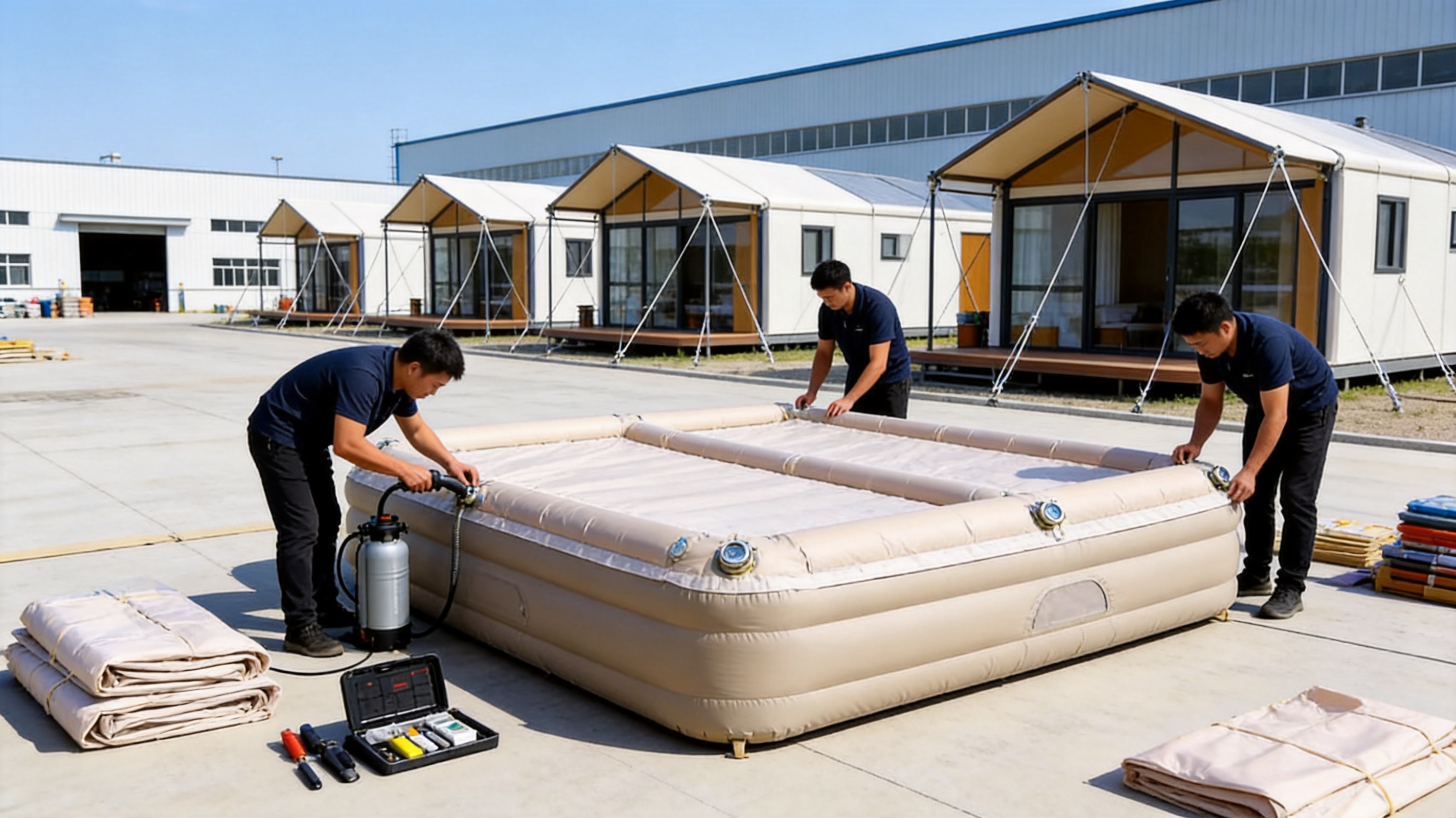
The supplier, Ningbo Zhenhai Tiansai Leisure Products Co., Ltd., specializes in the design, production, and sales of tents and related outdoor products. Its factory covers more than 13,000 square meters, providing a substantial base for material handling, cutting, sewing, assembly, inspection, packing, and order management.
A factory of this scale can support more organized production than a purely trading-based operation. Dedicated processes may be arranged for fabric preparation, pattern cutting, seam construction, air-beam integration, accessory installation, finished-product inspection, and packaging. For buyers, this can improve communication between product design and manufacturing teams, particularly when technical modifications are required.
The company’s location in Ningbo offers access to an important international port city. This is a practical advantage for overseas customers because export-oriented production depends not only on product quality but also on efficient freight coordination, documentation, packaging, and shipment scheduling.
The manufacturer has developed products for international markets and states that its tents are exported to countries and regions in North America, Europe, Asia, and elsewhere. Experience with overseas customers can help a supplier understand differences in climate, consumer expectations, packaging needs, labeling requirements, and product customization.
Design and Engineering Experience
Outdoor shelters must balance multiple factors at the same time. A larger floor plan can improve comfort but may increase fabric tension and wind exposure. A thicker fabric can improve durability but also add weight. More windows can improve ventilation but must be integrated without compromising weather resistance. An inflatable frame can simplify assembly but requires reliable valves, air channels, and repair provisions.
The manufacturer’s product development approach considers practicality and comfort together. Its professional design team works on outdoor products from the perspectives of usability, performance, and customer feedback. Collaboration with outdoor professionals and product testing by outdoor enthusiasts can help identify problems that may not be visible in a purely factory-based evaluation.
The company also reports experience with appearance patents and utility model patents. Intellectual property development can indicate an emphasis on creating differentiated products rather than simply reproducing generic market designs. For buyers seeking a private-label or custom product, this design capability may provide a stronger starting point for developing a distinctive shelter.
Quality Management and Production Control
Quality control for an inflatable tent must cover more than visual appearance. Critical inspection areas include fabric consistency, coating condition, seam strength, heat-sealed sections, air-beam integrity, valve installation, zipper operation, mesh attachment, floor waterproofing, guy-line points, and accessory completeness.
A professional manufacturing process should also include checks at several stages. Incoming material inspection verifies that fabric, PVC components, mesh, webbing, zippers, valves, and other parts meet the approved specifications. In-process inspection identifies cutting, sewing, or welding issues before the complete shelter is packed. Final inspection verifies dimensions, appearance, inflation performance, folding, labeling, and packaging.
The company emphasizes quality assurance and implements a quality management system intended to ensure that products meet international standards. Buyers should still request the specific test reports, certificates, and compliance documents relevant to their destination market and intended use. Requirements may differ depending on whether the product is sold to consumers, used in a resort, supplied to an institution, or deployed in an emergency project.
OEM and ODM Cooperation
Customization is an important advantage for importers, outdoor brands, distributors, and hospitality businesses. The supplier accepts OEM/ODM cooperation, allowing customers to discuss private-label production and product development.
Potential customization areas may include exterior color, fabric selection, logo application, packaging design, internal organizers, room layouts, doors, windows, ventilation arrangements, accessory kits, and size adjustments. Not every request will be technically or economically suitable, so the process should begin with a clear product brief.
A useful customization brief should specify the target market, expected climate, number of occupants, preferred dimensions, branding requirements, retail packaging, intended sales channel, target price, order quantity, and necessary compliance documentation. If the tent will be used in a commercial hospitality setting, the buyer should also describe expected installation frequency, seasonal storage, cleaning procedures, and replacement-part requirements.
Prototype approval is essential. Before mass production, the buyer should review a sample or pre-production unit and verify the fabric, colors, layout, inflation process, room configuration, dimensions, accessories, labels, and packing method. Any approved changes should be documented to reduce misunderstandings during later production.
Installation Procedure and Best Practices
Although the product is designed for rapid deployment, careful installation remains necessary for safety and performance.
1. Select the Site
Choose a level, stable area with adequate clearance. Remove sharp stones, sticks, branches, and other objects that could damage the floor or fabric. Avoid riverbeds, low-lying areas, unstable slopes, and locations beneath dead branches. Consider drainage, wind direction, access routes, and the position of the entrance.
2. Unpack and Position the Tent
Spread out the groundsheet or tent body according to the instructions. Identify the entrance, air beams, valves, guy lines, and anchoring points. Position the shelter before inflation so it does not need to be dragged after the air frame becomes rigid.
3. Secure the Main Anchors
Install the recommended anchors in suitable ground. Soft soil, sand, gravel, and hard surfaces may require different anchoring solutions. Do not rely solely on the weight of the tent. A large shelter presents a significant surface area to wind and should be secured using all supplied anchoring points where conditions require.
4. Inflate with the Matching Pump
Connect the pump to the correct valve and inflate each air beam according to the manufacturer’s instructions. Do not over-inflate and do not use an unsuitable inflating tool. Check that the air beams expand evenly and that the fabric is not caught, twisted, or placed under abnormal tension.
5. Attach Guy Lines and Adjust Tension
After the main structure is upright, attach and tension the guy lines. Lines should stabilize the shelter without pulling the fabric excessively. Recheck the anchors and structure after the tent has been fully erected.
6. Inspect Before Occupancy
Confirm that doors and windows operate correctly, mesh panels are closed, the floor is properly positioned, and the air valves are sealed. Check the interior for sharp objects and ensure that cooking or heating equipment is not used in a way that creates a fire or carbon monoxide hazard.
Actual setup time depends on the size selected and the conditions at the site. The advertised rapid setup refers to the inflation and basic erection process, not necessarily the entire task of clearing the site, anchoring every point, arranging furniture, and preparing the interior for guests.
Maintenance and Long-Term Care
Proper maintenance protects the investment and helps preserve the tent’s appearance and performance.
After each trip, remove dirt, leaves, sand, and organic material. Clean the fabric with appropriate mild cleaning methods recommended by the supplier. Avoid harsh chemicals, abrasive brushes, and solvents that may damage waterproof coatings, printed areas, PVC surfaces, or seam treatments.
Allow the tent to dry completely before folding. If the shelter must be packed during rain, unpack and dry it as soon as possible. Moisture trapped in folded fabric can encourage mildew and produce persistent odors. The storage area should be cool, dry, clean, and protected from rodents, sharp objects, and prolonged sunlight.
Inspect the air beams and valves regularly. Listen for unusual air loss, examine valve connections, and check for visible abrasions or punctures. A repair kit and maintenance instructions should be kept with the product. Small problems are generally easier to address before they become large failures.
Inspect zippers and mesh panels for dirt or misalignment. Do not force a zipper that is obstructed by fabric or debris. Check webbing, guy lines, buckles, anchors, and floor seams for wear. Commercial operators should record inspections and repairs so that each unit has a clear service history.
Do not store heavy objects on top of the folded tent. When moving the packed shelter, use appropriate lifting technique because the gross package weight is approximately 40 kilograms. For larger models or commercial installations, two or more people may be needed for safe handling.
Safety Considerations
Every temporary shelter requires responsible use. The tent should be anchored correctly and monitored during changing weather. If severe wind, thunderstorms, flooding, heavy snow, or other dangerous conditions are forecast, occupants should follow local safety guidance and move to a suitable permanent shelter when necessary.
Open flames, stoves, lanterns, heaters, and fuel-burning appliances must be managed with extreme care. Fabric structures can burn, and combustion appliances can create carbon monoxide. Cooking should only take place where permitted and where adequate ventilation, clearance, and fire safety controls are available.
Electrical equipment should be installed in accordance with local regulations. Cables should be protected from water and foot traffic, and connections should not be overloaded. In commercial applications, operators should provide clear emergency procedures and ensure that exits are not blocked by beds, furniture, luggage, or decorations.
The product’s water-resistant and weather-resistant features improve outdoor usability but do not remove the need for judgment. A responsible purchasing decision includes understanding the intended climate, local regulations, installation surface, occupancy level, and maintenance capacity.
Purchasing Considerations for Importers and Distributors
Wholesale customers should evaluate the complete supply arrangement rather than focusing only on the unit price. Important factors include material specifications, size, color, packaging, minimum order quantity, production lead time, sample approval, spare parts, repair kits, inspection procedures, warranty terms, shipping method, and after-sales communication.
The listed packaging information identifies a single-item package of approximately 80 × 30 × 35 cm with a gross weight of about 40 kilograms. Buyers should confirm whether this information applies to every size option, because larger configurations may require different packing dimensions or weights.
Distributors should also determine how the product will be presented to end users. An inflatable family shelter requires clearer instructions than a simple small tent. Retail packaging should explain the pump requirement, inflation precautions, anchoring, drying, storage, weather limitations, and basic repair procedures.
For resort projects, the buyer should request a complete product specification and discuss the expected number of installation cycles. A shelter used occasionally by private families may experience fewer stresses than one erected and dismantled every week. Commercial use may require additional reinforcement, spare air-beam components, replacement valves, customized flooring, or a service agreement.
Because the supplier is located in Ningbo, buyers can also discuss export packaging and port logistics at the quotation stage. Accurate product dimensions and shipping weights are important for freight planning, container utilization, customs documentation, and landed-cost calculations.
Why Work with an Experienced Tent Manufacturer?
Outdoor shelters combine textile engineering, structural design, manufacturing precision, packaging, and user education. A supplier with experience across these areas can help buyers avoid common problems such as inadequate seam sealing, poorly positioned windows, weak anchor points, confusing instructions, insufficient spare parts, or packaging that causes damage during transportation.
Tiansai Leisure has operated in the outdoor-product field for many years and has developed international business relationships. The company states that its core team includes professionals with more than ten years of experience in research and development, production, and overseas operations. Such experience can be valuable when a customer needs communication across design, manufacturing, inspection, and export stages.
The company’s connection with international outdoor brands and its reported patent activity also support its position as a product-oriented manufacturer. While every project should be evaluated through samples and documentation, a manufacturer that invests in design and product development may be better equipped to deliver differentiated solutions than a supplier focused solely on catalog reselling.
The company’s stated brand concept, “Explore Nature, Enjoy Outdoor,” reflects the purpose of this product category: bringing greater comfort and convenience to outdoor environments without eliminating the feeling of being close to nature. The inflatable cabin is a practical expression of that concept, combining open-air adventure with a more comfortable residential experience.
Frequently Asked Questions
What type of tent is this?
This is a large inflatable camping and glamping shelter in the Inflatable & Air Tents category. It uses reinforced air beams instead of a conventional multi-pole support system and is designed for family camping, resort use, outdoor events, and spacious temporary accommodation.
How quickly can it be installed?
The product information indicates that it can be built in approximately five minutes when the matching pump is used and the site is properly prepared. The total setup process may take longer because users must clear the ground, position the tent, install anchors, attach guy lines, and arrange the interior.
Does it include a pump?
The product information instructs users to use the matching pump, but the supplied accessories should be confirmed with the manufacturer before ordering. Buyers should ask whether the pump is included, which pump specification is required, and whether replacement pumps or adapters are available.
Is the tent suitable for all four seasons?
The product is identified as a four-season tent and is described as rain-resistant, snow-resistant, UV-resistant, wind-resistant, and insect-resistant. It should still be used responsibly. Extreme storms, heavy snow, severe winds, flooding, and other hazardous conditions may exceed the suitable operating environment for a temporary inflatable shelter.
How many people can sleep inside?
Occupancy depends on the selected size, internal layout, bed dimensions, furniture, and the amount of storage required. The two-bedroom structure is designed for family or group use, but buyers should request a specific recommended occupancy figure for the selected model and configuration.
What materials are used?
The product information identifies waterproof fabric, a full PVC waterproof bottom cloth, and an upgraded PVC air column with mesh-related components. Exact fabric composition, thickness, coating, denier, flame-retardancy options, and seam specifications should be confirmed in the technical quotation.
Can the tent be customized?
Yes. OEM/ODM cooperation is identified as acceptable. Customers may discuss branding, colors, dimensions, layouts, materials, packaging, organizers, windows, doors, and other features. Custom requests should be reviewed through drawings, samples, and written specifications before mass production.
Is it suitable for backpacking?
It is not primarily designed for backpacking. Its approximately 40-kilogram gross weight and large living area make it more suitable for vehicle-based camping, glamping resorts, events, and locations where the shelter can be transported without being carried long distances.
How should the tent be stored?
The tent should be cleaned, completely dried, deflated, folded according to the instructions, and stored in a cool, dry place. It should be protected from sharp objects, pests, excessive heat, and prolonged sunlight. The air beams, valves, seams, zippers, and mesh should be inspected before storage.
What should buyers confirm before placing a wholesale order?
Wholesale buyers should confirm the final size, material, color, layout, packaging, product weight, accessories, pump arrangement, order quantity, production time, inspection requirements, warranty, spare parts, compliance documents, shipping terms, and customization details.
Conclusion
The Luxury Inflatable Camping Tent Large Family Glamping Cabin Shelter is designed for customers who want a more comfortable and refined outdoor experience than a conventional small tent can provide. Its spacious floor plan, two-bedroom structure, high vertical clearance, waterproof floor, weather-resistant fabric, panoramic ventilation, insect-resistant mesh, and integrated air-beam frame make it suitable for family camping, glamping, resorts, events, and selected temporary accommodation applications.
Its greatest competitive advantage is the way it combines residential-scale comfort with rapid inflatable deployment. Compared with a large pole tent, it can simplify installation and packing. Compared with a pop-up tent, it provides considerably more room and structure. Compared with a trekking tent, it offers a higher level of livability for customers traveling by vehicle or operating from a fixed outdoor site.
The product also benefits from the manufacturing capabilities of Ningbo Zhenhai Tiansai Leisure Products Co., Ltd. The company’s factory capacity, export experience, product development focus, quality-management approach, patent activity, and OEM/ODM service provide a foundation for both standard orders and customized projects.
For the best results, buyers should match the size to the intended occupancy, inspect technical specifications carefully, follow correct inflation and anchoring procedures, and plan for regular maintenance. When used within suitable weather conditions and supported by responsible site management, this inflatable shelter can transform a basic camping trip into a spacious outdoor living experience and provide hospitality operators with a distinctive, flexible glamping accommodation solution.
References
1. Manufacturer-provided product specification for the Luxury Inflatable Camping Tent Large Family Glamping Cabin Shelter, model DYI-081.
2. Manufacturer-provided information concerning product materials, dimensions, packaging, setup guidance, and intended outdoor applications.
3. Manufacturer-provided company profile describing factory capacity, product development, export experience, quality management, and OEM/ODM services.
4. General principles of outdoor tent site selection, anchoring, ventilation, moisture management, and seasonal shelter maintenance.
5. General guidance for safe use of temporary textile structures, including fire prevention, severe-weather awareness, electrical safety, and carbon-monoxide prevention.
Product: Luxury Inflatable Camping Tent Large Family Glamping Cabin Shelter

Message Us Right Now!
-
Mp: +86-18858091910
E-mail: sales@tenplaytent.com
ADD: No. 529, Guangyuan Road, Xiepu Town, Zhenhai District, Ningbo City, Zhejiang Province, China
-
Quick Links
Home Products About Us Advantage News Contact Us -
Product
Inflatable & Air Tents Glamping & Resort Tents Backpacking & Trekking Tents Automatic & Pop-Up Tents Family & Camping Tents Specialty Tents & Shelters Kids Tents Pet Tents Humanitarian & Large Tents Hammock -
Get Connected
 Camping Tent Manufacturer in China