

 English
 عربى

Two-Person Backpacking Tents: Review the Usable Sleeping Layout
The label two-person describes an intended occupancy, but it does not tell a buyer how two selected sleeping pads, personal gear and the entrance will work together. A useful backpacking-tent sample review places those items inside the pitched shelter. It turns a capacity label into a specific layout that a retailer can explain without promising more room than the product actually provides.
Tenplay’s Ultralight 20D Ripstop Nylon 2-Person Freestanding Backpacking Tent provides the model for this layout review. The orange tent shown in the product photographs should be assessed with the intended sleeping equipment and supplied components. Neither the fabric designation nor an outdoor photograph alone establishes every occupancy or weather claim.
Pitch the model in its intended configuration
Tenplay’s reference is the ultralight 20D ripstop nylon two-person freestanding backpacking tent. The product photograph shows an orange tent with its exterior fly in place. Confirm the supplied inner tent, fly, poles and other components before reviewing the internal layout. A photograph from an outdoor scene does not establish a verified weather rating or a complete packing list.
Use the manufacturer’s pitching instructions and a suitable level review area. Establish the intended shape and tension before taking measurements. A loosely pitched sample can distort the floor and wall relationship, while an over-tensioned setup can create a misleading impression of available space.
- Pitch using the supplied instructions.
- Record pad dimensions.
- Check access with gear in place.
- Keep capacity and weight scope clear.
Use sleeping pads as actual objects
Place the intended pads on the floor rather than drawing two generic rectangles. Record their dimensions and orientation. Check the fit at the narrowest usable points, including any taper or change in the floor shape. The outside footprint and the usable sleeping area answer different questions.
Then review the space around the occupants’ heads and feet. Wall slope affects usable volume above the floor. A pad that fits flat may still leave limited space for a particular sleeping system. The sample review should describe the arrangement observed, not generalize it into a guarantee for every person or pad combination.
Follow the entrance movement
Consider how each occupant enters and leaves the shelter when both pads are installed. Check the door opening, zipper access and any gear placed beside the entrance. A door visible in an exterior photograph does not by itself explain the usable route inside the pitched tent.
Keep the assessment practical: identify whether an occupant needs to move gear or cross another sleeping position in the proposed layout. That may be acceptable for one retail audience and unsuitable for another. Describe it honestly rather than treating every capacity rating as the same user experience.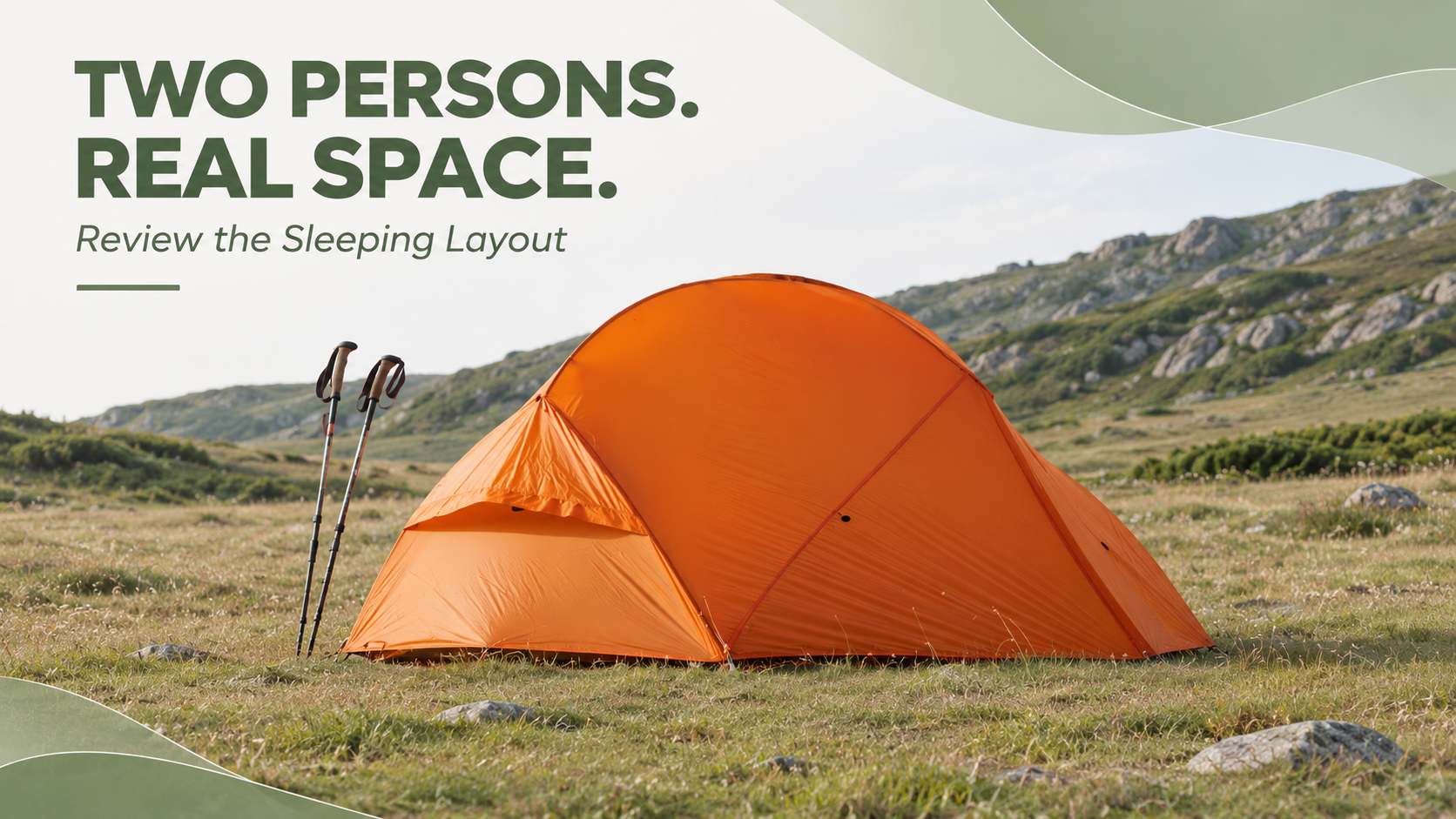
Give small items and wet gear a location
Backpacks, footwear and clothing can consume space that was assumed to be available for sleeping. Identify the intended storage locations and confirm any vestibule or pocket features on the actual sample. Do not add a storage compartment in marketing copy because a similar tent has one.
Separate a sleeping-space comparison from a broader shelter-use plan. Gear placement should not obstruct the entrance or interfere with the intended tent setup. The manufacturer’s instructions govern the product’s use; the sample layout helps the buyer choose which claims can be illustrated clearly for the intended customer.
| Space question | Sample reference |
|---|---|
| Floor fit | Actual pad dimensions and orientation |
| Usable volume | Wall slope above the sleeping positions |
| Entrance | Route with both pads installed |
| Carried package | Defined included components |
Compare weight using the same packing scope
If low weight is a buying criterion, define what is weighed. The complete supplied package, a selected pitching configuration and an individual component are different measurements. A retailer should not compare the full weight of one tent with a reduced component set from another.
Record the scope with the sample weight and confirm the production specification with Tenplay. The fabric designation alone does not define total package weight or durability. The poles, floor, fly, fittings and included accessories all contribute to the product a customer carries.
Create an honest retail space reference
Photograph the accepted pad arrangement and describe the pad dimensions used. Keep the camera view understandable and avoid a perspective that makes the floor look wider than it is. Show relevant gear placement if that is part of the occupancy claim.
The reference should remain attached to the model and configuration. If the inner tent or floor dimensions change, revisit the layout before reusing the image. A clear space demonstration can help buyers select the tent for the right audience without unsupported claims about extreme weather or universal comfort.
For a two-person backpacking tent, the strongest retail explanation is a specific, reproducible layout. Send Tenplay the intended audience and pad arrangement when reviewing the sample. The result is a more useful product description: one that connects the occupancy label to the shelter’s actual configuration and the equipment customers plan to use.
Two useful questions at the tent sample
Will the intended sleeping equipment leave the entrance usable? Try the arrangement with the equipment in place and record what has to move when an occupant enters or leaves. This is more informative than an empty-floor photograph because it shows the interaction between the sleeping layout and the door.
What does the capacity description leave unspecified? Pad width, personal preference and gear placement can change how the same shelter is used. A retailer can show a reviewed example and explain its basis without promising a universal fit. Keep the sample photographs and dimensions together, and review them again if the supplied inner tent changes. The outdoor setting in a cover photograph should be treated as presentation; it does not add a verified season rating or a performance claim to the product.
Message Us Right Now!
-
Mp: +86-18858091910
E-mail: sales@tenplaytent.com
ADD: No. 529, Guangyuan Road, Xiepu Town, Zhenhai District, Ningbo City, Zhejiang Province, China
-
Quick Links
Home Products About Us Advantage News Contact Us -
Product
Inflatable & Air Tents Glamping & Resort Tents Backpacking & Trekking Tents Automatic & Pop-Up Tents Family & Camping Tents Specialty Tents & Shelters Kids Tents Pet Tents Humanitarian & Large Tents Hammock Waterproof Dry Bags -
Get Connected
 Camping Tent Manufacturer in China