


 English
 عربى


4m Inflatable Air Villa Cabin Tent: A Professional All-Weather Shelter for Family Camping
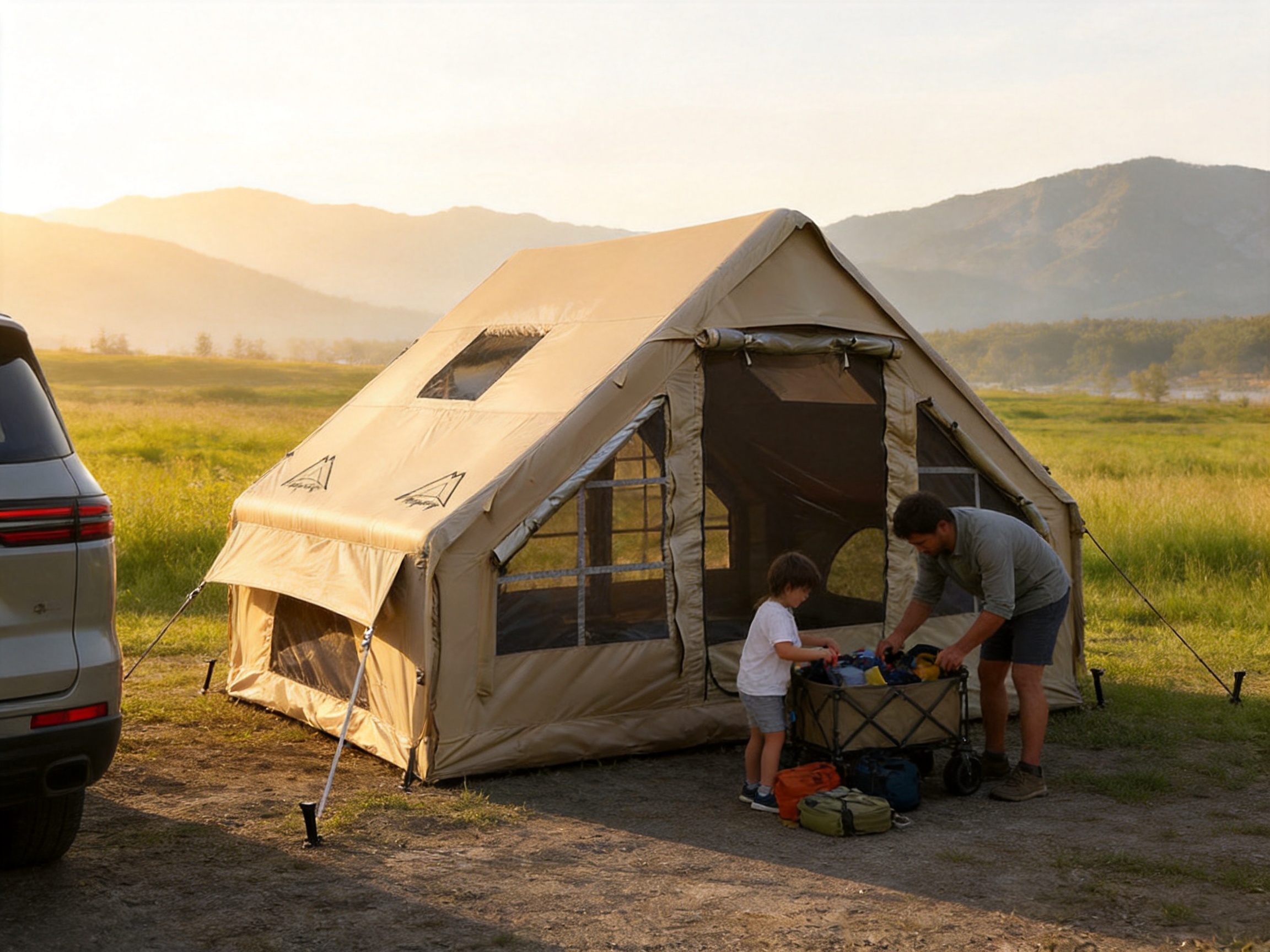
Modern campers increasingly want more than a basic place to sleep. They want a shelter that is quick to deploy, comfortable enough for extended stays, dependable in changeable weather, and practical to transport between destinations. The 4m Inflatable Air Villa Cabin Tent is designed around these expectations. It combines the spacious character of a cabin-style family tent with the structural simplicity of an inflatable air-column system, creating a versatile shelter for family camping, vehicle-based travel, glamping, outdoor events, and resort-style accommodation.
Unlike a conventional pole tent, this design uses integrated high-pressure air tubes as its primary structural framework. The result is a shelter that can be erected without assembling a complicated network of rigid poles. Once inflated and properly tensioned, the air skeleton supports the fabric shell and creates a stable, arched living space. The architecture is intended to provide useful headroom, practical floor space, and a strong visual profile while remaining relatively straightforward to pack and transport.
This product is positioned for users who value comfort and reliable shelter performance without accepting the long setup process associated with large traditional tents. Its combination of reinforced air tubes, waterproof fabric protection, heat-welded seams, mesh ventilation, and a compact carry format gives it a strong advantage for campers who move between locations or need a dependable basecamp for several people.

4m Inflatable Air Villa Cabin Tent Large Waterproof Canvas Family Sanctuary
What Makes an Inflatable Cabin Tent Different?
An inflatable cabin tent replaces many rigid poles with air-supported structural tubes. These tubes are inflated through dedicated valves, forming the framework that holds the tent’s roof and walls in position. The external fly or shell is then secured with tension points, guy lines, stakes, and other anchoring components. The air system does not eliminate the need for correct installation, but it simplifies the process by reducing the number of separate frame parts that must be identified, connected, and positioned.
The 4m Inflatable Air Villa Cabin Tent uses this principle to create a larger, more livable shelter. Its arched ceiling is intended to make better use of the interior volume than a low-sloping dome. In a dome tent, the walls often angle sharply toward the ground, reducing usable space around the edges. A cabin-inspired inflatable layout can provide a more open central area and improved vertical clearance, which is particularly valuable when campers need room for sleeping equipment, luggage, chairs, tables, and other family necessities.
The air-column approach also offers a different response to wind than a rigid pole assembly. A pole can bend, crack, or permanently deform if exposed to excessive force. A properly inflated air tube can flex and recover, helping the structure respond more progressively to gusts. This does not make any tent invulnerable to severe weather, and proper anchoring remains essential, but the flexible framework can offer a useful performance benefit in exposed camping environments.
For families and recreational users, the key difference is convenience. A traditional large tent may require several people to unfold, sort, connect, and insert multiple poles. An inflatable model typically allows the main structural tubes to be inflated in a more direct sequence. This can shorten the setup routine and reduce the frustration associated with missing or incorrectly connected pole sections.
Core Product Advantages
Rapid Deployment for Weekend and Touring Use
One of the most important advantages of this tent is its rapid deployment concept. The product is engineered for campers who want to spend less time building their shelter and more time enjoying the destination. The integrated air skeleton eliminates much of the frame assembly associated with traditional family tents. After selecting a suitable campsite, laying out the tent, attaching the relevant points, and inflating the structural tubes, users can concentrate on tensioning and final adjustments.
The exact setup time depends on the pump used, the number of people assisting, weather conditions, and the user’s familiarity with the product. Nevertheless, the streamlined folding and inflation system is designed to make the process more accessible than the assembly of a large multi-pole shelter. This is especially useful for families arriving late at a campsite, travelers who change locations frequently, or outdoor hosts who need to prepare several units efficiently.
A straightforward deployment process also improves campsite organization. Fewer loose frame components mean fewer opportunities for poles to be misplaced, damaged, or connected incorrectly. The air tubes remain integrated into the tent system, helping create a more unified product package. When packed into the carry bag, the shelter is easier to manage as a single camping unit rather than as a fabric bundle accompanied by several separate pole bags.
Flexible Structural Performance
The reinforced high-pressure air skeleton is designed to support the shelter while allowing a degree of controlled movement. In changing wind, flexible air tubes can absorb and release some movement instead of behaving like completely rigid members. The tent’s low-profile architecture, reinforced tension points, and anchoring system work together to help maintain stability.
Structural performance depends on several factors. Inflation pressure must be appropriate, valves must be closed correctly, seams and tubes must be free of damage, and the tent must be anchored according to the installation instructions. The position of the tent also matters. A sheltered, level site with good drainage is preferable to an exposed ridge, flood-prone hollow, or area beneath unstable trees.
Compared with a basic recreational tent, the product is intended to provide a more substantial feeling of security. The reinforced tubes and heavy-duty tension points are particularly relevant for family camping, where the shelter may need to remain stable while people move around inside, open doors repeatedly, or store equipment near the walls. The structure is also suitable for users who prefer the spacious appearance of a lodge or cabin tent but want a more modern setup method.
Waterproof Fabric and Seam Protection
Weather protection is a central part of the product’s design. The tent uses hydrophobic fabric materials intended to shed rain and reduce water penetration. Waterproof performance is not determined by fabric alone; it also depends on the roof shape, seam construction, door and window design, ground contact, zipper protection, and the quality of installation.
The product information emphasizes precision heat-welded seams. Heat welding joins compatible layers through controlled heat and pressure, helping create a continuous barrier at areas that are often vulnerable to water entry. This approach can be more consistent than relying only on conventional stitching and applied seam tape, although the final performance still depends on production control and correct use.
Heat-welded seams are particularly valuable along air tubes and exposed fabric junctions. These areas may experience repeated flexing during inflation, packing, transportation, and windy conditions. A well-controlled welding process can help protect the construction from leakage and moisture intrusion while supporting the long-term durability of the shelter.
Campers should remember that “waterproof” does not mean that a tent can be placed in standing water or left unsecured during extreme weather. The groundsheet should be positioned correctly, doors should be closed when necessary, ventilation should be maintained, and the tent should be dried thoroughly before long-term storage. Proper care preserves the fabric, zippers, air tubes, and welded areas.
Spacious Interior for Family Living
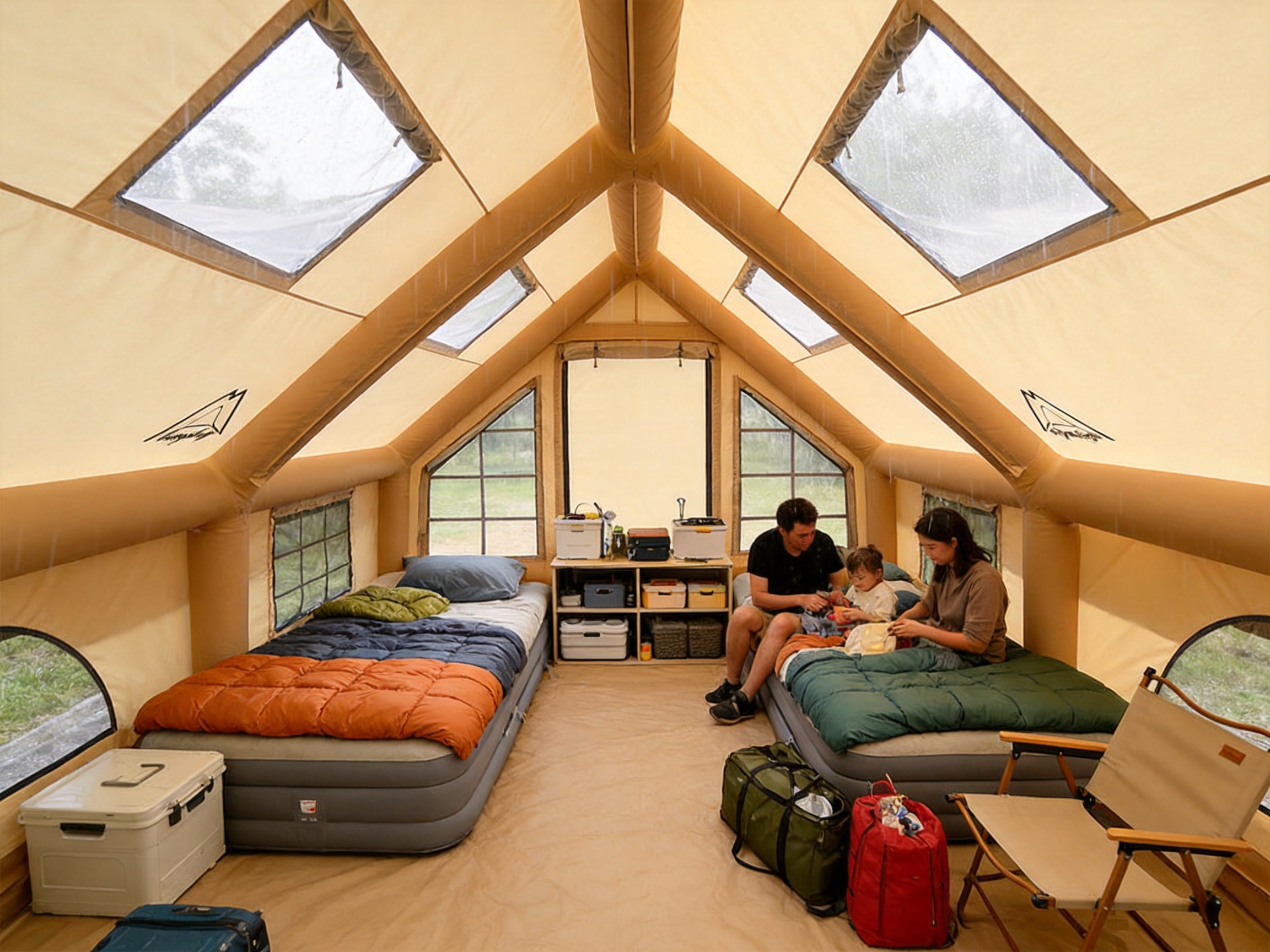
The 4m format is intended to provide a generous family camping environment. Instead of treating the tent only as a sleeping compartment, the cabin layout supports a broader range of activities. Campers can organize sleeping areas, gear storage, changing space, and a central living zone according to the trip’s requirements.
The arched ceiling helps maximize vertical clearance. This makes it easier for occupants to sit upright, change clothes, arrange bedding, and move around inside. A higher interior can also make a tent feel less confined during rainy days when the family must remain indoors. The cabin character is beneficial for longer stays because the space can be organized like a temporary room rather than a simple floor-level sleeping shelter.
Interior organization remains important. Large tents are most comfortable when heavy gear is kept low and close to the floor, walkways remain clear, and sleeping equipment does not obstruct ventilation openings. Families can use storage bags, compact organizers, and low-profile furniture to take advantage of the available volume without overloading the tent.
The product is designed to accommodate a full group and its equipment, but the practical capacity depends on the layout selected, the size of sleeping systems, and whether occupants want a separate living area. Buyers should review the manufacturer’s current floor plan and capacity guidance before placing an order, especially for commercial, resort, or high-occupancy applications.
Ventilation and Condensation Management
Large waterproof tents need an effective ventilation strategy. Moisture generated by breathing, cooking, wet clothing, and changing outdoor temperatures can condense on cooler interior surfaces. The tent addresses this issue through strategically placed high-density mesh windows and airflow openings.
Mesh windows serve two functions. They allow air to circulate through the living area and provide protection from insects when the outer weather panels are open. In suitable weather, campers can create cross-ventilation by opening opposing windows or doors. In rain, the outer panels can remain closed while ventilation openings are adjusted to support airflow without exposing the sleeping area unnecessarily.
Ventilation is most effective when users avoid blocking openings with luggage or bedding. It is also important to avoid cooking inside the tent unless the product instructions specifically allow it and adequate ventilation and fire-safety measures are available. Open flames, stoves, heaters, and fuel-burning appliances create serious risks in enclosed fabric shelters.
Compared with a fully enclosed low-cost tent, the combination of mesh ventilation and a higher ceiling can make the interior feel more comfortable. It helps reduce stuffiness and gives campers better control over airflow during warm evenings. The design therefore supports both weather protection and livability instead of treating ventilation as an afterthought.
Design Details That Support Outdoor Reliability
Reinforced Air Tubes
The tent incorporates multi-layer, puncture-resistant air tubes. Multiple layers are valuable because the tube must withstand internal pressure, repeated folding, contact with the outer shell, and the occasional abrasion associated with transport and campsite use. A puncture-resistant construction does not remove the need for care, but it can provide a more dependable foundation than a thin single-layer inflatable component.
Users should keep sharp objects away from the tubes, avoid dragging the inflated shelter across rough ground, and inspect the system before each trip. If a tube or valve shows unusual loss of pressure, the tent should not be used in demanding weather until the problem is identified and repaired. A suitable repair kit and the manufacturer’s maintenance guidance should be kept with the equipment.
Military-Grade Valve Design
The product description highlights military-grade valves intended to support reliable inflation and long-term air retention. Valves are critical components in any inflatable shelter. They must allow efficient inflation, remain securely closed, and resist leakage during use. Their position and accessibility also influence how easily campers can check pressure or perform maintenance.
Valve reliability is supported by correct operation. Dirt, sand, and moisture should be kept away from valve openings. After inflation, the closures should be checked before the tent is fully tensioned. When packing, users should release air according to the recommended sequence rather than forcing air out through unsuitable openings or placing unnecessary stress on the valve assemblies.
Heavy-Duty Tension Points
Tension points transfer forces from the fabric to the anchoring system. Reinforced attachment areas are essential because wind loads can concentrate around corners, roof edges, doors, and guy-line connections. The product’s heavy-duty tension points are intended to provide a stronger connection between the shelter and the ground anchors.
Correct tension is a balance. If the fabric is too loose, water may collect and wind movement can increase. If it is pulled excessively tight, unnecessary strain may be placed on seams, webbing, zippers, and air tubes. Campers should adjust the guy lines gradually, check the roof and side panels, and re-tension the tent if conditions change.
Compact Folding and Carrying
Large family tents often create a compromise between interior comfort and portability. The 4m Inflatable Air Villa Cabin Tent addresses this issue through a folding system and durable carry bag intended to make transport more manageable. It is not designed to compete with an ultralight backpacking tent in packed size or weight. Instead, it offers a practical middle ground for car campers, touring families, glamping operators, and users who prioritize living space.
The carry bag protects the folded tent during storage and transportation while keeping the main components together. Before packing, the shelter should be completely dry. Any trapped moisture can encourage mildew, unpleasant odors, and fabric deterioration. Folding should follow the recommended pattern, with air tubes positioned to avoid sharp creases and unnecessary pressure on valves.
For vehicle-based trips, the compact format makes it easier to load the tent alongside camping furniture, cooking equipment, sleeping bags, and personal luggage. For commercial operators, consistent packing can also simplify inventory management and reduce preparation time between guest stays.
Advantages over Conventional Pole Tents
The principal advantage over a conventional pole tent is setup simplicity. Traditional family tents can deliver excellent stability and durability, but their frame systems may involve numerous poles, connectors, sleeves, and crossing points. Inflatable architecture reduces that complexity by integrating the main structural components into air tubes.
A second advantage is the reduced risk of pole-related damage. Rigid poles can be lost, splintered, bent, or broken. An inflatable system has different maintenance requirements, including inspection of tubes, valves, and pressure retention. For many users, the ability to repair or replace an inflatable component is preferable to carrying a large selection of specialized pole sections.
A third advantage is the structural feel created by the air framework. The flexible tubes can accommodate movement under wind loads, while the broad fabric shell and tension points create a cohesive structure. This design can be especially appealing in coastal, mountain, and open-field environments where gusts are common, provided that the tent is correctly anchored and conditions remain within its intended use range.
A fourth advantage is interior volume. The arched cabin layout creates a useful combination of height and floor area. Many traditional dome tents are efficient for sleeping but offer limited standing or sitting space. The inflatable cabin design is better suited to families who plan to spend time inside the shelter, organize equipment, or remain at camp for several nights.
There are also trade-offs. Inflatable tents require a pump, and users must understand pressure management and air-system maintenance. They may be heavier or bulkier than small pole tents. Their performance depends on correct inflation and anchoring. These considerations do not reduce the product’s value; they clarify the type of user who will benefit most from it.
| Feature | 4m Inflatable Air Villa Cabin Tent | Basic Pole Family Tent | Small Backpacking Tent |
|---|---|---|---|
| Primary structure | Integrated inflatable air columns | Rigid or semi-flexible poles | Lightweight poles |
| Setup approach | Inflate, anchor, and tension | Assemble and insert multiple poles | Assemble a compact frame |
| Interior character | Cabin-style volume with arched clearance | Varies by model, often lower at the edges | Optimized mainly for sleeping |
| Weather protection | Hydrophobic fabric and heat-welded seam construction | Depends on fabric and seam treatment | Depends on fabric and lightweight construction |
| Ventilation | High-density mesh windows and airflow openings | Varies by model | Usually limited by compact dimensions |
| Best suited to | Family camping, vehicle travel, glamping, and extended stays | General recreational camping | Backpacking and low-weight travel |
| Maintenance focus | Air pressure, valves, tubes, fabric, and seams | Poles, fabric, seams, and zippers | Weight-sensitive components and fabric |
The comparison shows that the inflatable cabin tent is not intended to replace every other shelter category. A backpacker may prefer a smaller and lighter tent, while a user seeking the lowest initial cost may choose a basic pole design. The 4m model is strongest for customers who want a spacious, protective, rapidly deployable shelter and are willing to follow inflatable-system maintenance procedures.
Manufacturing Strengths and Product Development
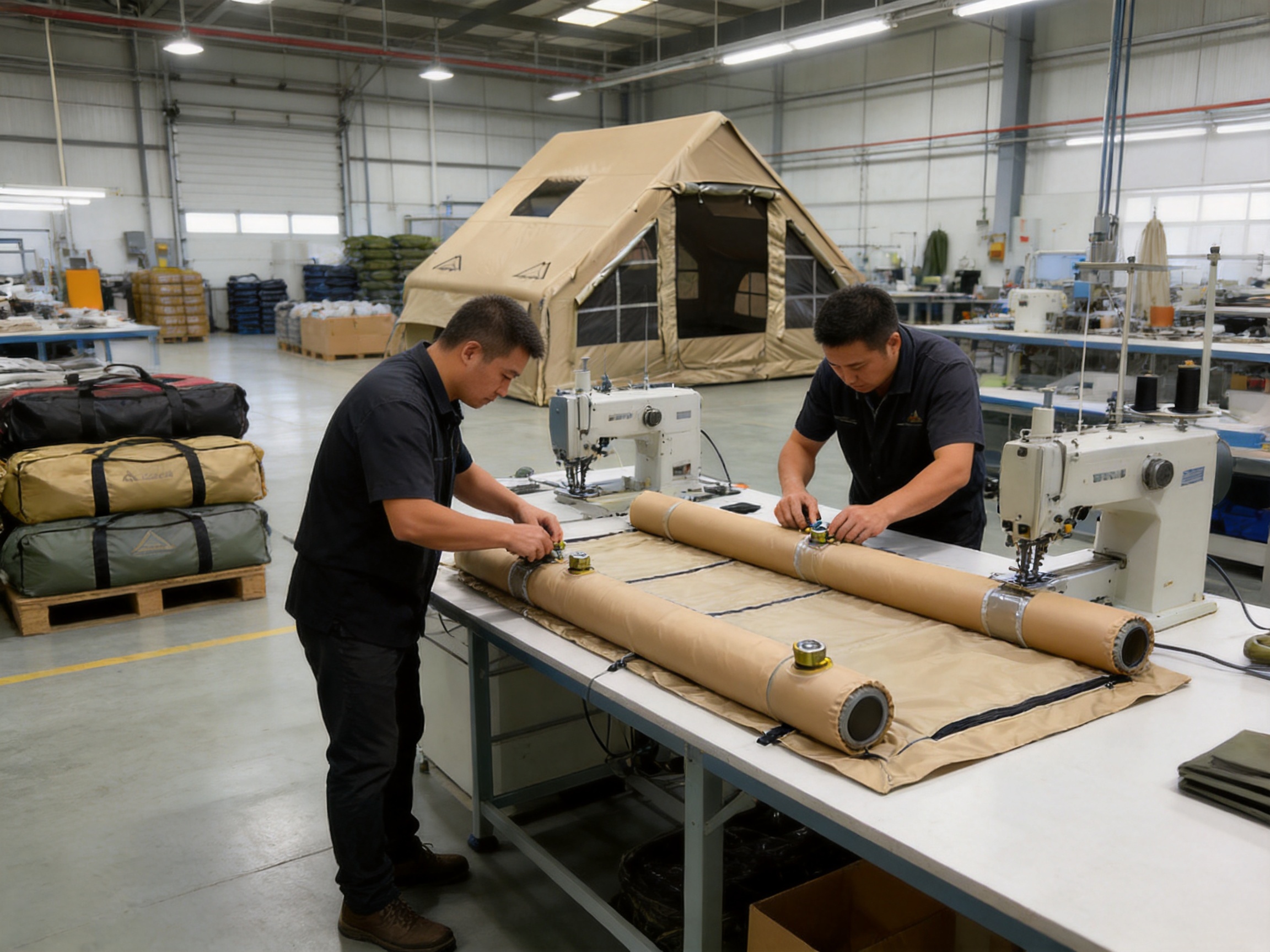
The product is manufactured by Ningbo Zhenhai Tiansai Leisure Products Co., Ltd., an established Chinese outdoor-equipment enterprise specializing in the design, production, and sales of tents. The company operates a factory covering more than 13,000 square meters in Zhenhai District, Ningbo. Its location near an important port supports international logistics and export activity, an important capability for wholesale buyers and global outdoor brands.
A large production facility can support the separation of key manufacturing activities, including material preparation, cutting, sewing, air-tube assembly, seam processing, inspection, packing, and finished-goods storage. Efficient organization is particularly important for inflatable tents because the product combines textile manufacturing with specialized air-system construction. Consistency must be maintained across both the outer shelter and the internal pressure-bearing components.
The company’s experience includes the design and production of multiple tent categories. Its broader product range covers outdoor tents, backpacking tents, glamping tents, inflatable tents, and other camping shelters. This category knowledge allows the manufacturer to understand the different requirements of lightweight travel, family accommodation, resort use, commercial camping, and emergency shelter applications.
Design and Engineering Capability
Product development is supported by a professional design team that considers practicality and comfort during the design process. This is important because a tent’s success cannot be measured by fabric strength alone. Door placement, window height, airflow, storage opportunities, internal clearance, packed format, inflation access, and repairability all affect the user experience.
The company reports that it collaborates with professionals and invites outdoor enthusiasts to participate in product testing. Field feedback can reveal issues that may not be obvious in a studio or factory environment. For example, testers may identify difficulties with packing, tension adjustment, ventilation control, access during rain, or the placement of valves. Incorporating this information helps refine the product for real-world use.
The company has also designed products that have received appearance patents and utility model patents. These forms of intellectual-property activity indicate an emphasis on product development and original construction solutions. Buyers should review the specific patent and technical documentation relevant to any individual model, but the company’s patent history demonstrates a continuing investment in design differentiation rather than simple commodity production.
Integrated Textile and Air-System Production
Inflatable shelters require close coordination between fabric production and air-frame assembly. The external shell must fit correctly around the air tubes, while the tubes must maintain their intended position during inflation and use. If the fit is inconsistent, the shelter may not tension evenly or the frame may experience unnecessary stress.
Production begins with material inspection and controlled cutting. Consistent panels help ensure that the finished tent has accurate dimensions and balanced tension. Sewing operations must maintain reliable stitch quality, while welded areas must receive appropriate heat, pressure, and dwell-time control. Air tubes require separate inspection for surface defects, valve attachment quality, and pressure retention.
After assembly, the completed product should undergo visual checks, functional checks, and packaging inspections. Depending on the production specification, testing may include inflation checks, seam review, zipper operation, attachment-point inspection, and water-resistance evaluation. Wholesale customers may also request additional quality-control procedures, inspection standards, packaging requirements, labeling, or pre-shipment inspection arrangements.
Quality Management and International Supply
The manufacturer states that it implements a quality-management system intended to ensure that products meet international standards. For buyers, quality management is most valuable when it is supported by documented procedures and traceable inspection results. Important areas include incoming-material control, in-process inspection, finished-product testing, nonconformance handling, and corrective action.
International supply also requires attention to consistency. A retailer or outdoor brand needs products that maintain the same appearance, dimensions, air-system behavior, packaging format, and performance expectations across repeated orders. A manufacturer with an established export background is better positioned to coordinate production schedules, international packaging, shipping documentation, and communication with overseas customers.
The company’s presence across North America, Europe, Asia, and other regions demonstrates experience serving customers with different climate conditions, consumer preferences, and distribution requirements. Its core team reportedly includes outdoor-product specialists with more than ten years of experience in research and development, production, and overseas operations. This combination can be valuable for customers seeking a long-term manufacturing partner rather than a one-time supplier.
Applications for Different Outdoor Markets
Family Camping
For families, the tent offers a balance between protection and livability. The interior can be arranged with sleeping areas, luggage storage, and a shared living space. Mesh windows support airflow, while the waterproof shell helps protect occupants from rain and damp conditions. The rapid setup approach is useful for parents who need to organize children, equipment, and campsite routines at the same time.
Families should establish clear internal rules. Cooking, sharp objects, muddy footwear, and heavy equipment should be managed carefully. Ventilation should remain available, and children should not climb on air tubes or pull on guy lines. With responsible use, the tent can become a comfortable base for weekend trips, holiday camping, and longer outdoor stays.
Glamping and Resort Operations
The cabin-style appearance and spacious interior make the product relevant to glamping operators and outdoor hospitality businesses. Guests often expect more comfort than a conventional lightweight tent can provide. A large inflatable shelter can serve as a temporary accommodation unit, lounge, activity room, reception area, or seasonal event structure, subject to local regulations and the operator’s safety assessment.
For commercial use, maintenance planning is essential. Staff should inspect the tent between guest stays, clean and dry the fabric, check air retention, examine valves and welded seams, and confirm that all stakes and guy lines are present. A consistent installation checklist helps reduce avoidable damage and improves guest confidence.
Operators should also consider fire safety, electrical equipment, heating, local weather limits, occupancy rules, accessibility, ground conditions, and emergency procedures. A recreational tent should not automatically be treated as a permanent building. Commercial users must determine whether additional engineering, certification, or regulatory approval is required for their intended application.
Vehicle-Based Touring
The product is well suited to car camping and touring because it provides a more substantial living area than a compact backpacking shelter while remaining designed for transport. Travelers can use it as a base at one campsite and move it to another location when their itinerary changes.
The carry format supports organized loading. The tent can be stored with its pump, repair materials, stakes, guy lines, and maintenance supplies in a dedicated equipment area. Before departure, users should confirm that every component is dry, properly folded, and secured against movement inside the vehicle.
Outdoor Events and Temporary Shelters
The product may also be considered for private outdoor gatherings, education programs, sports support areas, and temporary hospitality spaces. Its fast deployment can help organizers prepare a site efficiently. The shelter can provide shade and weather protection for equipment or participants, although its suitability depends on the event’s size, local weather, occupancy requirements, and safety plan.
Event organizers should avoid treating the shelter as a substitute for purpose-designed emergency or public-assembly structures unless the product has been specifically approved for that use. Anchoring, fire resistance, evacuation access, and crowd loading must all be assessed before deployment.
Setup Recommendations for Best Performance
Begin by selecting ground that is level, well drained, and free from sharp stones, branches, glass, and other objects that could damage the floor or air tubes. Avoid depressions where water may accumulate. Consider the direction of prevailing wind and position the lower-profile end toward the strongest expected airflow when practical.
Unpack the tent carefully and identify the pump, valves, guy lines, stakes, repair materials, and carry components before inflation. Lay the shelter flat and confirm that fabric panels are not twisted around the air tubes. Connect the pump to the correct inflation valve and inflate each structural section according to the manufacturer’s instructions.
Do not exceed the recommended pressure. Excessive pressure can place avoidable stress on air tubes, valves, seams, and attachment points. After inflation, close and inspect each valve. Walk around the tent to confirm that the frame is positioned correctly and that the fabric is evenly distributed.
Install stakes and guy lines before weather conditions deteriorate. Tension the shelter evenly rather than pulling one corner tight while leaving another loose. Check doors and windows to ensure that zippers operate smoothly and that the panels are not under excessive strain.
During use, inspect the tent after strong wind or heavy rain. Recheck anchor points, adjust tension where necessary, and look for water pooling on the roof. If the structure loses noticeable pressure, move occupants and equipment to a safe location if required and investigate the cause before continuing use.
At the end of the trip, clean away soil and debris, release air carefully, and fold the tent according to the recommended method. Never store the shelter while damp. A dry, cool, ventilated storage area is preferable to a hot vehicle, an exposed shed, or a location where rodents may damage fabric and tubes.
Maintenance, Safety, and Long-Term Value
Regular maintenance protects the product’s performance and extends its usable life. Before each trip, inspect the outer fabric for tears, abrasion, mildew, and damaged zippers. Examine the air tubes for swelling, cuts, unusual creases, or pressure loss. Check valves for contamination and confirm that all attachment points remain securely connected to the fabric.
Small repairs should be performed with materials compatible with the tent fabric and air-tube construction. Improvised adhesives may weaken coatings or create a permanent repair that is difficult to remove. Users should follow the manufacturer’s repair instructions or consult the supplier when the damage involves a structural tube, valve, welded seam, or major attachment point.
Cleaning should be gentle. Abrasive brushes, aggressive solvents, and unsuitable detergents can damage waterproof coatings, windows, and seam areas. A soft cloth, clean water, and a mild cleaning method are generally preferable, subject to the care instructions supplied with the product.
Safety begins with correct site selection and anchoring. Never use the tent near unstable trees, exposed electrical lines, active waterways, or areas at risk of flash flooding. Do not place heaters, candles, grills, or open flames inside the shelter. Maintain clear exits and ensure that every occupant knows how to leave quickly in an emergency.
Long-term value comes from combining durable construction with responsible use. The multi-layer air tubes, heat-welded seams, hydrophobic fabric, reinforced tension points, and serviceable valve system provide a strong foundation. However, even a professionally manufactured tent can be damaged by excessive wind, careless packing, sharp objects, neglect, or use beyond its intended conditions.
Why Work with an Experienced Tent Manufacturer?
For wholesale buyers and outdoor brands, product quality is only one part of the sourcing decision. Manufacturing communication, design support, production continuity, inspection procedures, packaging control, and after-sales cooperation are equally important. An experienced tent manufacturer can help translate a product concept into a repeatable commercial product.
Ningbo Zhenhai Tiansai Leisure Products Co., Ltd. offers experience across design, production, and international sales. Its factory capacity, outdoor-product specialization, patent activity, and overseas customer base provide a foundation for cooperation with distributors, retailers, resort operators, and private-label brands.
The company’s reported role as the sole global designated supplier for the British company TENTSILE further reflects experience in supplying specialized outdoor products for an international partner. Such relationships generally require attention to product consistency, delivery coordination, quality expectations, and communication across different markets.
Customers interested in OEM or wholesale cooperation should discuss technical drawings, fabric selections, color standards, logo placement, packaging, minimum order quantities, sample approval, testing requirements, production schedules, spare parts, and warranty procedures. These details help ensure that the final product matches the commercial application and target market.
Customization can be particularly useful for glamping operators and outdoor brands. Different customers may require alternative colors, interior layouts, branding elements, window configurations, accessory packages, or packaging designs. Any customization should be reviewed for its effect on structural performance, ventilation, waterproofing, manufacturability, and compliance requirements.
Buyer Evaluation Checklist
Before purchasing, buyers should confirm the intended use. The product is a large inflatable family and cabin-style shelter, not an ultralight backpacking tent. It is most appropriate where vehicle access or organized transport is available and where interior comfort is a priority.
Ask for the current technical specification, including packed dimensions, product weight, floor layout, recommended occupancy, compatible pump details, air-tube pressure guidance, fabric composition, waterproof performance information, repair-kit contents, and warranty terms. Specifications can vary between production versions, so current documentation should take priority over general marketing language.
For commercial buyers, request information about sample approval, inspection procedures, carton dimensions, shipping marks, spare parts, replacement air tubes, valve components, lead times, and production capacity. Clarify whether the supplier can provide private-label packaging, user manuals, and multilingual instructions.
For individual campers, compare the tent’s packed size with the vehicle’s available storage area. Confirm that the pump and all anchoring components are included or available separately. Consider how many people will set up the tent and whether the intended campsite has suitable ground for stakes and guy lines.
| Evaluation Area | Questions to Ask | Why It Matters |
|---|---|---|
| Dimensions | What are the erected and packed dimensions? | Confirms interior comfort and transport compatibility. |
| Air system | Which pump, valves, pressure guidance, and replacement parts are provided? | Supports correct setup and future maintenance. |
| Fabric | What are the material composition, coating, and care requirements? | Helps match the tent to climate and usage patterns. |
| Weather performance | What testing and installation conditions support the waterproof and wind claims? | Prevents unrealistic expectations and improves safety planning. |
| Commercial supply | What are the MOQ, lead time, packaging options, and inspection procedures? | Supports inventory, branding, and delivery planning. |
| After-sales support | Are repair kits, replacement tubes, valves, and technical assistance available? | Reduces downtime and protects long-term value. |
Q&A
What type of tent is the 4m Inflatable Air Villa Cabin Tent?
It is a large inflatable family and cabin-style tent in the Inflatable & Air Tents category. Its primary frame is formed by integrated air columns rather than a conventional set of rigid poles.
Who is this tent designed for?
It is designed for families, vehicle-based campers, glamping operators, outdoor brands, resort businesses, and other users who want a spacious shelter with a streamlined setup process. It is not primarily intended for ultralight backpacking.
Does the tent require a pump?
Yes. The air-column structure must be inflated through its dedicated valve system. Buyers should confirm whether a compatible pump is included in the selected package and follow the specified pressure guidance.
Is the tent suitable for heavy rain?
The tent is designed with hydrophobic fabric materials and precision heat-welded seams for strong moisture protection. It should still be installed on well-drained ground, correctly tensioned, properly anchored, and maintained according to the instructions. No recreational tent should be considered immune to extreme weather or flooding.
How does the inflatable frame behave in wind?
The reinforced air skeleton is designed to flex and recover under gusts, while the low-profile shape and reinforced tension points support stability. Performance depends on correct inflation, anchoring, site selection, and weather conditions within the product’s intended operating range.
Can several people sleep inside?
The spacious cabin-style interior is intended to accommodate a full group and its equipment. Practical occupancy depends on the selected sleeping layout and the amount of living space required. Buyers should consult the current floor plan and manufacturer capacity guidance for exact arrangements.
How does the tent control condensation?
High-density mesh windows and ventilation openings allow air to move through the interior while helping keep insects out. Users should keep ventilation points clear, avoid unnecessary indoor moisture, and open panels when weather conditions allow.
Is the tent easy to transport?
The product is designed to fold into a manageable package and includes a durable carry bag. It is intended primarily for vehicle-based camping and organized transport rather than long-distance carrying in a backpack. Buyers should verify packed dimensions and weight before purchase.
What maintenance does the air system require?
Users should inspect air tubes and valves before each trip, keep valve openings clean, follow the recommended inflation pressure, and use compatible repair materials. The tent should be completely dry before storage, and any significant pressure loss should be investigated before use in demanding conditions.
Can the product be customized for wholesale or private-label use?
The manufacturer provides OEM and camping-tent wholesale solutions. Potential customers should discuss colors, fabrics, branding, packaging, layouts, order quantities, sample approval, inspection requirements, and delivery schedules directly with the production team.
What makes the manufacturer suitable for international buyers?
The manufacturer has a factory of more than 13,000 square meters, experience in tent design and production, an international customer base, patent-related product development experience, and a team with extensive outdoor-product and overseas-operation knowledge. These capabilities can support retailers, distributors, resorts, and outdoor brands seeking a long-term supply partner.
Conclusion
The 4m Inflatable Air Villa Cabin Tent brings together the spaciousness of a family cabin tent and the convenience of an inflatable structural system. Its reinforced air columns, hydrophobic fabric, heat-welded seams, mesh ventilation, arched ceiling, heavy-duty tension points, and compact carry format address the main priorities of modern recreational and commercial campers.
Its strongest advantage over a basic pole tent is the combination of rapid deployment and generous living volume. Instead of choosing between a complicated large shelter and a cramped lightweight design, users can select a middle path that prioritizes comfort, weather protection, and setup efficiency. The product is particularly well suited to family camping, vehicle touring, glamping, resort applications, and organized outdoor events.
The manufacturer’s factory capacity, design resources, patent experience, quality-management focus, international supply background, and OEM capabilities add value for buyers who need more than a finished product. Whether purchased for personal camping or developed as part of a commercial outdoor range, the tent should be evaluated with attention to technical specifications, intended weather conditions, maintenance requirements, and local safety rules.
With correct installation and responsible care, this inflatable cabin shelter can serve as a dependable outdoor basecamp. It offers the comfort of a larger temporary room while preserving the practical mobility required for modern camping and outdoor hospitality.
References
1. Product information supplied for the 4m Inflatable Air Villa Cabin Tent, including construction features, air-column design, moisture protection, ventilation, portability, and intended outdoor applications.
2. Manufacturer information supplied for Ningbo Zhenhai Tiansai Leisure Products Co., Ltd., including factory capacity, product-development activities, international markets, quality-management approach, and OEM service capabilities.
3. General principles of textile-tent construction, including fabric coatings, seam protection, anchoring, ventilation, condensation management, and outdoor equipment maintenance.
4. General inflatable-structure engineering principles concerning air retention, flexible load response, valve operation, pressure management, and repair procedures.
5. General outdoor-camping safety guidance concerning site selection, weather awareness, fire prevention, ventilation, storage, and responsible use of temporary shelters.
Product: 4m Inflatable Air Villa Cabin Tent Large Waterproof Canvas Family Sanctuary

Message Us Right Now!
-
Mp: +86-18858091910
E-mail: sales@tenplaytent.com
ADD: No. 529, Guangyuan Road, Xiepu Town, Zhenhai District, Ningbo City, Zhejiang Province, China
-
Quick Links
Home Products About Us Advantage News Contact Us -
Product
Inflatable & Air Tents Glamping & Resort Tents Backpacking & Trekking Tents Automatic & Pop-Up Tents Family & Camping Tents Specialty Tents & Shelters Kids Tents Pet Tents Humanitarian & Large Tents Hammock -
Get Connected
 Camping Tent Manufacturer in China