


 English
 عربى


Luxury Inflatable Camping Tent for Comfortable Family Adventures
Outdoor travel is changing. Campers increasingly want the freedom of nature without giving up the comfort, space, and convenience associated with home. Traditional camping can be rewarding, but it may also involve complicated assembly, crowded interiors, heavy poles, limited headroom, and long preparation times. The luxury inflatable camping tent described in this article is designed to answer those challenges with a spacious, practical, and visually refined outdoor shelter for families, groups, resorts, events, and leisure applications.
As a large family outdoor shelter, this inflatable tent combines quick installation with a comfortable interior environment. Its air-supported structure reduces dependence on rigid frame components while creating an inviting living area for sleeping, relaxing, dining, socializing, or taking shelter from changing weather. The result is a more flexible approach to camping: users can spend less time organizing equipment and more time enjoying their surroundings.
The product is manufactured by Ningbo Zhenhai Tiansai Leisure Products Co., Ltd., a China-based tent producer with experience in design, production, export, and outdoor-product development. Operating from a factory of more than 13,000 square meters in Ningbo, Zhejiang Province, the company serves outdoor brands and customers in North America, Europe, Asia, and other international markets.
This article examines the product’s main advantages, suitable applications, construction philosophy, manufacturing strengths, quality approach, customization potential, and purchasing considerations. It also explains why an inflatable family tent can be a strong alternative to conventional pole tents, compact backpacking tents, and basic event shelters.

Luxury Inflatable Camping Tent Large Family Outdoor Shelter Cabin
1. A New Standard for Comfortable Outdoor Living
Camping is often associated with simplicity, but simplicity does not have to mean discomfort. A modern family tent should provide room to move, protection from the elements, a welcoming appearance, and a setup process that does not overwhelm the people using it. The luxury inflatable camping tent is developed around these expectations.
Its spacious design is intended to accommodate an entire family or a group of campers. Instead of forcing users to remain in a low, narrow sleeping area, the shelter can function as a broader outdoor room. Campers may use the interior for sleeping at night, relaxing during the day, organizing personal belongings, or gathering together when weather conditions make outdoor activities less convenient.
The design is especially suitable for customers who value a higher level of comfort. Families with children can benefit from the additional usable space, while groups of friends can create a shared base for conversation and meals. At commercial sites, the tent can contribute to a more premium guest experience by offering an attractive and comfortable shelter that feels distinct from an ordinary temporary tent.
The modern appearance is another important feature. Many conventional camping shelters prioritize basic function but offer limited visual refinement. This product is intended to create a more sophisticated atmosphere, making it suitable not only for private camping but also for glamping grounds, resorts, festivals, outdoor gatherings, and branded hospitality environments.
Although appearance is important, the value of the tent comes from the combination of design, materials, inflation technology, usability, and manufacturing control. A visually appealing shelter must also be dependable, practical to transport, and capable of supporting repeated outdoor use. These considerations are central to the product concept.
2. The Advantages of an Inflatable Structure
Fast and Convenient Setup
One of the most noticeable advantages of an inflatable tent is the simplified installation process. Traditional large tents often rely on numerous poles, connectors, sleeves, and tension points. Assembly can require several people, careful reading of instructions, and considerable time, particularly when the shelter is large or the weather is unfavorable.
The inflatable design uses air-supported structural elements. With the appropriate inflation system, the main supporting tubes can be filled quickly, allowing the tent to take shape without the same level of frame assembly required by a conventional pole shelter. The product information describes a one-click inflation system intended to make setup faster and more straightforward.
This convenience is valuable for families, older campers, first-time users, event organizers, and commercial operators. A simpler setup can reduce frustration and help users establish their campsite efficiently. It may also allow a smaller team to install a large shelter, which can be particularly useful for hospitality businesses, outdoor activity providers, and temporary event locations.
Fewer Rigid Components
Rigid poles can be effective, but they add weight, storage requirements, and assembly complexity. They may also be vulnerable to bending or breakage if handled incorrectly. An inflatable structure replaces much of this rigid framework with air beams, creating a different balance between support, portability, and convenience.
Reducing the number of separate structural components can make packing and inventory management easier. Users do not need to organize as many long pieces, and commercial operators can simplify equipment handling between locations. This does not eliminate the need for careful packing and maintenance, but it can improve the overall ownership experience.
Family-Oriented Interior Space
Compact tents are excellent for lightweight travel, but they are not always suitable for family camping. Limited floor area, low ceilings, and insufficient storage space can make longer stays uncomfortable. The large inflatable shelter is designed to provide a more generous interior, making it better suited to users who want a genuine basecamp rather than a minimal sleeping enclosure.
A spacious interior can support multiple activities. During the day, it may serve as a lounge or dining area. At night, it can be arranged for sleeping. During rain or strong sunlight, it becomes a protected place where children and adults can rest. This multifunctional character makes the tent more useful than a shelter designed for only one narrow purpose.
A More Relaxed Camping Experience
Comfort influences how people experience the outdoors. When campers are not constantly struggling with installation, cramped space, or disorganized equipment, they have more energy to explore, communicate, and appreciate the natural environment. The inflatable tent supports this relaxed approach by combining outdoor access with a more comfortable living environment.
It is not intended to replace every type of tent. Backpackers who count every gram may prefer a compact trekking shelter, while mountaineers may require specialized expedition equipment. However, for family camping, vehicle-based travel, glamping, leisure sites, and social outdoor activities, comfort and space can be more important than minimum weight.
3. Material and Weather-Protection Considerations
The tent is described as using high-quality waterproof and wear-resistant fabric. These characteristics are important for a shelter expected to face outdoor conditions repeatedly. Waterproof fabric helps protect occupants and personal belongings from rain, while wear resistance supports the product’s ability to handle transport, installation, packing, and contact with outdoor surfaces.
Outdoor fabrics must perform in more than one environment. A campsite may include soil, grass, sand, gravel, tree branches, moisture, and changing temperatures. The fabric must therefore be selected and processed with practical use in mind. Strong material alone is not enough; seams, attachment points, reinforced areas, zippers, valves, and load-bearing sections must also be handled carefully during production.
A weather-resistant tent is not an invitation to ignore safe camping practices. Users should select an appropriate site, avoid standing water, secure the shelter correctly, follow inflation instructions, and inspect the tent before use. Severe storms, flooding, high winds, snow loading, and other extreme conditions may exceed the intended operating environment of any leisure shelter.
Waterproof performance is also influenced by construction quality. Accurate cutting helps panels align correctly. Consistent sewing or bonding helps reduce weak points. Proper treatment of seams and stress areas supports the integrity of the finished structure. A manufacturer with an established production system can manage these details more consistently than an informal workshop with limited process control.
Durability for Repeated Outdoor Use
Families and commercial operators generally expect more than a single-use product. A durable tent should tolerate repeated setup and removal, folding, transportation, and ordinary exposure to outdoor conditions. Wear-resistant fabric contributes to this goal, while careful workmanship helps protect the areas that experience the greatest stress.
Durability should be understood as a complete product characteristic. It includes fabric performance, seam quality, air-beam construction, valve reliability, attachment design, accessory compatibility, packaging, and user instructions. These elements must work together. The company’s focus on design, testing, customer feedback, and continuous improvement supports a more complete approach to product durability.
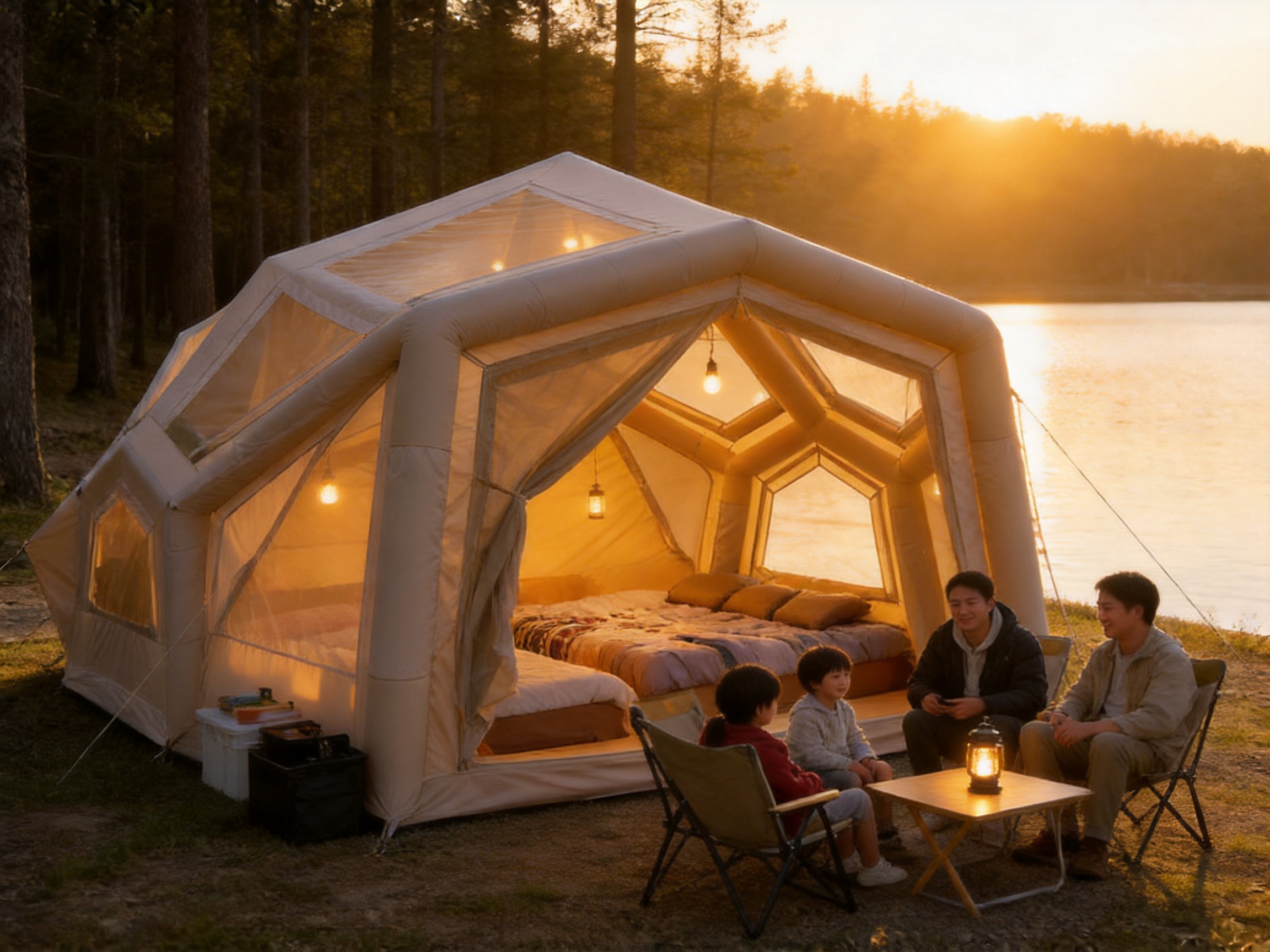
4. Comparing the Tent with Conventional Alternatives
Different tent categories serve different customers. A fair comparison should consider the intended application rather than claiming that one shelter is ideal for every situation. The luxury inflatable family tent is most competitive where spaciousness, quick installation, visual appeal, and flexible use are important.
| Comparison Factor | Luxury Inflatable Family Tent | Traditional Pole Family Tent | Compact Backpacking Tent | Basic Event Shelter |
|---|---|---|---|---|
| Primary Strength | Comfortable space with simplified inflation-based setup | Familiar structure and broad availability | Low packed weight and mobility | Large open coverage for short events |
| Setup Experience | Designed for quick inflation and reduced frame assembly | May require multiple poles and more assembly steps | Usually simple but limited by smaller size | May require a frame, anchors, and several installers |
| Interior Use | Sleeping, relaxing, dining, and family activities | Primarily sleeping and basic shelter | Sleeping and essential storage | Often open-sided and less suitable for private sleeping |
| Visual Positioning | Modern, premium, and suitable for leisure settings | Functional family camping appearance | Technical and compact | Utility-focused event appearance |
| Best Applications | Family camping, glamping, resorts, festivals, gatherings | General recreational camping | Trekking and lightweight travel | Temporary shade, markets, and outdoor events |
| Key Consideration | Requires correct inflation, anchoring, and care | Requires pole organization and assembly | Offers less space and comfort | May provide limited privacy and weather protection |
Compared with Traditional Pole Tents
A pole tent may be familiar and widely used, but a large model can involve considerable assembly. Poles must be identified, connected, positioned, and inserted into sleeves or attachment points. When a family arrives late at a campsite or encounters rain during setup, these steps can become inconvenient.
The inflatable alternative focuses on reducing this burden. Its structure is formed through inflation rather than by assembling an extensive rigid frame. This can provide a more accessible installation experience, especially for users who prefer practical convenience. It also creates a distinctive product identity for retailers and brands seeking something beyond standard pole-based designs.
Compared with Backpacking Tents
Backpacking tents are designed around portability and low weight. Their compact size is a major advantage on long-distance trails, but the same compactness limits interior comfort. They are not normally intended to function as a family lounge, dining room, or flexible day shelter.
The large inflatable family tent serves a different market. It is better suited to customers traveling by car, staying at established campsites, operating a glamping location, or seeking a comfortable base for several people. Its value lies in usable living space and convenience rather than extreme weight reduction.
Compared with Basic Event Shelters
Basic event shelters often provide overhead coverage but may be open on several sides. They can be useful for shade, temporary displays, food service, or short outdoor activities. However, they may not provide the same privacy, enclosed comfort, or sleeping capability as a family tent.
The inflatable tent offers greater flexibility because it can function as a private resting area, family shelter, festival lounge, or covered social space. Its more refined appearance may also fit better with premium events, resort settings, and hospitality projects where the shelter contributes to the overall atmosphere.
5. Flexible Applications in Different Outdoor Settings
Family Camping
The primary application is family camping. Parents can use the shelter as a central base for sleeping, changing clothes, organizing supplies, and resting between outdoor activities. Children can benefit from having enough room to move around safely inside rather than remaining confined to a small sleeping compartment.
Family trips often involve different schedules and preferences. One person may want to rest while another prepares food or plans the next activity. A larger interior makes it easier to accommodate these routines. It also provides a comfortable fallback area when rain, heat, insects, or tiredness interrupt outdoor plans.
Mountain, Forest, and Lakeside Trips
The product is suitable for leisure camping in mountains, forests, and lakeside areas when the site and weather conditions are appropriate. Its waterproof and wear-resistant fabric supports outdoor use, while the spacious structure allows campers to enjoy longer stays with more comfort.
Site selection remains essential. Users should choose level ground, maintain a safe distance from rivers and unstable slopes, remove sharp objects beneath the tent, and use suitable anchoring equipment. A well-designed tent performs best when installed correctly in a suitable environment.
Outdoor Picnics and Sun-Shade Areas
The tent can also be used as a sunshade or covered rest area during outdoor picnics. In this role, it provides a more substantial alternative to a small umbrella or open canopy. Families can place seating, coolers, games, and picnic supplies inside while maintaining a comfortable gathering point.
A covered structure can be especially useful for multigenerational groups. Older family members may need a place to sit away from direct sun, while children can take breaks between activities. The shelter can help make a picnic more organized and comfortable without requiring a permanent structure.
Festivals and Cultural Events
Festivals require spaces that are easy to identify, practical to install, and adaptable to changing programs. The inflatable tent can be used as a rest area, hospitality lounge, staff shelter, information space, or small activity zone. Its modern appearance can also support the visual identity of an event.
Event organizers should evaluate local regulations, fire-safety requirements, anchoring rules, occupancy limits, and access routes before installation. For commercial events, the operating team should receive clear training on inflation, deflation, storage, and emergency procedures.
Friends’ Gatherings and Social Activities
A spacious shelter can transform a campsite into a social environment. Friends can gather for meals, conversation, games, or evening relaxation without being fully exposed to wind and sun. The interior can be arranged according to the occasion, allowing users to create a lounge, dining area, or informal meeting space.
Glamping and Resort Operations
Glamping businesses and resorts often seek accommodation products that combine outdoor atmosphere with comfort and visual appeal. An inflatable tent can contribute to a distinctive guest experience by offering a spacious shelter that feels more like a temporary outdoor room than a basic camping enclosure.
For commercial operators, product selection should include more than appearance. Important considerations include repeat-use durability, cleaning procedures, replacement parts, staff training, packing dimensions, maintenance requirements, and the ability to order consistent products over time. A manufacturer with OEM and international supply experience can be valuable in these areas.
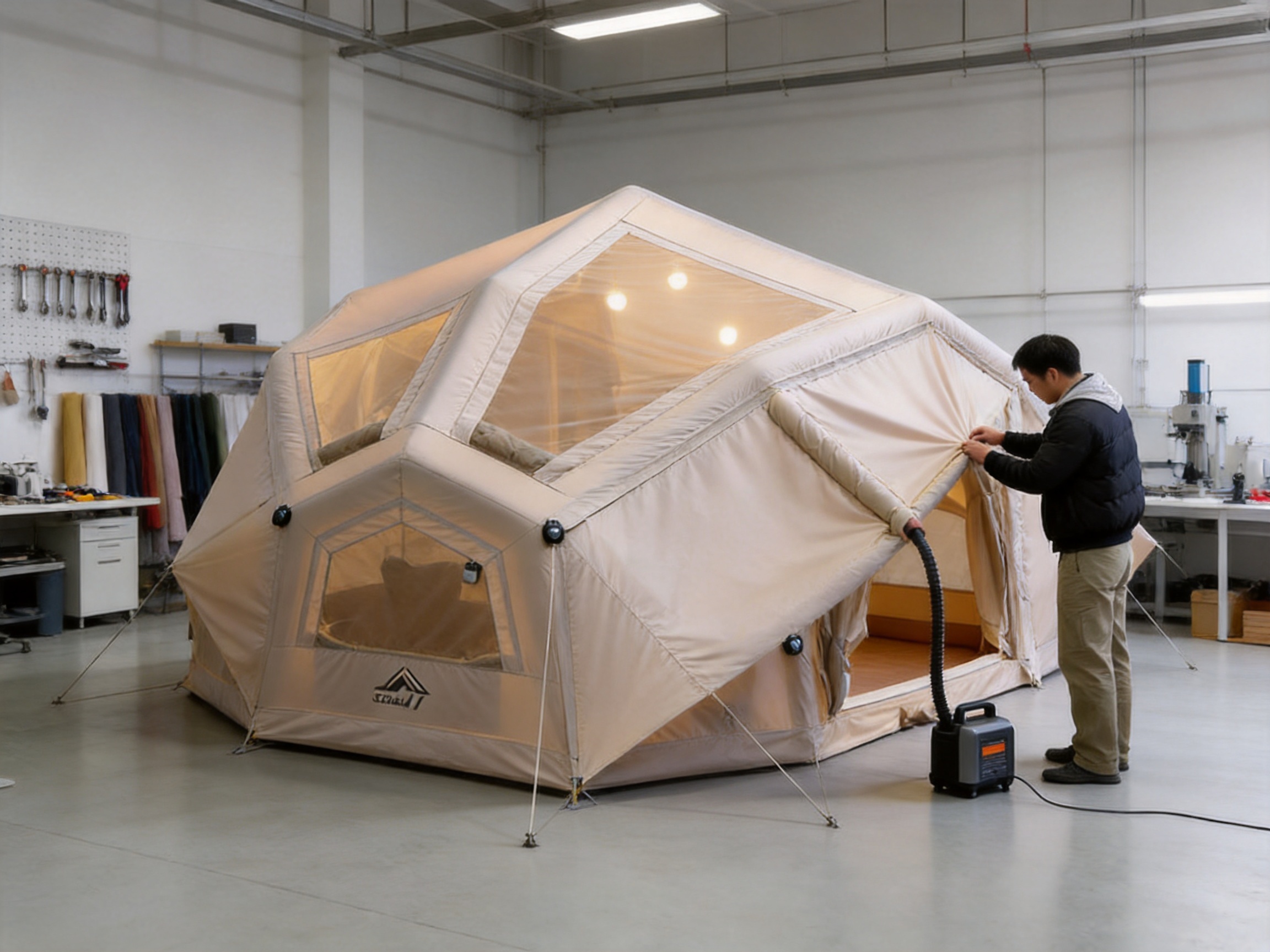
6. Manufacturing Strengths and Product Development Experience
The product is supported by the manufacturing capabilities of Ningbo Zhenhai Tiansai Leisure Products Co., Ltd. The company operates a factory covering more than 13,000 square meters, providing a production base for tent design, development, manufacturing, inspection, packaging, and export coordination.
A large and established factory environment can support better division of responsibilities. Design teams can focus on usability and appearance, production personnel can follow defined manufacturing procedures, and quality staff can check materials and finished products. This structure is particularly important for large tents because their size increases the number of panels, seams, connection points, and structural details that must be controlled.
Professional Design Capability
The company has established a professional design team that develops products from the perspectives of practicality and comfort. This approach is important because outdoor products must perform in real environments rather than only look attractive in a catalog.
Practical design includes considerations such as how easily the product can be installed, how users move inside it, how equipment is stored, how the tent is packed, and how the shelter responds to common outdoor conditions. Comfort involves usable space, atmosphere, privacy, ventilation planning, and the overall experience of staying inside the structure.
The company also works with professionals and invites outdoor enthusiasts to participate in testing. Feedback from actual users can reveal details that may not be obvious during computer-aided design or factory inspection. A zipper may need repositioning, a storage feature may need reinforcement, or an inflation point may need to be more accessible. Continuous feedback helps connect product development with real camping behavior.
Patents and Innovation
Tiansai Leisure has successfully designed and obtained a number of appearance patents and utility model patents. These achievements indicate an ongoing focus on product innovation and design differentiation. For international buyers, original design capability can provide a useful advantage when developing a distinctive product line rather than selling a generic shelter.
Innovation in the tent industry does not depend only on adding decorative features. It may involve structural improvements, more efficient assembly, better use of materials, improved comfort, simpler maintenance, or more practical configurations. A product that solves several everyday problems at once can offer stronger long-term value than one that focuses solely on visual novelty.
International Market Experience
The company’s products are exported to many countries and regions, including North America, Europe, Asia, and other markets. International experience requires awareness of different customer expectations, climate conditions, packaging needs, communication practices, and quality requirements.
The company has also become the sole global designated supplier of the British company TENTSILE. This relationship reflects experience in producing outdoor products for an international brand and supporting overseas supply requirements. For buyers seeking a reliable OEM or wholesale partner, experience with established outdoor brands can be an important consideration.
Quality Management Approach
The company states that it strictly implements a quality management system to ensure that products meet international standards. Quality management is especially relevant to inflatable shelters because the product depends on the interaction of fabric, seams, air-support components, valves, anchoring points, and accessories.
A responsible quality process may include incoming material checks, cutting accuracy control, sewing or bonding inspection, structural examination, inflation checks, appearance review, packaging inspection, and documentation. The exact inspection program should be confirmed with the manufacturer for each model and order, but the overall principle is clear: quality must be managed throughout production rather than checked only at the final stage.
7. Production Processes That Support Reliability
Although specific factory procedures may vary by model and order, manufacturing an inflatable family tent generally requires a coordinated sequence of operations. Each stage affects the finished product’s performance, appearance, and service life.
Material Selection and Incoming Inspection
Production begins with the selection of suitable fabric, thread, webbing, valves, fasteners, reinforcement materials, and accessories. Materials should be checked for consistency, visible damage, color variation, thickness, and compatibility with the intended construction method.
For an outdoor shelter, the material must balance strength, flexibility, waterproof performance, handling, and appearance. A fabric that is too rigid may be difficult to fold or sew, while one that is too light may not provide the desired durability. Matching the material to the product’s intended use is therefore an essential design and purchasing decision.
Pattern Development and Precision Cutting
Large tents contain numerous panels, and small cutting errors can become more significant during assembly. Accurate patterns help ensure that panels align correctly and that the structure maintains the intended shape after inflation.
Computer-assisted design and controlled cutting can improve repeatability. Consistent panel dimensions are important for both appearance and performance. They also help maintain production consistency across wholesale orders, private-label programs, and replacement components.
Sewing, Bonding, and Reinforcement
Seams are among the most important areas of a tent. They connect panels, transfer loads, and help prevent water from entering the shelter. Depending on the material and design, manufacturers may use specialized sewing, bonding, seam treatment, or a combination of construction methods.
High-stress areas require particular attention. Corners, webbing attachments, guy-line points, air-beam connections, door openings, and valve areas may need additional reinforcement. A strong design distributes forces instead of concentrating them in a single weak point.
Air-Beam and Inflation-System Assembly
The air-supported structure is central to the product. Air beams must be assembled carefully, connected securely, and integrated with the outer tent body. Inflation valves and related components must be positioned for convenient access and reliable operation.
The one-click inflation concept is intended to simplify setup for the user. Before shipment, manufacturers should verify that the inflation system operates correctly and that the air-supported sections maintain their intended shape. Buyers should ask for model-specific instructions concerning inflation time, operating pressure, pump compatibility, inspection, and safe deflation.
Functional Testing and Final Inspection
Testing may include inflation checks, visual inspections, seam examinations, accessory verification, folding evaluations, and sample-based weather or leakage testing. A completed tent should be inspected for workmanship, cleanliness, labeling, packaging, and completeness of the accessory set.
Final inspection is not a substitute for process control, but it provides an important last opportunity to identify issues before shipment. For large orders, buyers may also arrange pre-shipment inspections or agree on approved samples and quality standards in advance.
8. Comfort, Layout, and Everyday Usability
A large tent is valuable only when its space is easy to use. Interior layout should support natural movement and allow users to organize equipment without blocking doors or ventilation areas. Families may place sleeping mats, folding chairs, luggage, tables, and personal items inside, so a practical arrangement is important.
Users should consider how the tent will be used during different parts of the day. A sleeping layout may require clear floor zones, while daytime use may benefit from central open space. If the tent is used as a resort unit or event lounge, furniture placement should leave accessible walkways and maintain a comfortable sense of openness.
Ventilation is another essential consideration. Even a spacious tent needs appropriate airflow, especially when several people are inside. Users should operate available ventilation features according to the instructions and avoid blocking vents with luggage or furniture. In warm weather, shade, airflow, and site selection all contribute to interior comfort.
Privacy can also influence the user experience. A fully enclosed shelter offers a more private environment than an open canopy, making it useful for changing clothes, resting children, taking breaks, or creating a quiet area at a busy outdoor event.
9. Sustainability and Responsible Outdoor Use
The company states that it plans to increase investment in lightweight and environmentally friendly materials. This direction reflects broader changes in the outdoor industry, where customers increasingly consider material efficiency, product longevity, packaging, repairability, and responsible end-of-life handling.
A durable tent can support sustainability by remaining useful for many trips rather than being replaced after limited use. Proper storage is important: the shelter should be clean and fully dry before packing whenever possible. Moisture left inside folded fabric can contribute to odor, mildew, or material deterioration.
Users should also avoid unnecessary damage to the campsite. They should follow local regulations, dispose of waste properly, respect vegetation, and minimize disturbance to wildlife. A comfortable shelter should enhance contact with nature, not create additional environmental harm.
For commercial operators, sustainability can be incorporated into purchasing decisions. Buyers may evaluate whether the supplier offers repair components, packaging optimization, replacement parts, material information, and long-term product support. These considerations can reduce operating waste and improve the total value of the equipment.
10. Purchasing for Wholesale, OEM, and Resort Projects
Businesses considering this product should define their intended application before placing an order. A family retail product may require different colors, packaging, accessories, and instructions than a resort or festival model. Clear requirements help the manufacturer recommend a suitable configuration.
Important purchasing questions may include the target capacity, dimensions, fabric specification, color, logo placement, packaging format, inflation equipment, anchoring accessories, order quantity, production schedule, inspection procedure, and shipping method. Buyers should also confirm whether the product is intended for private-label sale, direct hospitality use, rental operations, or event deployment.
OEM cooperation can provide opportunities for customization. Depending on the project, customization may involve appearance, branding, interior configuration, fabric selection, accessory combinations, packaging, manuals, and product features. Any custom development should be evaluated carefully because changes to dimensions or materials can affect inflation behavior, structural performance, shipping volume, and production cost.
For wholesale buyers, consistency is particularly important. A supplier should be able to reproduce approved specifications across production batches. Color matching, logo placement, stitching quality, accessory compatibility, and packaging details all influence customer satisfaction and brand reputation.
The manufacturer’s full-link service philosophy is intended to support customers from product development through production and overseas delivery. A one-stop partner can simplify communication, especially when a project requires design discussion, sample approval, production coordination, inspection, and after-sales support.
11. Care, Maintenance, and Safe Operation
Correct use helps preserve the performance of any inflatable tent. Before installation, users should inspect the fabric, air beams, valves, zippers, guy lines, and anchoring points. Sharp objects should be removed from the ground, and the tent should be placed away from hazards such as dead branches, unstable slopes, and areas prone to flooding.
The tent should be inflated according to the manufacturer’s instructions. Users should not exceed the recommended inflation level or use incompatible equipment. Once inflated, the structure should be checked for unusual deformation, visible damage, or air loss. If a problem is discovered, the tent should be repaired or assessed before continued use.
Anchoring is essential, even when the air structure appears stable. Wind can place significant force on a large shelter. Pegs, guy lines, and attachment points should be installed correctly, and the shelter should be monitored if weather conditions change.
After use, the tent should be deflated carefully, cleaned as appropriate, and dried completely before long-term storage. It should be folded according to the recommended method to reduce unnecessary creasing or pressure on valves and seams. Heavy objects should not be placed on the packed tent for extended periods.
Repairs should be performed with compatible materials and appropriate procedures. Users should contact the supplier when they need advice about air-beam repair, replacement valves, fabric patches, or other components. Commercial operators should maintain a written inspection and cleaning schedule to support safe, consistent use across multiple guest groups.
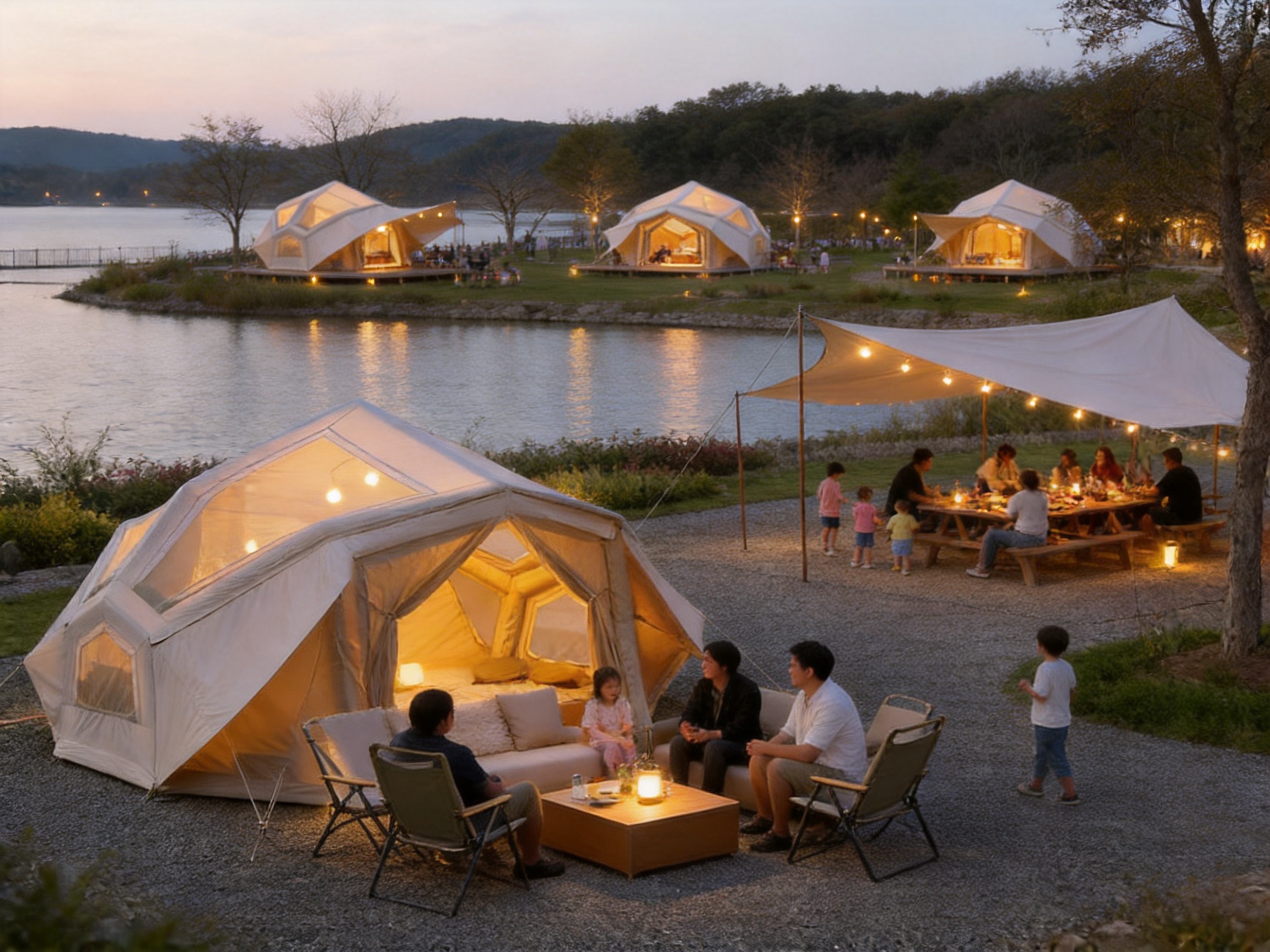
12. Why This Product Is a Strong Competitive Choice
The product’s competitive value comes from the way several benefits work together. It is not simply a large tent, and it is not only an inflatable structure. It combines generous family-oriented space, a premium appearance, simplified setup, flexible applications, weather-oriented materials, and support from an experienced outdoor-product manufacturer.
Compared with a basic pole tent, it can offer a more convenient installation experience and a distinctive visual identity. Compared with a compact backpacking shelter, it provides substantially more room for families and groups. Compared with an open event canopy, it can deliver greater enclosure, privacy, and all-around usability. Compared with a purely decorative glamping structure, it is positioned around practical outdoor use as well as appearance.
The manufacturing background further strengthens the product proposition. A factory exceeding 13,000 square meters, an experienced design team, international export capability, patent activity, outdoor testing, and a stated quality management system provide a foundation for stable production and product development.
These advantages are particularly relevant to buyers who want more than a one-season novelty. Retailers can offer customers a high-comfort family shelter. Resorts can create attractive accommodation or lounge spaces. Event operators can establish flexible covered areas. Outdoor brands can explore OEM programs with a manufacturer experienced in international cooperation.
The right choice still depends on the intended use. Customers who prioritize ultralight trekking should consider specialized backpacking products. Customers who require expedition-grade shelters for extreme environments should seek equipment designed for those conditions. However, for comfortable family camping, leisure travel, glamping, resort operation, festivals, and social outdoor activities, this inflatable shelter offers a compelling balance of convenience, space, and style.
13. Frequently Asked Questions
What is the main purpose of this inflatable camping tent?
The tent is designed as a spacious outdoor shelter for families and groups. It can be used for camping, leisure, relaxation, picnics, festivals, gatherings, glamping, and resort applications. Its interior can support sleeping, resting, dining, and social activities.
How is an inflatable tent different from a traditional pole tent?
An inflatable tent uses air-supported structural elements instead of relying primarily on a set of rigid poles. This can reduce the number of assembly steps and make setup more convenient. Users still need to inflate, anchor, inspect, and maintain the tent correctly.
Is the tent suitable for family camping?
Yes. The spacious design is specifically intended to accommodate an entire family or a group of people. It provides more usable living space than a compact backpacking tent and can function as a central family shelter during a camping trip.
Can the tent be used in rainy weather?
The product is described as using waterproof fabric and is intended to provide protection in outdoor conditions. However, safe installation, correct anchoring, suitable site selection, closed openings, and proper maintenance are also necessary. Users should follow the model-specific instructions and avoid extreme weather beyond the product’s intended use.
Can it be used as a sunshade?
Yes. The product can be used as a covered rest area or sunshade for outdoor picnics and similar activities. The exact configuration and ventilation approach should follow the manufacturer’s instructions for the specific model.
Is it suitable for festivals and resort projects?
It can be used for festival rest areas, event lounges, resort spaces, and other leisure applications. Commercial users should confirm local regulations, fire-safety requirements, occupancy rules, anchoring requirements, cleaning procedures, and operating conditions before deployment.
What makes the product suitable for wholesale or OEM cooperation?
The manufacturer has a factory exceeding 13,000 square meters, international export experience, a professional design team, patent development experience, and experience serving overseas outdoor brands. Buyers can discuss product specifications, packaging, branding, accessories, and other customization requirements according to their project.
What should buyers confirm before ordering?
Buyers should confirm dimensions, capacity, material specifications, color, branding, inflation equipment, anchoring accessories, packaging, inspection standards, order quantity, production schedule, shipping terms, warranty arrangements, and after-sales support. A sample approval process is recommended for customized or large-volume orders.
How should the tent be stored?
The tent should be cleaned and fully dried before storage whenever possible. It should be deflated, folded according to the instructions, protected from sharp objects, and kept in a dry environment away from excessive heat, moisture, and direct sunlight.
Does the manufacturer support product development?
The company has a professional design team and develops products with attention to practicality and comfort. It also uses feedback from professionals and outdoor enthusiasts to improve product performance. Buyers should discuss the available development and customization scope directly for their specific project.
Conclusion
The luxury inflatable camping tent provides a practical response to the evolving expectations of outdoor customers. It offers the space families need, the quick setup many users prefer, the weather-oriented materials required for outdoor use, and the modern appearance demanded by glamping, resort, and event applications.
Its greatest advantage is versatility. The shelter can serve as a family campsite, a picnic shade area, a festival lounge, a social gathering space, or a commercial outdoor accommodation unit. This ability to support multiple uses increases its value for both individual customers and professional operators.
The manufacturing foundation is equally important. Ningbo Zhenhai Tiansai Leisure Products Co., Ltd. combines a substantial factory base, design and development experience, patent activity, international market service, outdoor-product expertise, and a stated commitment to quality management. These strengths support the production of tents intended to deliver comfort, convenience, and dependable outdoor performance.
For customers seeking an alternative to crowded traditional tents, complicated pole systems, or basic open shelters, this inflatable family tent presents a more refined way to experience nature. With correct installation, responsible care, and suitable site selection, it can become a durable and flexible centerpiece for memorable outdoor adventures.
References
1. Product information supplied for the luxury inflatable camping tent, including its described features, applications, materials, and inflation system.
2. Company information supplied for Ningbo Zhenhai Tiansai Leisure Products Co., Ltd., including factory capacity, design experience, export markets, and quality-management approach.
3. General principles of outdoor tent design, including fabric selection, seam construction, structural reinforcement, anchoring, ventilation, and maintenance.
4. General guidance for safe family camping, outdoor shelter installation, weather awareness, campsite selection, and responsible outdoor recreation.
5. General principles of OEM and wholesale product development, including sample approval, specification control, packaging coordination, inspection, and after-sales support.
Product: Luxury Inflatable Camping Tent Large Family Outdoor Shelter Cabin

Message Us Right Now!
-
Mp: +86-18858091910
E-mail: sales@tenplaytent.com
ADD: No. 529, Guangyuan Road, Xiepu Town, Zhenhai District, Ningbo City, Zhejiang Province, China
-
Quick Links
Home Products About Us Advantage News Contact Us -
Product
Inflatable & Air Tents Glamping & Resort Tents Backpacking & Trekking Tents Automatic & Pop-Up Tents Family & Camping Tents Specialty Tents & Shelters Kids Tents Pet Tents Humanitarian & Large Tents Hammock -
Get Connected
 Camping Tent Manufacturer in China