

 English
 عربى

12m² Oxford Fabric Inflatable Tent for 6–8 People: A Practical Guide to High-Capacity Four-Season Outdoor Accommodation
Modern outdoor accommodation needs to combine comfort, portability, durability, and commercial practicality. The 12m² Oxford fabric inflatable tent for 6–8 people is designed to address these requirements in one spacious shelter. With an unfolded size of 400 × 300 × 210 cm, a reinforced PVC air-column frame, a 210D Oxford fabric body, and a 3000 mm waterproof rating, it provides a substantial living area without relying on a conventional metal pole structure.
This type of inflatable tent is suitable for family car-camping, glamping resorts, festival accommodation, outdoor fishing, backyard leisure, and tent rental operations. It is also well suited to outdoor brands, hospitality operators, event organizers, and distributors seeking a customizable tent platform for wholesale or private-label programs.
Compared with many standard pole tents in the same capacity range, this model offers a different balance of setup convenience, interior volume, structural organization, and transportability. The inflatable architecture reduces the number of rigid components that must be assembled, while the Oxford fabric shell provides a practical combination of abrasion resistance, weather protection, and manageable weight.
The product is manufactured by Ningbo Zhenhai Tiansai Leisure Products Co., Ltd., a Chinese tent producer with a factory of more than 13,000 square meters and experience in design, production, export, and OEM and ODM development. The company’s production capabilities support customized colors, dimensions, structures, fabrics, logos, and performance requirements for professional buyers.
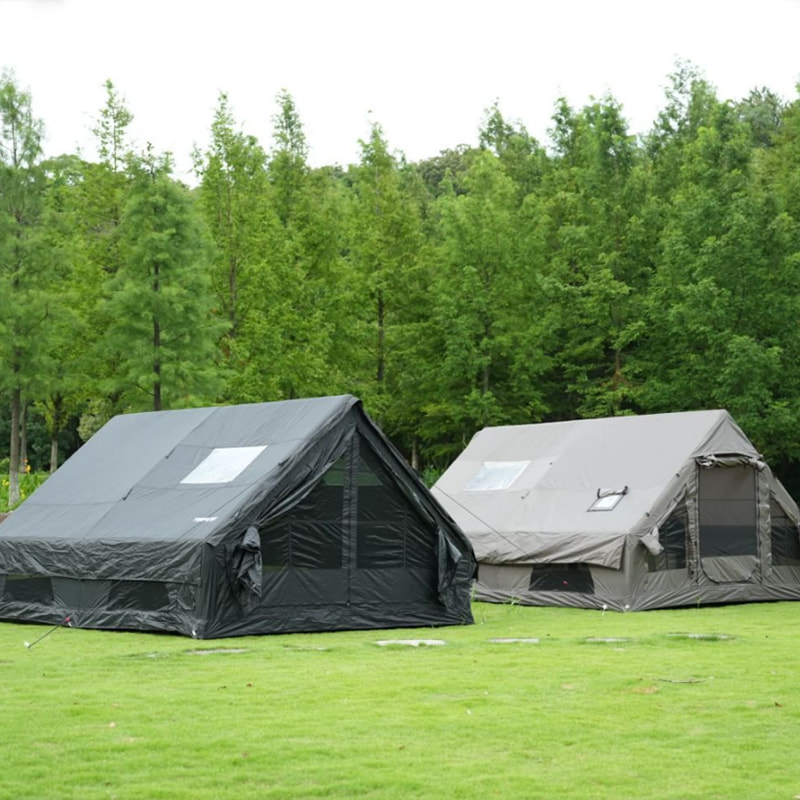
12m² Oxford Fabric Inflatable Tent for 6-8 People
1. Product Overview
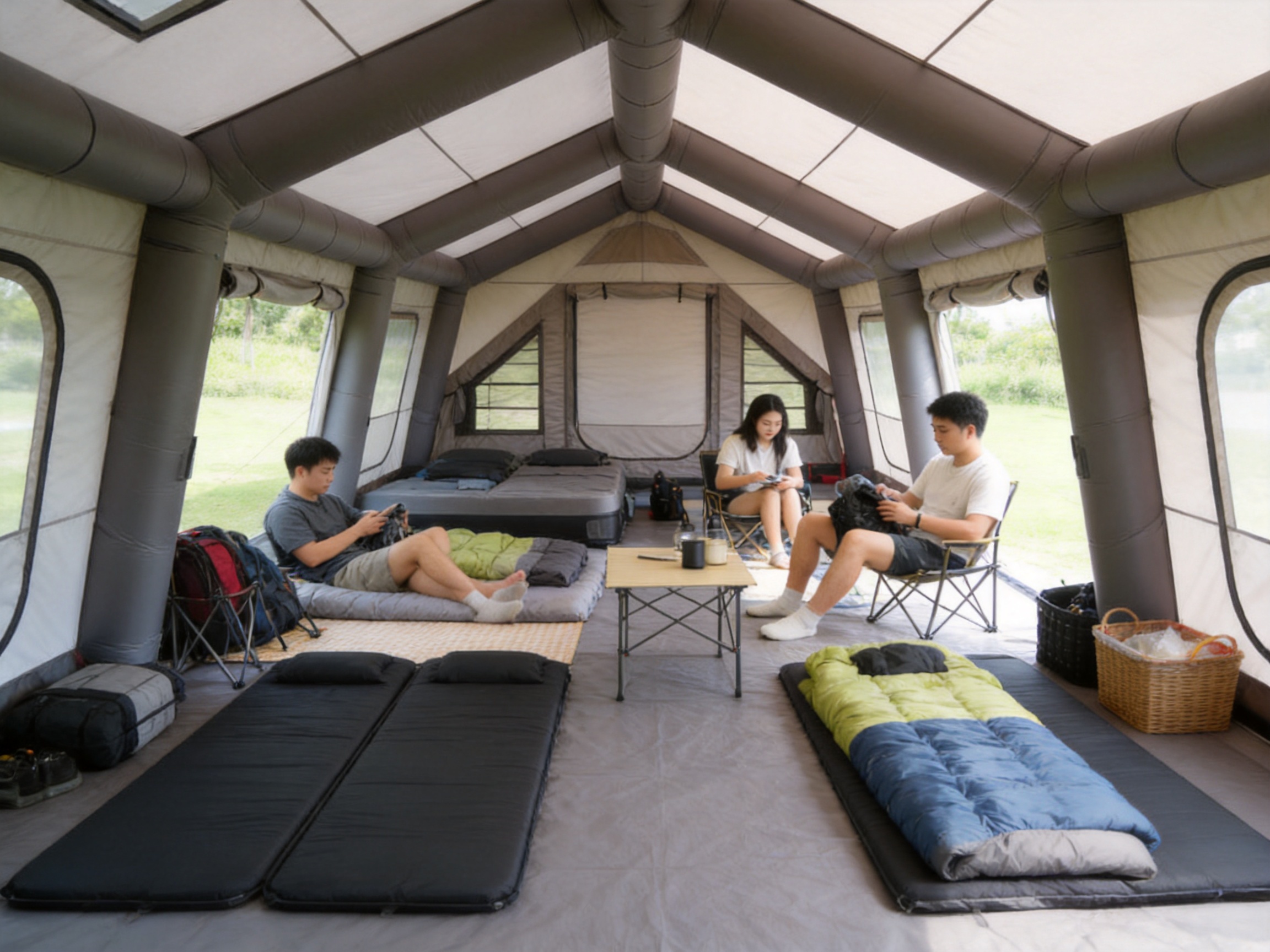
The 12m² inflatable tent is a large-capacity outdoor shelter intended for six to eight people. Its 400 cm length and 300 cm width create a total floor area of approximately 12 square meters, while the 210 cm peak height allows most users to stand and move around comfortably inside.
The tent is supplied as one complete set packed into a carton with an outer bag. Its packed dimensions are approximately 80 × 50 × 37 cm, and its listed weight is 25 kg. These specifications make it suitable for organized transport by car, freight shipment, rental inventory logistics, and warehouse storage.
The main tent fabric is 210D Oxford fabric with a listed weight of 90 gsm. A matching 210D Oxford groundsheet provides a continuous protective layer between occupants and the ground. The shelter is supported by a PVC air-column frame rather than a full network of steel or fiberglass poles.
The tent is rated for four-season use and offers a listed wind-resistance level of 6, a 3000 mm waterproof rating, and UPF 50+ ultraviolet protection. These figures indicate that the tent is designed for demanding outdoor use, although correct anchoring, site selection, ventilation, and weather judgment remain essential for safe operation.
| Specification | Details |
|---|---|
| Product type | Inflatable outdoor tent |
| Capacity | 6–8 people |
| Floor area | Approximately 12m² |
| Unfolded size | 400 × 300 × 210 cm |
| Packed size | 80 × 50 × 37 cm |
| Product weight | 25 kg |
| Main fabric | 210D Oxford fabric, 90 gsm |
| Groundsheet | 210D Oxford fabric |
| Support structure | PVC air column |
| Waterproof rating | 3000 mm |
| Ultraviolet protection | UPF 50+ |
| Wind resistance | Level 6 |
| Season classification | Four season |
| Packaging | Outer bag and carton |
| Packing quantity | One set per carton |
| Minimum order quantity | 100 sets |
2. Spacious Interior for Family and Group Camping
The largest advantage of a 12m² shelter is usable interior volume. Many tents advertised for six to eight people provide enough sleeping capacity only when occupants use compact sleeping arrangements and store equipment outside. A 400 × 300 cm floor plan provides more flexibility for sleeping mats, inflatable beds, luggage, camping furniture, and personal equipment.
For family camping, the interior can be organized into sleeping and living zones. Two or three sleeping areas can be arranged along the sides, leaving a central passage for movement. Families can also use the space for changing clothes, preparing personal items, reading, or relaxing when weather conditions prevent outdoor activities.
For glamping applications, the same floor area can accommodate a bed, side tables, lighting, soft furnishings, storage baskets, and decorative accessories. The 210 cm height gives the tent a more open and room-like feeling than low-profile backpacking shelters. This makes it a practical foundation for resort accommodation, seasonal campsites, and outdoor hospitality projects.
For festival camping, the capacity allows groups of friends to share one shelter while keeping equipment organized. The high roof reduces the confined feeling associated with many compact dome tents. For fishing and backyard leisure, the large floor plan creates room for chairs, coolers, equipment bags, and other recreational supplies.
Capacity figures should always be interpreted according to the intended use. Six to eight people may fit for sleeping with efficient organization, while fewer occupants will have more living space and comfort. Commercial operators can also position the tent as a six-person premium model, a family shelter for four to six people, or a maximum-capacity group tent for eight compact sleepers.
Interior Planning Advantages
The rectangular floor plan is straightforward to furnish and divide. It avoids some of the unusable corner areas found in highly tapered tent designs. Operators can place beds and furniture against the walls, while the central area remains available for circulation.
The height of 210 cm is particularly valuable for glamping and rental applications. Guests can enter, change clothes, and organize belongings without constantly bending. A higher interior also supports the use of standard camping tables, chairs, storage systems, and decorative lighting.
For product distributors, the large interior volume broadens the target market. The tent can be presented to families, outdoor clubs, event companies, holiday parks, rental businesses, and hospitality operators instead of being limited to backpackers or minimalist campers.
3. Inflatable Air-Column Construction
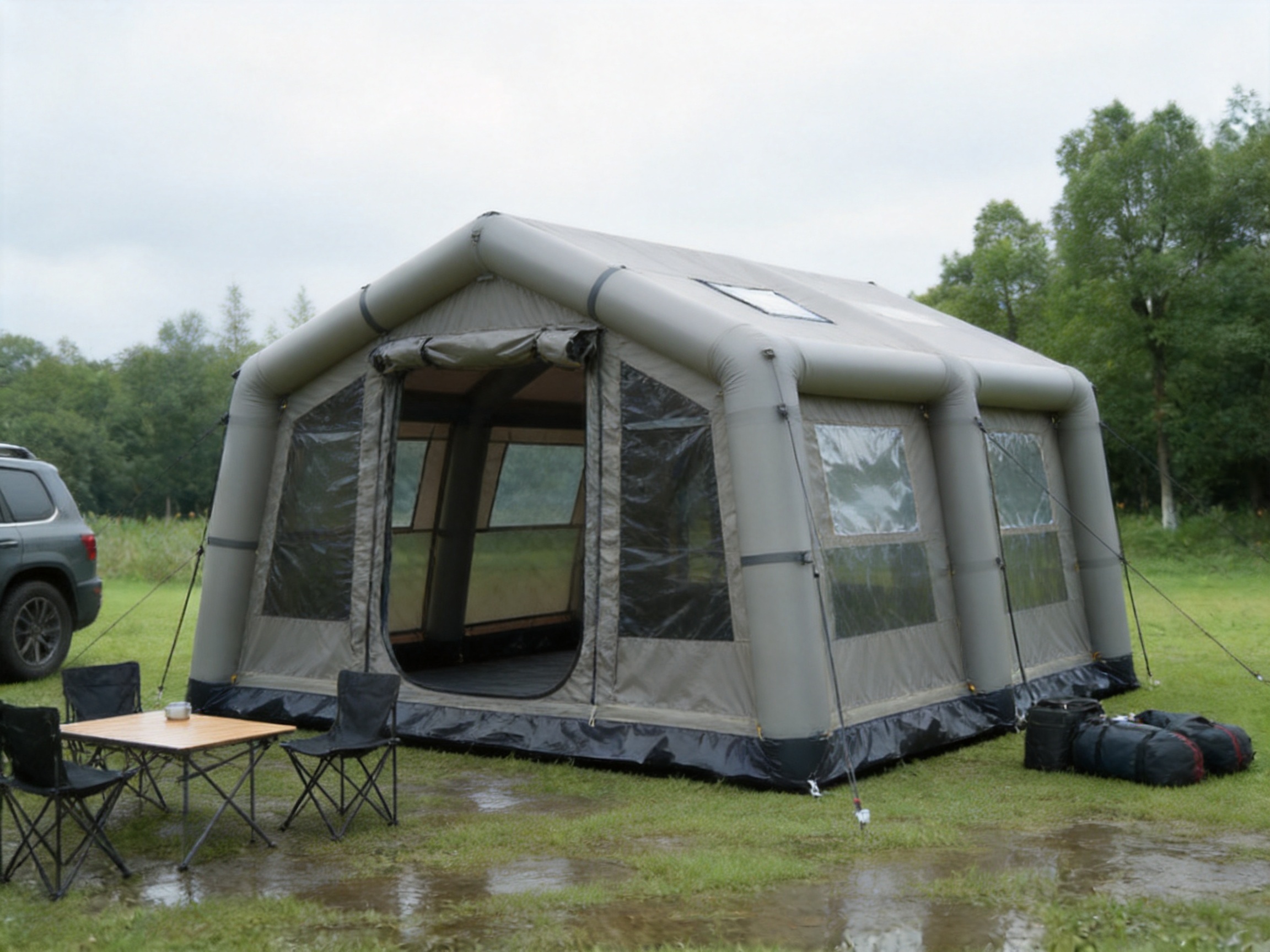
The reinforced PVC air-column frame is the defining feature of this shelter. Instead of requiring multiple rigid poles to be connected and threaded through sleeves, the tent obtains structural support from air-filled columns integrated into the design. Once inflated to the required pressure, these columns create the main frame that supports the fabric canopy.
This construction can simplify setup because users do not need to assemble a large collection of pole sections. The absence of a complex metal framework also makes packing and unpacking more convenient. For families and rental operators, reducing the number of loose structural components can make inventory management easier.
An inflatable frame is also useful for commercial applications where tents are repeatedly installed and removed. Staff can learn a consistent inflation process and follow a standard inspection routine. When the air structure is deflated, the tent can be folded into its carry bag and prepared for transport or storage.
The PVC air column is reinforced to support repeated outdoor use. However, the frame should still be protected from sharp objects, rough handling, excessive heat, and incorrect inflation pressure. A suitable ground inspection before setup is important because stones, branches, broken glass, and other sharp debris may damage the floor or air system.
Setup Efficiency
Traditional large tents often require two or more people to sort poles, connect sections, lift the canopy, and attach the fabric to the frame. An inflatable model can reduce these steps. The user generally spreads the tent, connects the inflation system, raises the air columns, secures the guy lines, and completes the anchoring process.
The exact setup time depends on the pump, weather conditions, ground type, user experience, and final design configuration. Buyers should follow the supplied operating instructions and use the correct pump and pressure recommendations. The air frame should not be overinflated, and all valves should be checked before the tent is occupied.
For rental businesses, a simpler setup process can help reduce labor requirements during turnover between customers. Staff can also inspect valves, air tubes, seams, zippers, anchor points, and fabric surfaces as part of a repeatable service procedure.
Storage and Transport Benefits
When deflated, the air-column system does not require long rigid poles to remain attached to the package. This contributes to the compact packed size of 80 × 50 × 37 cm. A compact package is easier to load into a vehicle, move through a warehouse, or ship as part of a larger order.
The 25 kg product weight is appropriate for a shelter of this capacity and material specification, although it is not intended to compete directly with ultralight backpacking tents. Its design prioritizes space, weather protection, and group use rather than minimum carry weight.
The included outer bag supports handling and protects the folded tent during ordinary transport. Carton packaging adds an additional layer of protection for wholesale shipment, distribution, and factory-to-customer logistics.
4. Oxford Fabric Performance
The tent uses 210D Oxford fabric with a stated fabric weight of 90 gsm. Oxford fabric is widely used in outdoor products because its woven construction offers a practical balance between flexibility, strength, abrasion resistance, and cost control.
For a large family or commercial tent, fabric durability is important because the shelter may be folded, unfolded, moved, and installed repeatedly. The fabric must also withstand contact with equipment, ground conditions, moisture, and regular handling. Oxford fabric is well suited to these requirements when it is properly coated, sewn, reinforced, and maintained.
The matching Oxford groundsheet creates a consistent material system across the main shelter and floor. The groundsheet helps reduce contact between occupants and wet soil while providing a protective base for sleeping equipment, furniture, and personal belongings.
A 90 gsm fabric specification can help reduce unnecessary bulk while preserving useful coverage for outdoor accommodation. The performance of the finished tent depends not only on fabric weight but also on yarn quality, coating technology, seam construction, stitching density, reinforcement patches, zipper quality, and production inspection.
Waterproof Protection
The listed waterproof rating is 3000 mm. This rating represents the pressure of water that the fabric coating can withstand under a standardized hydrostatic test. A higher number generally indicates stronger resistance to water penetration through the fabric itself.
A 3000 mm rating is appropriate for many family camping, glamping, festival, and rental applications. It can provide protection during sustained rain when the tent is correctly pitched and maintained. The rating does not mean that water can never enter the shelter. Water resistance also depends on seam sealing, zipper design, fabric tension, roof angle, groundsheet layout, drainage, and setup quality.
Users should pitch the tent on well-drained ground and avoid depressions where rainwater can collect. The groundsheet should be positioned correctly, and doors and ventilation openings should be closed or adjusted according to weather conditions. After use, the tent should be dried fully before long-term storage.
Ultraviolet Protection
The UPF 50+ rating helps protect the fabric from ultraviolet exposure and supports more comfortable use in sunny environments. This is particularly relevant to glamping resorts, festival operators, beachside camping, and backyard leisure settings where tents may remain exposed during the day.
Ultraviolet protection does not eliminate the effects of long-term sunlight. Any fabric shelter can experience fading, coating degradation, or reduced material performance if it is left outdoors continuously without maintenance. Commercial users should rotate inventory when possible, inspect high-exposure areas, and store the tent in a dry, shaded location when it is not in use.
5. Wind Resistance and Four-Season Positioning
The tent is listed with level 6 wind resistance. This indicates a design intended for stronger outdoor conditions than basic recreational shelters, but wind performance depends heavily on correct installation and local conditions.
Anchoring is one of the most important factors in wind stability. Every available guy line and ground anchor should be used according to the manufacturer’s instructions. Anchors must be appropriate for the soil, sand, grass, gravel, or other surface where the tent is installed. The tent should be positioned to reduce direct exposure to the strongest wind direction whenever possible.
Users should inspect the air columns, anchor points, seams, zippers, and fabric tension before occupation. If severe weather exceeds the product’s intended operating conditions, the tent should be evacuated and taken down when it is safe to do so. No portable tent should be treated as a permanent building or as a substitute for an engineered shelter in extreme weather.
The four-season classification indicates that the shelter is intended for use across spring, summer, autumn, and winter conditions when properly managed. It does not necessarily mean that the tent is designed for heavy snow loading, alpine expeditions, or extreme polar environments. Buyers should match use conditions to the specific environment and request additional technical details for specialized deployments.
6. Applications Across Outdoor and Commercial Markets
Family Car-Camping
The tent provides a comfortable base for families traveling by vehicle. Because the equipment can be transported by car rather than carried over long distances, the 25 kg weight is manageable for this market. The large floor plan provides room for sleeping systems, bags, children’s belongings, and camping furniture.
Families can use the central space for meals, games, reading, or relaxing during rain. The tall interior is also useful for changing clothes and organizing equipment. Compared with several smaller tents, one large shelter may simplify group coordination and create a shared living area.
Glamping Resorts
Glamping operators need accommodation that combines a distinctive outdoor experience with practical deployment and maintenance. The 12m² inflatable structure can serve as a flexible accommodation shell for seasonal camps, garden resorts, event villages, and temporary hospitality sites.
Operators may furnish the interior with beds, rugs, lighting, side tables, storage units, and decorative textiles. The 210 cm height supports a more conventional room arrangement than low camping tents. Custom colors and structures also allow a resort to coordinate tent exteriors with its visual identity.
For hospitality applications, operators should consider local regulations, fire-safety requirements, electrical safety, emergency access, ventilation, accessibility, and guest protection. The tent can provide the fabric shelter, while the final accommodation system must be planned according to the conditions of the installation site.
Festival Camping
Festival organizers and attendees often need tents that can accommodate several people while remaining transportable. The compact packed size supports efficient movement to and from the event, and the air-column frame may reduce setup complexity compared with a large pole tent.
The interior can support shared sleeping arrangements and personal storage. Custom printing or logo placement may also help event organizers create branded accommodation for staff, performers, sponsors, or VIP guests.
Outdoor Fishing and Backyard Leisure
Fishing groups can use the tent as a base for equipment, rest, and overnight accommodation. The Oxford floor helps separate equipment from damp ground, while the spacious shape allows users to keep tackle boxes, bags, chairs, and other gear organized.
For backyard use, the shelter can function as a seasonal guest room, children’s activity area, relaxation space, or shaded entertainment zone. Its relatively large capacity makes it useful for gatherings where a standard small tent would feel restrictive.
Tent Rental Businesses
Rental companies often prioritize durability, repeatable setup, easy storage, repairability, and visual appeal. This product addresses these needs through its commercial-scale capacity, inflatable support system, Oxford fabric construction, and customization options.
A rental operator can select colors, add logos, modify selected structural features, and develop a product line for family camping, glamping, festivals, or corporate events. The 100-set MOQ is suitable for businesses planning a substantial fleet rather than purchasing a few individual units.
7. Advantages Compared with Conventional Competitor Designs
Different tent constructions serve different users, so the most appropriate comparison depends on the application. This inflatable Oxford fabric model offers several advantages over many conventional pole tents and lower-capacity recreational tents.
| Comparison factor | Inflatable Oxford tent | Typical small pole tent | Potential commercial benefit |
|---|---|---|---|
| Interior capacity | Approximately 12m² for 6–8 people | Often more limited | Supports families, groups, and furnished glamping layouts |
| Structural system | Reinforced PVC air columns | Multiple rigid poles | Fewer loose frame components and simplified handling |
| Standing height | Approximately 210 cm | Often lower | More comfortable movement and room-style furnishing |
| Water protection | 3000 mm listed rating | Varies widely | Suitable for many wet-weather outdoor applications |
| UV protection | UPF 50+ listed | Varies by fabric and coating | Useful for sunny camps and seasonal resort use |
| Customization | Color, logo, size, structure, and fabric options | May be limited | Supports private-label and project-specific programs |
| Commercial order size | MOQ of 100 sets | Depends on supplier | Suitable for fleet and wholesale purchasing |
Compared with ultralight backpacking tents, this model is heavier and larger, but that is a deliberate trade-off. Backpacking shelters prioritize minimum weight and compact carrying dimensions, while this product prioritizes capacity, livability, and group comfort.
Compared with rigid-frame accommodation units, the inflatable tent is more portable and easier to store. It may also be more flexible for seasonal or temporary installations. Compared with very low-cost tents, its specifications and customization support are better aligned with professional and repeat-use markets.
Compared with some large pole tents, the inflatable system can reduce assembly complexity and eliminate the need to manage long pole sections. This can be particularly valuable for rental staff, festival crews, and family users who prefer a more straightforward setup process.
8. Manufacturing Strengths and Production Capabilities
Ningbo Zhenhai Tiansai Leisure Products Co., Ltd. operates from Zhenhai District, Ningbo City, Zhejiang Province, China. The company’s factory covers more than 13,000 square meters and benefits from Ningbo’s position as an important port city. This location supports export logistics and access to international shipping routes.
The company specializes in the design, production, and sale of tents and outdoor leisure products. Its experience includes inflatable tents, family tents, glamping products, specialty shelters, and customized outdoor equipment. This product range provides a foundation for serving both standard catalog requirements and project-based product development.
The company has worked as the global designated supplier for the British company TENTSILE and has developed products associated with appearance patents and utility model patents. Such experience reflects a focus on product development rather than simple trading or resale. The design team evaluates products from practical and comfort-oriented perspectives and uses feedback from professionals and outdoor enthusiasts to improve product performance.
Integrated Design and Development
An integrated design process allows the manufacturer to coordinate the fabric shell, air-column structure, floor system, attachment points, packaging, and customization requirements. This is important because a change to one component can affect the dimensions, weight, inflation behavior, production method, or packing process of the entire tent.
For OEM and ODM buyers, integrated development can reduce communication gaps between design and production. Buyers may provide a logo, preferred color, target market, required dimensions, structural concept, fabric performance, or reference sample. The manufacturer can then evaluate the feasibility and prepare a development plan.
Quality Management
The company states that it strictly implements a quality management system to help ensure products meet international standards. For an inflatable tent, quality control should cover incoming fabric inspection, coating consistency, cutting accuracy, sewing quality, air-column welding or assembly, valve installation, seam strength, zipper operation, waterproof performance, visual appearance, and packaging accuracy.
Production inspection is particularly important for large inflatable shelters because small defects may affect repeated setup performance. Air columns require careful attention to airtightness, valve security, connection points, and pressure retention. The outer tent requires consistent seam construction and reinforcement in areas subject to stress.
Professional buyers should request detailed inspection procedures, sample approval standards, test reports where applicable, and a clear process for handling nonconforming products. These documents help align expectations before mass production begins.
Export and International Service Experience
The company’s products are exported to multiple countries and regions, including North America, Europe, Asia, and other markets. International experience can support communication about packaging, labeling, shipping documentation, product instructions, and market-specific customization.
As an outdoor product manufacturer, the company’s core team includes professionals with more than ten years of experience in research and development, production, and overseas operations. This combination can be valuable to importers seeking a supplier capable of supporting the full product cycle from sampling and production to delivery.
9. OEM and ODM Customization Options
The product is available for OEM and ODM programs with a minimum order quantity of 100 sets. The stated production lead time is approximately 30–45 days, while sample development generally requires 2–3 weeks. Actual timing may depend on design complexity, material availability, artwork approval, order quantity, and production scheduling.
Logo Customization
Buyers can provide logo artwork for application to the tent, carry bag, packaging, labels, or selected accessories. Artwork should be supplied in a suitable professional format and confirmed before production. Logo position, size, color, printing method, and durability requirements should be approved during the sample stage.
Color Customization
Color can be selected using a Pantone number. This is useful for outdoor brands, resort operators, event organizers, and rental businesses seeking consistent visual identity across multiple products. Buyers should confirm whether the final fabric color can vary slightly because of material composition, coating, lighting, and production batch conditions.
Size and Structure Customization
The manufacturer can customize dimensions and structures according to buyer requirements. Possible design considerations include floor area, roof height, room division, door placement, window configuration, vestibule design, attachment points, air-column arrangement, and storage features.
Any structural modification should be evaluated for stability, manufacturability, packing volume, inflation requirements, and final weight. A larger interior may require additional air columns or reinforcement. A smaller packed size may affect folding methods or fabric tension. Early technical communication helps avoid unexpected changes later in the project.
Fabric Customization
Fabric specifications can be customized according to desired waterproof and ultraviolet-resistant ratings. Buyers may also request different fabric weights, coatings, textures, colors, or performance targets. The selection should be based on the intended market and environment rather than relying only on a single headline specification.
For rental fleets, abrasion resistance and easy maintenance may be priorities. For luxury glamping, appearance, touch, light transmission, and interior atmosphere may be more important. For wet climates, waterproofing, seam treatment, and drainage design require special attention.
10. Manufacturing Process for an Inflatable Tent
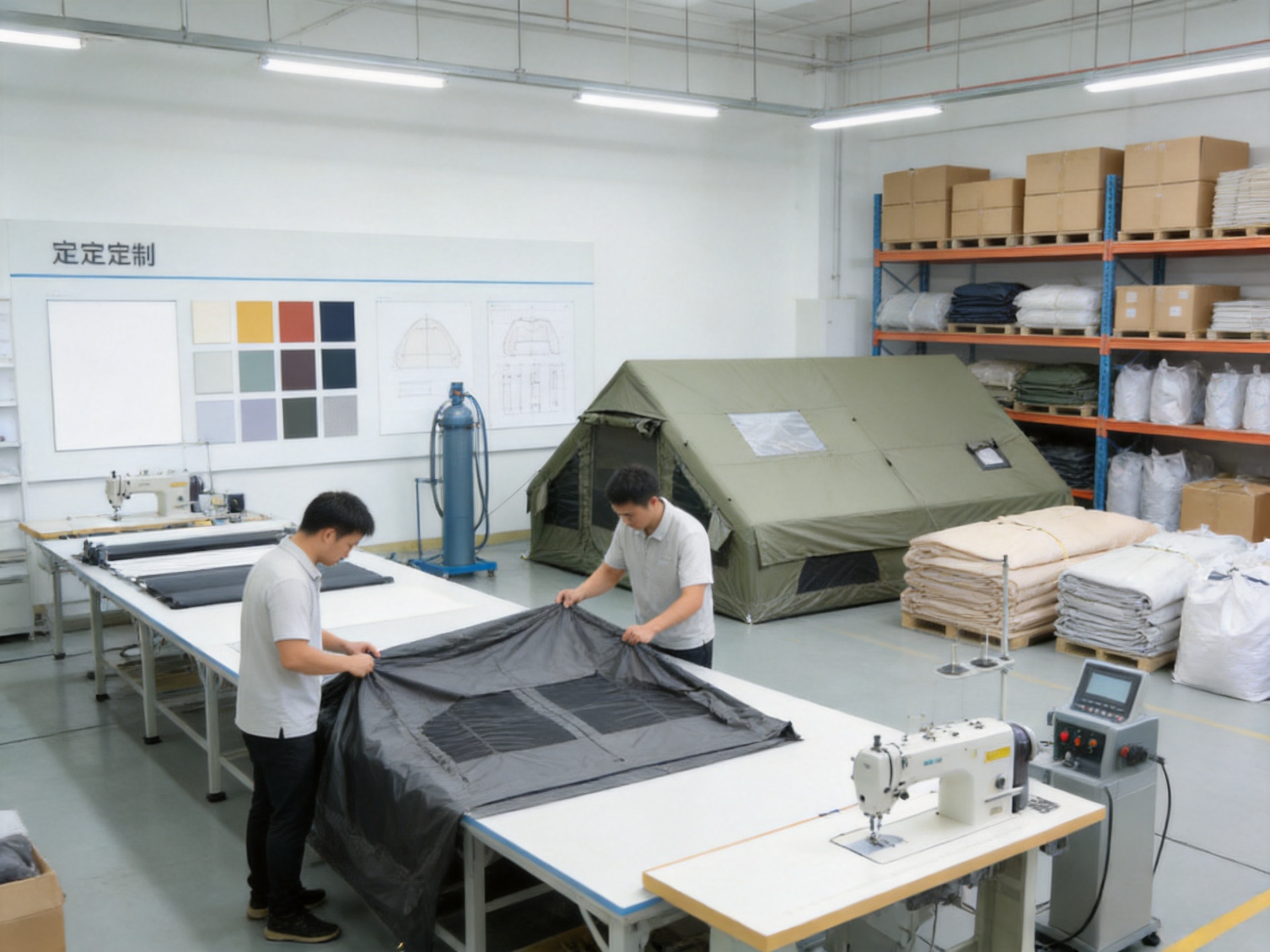
The manufacturing process begins with product planning and technical confirmation. The design team reviews the required size, capacity, air-column layout, fabric, floor system, entry points, ventilation, packaging, and visual details. For customized orders, artwork, Pantone colors, and structural drawings are approved before production tooling or cutting begins.
Material Preparation
Fabric rolls are inspected for color consistency, surface defects, coating irregularities, width variation, and other issues that may affect production. The 210D Oxford fabric and floor material must be prepared according to the cutting plan. Any customized fabric specification is checked against the approved sample or technical documentation.
Pattern Cutting
Accurate pattern cutting is essential for maintaining the intended dimensions and ensuring that panels fit correctly during sewing. Large tent panels require careful handling because small inaccuracies can accumulate across the roof, walls, floor, and air-column sleeves.
Cutting plans are also optimized to reduce material waste. Efficient nesting of pattern pieces can improve production efficiency while maintaining the required grain direction, coating orientation, and appearance consistency.
Panel Sewing and Reinforcement
Fabric panels are assembled according to the approved construction method. Stress areas, corners, guy-line points, handles, zippers, and air-column attachment zones may require additional reinforcement. Stitch quality must be consistent, with attention to thread tension, seam alignment, and edge finishing.
The floor is connected to the tent body using a construction method appropriate to the required waterproof and strength performance. Door and window areas are fitted with their relevant closures and ventilation components. The final design must balance weather protection with airflow and occupant comfort.
Air-Column Assembly
The PVC air-column system is prepared and integrated into the tent structure. Valves and connection points are positioned according to the design. Airtightness and pressure retention are critical inspection points. The air frame must expand evenly and support the fabric shell without excessive stress or distortion.
Where welding or specialized bonding is used, process consistency is essential. The air-column material, joining method, temperature, pressure, and dwell time must be controlled according to the production procedure. Each air system should be checked for leakage before packaging.
Functional Testing
Finished tents should be opened and inspected for overall appearance, dimensional consistency, zipper function, air-column performance, seam quality, floor attachment, and accessory completeness. Depending on the order and customer requirements, testing may include waterproofing, air retention, fabric performance, and load-related checks.
Sample approval before mass production allows buyers to verify the appearance, dimensions, color, logo placement, packaging, and functional features. For large orders, production samples and inspection records provide additional quality assurance.
Folding and Packaging
After inspection, the tent is dried if necessary, folded according to a repeatable method, placed into its outer bag, and packed into a carton. Consistent folding protects the fabric, reduces package variation, and helps customers unpack and repack the product more easily.
11. Buyer Considerations Before Wholesale Purchase
Wholesale buyers should first define the intended market. A family camping retailer may prioritize simple setup instructions, attractive colors, and compact packaging. A glamping resort may need customized dimensions, interior features, and coordinated branding. A rental business may require reinforced components, replacement parts, and a standard maintenance procedure.
Buyers should confirm the complete product configuration, including pump requirements, inflation valves, guy lines, anchors, repair kits, carry bags, cartons, manuals, and optional accessories. It is also useful to clarify whether the stated 25 kg weight includes all accessories and packaging or refers only to the tent set.
Weather ratings should be discussed in relation to the target market. The 3000 mm waterproof rating and UPF 50+ protection are useful specifications, but the complete product performance depends on construction details and use conditions. Importers should request relevant test information when required by local regulations or retail standards.
Packaging should be reviewed for shipping efficiency. One set per carton supports inventory counting and handling, while outer-bag packaging protects the folded product. Buyers should confirm carton dimensions, gross weight, palletization, container loading quantity, shipping marks, and barcode or label requirements.
For customized orders, the buyer should approve a sample before mass production. The sample should be evaluated for color, logo quality, fabric feel, floor construction, inflation behavior, packed size, setup process, and interior dimensions. Any changes should be documented in writing before the production order is released.
12. Installation, Use, and Maintenance Guidance
Choose a level site with good drainage and remove sharp objects before spreading the tent. Avoid areas beneath unstable branches, near rapidly rising water, or in locations exposed to hazards. Lay out the tent carefully and confirm that the air columns, valves, fabric, and accessories are not twisted or trapped.
Inflate the air columns using the recommended pump and pressure procedure. Do not use excessive pressure. Once the structure is raised, attach all guy lines and anchors. Check that the fabric is evenly tensioned and that doors and windows operate correctly.
During use, maintain ventilation to reduce condensation. Condensation can occur even when the tent is fully waterproof, especially when several people sleep inside, cooking takes place nearby, or the outside temperature changes rapidly. Adequate airflow helps maintain a more comfortable interior.
Keep open flames, stoves, heaters, and other ignition sources away from the fabric unless the product has been specifically designed and certified for such use. Follow local fire-safety requirements and never cook in an enclosed tent without suitable ventilation and safety controls.
After use, remove dirt with a soft brush or mild cleaning solution. Avoid harsh chemicals that could damage coatings, seams, or printed surfaces. Allow the tent to dry completely before packing it for storage. Store it in a cool, dry place away from direct sunlight, rodents, sharp objects, and excessive pressure.
Rental operators should inspect every unit after return. Recommended checks include air-column pressure retention, valve condition, zipper operation, fabric tears, seam separation, floor damage, anchor points, guy lines, carry bags, and included accessories. Minor repairs should be completed before the tent is returned to inventory.
13. Frequently Asked Questions
How many people can use this tent?
The listed capacity is six to eight people. The actual comfort level depends on sleeping equipment, luggage, furniture, and how much living space users require. For maximum comfort, fewer occupants may be preferable, while six to eight compact sleepers can use the available floor area efficiently.
What are the unfolded dimensions?
The unfolded dimensions are approximately 400 × 300 × 210 cm. This creates a floor area of about 12 square meters and a maximum height of approximately 210 cm.
What are the packed dimensions?
The packed dimensions are approximately 80 × 50 × 37 cm. The product is supplied with an outer bag and carton packaging, with one set packed per carton.
Is the tent suitable for four-season use?
The product is listed as a four-season tent. It is designed for use across a range of seasonal outdoor conditions, but users must consider local weather, snow, wind, temperature, drainage, and anchoring requirements. Extreme conditions may require a specialized shelter.
How waterproof is the fabric?
The listed waterproof rating is 3000 mm. This provides useful protection for many family camping, glamping, festival, and rental applications. Waterproof performance also depends on seams, zippers, setup, fabric tension, drainage, and maintenance.
What type of frame does the tent use?
The tent uses a reinforced PVC air-column frame. The air columns are inflated to support the main fabric structure, reducing the need for numerous rigid pole sections.
Is a pump included?
The supplied product information identifies the PVC air-column structure but does not specify the pump configuration. Buyers should confirm whether a pump is included, which pump type is recommended, and whether pressure-control accessories are supplied before placing an order.
Can the color be customized?
Yes. Color customization is available by selecting a color according to a Pantone number. Final color approval should be completed through a sample or approved production reference.
Can the size and structure be changed?
Yes. The manufacturer offers customized sizes and structures according to buyer requirements. Changes should be reviewed for stability, air-column layout, packing size, production feasibility, and final cost.
Can logos be added?
Yes. Buyers can provide logo artwork for customization. The placement, size, color, printing method, and packaging application should be confirmed before production.
What is the minimum order quantity?
The minimum order quantity for the listed OEM and ODM programs is 100 sets.
How long does production take?
The stated production lead time is approximately 30–45 days. Sample development generally takes 2–3 weeks. Timelines can change according to customization, order volume, material availability, and approval speed.
What industries can use this product?
The tent is suitable for family camping, glamping resorts, outdoor fishing, festival camping, backyard leisure, and tent rental businesses. It can also be developed for outdoor brands, event organizers, hospitality projects, and distributors.
What should be checked before long-term storage?
The tent should be fully dry and clean before storage. Users should inspect the air columns, valves, seams, floor, zippers, anchors, and carry bag. Store the product in a dry, shaded area away from heat, moisture, chemicals, and sharp objects.
14. Overall Evaluation
The 12m² Oxford fabric inflatable tent offers a strong combination of capacity, standing height, weather protection, inflatable convenience, and commercial customization. Its 400 × 300 × 210 cm interior is large enough for six to eight people and flexible enough for family camping, group travel, glamping, festivals, and rental operations.
The reinforced PVC air-column structure distinguishes it from conventional pole tents by reducing the number of rigid components and supporting a more streamlined setup process. The 210D Oxford fabric and matching floor provide a practical foundation for repeated outdoor use, while the 3000 mm waterproof rating and UPF 50+ protection support a wide range of seasonal applications.
Its advantages are particularly relevant to buyers who need more than a basic recreational tent. The product can be adapted to a brand identity, resort concept, event requirement, or rental fleet through logo, color, size, structure, and fabric customization. The 100-set MOQ and defined sample and production lead times support professional wholesale purchasing.
The manufacturing capabilities of Ningbo Zhenhai Tiansai Leisure Products Co., Ltd. strengthen the product’s commercial potential. The company combines product design, factory production, export experience, customization services, and quality-management procedures. Its factory scale, professional design team, patent-related development experience, and international customer base provide a foundation for OEM and ODM cooperation.
For buyers seeking a spacious and adaptable shelter rather than an ultralight backpacking tent, this inflatable Oxford fabric model is a practical candidate. With correct setup, responsible weather use, regular inspection, and suitable maintenance, it can serve as a reliable platform for personal outdoor recreation and professional outdoor accommodation projects.
References
1. Product technical specifications supplied for the 12m² Oxford fabric inflatable tent.
2. Manufacturer information for Ningbo Zhenhai Tiansai Leisure Products Co., Ltd.
3. General textile testing principles for hydrostatic pressure and waterproof fabric evaluation.
4. General outdoor equipment guidance concerning tent anchoring, ventilation, condensation control, and fabric care.
5. General product development and quality-control practices for inflatable outdoor structures.
Product: 12m² Oxford Fabric Inflatable Tent for 6-8 People

Message Us Right Now!
-
Mp: +86-18858091910
E-mail: sales@tenplaytent.com
ADD: No. 529, Guangyuan Road, Xiepu Town, Zhenhai District, Ningbo City, Zhejiang Province, China
-
Quick Links
Home Products About Us Advantage News Contact Us -
Product
Inflatable & Air Tents Glamping & Resort Tents Backpacking & Trekking Tents Automatic & Pop-Up Tents Family & Camping Tents Specialty Tents & Shelters Kids Tents Pet Tents Humanitarian & Large Tents Hammock -
Get Connected
 Camping Tent Manufacturer in China