


 English
 عربى


The Complete Guide to an 8–12 Person SUV-Connected Stormproof Cotton Canvas Pyramid Tipi Glamping Tent
Outdoor accommodation is changing. Campers increasingly want more than a basic sleeping enclosure, yet many do not want to tow a trailer, purchase a recreational vehicle, or carry a complicated cabin system. The ideal solution combines the mobility of a vehicle with the comfort of a spacious tent. The 8–12 Person SUV-Connected Stormproof Cotton Canvas Pyramid Tipi Glamping Tent is designed around precisely that idea: it transforms the rear area of a compatible SUV or MPV into an extension of a large, breathable, weather-resistant outdoor living space.
With its tall pyramid profile, heavy-duty technical cotton canvas, vehicle connector, quick-mount frame, and reinforced waterproof seals, this tent is intended for glamping resorts, family adventures, road trips, festivals, expedition travel, and extended backyard use. It is not simply a larger version of a conventional camping tent. Its design combines a freestanding shelter, a vehicle-linked vestibule, and a high-capacity interior into one adaptable outdoor system.
This article examines the product in detail, including its construction, layout, weather performance, installation concept, advantages over competing tent categories, commercial potential, and the manufacturing strengths behind its development. It also explains which users can benefit most from the tent and what buyers should consider before ordering.

8-12 Person SUV-Connected Stormproof Cotton Canvas Pyramid Tipi Glamping Tent
1. Product Overview
The 8–12 Person SUV-Connected Stormproof Cotton Canvas Pyramid Tipi Glamping Tent is a high-capacity shelter designed for groups that require substantial interior volume without giving up the flexibility of vehicle-based travel. Its conical pyramid or tipi-inspired structure creates a tall central area, broad usable floor space, and a distinctive visual appearance that suits both private camping and hospitality applications.
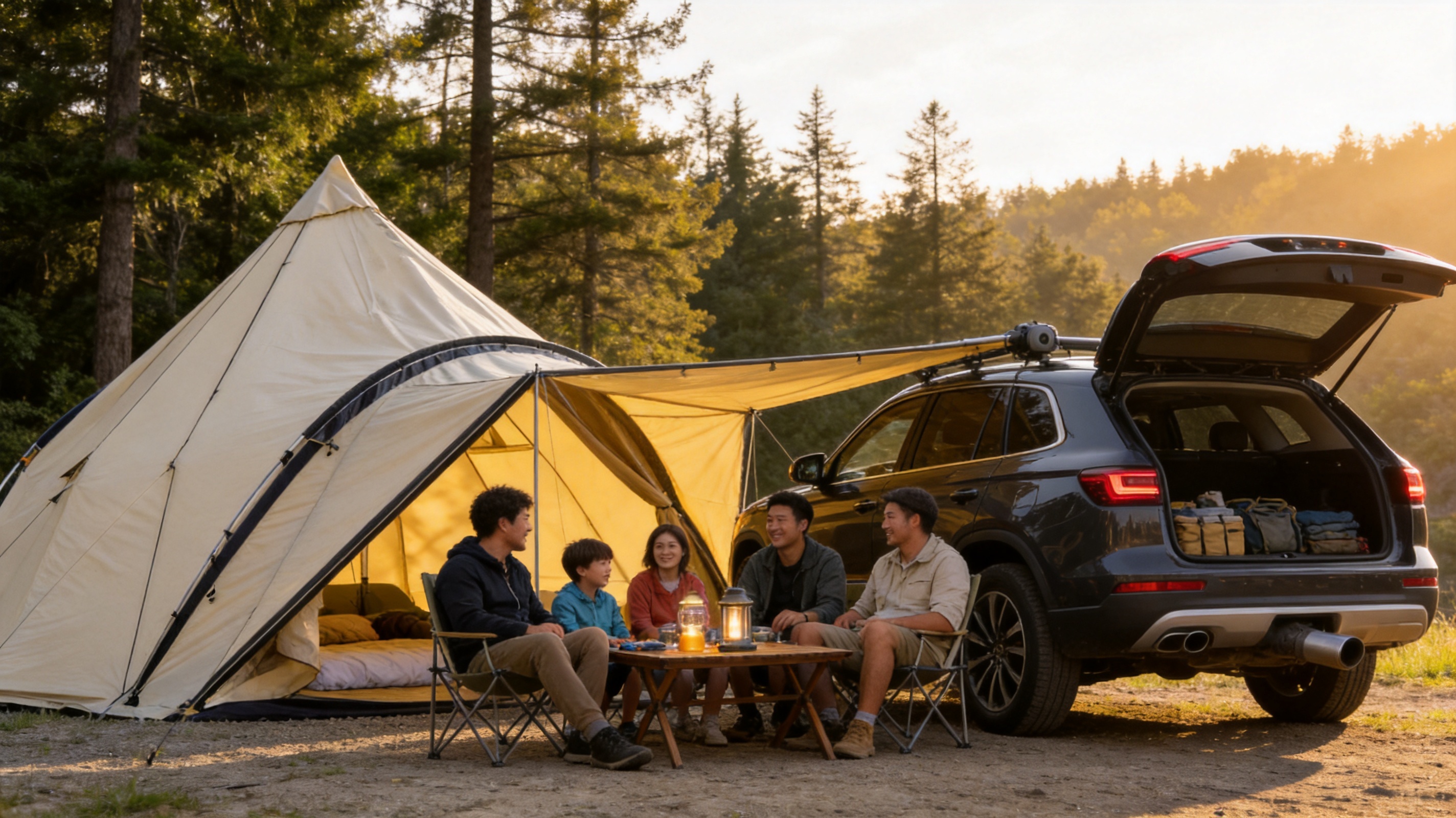
The tent is designed to connect to the rear of many SUVs and MPVs through a universal attachment system. Once attached, the vehicle can serve as an additional sleeping, storage, changing, or utility area, while the tent provides the main communal living space. This arrangement can be especially valuable when users need to separate sleeping zones from cooking, dining, equipment storage, or social areas.
The stated capacity is eight to twelve people, making the tent suitable for large families, group travel, outdoor education, event accommodation, and glamping operations. Actual occupancy should depend on the users’ sleeping arrangements, furniture, equipment, and desired comfort level. A group using compact sleeping mats will experience the interior differently from a resort operator furnishing the space with beds, tables, chairs, and decorative elements.
The shelter is built around a high-density technical cotton fabric, commonly identified as TC fabric in outdoor product terminology. The material is intended to balance breathability, durability, weather resistance, and comfort. In contrast to thin synthetic tents that prioritize minimum packed weight, a heavy-duty cotton-blend canvas shelter generally emphasizes a more stable interior climate, stronger visual appeal, and a premium long-term camping experience.
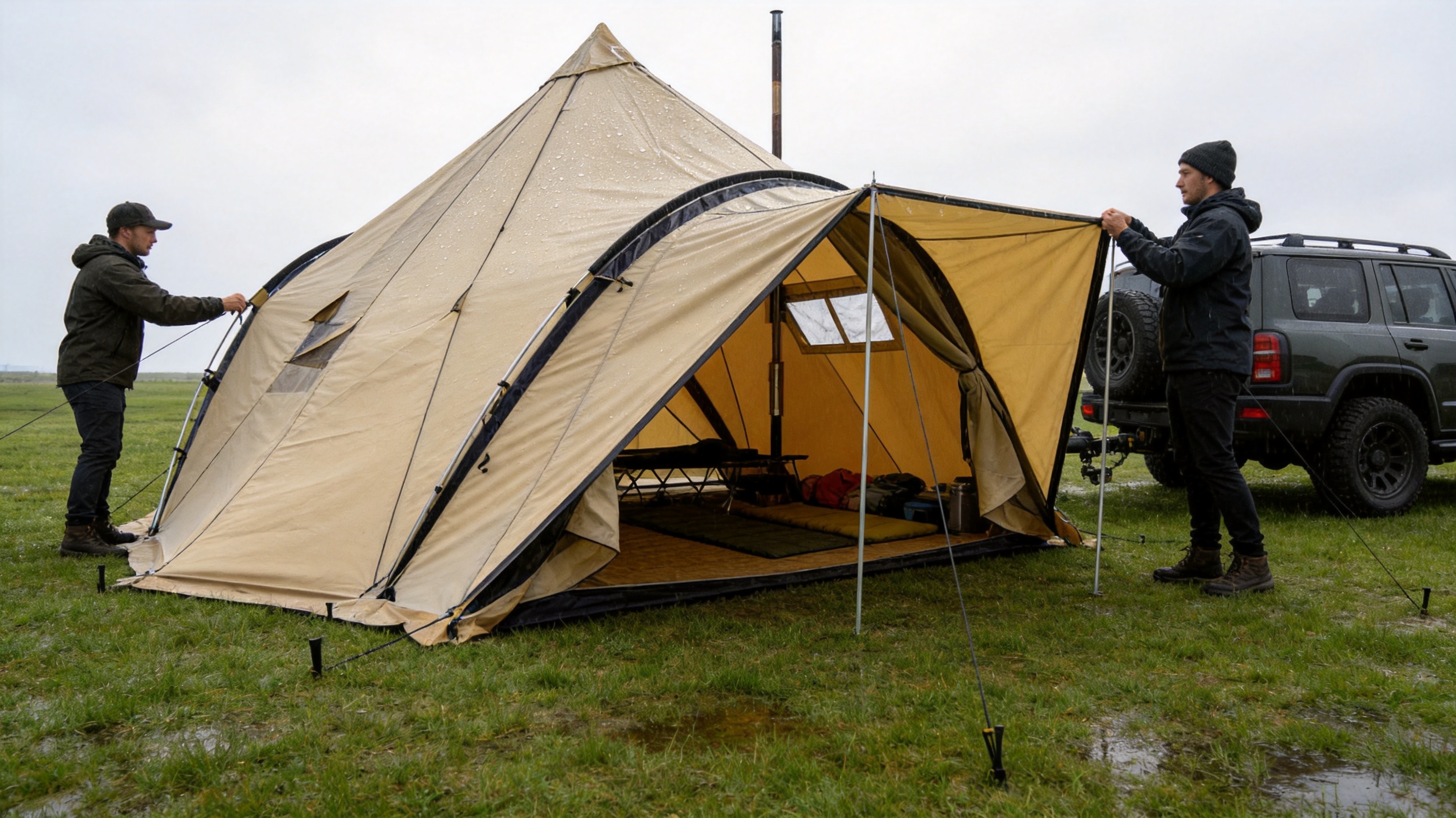
The main structure uses a quick-mount frame concept. This helps reduce the time and labor required during setup, an important consideration for road trips, festivals, rental fleets, and commercial campgrounds. Reinforced waterproof seals are incorporated into key connection and exposure points to help protect the interior from rain and ground-level moisture.
2. Design Philosophy: A Vehicle and Tent Working as One Space
Traditional tents and vehicle camping each have clear strengths. A traditional tent offers a relatively large living area, but it may require users to sleep on the ground and carry all equipment inside the shelter. A vehicle provides a raised, enclosed, secure-feeling space, but its interior volume is limited. This product combines the two concepts by using the vehicle as an integrated extension of the tent.
The SUV connection is particularly useful during changing weather. Campers can move between the vehicle and the shelter without walking through open rain or crossing a large exposed gap. Equipment can remain organized in the vehicle, while the tent remains available for sleeping, dining, relaxing, and social activities. The connected configuration can also help create a more unified camp environment for families traveling with children or groups carrying substantial gear.
The attachment system is described as universal and intended to fit most SUVs and MPVs. Because vehicle body shapes, rear hatch designs, roof heights, and tailgate dimensions vary, buyers should verify compatibility before purchase. A universal concept improves market coverage, but no attachment system can be assumed to fit every vehicle without checking the specific vehicle profile and installation requirements.
Unlike a roof tent, the main shelter remains at ground level. This can provide easier access for children, older campers, pets, and users carrying bulky items. Unlike a conventional awning, it delivers a genuinely enclosed, high-capacity room. Unlike a trailer tent, it does not require a separate towing platform, trailer registration, or trailer maneuvering in many use cases.
3. Pyramid Tipi Structure and Interior Volume
The pyramid tipi form is one of the product’s most important design features. A tall central peak produces generous vertical clearance, while the sloping walls help direct rainwater away from the main living area. The conical silhouette also distributes wind loads around the shelter more continuously than a design with large flat vertical wall sections.
High headroom changes how a large tent feels. In a low-profile family tent, users may need to crouch or crawl in sections of the interior. In a tall pyramid shelter, people can stand, move around, change clothes, organize equipment, and interact more naturally. This makes the tent better suited to extended stays, not merely overnight sleeping.
The central height can also support a more flexible internal layout. Depending on the final configuration, users may arrange sleeping mats around the perimeter and retain an open central area for shared activities. Glamping operators may use beds or low furniture, while expedition groups may prefer clear floor space for gear. The product’s broad footprint allows it to serve both recreational and semi-commercial purposes.
The shape is also visually distinctive. Many mass-market tents use familiar tunnel, dome, or cabin forms. A pyramid tipi creates a stronger identity for a resort, event, festival, or rental business. In a competitive hospitality market, a memorable silhouette can improve the guest experience and contribute to a recognizable accommodation theme.
However, pyramid structures require careful anchoring. The tall profile can be stable when correctly tensioned, but users must install the frame, guy lines, stakes, and connectors according to the supplied instructions and site conditions. Wind resistance is not a substitute for proper setup. The shelter should not be used in severe weather beyond its design parameters.
4. Technical Cotton Canvas: Comfort and Durability
The tent uses high-density technical cotton fabric intended to provide a more comfortable indoor environment than many lightweight synthetic alternatives. Cotton-based or cotton-blend canvas materials are valued in glamping because they offer a soft, natural appearance and a more substantial hand feel. They can also moderate temperature changes by allowing a degree of moisture vapor movement through the fabric.
Breathability is important in a large shelter. When several people sleep or spend time inside a closed tent, humidity and condensation can build up. A breathable fabric can help reduce the feeling of stale air, although ventilation openings should still be used. No fabric alone eliminates condensation; local weather, cooking, body heat, wet clothing, ground moisture, and occupancy all affect interior humidity.
The high-density construction is designed for repeated outdoor use. Compared with very thin temporary shelters, a heavier canvas structure can offer better resistance to abrasion, handling stress, and routine campsite wear. This is valuable for families who use the same tent regularly, as well as rental companies that need products to withstand frequent setup and packing cycles.
The fabric also contributes to UV shielding. Outdoor textiles are exposed to sunlight, and long-term ultraviolet radiation can weaken fibers, fade colors, and reduce coating performance. A dense technical fabric, combined with appropriate finishing and responsible maintenance, can help improve service life. The exact UV rating, fabric weight, waterproof rating, and colorfastness should be confirmed in the product specification for each production batch or model configuration.
Canvas tents require appropriate care. They should be fully dried before long-term storage, packed without trapped moisture, and inspected after use. If the fabric is stored wet, mildew and unpleasant odors may develop. Users should also avoid harsh chemicals, open flames, and direct contact between hot equipment and the tent wall. Proper maintenance is central to achieving the long service life expected from a premium canvas shelter.
Technical Cotton Compared with Lightweight Synthetic Fabric
| Consideration | Technical Cotton Canvas Pyramid Tent | Lightweight Synthetic Tent |
|---|---|---|
| Interior atmosphere | Designed to provide a breathable, substantial fabric environment | Often prioritizes lightness and compact packing |
| Visual character | Natural, premium, and well suited to glamping | Usually more technical and recreational in appearance |
| Durability focus | Suitable for repeated use when correctly maintained | Can be durable, but fabric weight and construction vary widely |
| Pack size and weight | Generally more substantial because of the heavier fabric | Often lighter and easier to carry over long distances |
| Climate comfort | Designed to moderate the indoor feel through fabric breathability | Depends heavily on ventilation and fabric coating |
| Maintenance | Requires careful drying and storage | Usually easier to dry, though coatings require their own care |
The comparison does not mean that one material is universally better. Backpackers carrying equipment over long distances may prioritize minimum weight. Families, glamping operators, and vehicle-based campers may prefer the comfort, appearance, and durability associated with a heavier technical canvas shelter.
5. Stormproof Construction and Weather Protection
The product is described as stormproof and incorporates reinforced waterproof seals. These features indicate a design intended for demanding outdoor conditions, including rain, variable temperatures, and exposed campsites. The tent’s protection comes from a combination of fabric, seam construction, frame geometry, ground contact details, doors, vents, connector design, and anchoring—not from one feature in isolation.
Waterproof seals are especially important around seams and transition points. Needle holes, panel joins, zippers, attachment areas, and vehicle connectors can become potential paths for water entry if they are not correctly designed and finished. Reinforcing these locations helps maintain protection where different pieces of fabric and structure meet.
The pyramid profile supports water shedding by avoiding broad horizontal surfaces where rain can pool. Sloped panels guide water toward the ground, reducing the pressure placed on the fabric. Correct tension is essential: loose fabric can sag, create pockets, and increase the chance of leakage, while excessive tension can place unnecessary stress on seams, webbing, and anchor points.
Wind performance benefits from the continuous conical shape and central frame arrangement. The form can reduce the impact of direct wind on large flat walls. Nevertheless, performance depends on site selection, ground conditions, stake quality, guy-line placement, and the direction and strength of the wind. Campers should avoid exposed ridgelines, unstable trees, flood-prone ground, and locations where falling branches may create hazards.
The vehicle connector creates another weather-related consideration. The connection must be properly fitted to the rear of the vehicle, and the vehicle should be positioned on reasonably level ground. Users should check that the rear hatch, doors, exhaust outlet, lights, and ventilation systems remain safe and functional. Vehicle engines must never run in an enclosed or poorly ventilated tent area.
Practical Weather Guidelines
Before setup, inspect the forecast, select well-drained ground, and identify the prevailing wind direction. Use all recommended stakes and guy lines. Check that the frame is fully seated and that the connector is evenly tensioned. After rain, inspect seams and low points rather than assuming that a dry interior confirms perfect installation.
During hot weather, use ventilation openings to improve airflow. During cold weather, avoid blocking vents because occupants generate moisture even when the temperature is low. Never use an open flame, charcoal grill, or fuel-burning appliance inside the tent unless the product documentation specifically approves a safe and properly vented system.
6. Quick-Mount Frame and Installation Concept
Large tents can be intimidating when they require multiple poles, complicated sleeves, and several stages of adjustment. The quick-mount frame concept is intended to simplify installation and reduce setup time. This is important for private users who may arrive at a campsite after a long journey, and for professional operators who may assemble and disassemble shelters repeatedly.
The exact procedure depends on the final product configuration, but a typical installation sequence includes selecting the site, laying out the tent, assembling or positioning the frame, attaching the main fabric, tensioning the base, securing the guy lines, and connecting the rear vehicle section. Users should always follow the supplied manual because frame architecture, pole order, and attachment points can differ between models.
For commercial applications, installation efficiency affects operating costs. A resort or rental business may need to prepare multiple units before guests arrive. A frame that is straightforward to understand can reduce staff training time, decrease setup errors, and support more consistent presentation across a property. Clear labeling, durable fittings, and repeatable assembly steps are valuable elements in a commercial tent system.
Setup should be practiced at home before the first trip. This allows users to identify the parts, understand the attachment process, and check the fit with their vehicle. Practice also makes it easier to determine how many people are needed for efficient assembly. Although the product is designed for convenient mounting, a shelter of this size is best handled by at least two adults during setup, especially in windy conditions.
7. Advantages over Competing Tent Categories
Compared with Standard Family Tents
Standard family tents can provide good value and reasonable sleeping capacity, but many have lower ceilings, less robust fabrics, and limited integration with vehicles. The SUV-connected pyramid tipi offers a larger social environment and a more premium presentation. The vehicle connection adds useful storage and transitional space, while the canvas construction is intended for more substantial seasonal use.
The product may be especially attractive to families who spend several nights at one campsite. Instead of repeatedly moving between a compact tent and a car, users can create a more organized base. Parents can keep luggage and supplies in the vehicle while children use the tent as a sheltered play or sleeping area, subject to safe supervision.
Compared with Roof Tents
Roof tents are fast to deploy and keep occupants above wet or uneven ground, but their internal capacity is limited. Access requires a ladder, which may be inconvenient for young children, older adults, pets, and users carrying large items. A ground-level pyramid tent provides a much larger communal room and easier movement in and out.
The SUV-connected shelter also avoids placing the entire sleeping load on the vehicle roof. This can be relevant for users whose vehicles are not equipped for a roof tent or who want to preserve roof space for other equipment. It does, however, require a suitable ground area and takes more floor space at the campsite.
Compared with Vehicle Awnings
A vehicle awning offers quick shade and rain protection, but many awnings remain open-sided or have limited enclosure. They are excellent for short stops, yet they do not provide the same sleeping capacity, privacy, or climate separation as a full tent. The pyramid shelter creates a genuine room that can be used for overnight accommodation and longer stays.
Compared with Trailer Tents and Large Modular Shelters
Trailer tents can offer substantial space, but they involve additional equipment, towing considerations, storage, and transport logistics. A vehicle-connected ground tent uses the existing SUV or MPV rather than requiring a separate trailer. It can therefore appeal to users seeking a large camp without entering the trailer market.
Compared with very large modular event shelters, this product is more focused on flexible camping and vehicle-based travel. Its size is suitable for group accommodation while remaining more approachable for private users. Its quick-mount frame and integrated connector add functionality that a standard event marquee may not offer.
Competitive Feature Summary
| Feature | Vehicle-Connected Pyramid Tipi | Basic Family Tent | Roof Tent | Open Vehicle Awning |
|---|---|---|---|---|
| Large ground-level living area | Yes | Often, depending on model | Limited | Usually partial |
| Direct vehicle connection | Designed as a core feature | Usually unavailable | Vehicle-mounted, but not a ground-level room | Common, but generally open-sided |
| Capacity for large groups | Designed for 8–12 people | Varies widely | Usually limited | Not normally intended for sleeping groups |
| Standing-height interior | Supported by the tall pyramid design | Depends on model | Usually limited | Depends on support poles |
| Canvas glamping appearance | Yes | Less common | Less common | Varies |
| Suitable for extended campsite stays | Yes, with correct maintenance | Yes, depending on construction | More limited in interior space | Usually supplementary |
8. Applications for Glamping and Resort Operations
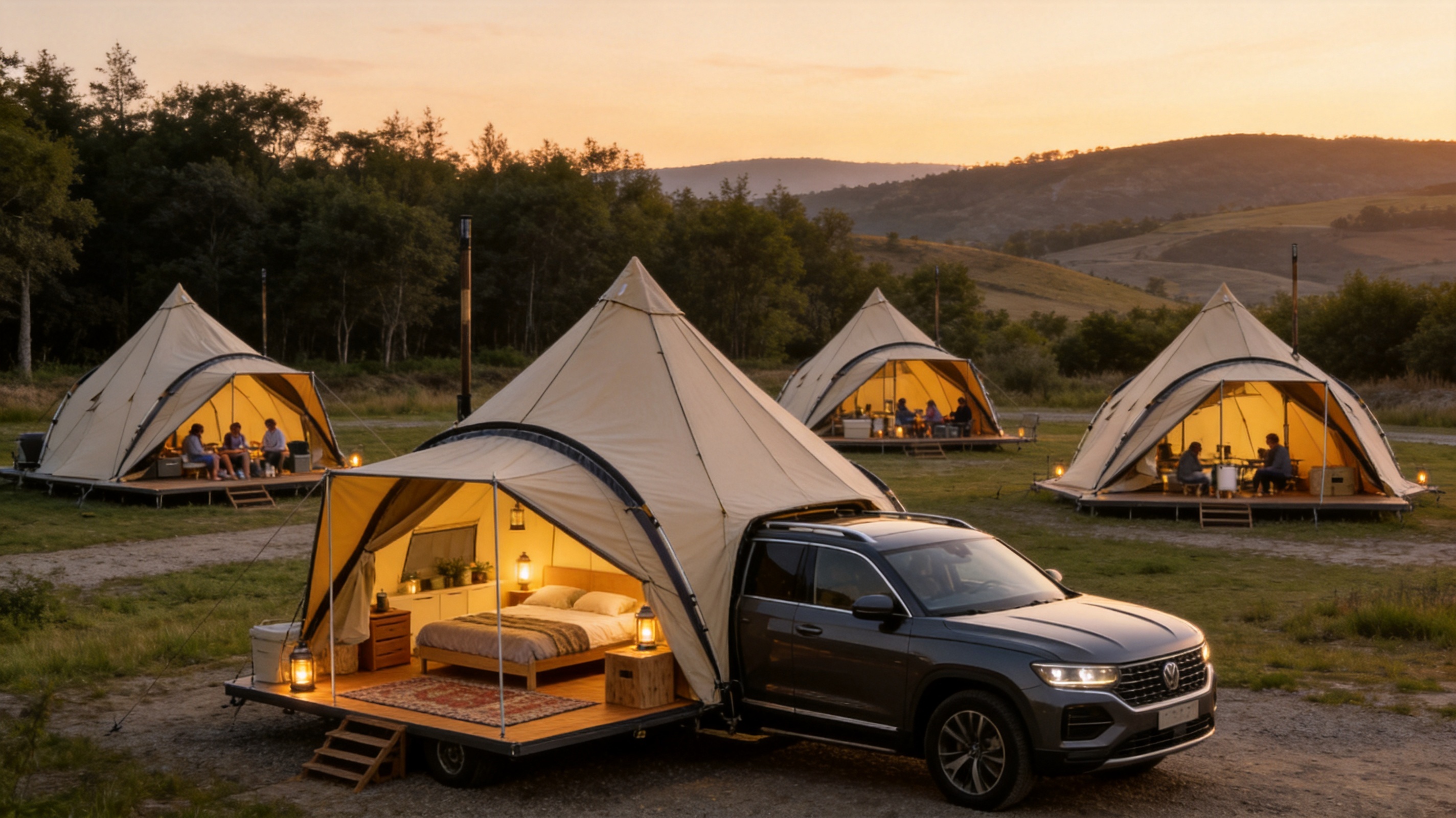
Glamping businesses require accommodation that is visually appealing, comfortable, durable, and practical for staff. This shelter addresses those needs with a recognizable silhouette, large capacity, and the possibility of creating a vehicle-linked guest experience. It can function as a standalone accommodation, a seasonal family unit, or an additional living space beside a guest vehicle.
The pyramid form can support themed campsites based on exploration, road travel, nature retreats, family adventures, or festival accommodation. Operators may furnish the interior with beds, rugs, low tables, lighting, and storage, provided all furnishings remain compatible with ventilation and fire-safety requirements.
For mobile glamping providers, the SUV connector creates a differentiated package. A guest vehicle can become part of the accommodation concept, allowing the shelter to serve as a flexible extension during road-based holidays. The system may also suit outdoor events where guests arrive in different vehicles and want a private, comfortable base without transporting a permanent cabin.
Commercial users should evaluate more than the initial purchase price. Important factors include cleaning time, drying space, replacement-part availability, fabric repair procedures, staff training, packing dimensions, seasonal storage, and expected setup frequency. A premium tent can be commercially valuable when its service life and operating convenience offset the initial investment.
Operators should also develop clear guest instructions. These should cover vehicle compatibility, safe use of doors and connectors, ventilation, cooking restrictions, weather limits, drying procedures, and emergency exit access. Consistent instructions protect both guests and the equipment.
9. Applications for Families, Expeditions, and Road Trips
Families often need flexible zones. Children may sleep in one part of the tent, adults in another, and luggage or outdoor equipment may stay in the vehicle. The large interior can provide a place to eat or relax when rain prevents outdoor activities. The vehicle connection can make it easier to retrieve food, clothing, medical supplies, or electronics without leaving the shelter completely.
For road trips, the tent expands the possibilities of a standard SUV or MPV. Travelers can use the vehicle for transport and secure storage while enjoying the openness of a campsite. This is particularly useful when a trip includes several nights at one location and the group wants more room than the vehicle alone can provide.
Expedition users can benefit from the structure’s capacity and weather-oriented design. The tent can accommodate people and equipment in environments where a lightweight backpacking shelter would be too small. It is better suited to vehicle-supported expeditions than to trips that require carrying the shelter over long distances.
Festival campers may appreciate the combination of privacy, capacity, and distinctive appearance. A large enclosed room can provide a retreat from crowds and changing weather. The vehicle connection also creates a practical location for equipment, coolers, clothing, and supplies.
10. Manufacturing Strengths Behind the Product
The product is manufactured by Ningbo Zhenhai Tiansai Leisure Products Co., Ltd., a tent-focused company based in Ningbo, Zhejiang Province, China. The company operates a factory covering more than 13,000 square meters and specializes in the design, production, and sales of outdoor tents and related leisure products.
A dedicated factory environment is important for complex shelters because product quality depends on coordination among fabric cutting, sewing, structural assembly, waterproof treatment, inspection, packing, and logistics. Large tents contain numerous panels, seams, webbing sections, attachment points, poles, fittings, and accessories. Manufacturing consistency is therefore more demanding than producing a simple single-layer cover.
The company’s location in Ningbo provides access to an important international port city. This supports export-oriented production and can simplify the movement of finished goods, raw materials, samples, and replacement components. International logistics capability is particularly relevant to wholesale customers, outdoor brands, resort operators, and importers serving multiple markets.
The company reports experience in product development, international sales, and outdoor equipment manufacturing. Its core team includes experienced professionals in research and development, production, and overseas operations. This combination can help bridge the gap between technical design and the practical needs of global customers.
The manufacturer also reports cooperation as the sole global designated supplier for the British company TENTSILE. In addition, it has designed products associated with appearance patents and utility model patents. These details indicate an emphasis on proprietary product development rather than relying exclusively on generic catalog designs.
Design and Research Capability
Outdoor products must be developed around real use conditions. A shelter that looks attractive in a studio may be difficult to install, uncomfortable in humid weather, or vulnerable at high-stress connection points. The company describes a design process that considers practicality and comfort and includes collaboration with professionals, outdoor-user testing, and continuous optimization based on customer feedback.
For the SUV-connected pyramid tent, this development approach is relevant to the connector, frame, fabric tension, door placement, storage possibilities, ventilation, and user movement. Each of these elements affects the overall experience. A vehicle connection that is difficult to tension, for example, can undermine an otherwise strong shelter design.
Product testing should ideally examine repeated setup cycles, seam performance, fabric behavior, connector fit, frame stability, zipper operation, packing, and exposure to rain and ultraviolet light. Buyers seeking private-label or OEM products can request information about applicable testing procedures, inspection points, material records, and acceptance standards.
Quality Management and Production Control
The company states that it implements a quality management system to help ensure that products meet international standards. In practical manufacturing terms, quality control for a large technical tent may include incoming fabric inspection, color and coating checks, dimensional review, sewing-line inspection, seam-strength monitoring, hardware verification, finished-product examination, and pre-shipment sampling.
Quality control is most effective when it begins before sewing. Fabric defects, inconsistent coating, incorrect grain direction, or inaccurate cutting can create problems that are difficult to correct later. A structured process should therefore connect purchasing, warehouse management, cutting, sewing, assembly, inspection, and packing.
For wholesale buyers, production transparency can be as important as the finished appearance. Buyers may request approved samples, inspection reports, packaging details, spare-part recommendations, production lead times, and clear tolerances. These discussions help reduce misunderstandings when ordering large quantities or developing a customized version.
11. OEM and Wholesale Potential
The product is a strong candidate for OEM and wholesale programs because its design can serve several market segments. Outdoor retailers may position it as a premium family shelter. Glamping operators may purchase multiple units for accommodation or seasonal events. Vehicle-accessory distributors may offer it as an expansion system for SUVs and MPVs. Tourism companies may use it as part of a road-trip package.
Customization opportunities may include fabric colors, branding, packaging, accessory kits, connector configurations, internal partitions, flooring solutions, windows, logos, and instruction manuals. The feasibility of each option depends on order quantity, production schedule, material availability, tooling, and product-safety requirements.
A reliable OEM partner should provide more than a logo application. The manufacturer should be able to discuss pattern development, sample approval, quality standards, packaging efficiency, carton protection, replacement parts, and after-sales support. For a large tent, the ability to reproduce the approved sample consistently is essential.
Wholesale buyers should also consider regional requirements. Different markets may have specific expectations for flame resistance, labeling, consumer instructions, chemical compliance, packaging, and warranty documentation. These requirements should be discussed before production rather than after goods arrive.
12. Installation, Care, and Long-Term Ownership
Long-term performance depends on use and maintenance as much as on original construction. After every trip, users should remove dirt, leaves, sand, and standing water. If the tent becomes wet, it should be dried thoroughly before storage. Drying can be completed by setting it up in a clean, ventilated area or following the manufacturer’s approved method.
The fabric should be inspected for cuts, abrasion, loose stitching, mildew, damaged zippers, and weakened webbing. Small problems are easier to repair before the next trip. Frame components should be checked for bending, cracks, corrosion, and missing fittings. Stakes and guy lines should be stored together so that the tent is ready for the next installation.
Users should avoid dragging the assembled shelter across rough ground. Heavy equipment should not be placed directly against the fabric, and sharp objects should be kept away from the floor and walls. When loading the packed tent into a vehicle, protect the fabric from contact with tools, metal edges, and wet cargo.
Cleaning should follow the product instructions. Aggressive detergents, bleach, solvents, and unauthorized waterproofing products may damage technical finishes or alter the fabric’s performance. If re-treatment becomes necessary after extended use, users should select a treatment compatible with the fabric and consult the supplier first.
Vehicle Compatibility and Safe Connection
Before purchasing, confirm the vehicle’s rear dimensions, hatch movement, tailgate clearance, exhaust position, and surrounding bodywork. The connector must not interfere with lights, license plates, door hinges, or safe access. If the rear hatch cannot remain in the intended position, the connection may not function as designed.
The vehicle should be parked on stable, level ground with the parking brake engaged. Users should not rely on the vehicle as the only anchor for the tent. The tent frame, perimeter stakes, and guy lines must all be installed as directed. The connector should be checked after initial tensioning and again after wind or rain.
Engine exhaust is a serious safety concern. Vehicles should not be left running with the tent attached or with occupants inside an enclosed shelter unless the arrangement is specifically designed and ventilated for that purpose. Carbon monoxide is odorless and potentially fatal. Safe camping practice requires the engine to remain off when people are inside or near the connected shelter.
13. Buyer Evaluation Checklist
Customers comparing this tent with alternative shelters should evaluate the entire use case rather than focusing only on capacity. The following questions can help determine whether the product is appropriate:
- Is the main use vehicle-based camping rather than long-distance backpacking?
- Does the group need a large, standing-height living area?
- Is a breathable canvas-style interior more important than minimum packed weight?
- Will the tent be used for private recreation, commercial glamping, rental, or events?
- Is the vehicle compatible with the rear connector?
- Is there sufficient campsite space for the full footprint and guy lines?
- Can the buyer provide proper drying and storage after wet use?
- Are regional safety, labeling, and material requirements understood?
- Are replacement parts and after-sales support available for the intended market?
Buyers should request the complete technical specification before placing an order. Important data may include fabric composition, fabric weight, waterproof performance, packed dimensions, total product weight, frame material, floor construction, ventilation details, door configuration, connector range, recommended occupancy arrangement, wind-use guidance, and included accessories.
14. Frequently Asked Questions
Q1: How many people can use the tent?
The stated capacity is eight to twelve people. The practical number depends on whether the tent is used for sleeping only or as a furnished living space. Sleeping mats allow greater density, while beds, furniture, luggage, and equipment reduce available floor area.
Q2: What vehicles can connect to the tent?
The product uses a universal attachment concept intended for most SUVs and MPVs. Compatibility should still be confirmed for the specific vehicle because rear hatch dimensions, body contours, roof height, tailgate movement, and exhaust placement vary between models.
Q3: Is the tent suitable for rain?
Yes, it is designed as a stormproof, weather-oriented shelter and includes reinforced waterproof seals. Correct setup is essential. The tent must be properly tensioned, anchored, ventilated, and maintained. No tent should be treated as completely immune to extreme weather or flooding.
Q4: Is the technical cotton fabric breathable?
The high-density technical cotton or TC fabric is designed to provide a more breathable and comfortable indoor environment than many heavily coated lightweight fabrics. Ventilation should still be used, especially when several people are inside or when cooking and wet clothing create additional moisture.
Q5: Is this a backpacking tent?
No. The product is intended primarily for vehicle-supported camping, glamping, family use, expeditions, festivals, and resort applications. Its large capacity and heavy-duty canvas construction are more important than minimum carrying weight.
Q6: Does the tent require professional installation?
The quick-mount frame is intended to simplify setup, but users should practice installation and follow the supplied instructions. Because the shelter is large, two or more adults may be helpful, particularly during windy conditions or when connecting it to a vehicle.
Q7: Can the tent be used as a glamping accommodation unit?
Yes. Its tall pyramid shape, premium canvas appearance, large capacity, and adaptable interior make it suitable for glamping concepts. Commercial operators should confirm local requirements for fire safety, guest accommodation, foundations, sanitation, insurance, and seasonal operation.
Q8: How should the tent be stored?
It should be completely dry before packing for long-term storage. Store it in a cool, dry, ventilated location away from direct sunlight, pests, sharp objects, and chemicals. Inspect the fabric and frame before storage and again before the next use.
Q9: What makes the tent different from a normal SUV awning?
An awning normally provides shade or partial rain protection, while this product creates a large enclosed room with sleeping and living capacity. Its vehicle connector is part of a broader shelter system rather than a simple overhead cover.
Q10: Can the product be customized for wholesale orders?
Customization may be available for qualified OEM and wholesale programs. Possible options can include color, branding, packaging, accessory selection, and selected structural details. Buyers should discuss order quantity, sample approval, production timing, and technical requirements with the manufacturer.
15. Overall Assessment
The 8–12 Person SUV-Connected Stormproof Cotton Canvas Pyramid Tipi Glamping Tent is designed for people who want the freedom of vehicle travel and the comfort of a spacious outdoor room. Its most important advantages are its large capacity, tall pyramid interior, breathable technical canvas, vehicle integration, quick-mount frame, reinforced waterproof seals, and distinctive glamping appearance.
Compared with a compact synthetic family tent, it offers a more substantial and premium accommodation experience. Compared with a roof tent, it provides far more ground-level living space and easier access. Compared with an open awning, it delivers greater privacy, weather protection, and sleeping capability. Compared with a trailer-based system, it can expand a compatible SUV or MPV without requiring a separate towing platform.
The product is particularly well suited to families, road-trip travelers, festival campers, expedition groups, outdoor hospitality businesses, and private-label distributors. It is less suitable for users whose main priority is carrying a shelter long distances on foot or minimizing total packed weight.
Its commercial value is strengthened by the manufacturer’s dedicated tent factory, more than 13,000 square meters of production space, design and development experience, international export capability, reported patent-related product development, and focus on quality management. These factors can support buyers seeking a long-term supply partner rather than a one-time generic product source.
As with any large outdoor shelter, the best results depend on correct installation, suitable site selection, careful vehicle compatibility checks, regular drying, and responsible storage. When those conditions are met, this pyramid tipi tent can serve as a versatile bridge between camping equipment and mobile outdoor accommodation.
References
1. Manufacturer-provided product specifications and product description for the 8–12 Person SUV-Connected Stormproof Cotton Canvas Pyramid Tipi Glamping Tent.
2. Manufacturer-provided company profile for Ningbo Zhenhai Tiansai Leisure Products Co., Ltd., including factory capacity, product development, export activity, and quality-management information.
3. General principles of outdoor tent design, including fabric breathability, seam protection, structural tension, ventilation, and campsite anchoring.
4. General textile-care guidance for cotton canvas and cotton-blend outdoor fabrics, including drying, storage, cleaning, and mildew prevention.
5. General vehicle-camping safety guidance concerning exhaust emissions, carbon monoxide prevention, ventilation, stable parking, and safe use of vehicle-connected shelters.
Product: 8-12 Person SUV-Connected Stormproof Cotton Canvas Pyramid Tipi Glamping Tent

Message Us Right Now!
-
Mp: +86-18858091910
E-mail: sales@tenplaytent.com
ADD: No. 529, Guangyuan Road, Xiepu Town, Zhenhai District, Ningbo City, Zhejiang Province, China
-
Quick Links
Home Products About Us Advantage News Contact Us -
Product
Inflatable & Air Tents Glamping & Resort Tents Backpacking & Trekking Tents Automatic & Pop-Up Tents Family & Camping Tents Specialty Tents & Shelters Kids Tents Pet Tents Humanitarian & Large Tents Hammock -
Get Connected
 Camping Tent Manufacturer in China