


 English
 عربى


Large Inflatable Family Camping Tent Heavy Duty All Season Cabin
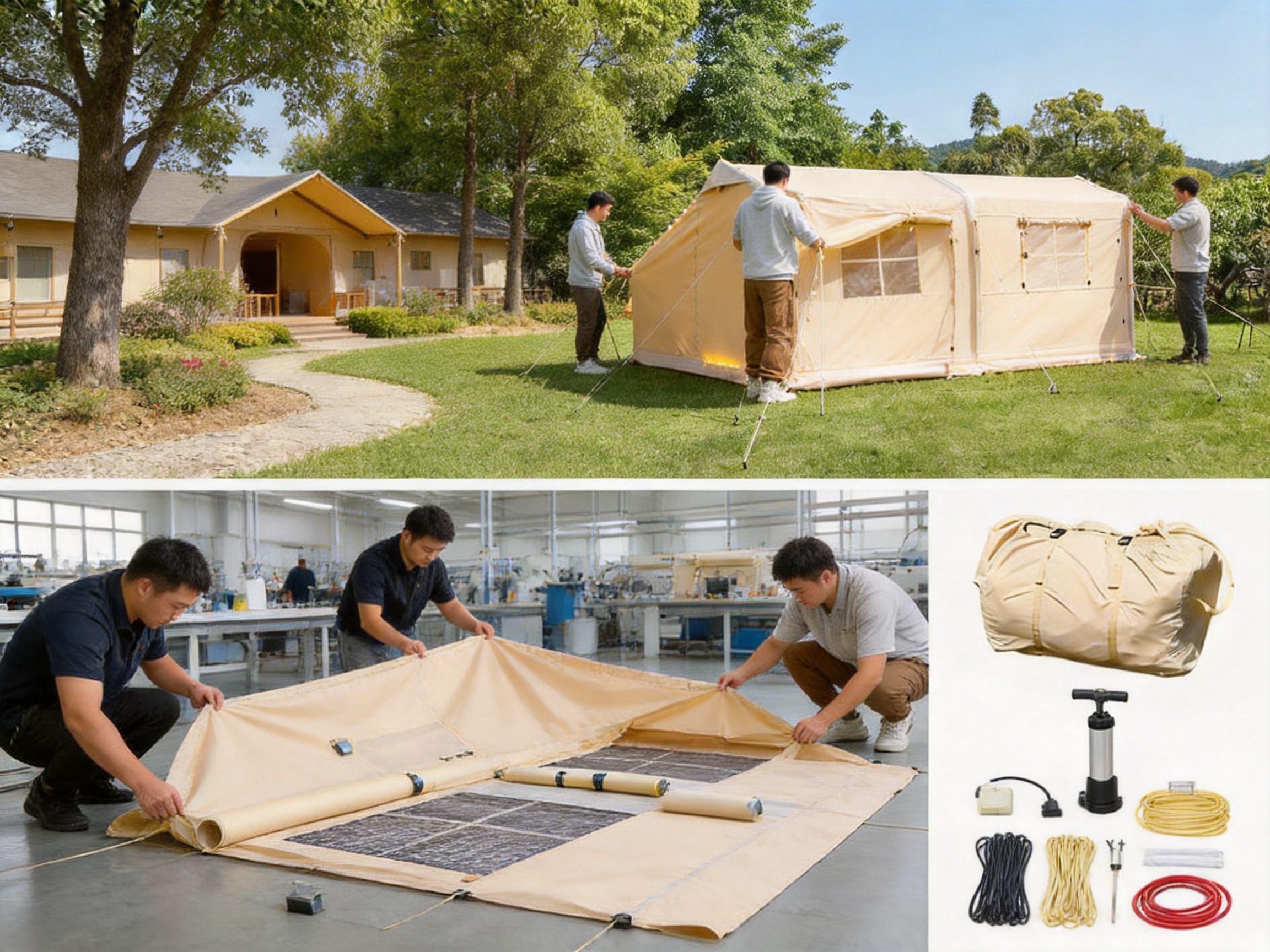
Modern family camping is no longer limited to short weekend trips in compact tents. More outdoor travelers now want a dependable basecamp that combines weather protection, generous living space, privacy, storage, and the everyday comfort needed for extended stays. The Large Inflatable Family Camping Tent Heavy Duty All Season Cabin is designed for exactly this purpose. It creates a spacious outdoor living environment with two sleeping areas and one shared living room, while its inflatable structural system simplifies setup compared with conventional large tents that rely on numerous rigid poles.
With a choice of practical family-oriented layouts, waterproof materials, reinforced air columns, integrated ventilation, and a full partition system, this cabin-style shelter is suitable for family camping, glamping, resort accommodation, outdoor events, and long-stay recreational use. Its design emphasizes strength and comfort without overlooking portability. When packed, the tent is prepared as a single package, while the air-beam structure helps reduce the complexity normally associated with erecting a large cabin tent.
The product is manufactured by Ningbo Zhenhai Tiansai Leisure Products Co., Ltd., a professional Chinese outdoor equipment manufacturer with a factory covering more than 13,000 square meters. The company combines product development, material selection, production, quality control, and export service to support outdoor brands, wholesalers, distributors, and OEM customers around the world.
Built as a Complete Outdoor Living Space
The primary advantage of this inflatable cabin is that it is designed as a livable environment rather than merely a sleeping shelter. A large central room can be used for dining, relaxing, organizing equipment, or spending time indoors during poor weather. Separate bedrooms provide privacy and help divide the interior into practical zones. This arrangement is especially useful for families with children, groups of friends, and campers who plan to remain at one site for several days.
The available product information identifies the structure as two bedrooms and one living room. Additional product configurations are described as one room and one hall or as a larger partitioned family layout. The listed sizes include approximately 410 × 270 × 200 centimeters and 400 × 300 × 220 centimeters. These variations provide flexibility for different market requirements, campsite sizes, and customer preferences.
Compared with a single-compartment dome tent, a cabin-style layout provides a more organized experience. Sleeping bags, luggage, cooking equipment, clothing, and outdoor accessories can be assigned to separate areas. The living room can remain open for shared activities instead of becoming crowded with personal belongings. This zoning also allows occupants to maintain a degree of privacy while still enjoying a shared family basecamp.
The generous interior height further improves usability. A standing-height design reduces the inconvenience of crouching or crawling, especially when changing clothes, preparing meals, arranging beds, or assisting children. For longer camping holidays, this additional interior comfort can make a significant difference in the overall experience.

Large Inflatable Family Camping Tent Heavy Duty All Season Cabin
Inflatable Structural Technology for Faster Setup
Large family tents traditionally depend on multiple steel, aluminum, or fiberglass poles. Although pole systems can provide reliable support, they may require several people to assemble correctly. Long poles can be difficult to transport, and connecting, lifting, and tensioning a large frame can take considerable time. The inflatable cabin replaces much of this rigid framework with high-performance PVC air columns.
The air-beam structure is designed to be inflated with a suitable pump, allowing the main frame to rise progressively into position. This approach reduces the number of separate structural components and simplifies the setup process. Once the air columns are properly inflated and the tent is anchored, the shelter forms a stable cabin-like structure suitable for family camping and extended outdoor use.
An inflatable frame also offers practical advantages during transport and storage. Air beams can be deflated and folded, allowing the packed tent to fit into a manageable single package. The provided packaging information lists a package size of approximately 85 × 40 × 45 centimeters. The source material also lists a gross weight of 37,000 kilograms, which appears inconsistent with a portable camping product and is likely a catalog formatting or unit-entry error. Buyers should confirm the final packed weight with the manufacturer before ordering or planning freight.
The air-column construction is not intended to eliminate the need for proper anchoring. Every large tent must be positioned on suitable ground and secured with appropriate guy lines, pegs, and tension points. Correct inflation pressure, anchoring, and routine inspection are essential for safe operation. The listed safety-related features include pressure-relief valves and reinforced seams, which help support controlled inflation and long-term structural reliability.
For commercial users, the inflatable design can also improve operational efficiency. A campsite operator, event organizer, or resort team can develop a repeatable installation procedure without managing a large collection of poles for every unit. Training can focus on pump operation, anchoring, inflation inspection, and fabric tension, helping reduce setup variation between different staff members.
Advantages of an Air-Beam Frame
Compared with many conventional large tents, an air-beam structure offers several notable benefits:
• Simplified assembly with fewer rigid components to connect.
• Reduced risk of bent or misplaced poles during transport.
• A flexible frame that can be deflated for compact storage.
• Convenient deployment for family users who may not have extensive camping experience.
• A practical solution for larger shelters used in glamping and hospitality settings.
• A clean interior layout without a dense network of poles occupying living space.
These benefits make the inflatable cabin especially attractive to customers who want a large shelter but do not want the setup complexity associated with traditional expedition or event tents.
Heavy-Duty Materials for Four-Season Protection
The tent is specified as a four-season shelter and is designed for use in spring, summer, autumn, and winter. Its material package includes waterproof fabric, a full PVC waterproof bottom cloth, and reinforced PVC air columns with netting. The design also incorporates an integrated waterproof groundsheet, helping protect the interior from damp ground, rainwater, and surface moisture.
The outer fabric is described as high-tensile ripstop material. Ripstop construction is valued in outdoor equipment because its reinforced grid structure helps limit the spread of small tears. No fabric is completely immune to abrasion or puncture, but a properly manufactured ripstop shell can provide a useful balance of durability, weight, flexibility, and packability.
Waterproof performance depends on more than the fabric itself. Seams, zippers, floor connections, doors, air-column sleeves, and attachment points must all be carefully constructed. For this reason, reinforced seams are an important part of the product design. Correct site selection and setup also remain essential. The tent should be pitched away from depressions where water may collect, and the groundsheet should be positioned smoothly without sharp stones or branches underneath.
The full PVC waterproof bottom offers a strong barrier between the interior and the ground. It can help reduce water seepage during wet conditions and makes the cabin more suitable for longer stays than many lightweight recreational tents. A connected or integrated floor also helps reduce drafts at ground level and limits the entry of insects and surface debris.
For hot weather, the tent includes UV-reflective properties intended to reduce heat buildup. High-density mesh windows encourage cross-ventilation while helping keep insects outside. Ventilation is particularly important in a large family shelter because several occupants can produce substantial heat and moisture overnight. Properly positioned windows and mesh panels help the interior remain more comfortable during warm conditions.
Although the shelter is described as all-season, “four-season” should be understood as a design category rather than a guarantee for every extreme environment. Heavy snow accumulation, hurricanes, severe thunderstorms, freezing rain, and exposed high-altitude conditions require specialized planning and may exceed the intended operating range. Users should follow the manufacturer’s recommendations for weather limits, inflation pressure, anchoring, and maintenance.
Privacy Through Modular Interior Zoning
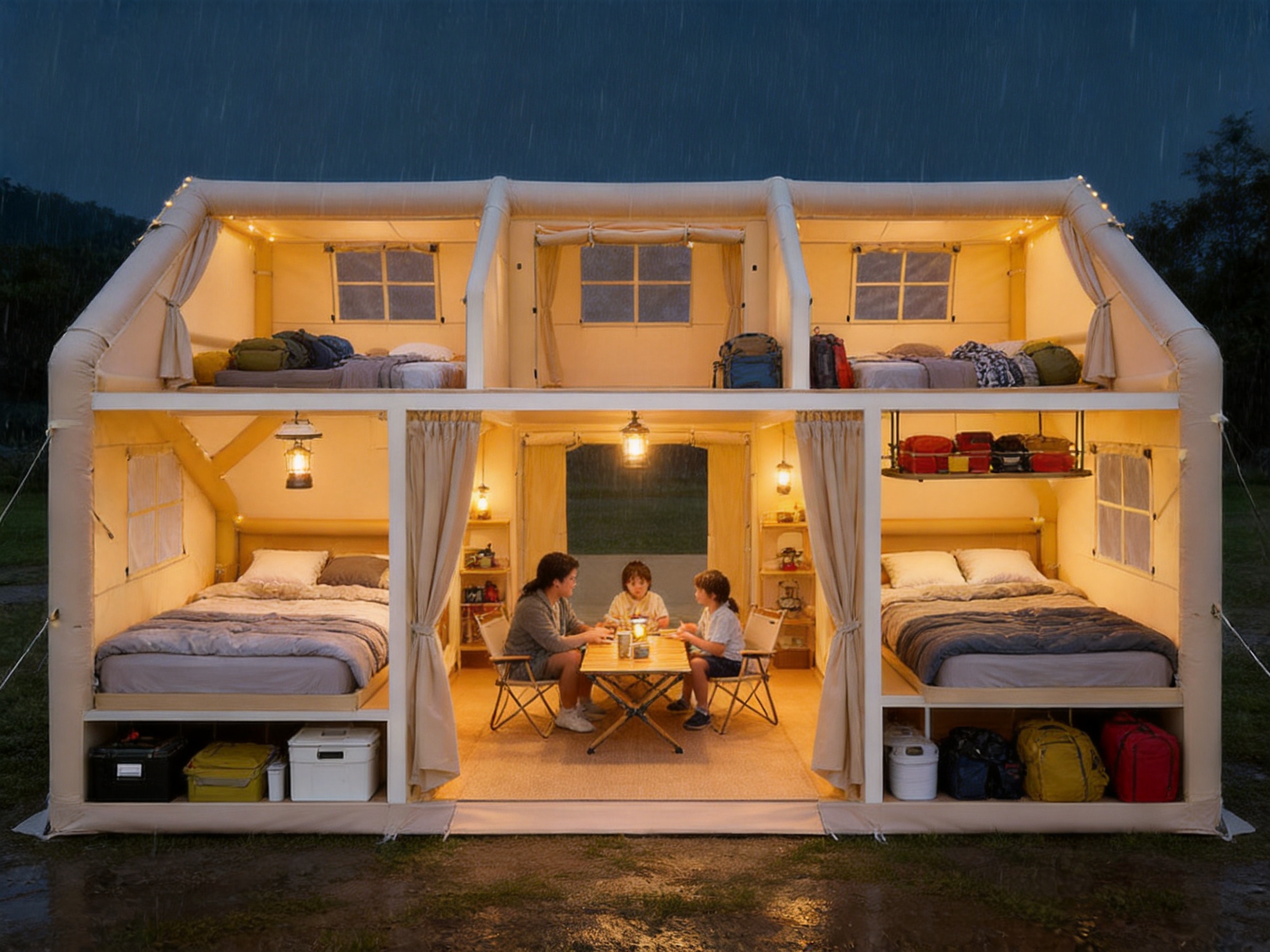
One of the strongest differentiators of the cabin layout is its use of internal partitions. In many large family tents, a single open floor plan provides space but little privacy. The partitioned design allows the interior to be divided into separate sleeping rooms and a central living area. This arrangement supports more comfortable family routines, particularly when adults and children share the same shelter.
Two bedrooms can accommodate different sleeping arrangements. One room may be used by parents while the second is assigned to children, guests, or equipment. Depending on the selected configuration, the rooms can also be used as private changing areas, storage zones, or quiet spaces for rest. The central room remains available for meals, conversation, reading, and indoor activities.
Modular zoning is also valuable for glamping operators. A large air cabin can be furnished with beds, chairs, tables, rugs, storage units, and decorative lighting to create a more premium guest experience. The division between sleeping and living areas helps the shelter feel more like a compact lodge than a basic tent. This makes the design suitable for resort environments, seasonal accommodation, nature retreats, and private outdoor hospitality projects.
The interior architecture also improves organization. Campers can establish designated locations for footwear, cooking accessories, clothing, and personal bags. Keeping equipment out of sleeping rooms can reduce clutter and support better hygiene. In changing weather, the living room can provide a transition area where wet jackets, muddy shoes, and outdoor gear are managed before entering the sleeping spaces.
Ventilation, Light, and Interior Comfort
Comfort inside a family tent depends on air movement, humidity management, light control, and usable space. The cabin addresses these requirements through mesh windows, ventilation openings, and a layout that provides separation between occupied areas. High-density mesh supports airflow while helping prevent mosquitoes and other insects from entering the living space.
Cross-ventilation is most effective when openings on different sides of the structure can be used together. On warm days, users can open selected doors and windows to encourage natural air movement. During rain, vents and protected openings can continue to support airflow while the main shell remains closed. Ventilation should never be blocked by luggage, furniture, or bedding.
The cabin’s height and open living room create a greater sense of volume than a low-profile backpacking tent. This is important for families spending extended periods indoors. Natural light entering through windows can also make the interior feel brighter during the day, reducing the need for artificial lighting. Cable entry points support the organized use of electronic devices, portable lamps, and other campsite accessories.
Interior gear lofts provide elevated storage for lightweight items such as headlamps, books, small clothing pieces, maps, and personal accessories. Using overhead storage helps keep the floor clear for movement and furniture. Because gear lofts should not be overloaded, heavier equipment should remain on the ground or in dedicated storage containers.
Practical Dimensions and Configuration Options
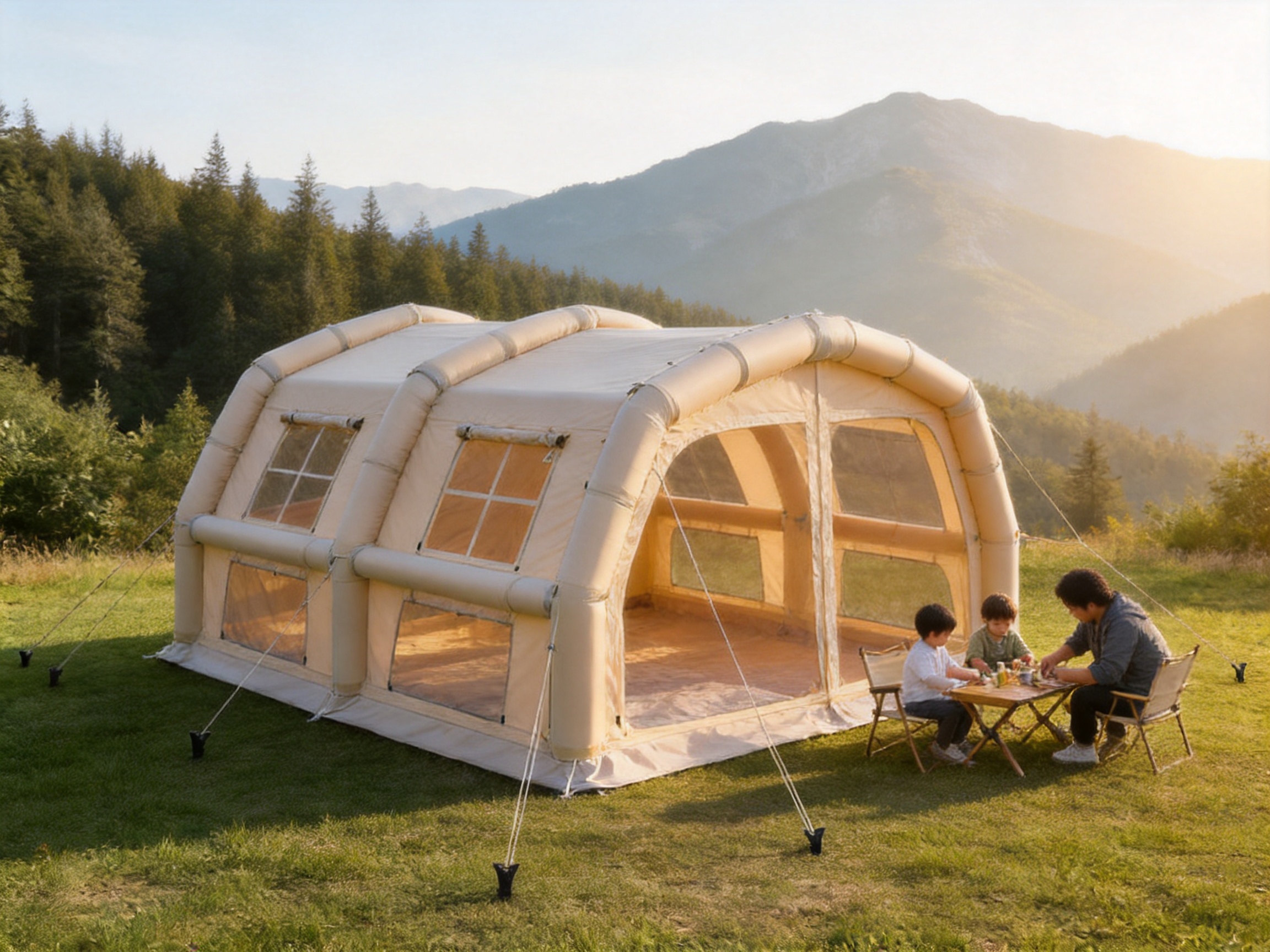
The product data presents more than one size and layout, reflecting the adaptable nature of the range. One listed configuration measures approximately 410 × 270 × 200 centimeters. Another measures approximately 400 × 300 × 220 centimeters. The first option may suit customers who prioritize a compact footprint, while the second offers additional width and height for a more open family living environment.
Buyers should confirm the exact layout, floor plan, room divider arrangement, door position, window configuration, and included accessories before placing an order. Product catalogs may combine multiple related configurations under one listing, especially when the manufacturer supports custom OEM and ODM development. Confirming these details is particularly important for wholesalers and project purchasers who need consistent specifications across multiple units.
The model number associated with the product information is DYI-068. The keyword description identifies it as a two-room inflatable tent, while the structure field specifies two bedrooms and one living room. These details indicate that the product is intended to provide multiple interior zones rather than a single open sleeping chamber.
| Item | Provided Specification | Practical Benefit |
|---|---|---|
| Product category | Inflatable and air tent | Fast, flexible setup with a deflatable frame |
| Season rating | Four-season tent | Designed for use across spring, summer, autumn, and winter |
| Structure | Two bedrooms and one living room | Privacy, organized storage, and shared family space |
| Model number | DYI-068 | Useful for quotation, sampling, and order identification |
| Approximate size option one | 410 × 270 × 200 cm | Family-scale floor plan with standing-height interior |
| Approximate size option two | 400 × 300 × 220 cm | Broader and taller configuration for increased comfort |
| Main materials | Waterproof fabric, PVC waterproof floor, PVC air columns | Moisture resistance and structural support |
| Ventilation | High-density mesh windows and netted air-column design | Airflow and insect protection |
| Special features | Gear lofts, cable entry points, reinforced seams, pressure-relief valves | Organization, convenience, and controlled inflation |
| OEM and ODM | Custom development accepted | Suitable for private-label and project requirements |
Why It Outperforms Basic Family Tents
The product competes in a segment that includes traditional family tents, cabin tents, large tunnel tents, canvas shelters, and premium glamping structures. Its principal advantage is the combination of size, comfort, and inflatable convenience. Many entry-level family tents provide adequate sleeping capacity but offer limited standing room, minimal privacy, and less robust flooring. This air cabin is designed with a more complete living concept.
Compared with small dome tents, the cabin provides substantially more interior volume and a more practical floor plan. Dome tents are often excellent for portability and short trips, but their sloping walls can reduce usable standing and storage space. The cabin’s straighter profile and central living room make it better suited to families who plan to spend time inside the shelter.
Compared with large pole tents, the inflatable frame can reduce assembly complexity and eliminate the need to carry a long set of rigid poles. This is particularly helpful for customers who travel in standard family vehicles or who want to establish a campsite without a large team. The air-beam system also leaves the interior less obstructed than some multi-pole designs.
Compared with lightweight backpacking tents, this product prioritizes roominess, durability, and residential comfort rather than minimum packed weight. It is not intended to replace an ultralight shelter for long-distance trekking. Instead, it is designed for car camping, family holidays, resort use, outdoor events, and semi-permanent recreational setups where usable space is more important than carrying weight.
Compared with some canvas glamping tents, the inflatable cabin may offer faster deployment and easier seasonal handling. Canvas can provide excellent atmosphere and durability, but it may require more drying time, heavier transport equipment, and more involved installation. The inflatable format offers a different balance: a spacious premium-style shelter that can be packed down when not in use.
No tent is ideal for every customer. The best choice depends on transport capacity, climate, site conditions, required permanence, and the desired level of interior comfort. The strength of this model lies in its balanced positioning between a basic recreational tent and a large, fully equipped accommodation structure.
Manufacturing Capabilities and Quality Focus
The manufacturer behind this product operates a factory of more than 13,000 square meters in Ningbo, Zhejiang Province. Ningbo is a major Chinese port city, which provides logistical advantages for exporting bulky outdoor products to international markets. For overseas buyers, factory location can influence shipping coordination, container planning, sample delivery, and replenishment efficiency.
The company specializes in the design, production, and sales of tents and related outdoor equipment. Its product range includes outdoor tents, backpacking tents, glamping tents, inflatable tents, and other shelter solutions. This breadth of experience supports the development of products for different use cases, from lightweight recreational camping to larger commercial accommodation.
Manufacturing an inflatable family cabin requires coordinated control of multiple processes. Fabric must be selected for tensile performance, coating consistency, abrasion resistance, and waterproof behavior. PVC air columns require accurate cutting, sealing, welding, and pressure testing. Floor materials must be joined securely to the upper shell. Mesh panels, zippers, doors, webbing, guy points, and reinforcement patches must be positioned according to the intended load paths.
Quality assurance is especially important for inflatable products because the air frame is a functional structural component. A reliable production process should include inspection of raw materials, verification of welded seams, inflation tests, leak checks, dimensional checks, and evaluation of finished products before packing. Pressure-relief valves must also be correctly installed and tested so the air system can operate within the intended range.
Reinforced seams and stress points deserve particular attention. Doors, corners, guy-line attachments, air-column intersections, and floor connections can experience repeated loading during setup, wind, and packing. Reinforcement helps distribute these forces and can improve service life when the product is used and maintained correctly.
The company reports experience in product innovation, professional design, outdoor testing, and continuous improvement based on customer feedback. It has also developed appearance patents and utility model patents. These capabilities are relevant for wholesale buyers seeking more than a generic catalog item. A supplier with in-house design experience can help refine layouts, materials, branding elements, packaging, and accessories for a particular market.
OEM and ODM Support
The product information states that OEM and ODM customization is acceptable. This allows importers, distributors, camping brands, resorts, and event companies to explore modifications based on their business requirements. Possible development areas may include fabric colors, printed logos, private-label packaging, room configurations, window placement, accessory kits, and branding details.
Customization should be treated as an engineering and production project rather than a simple visual change. Altering the floor plan can affect air-column placement, load distribution, ventilation, sewing patterns, packaging volume, and setup instructions. A professional supplier should therefore review the complete specification before producing samples or approving mass production.
For commercial orders, buyers should request a clear technical specification covering dimensions, fabric composition, waterproof treatment, air-column construction, pump compatibility, included repair parts, packaging, labeling, testing procedures, and warranty conditions. Sample approval is strongly recommended before bulk production.
Designed for Multiple Commercial Applications
Although the product is suitable for private family camping, its cabin format also supports several commercial applications. Glamping resorts can furnish the interior with beds and living-room furniture to create a comfortable guest unit. Outdoor education providers can use partitioned tents for group accommodation, instructor areas, or equipment storage. Event organizers can deploy them as hospitality rooms, backstage spaces, temporary offices, or sheltered activity areas.
Holiday parks and campgrounds may use the tent as a seasonal accommodation option. Its living room and separate bedrooms can make it more appealing to guests who want an outdoor experience without giving up familiar domestic arrangements. The air-beam design can also support efficient installation and removal when sites change according to the season.
Retailers and wholesalers can position the product as a premium family camping solution. Its selling points are easy to communicate: large floor plan, two-bedroom zoning, inflatable setup, waterproof construction, four-season usability, storage features, and standing-height comfort. The product can be displayed as an upgrade for customers who have outgrown smaller tents or want a more comfortable basecamp.
For humanitarian and emergency applications, suitability must be evaluated against specific procurement standards and environmental requirements. The spacious floor plan and rapid deployment concept may be useful in certain temporary shelter projects, but institutional buyers should conduct detailed assessments of fire performance, wind resistance, sanitation, accessibility, local regulations, and deployment procedures before making a commitment.
Setup Recommendations for Best Performance
A reliable setup begins with site selection. Choose level ground that is free from sharp rocks, branches, standing water, and low areas where runoff may collect. Consider wind direction, tree hazards, drainage, access routes, and the space required for guy lines. The tent should not be placed directly beneath dead branches or in areas exposed to sudden water flow.
Lay out the groundsheet and inspect the fabric before inflation. Confirm that doors and partitions are not twisted and that air-column sleeves are correctly positioned. Connect the recommended pump and inflate the air frame according to the manufacturer’s instructions. Do not exceed the specified pressure. Pressure-relief valves are a safety feature, but they should not replace careful monitoring.
Once the structure reaches its recommended pressure, secure the tent using the supplied anchoring points. Guy lines should be evenly tensioned without distorting the frame or pulling excessively on the fabric. In windy conditions, inspect the anchors regularly and add suitable ground reinforcement if necessary. The tent should never be left unsecured simply because the air columns appear rigid.
After setup, check the main seams, floor perimeter, doors, windows, valves, and attachment points. Confirm that ventilation panels are available and that interior partitions are correctly attached. Arrange furniture and equipment so that air circulation remains unobstructed and no sharp objects press against the floor or walls.
Maintenance, Storage, and Service Life
Regular care can significantly extend the useful life of any large outdoor shelter. After each trip, remove soil, leaves, food residue, and moisture. If the tent has been exposed to rain, it should be dried completely before long-term storage. Packing a damp tent can encourage mildew, unpleasant odors, coating damage, and fabric deterioration.
Clean the outer fabric with a soft cloth, clean water, and a mild cleaning solution when necessary. Avoid aggressive chemicals, abrasive brushes, and high-pressure cleaning methods that could damage coatings or seams. Zippers should be kept free from sand and grit. Mesh panels should be handled carefully because they can be damaged by rough objects or excessive pulling.
Air columns should be inspected for visible abrasion, valve damage, and unusual pressure loss. If a leak is suspected, isolate the relevant air chamber and use an approved leak-detection method. Small punctures may be repairable with the supplied repair kit, but larger damage or seam failure should be assessed by a qualified service provider.
Before deflation, remove furniture and personal items from the tent. Open the valves according to the instructions and allow air to escape naturally or with the approved deflation method. Fold the fabric without forcing sharp creases into valves, windows, or reinforced connection areas. Store the packed tent in a cool, dry place away from direct sunlight, chemicals, rodents, and sources of heat.
When used in a commercial setting, operators should maintain a service log. The log can record installation dates, pressure checks, repairs, cleaning, fabric inspections, and replacement of consumable parts. This simple procedure helps identify repeated problems and supports consistent guest safety.
Important Purchasing Considerations
Before purchasing, buyers should confirm which of the listed configurations is being quoted. The two documented size options are similar but not identical, and the interior partition design may vary. Ask for a floor plan or technical drawing showing the number of bedrooms, living-room dimensions, door locations, window openings, and the position of the air beams.
Clarify whether the package includes an air pump, repair kit, pegs, guy lines, storage bag, partition curtains, and installation instructions. Accessories can vary by market and order quantity. For wholesale orders, packaging labels and user manuals should be reviewed for language, safety information, and compliance requirements.
Material information should also be confirmed in writing. Buyers may request fabric weight, coating type, waterproof rating, floor thickness, PVC air-column specifications, seam construction, UV treatment, mesh density, and zipper quality. These details help compare suppliers on a meaningful basis rather than relying only on photographs or general descriptions.
For four-season positioning, ask the manufacturer to define the recommended operating conditions. Snow, wind, cold temperatures, and prolonged ultraviolet exposure can affect performance. The final marketing language should match verified test results and local regulatory expectations.
Commercial customers should review production lead times, minimum order quantities, sample policies, inspection procedures, warranty terms, spare-part availability, and after-sales support. A dependable supplier relationship is especially important for large tents because shipping, replacement, and field repairs can be more complex than for small camping accessories.
Safety Guidance
Always use the tent according to the supplied instructions. Keep flames, stoves, heaters, lanterns, and other heat sources away from the fabric and air columns unless the manufacturer specifically approves their use and provides appropriate safety guidance. Indoor cooking can create fire, carbon monoxide, and condensation hazards, so cooking should normally be carried out in a properly ventilated area outside the sleeping compartments.
Do not modify air valves, pressure-relief devices, structural sleeves, or load-bearing attachment points without professional approval. Avoid hanging heavy objects from the ceiling, air columns, or gear lofts. Keep children away from pumps, valves, guy lines, and open zippers during installation.
During severe weather, inspect the shelter frequently and follow local safety advice. If conditions become unsafe, evacuate the tent and move to a suitable permanent structure. A four-season tent can provide broad weather protection, but it is not a substitute for judgment, proper anchoring, or an emergency plan.
Company Strength and Supply-Chain Reliability
Ningbo Zhenhai Tiansai Leisure Products Co., Ltd. has built its business around the design, manufacture, and export of tents and outdoor products. Its location in Ningbo supports international logistics, while its factory scale provides a foundation for organized production and product development.
The company states that it has supplied international customers across North America, Europe, Asia, and other regions. It also reports cooperation as a designated global supplier for the British company TENTSILE. This experience indicates familiarity with international product expectations, export documentation, quality requirements, and communication with overseas customers.
A professional design team supports product improvement from the perspectives of practicality and comfort. The company describes a development process that includes collaboration with professionals, outdoor-user testing, and design adjustments based on customer feedback. For inflatable family tents, this user-focused approach is valuable because real-world performance depends on setup convenience, ventilation, storage, room access, cleaning, and repairability as much as on basic appearance.
The company also emphasizes quality management, product innovation, lightweight and environmentally conscious material development, and full-link service. Its core team is described as having more than ten years of experience in outdoor product research and development, production, and overseas operations. These capabilities can benefit customers seeking a long-term manufacturing partner rather than a one-time trading transaction.
Q&A
What type of tent is this?
It is a large inflatable family camping tent in a cabin-style format. The listed structure includes two bedrooms and one living room, with additional related configurations described as one room and one hall or a partitioned family layout.
Is the tent suitable for four seasons?
The product is listed as a four-season tent and is designed for spring, summer, autumn, and winter use. It includes waterproof fabric, a waterproof PVC floor, air columns, reinforced seams, and ventilation features. Users should still follow the manufacturer’s weather guidance and should not assume that the tent is suitable for every extreme climate.
How is the tent supported?
The main structure uses inflatable PVC air columns rather than a conventional network of rigid poles. The frame is inflated with a suitable pump and then secured with anchors and guy lines.
How many rooms does it have?
The key attributes identify the structure as two bedrooms and one living room. Because the listing includes more than one related configuration, buyers should confirm the exact floor plan before ordering.
What are the available dimensions?
The product information lists approximately 410 × 270 × 200 centimeters and 400 × 300 × 220 centimeters for different configurations. Final dimensions should be confirmed on the quotation, technical drawing, or approved sample.
What materials are used?
The listed materials include waterproof fabric, a full PVC waterproof bottom cloth, and upgraded PVC air columns with netting. The design also refers to high-tensile ripstop fabric, reinforced seams, mesh windows, and an integrated waterproof groundsheet.
Does it have separate sleeping areas?
Yes. The cabin concept includes internal partitions that create separate sleeping rooms and a shared living room. This arrangement offers greater privacy and organization than a single open-compartment tent.
Is it suitable for glamping resorts?
Yes. Its large interior, standing height, room partitions, inflatable setup, and residential-style layout make it suitable for glamping, resort accommodation, nature retreats, and seasonal outdoor hospitality projects. Commercial users should verify local regulations and required performance standards.
What ventilation features are included?
The product includes high-density mesh windows and netted ventilation areas. These features support airflow and help limit insect entry. Ventilation openings should be used according to weather conditions and should not be blocked by luggage or furniture.
Does the tent include storage features?
The design includes internal gear lofts and cable entry points. Gear lofts are suitable for lightweight personal items, while cable entries help organize power or lighting cables. Heavy equipment should not be suspended from the ceiling or lofts.
Can the product be customized?
The manufacturer states that OEM and ODM customization is acceptable. Potential projects may involve branding, colors, packaging, layouts, accessories, or other specifications. Custom changes should be reviewed through drawings, samples, and written technical approval.
What should be checked before a bulk order?
Buyers should confirm dimensions, room layout, fabric specifications, waterproof performance, air-column construction, included accessories, packaging, labeling, inspection procedures, warranty terms, production time, and spare-part support. A pre-production sample is recommended for customized or large-volume orders.
How should the tent be stored?
Dry the tent completely before packing it for long-term storage. Remove dirt and debris, inspect the air columns and valves, fold the shelter carefully, and store it in a cool, dry location away from sunlight, chemicals, sharp objects, and excessive heat.
Is this tent suitable for backpacking?
It is designed primarily for family camping, car camping, glamping, resorts, and other applications where spacious living capacity is important. It is not intended as an ultralight backpacking tent for long-distance trekking.
Conclusion
The Large Inflatable Family Camping Tent Heavy Duty All Season Cabin provides a strong combination of comfort, space, privacy, weather protection, and setup convenience. Its two-bedroom-and-living-room concept transforms the traditional tent into a functional outdoor residence. The inflatable air-beam frame reduces pole-related complexity, while the waterproof shell, PVC floor, reinforced construction, mesh ventilation, storage lofts, and cable entry points support practical family use.
Its advantages over basic family tents are most apparent during extended stays. Users gain standing height, separate sleeping zones, a shared living area, improved organization, and a more comfortable environment in changing weather. For glamping and commercial operators, the same characteristics support a premium guest experience and a flexible accommodation format.
The manufacturer adds value through factory capacity, design expertise, outdoor product experience, quality management, export knowledge, and OEM/ODM support. With appropriate configuration verification, careful setup, regular maintenance, and responsible weather planning, this inflatable cabin can serve as a dependable platform for family adventures, resort projects, outdoor events, and customized camping programs.
References
1. Product specification sheet for the Large Inflatable Family Camping Tent, model DYI-068.
2. Manufacturer-provided material and packaging information for inflatable family camping tent configurations.
3. General principles of waterproof textile construction, ripstop fabric design, and outdoor shelter maintenance.
4. General guidance on inflatable air-beam tent setup, anchoring, pressure management, and storage.
5. Manufacturer profile and company information supplied for Ningbo Zhenhai Tiansai Leisure Products Co., Ltd.
Product: Large Inflatable Family Camping Tent Heavy Duty All Season Cabin

Message Us Right Now!
-
Mp: +86-18858091910
E-mail: sales@tenplaytent.com
ADD: No. 529, Guangyuan Road, Xiepu Town, Zhenhai District, Ningbo City, Zhejiang Province, China
-
Quick Links
Home Products About Us Advantage News Contact Us -
Product
Inflatable & Air Tents Glamping & Resort Tents Backpacking & Trekking Tents Automatic & Pop-Up Tents Family & Camping Tents Specialty Tents & Shelters Kids Tents Pet Tents Humanitarian & Large Tents Hammock -
Get Connected
 Camping Tent Manufacturer in China