


 English
 عربى


Spreader Bar Hammock with Stand-Style Flat-Lay Comfort for Outdoor Relaxation
A hammock should be more than a place to sit for a few minutes. It should provide a comfortable, stable, and inviting space where people can read, nap, rest, or enjoy the outdoors without feeling restricted. The spreader bar hammock described in this article is designed around that idea. Its defining feature is a pair of solid spreader bars positioned at both ends of the fabric bed. These bars hold the hammock open, creating a broad, flat, and stable surface that feels closer to a suspended daybed than to a narrow, deeply curved traditional hammock.
With breathable fabric, reinforced stitching, heavy-duty tree straps, carabiners, a 500-pound stated weight capacity, and a compact carry bag, the product is intended to combine everyday comfort with practical portability. It can be used in a garden, patio, campsite, vacation property, or suitable indoor location. Its open structure also gives it an elegant appearance that works well in leisure environments where appearance matters as much as function.
Behind this product is Ningbo Zhenhai Tiansai Leisure Products Co., Ltd., an established Chinese outdoor-product manufacturer with a factory covering more than 13,000 square meters. The company specializes in the design, production, and sales of tents and related outdoor leisure equipment. Its experience in fabric products, suspension-oriented outdoor designs, product development, and international supply gives this hammock a manufacturing foundation that smaller trading-only suppliers may not be able to offer.
This article examines the hammock’s design, user benefits, construction, setup, portability, manufacturing strengths, quality considerations, customization potential, and suitability for different markets. It also compares the product’s practical advantages with common weaknesses found in basic hammocks, while explaining how buyers can evaluate the item responsibly for residential, hospitality, retail, and outdoor-use applications.

Spreader Bar Hammock with Stand Style Flat Lay Design for Outdoor Relaxation
1. The Core Idea: A Hammock Designed Like a Floating Bed
Traditional gathered-end hammocks are usually suspended from two points and allowed to form a deep curve. That shape can be relaxing, but it often creates several limitations. The fabric may bunch around the user’s shoulders and legs, the sleeping surface may feel narrow, and getting in or out can require careful movement. When one person shifts position, the entire hammock may rotate or fold inward.
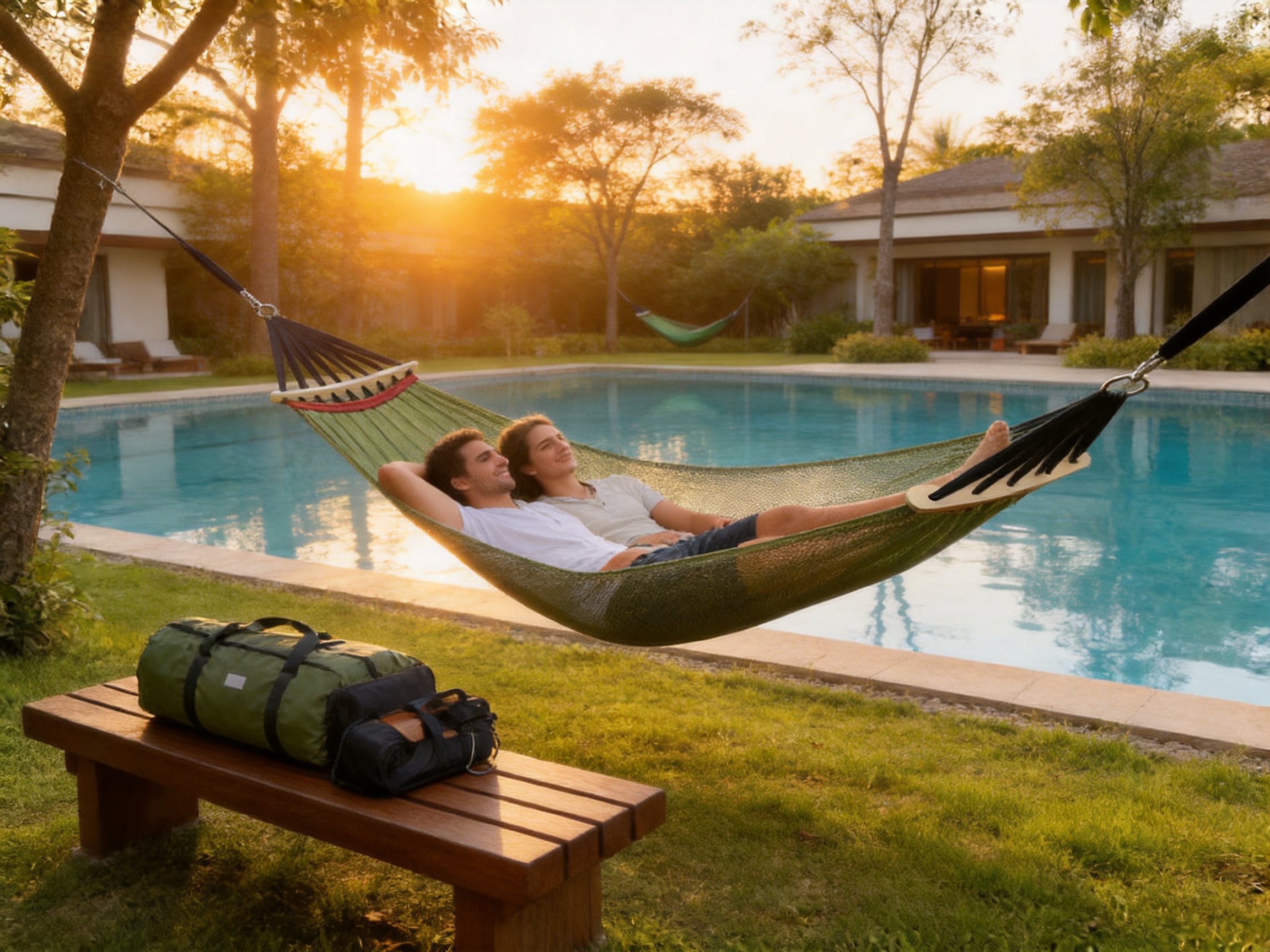
A spreader bar hammock takes a different approach. The bars at both ends pull the fabric outward, maintaining a more open rectangular sleeping area. Instead of wrapping around the user, the fabric presents a wider and flatter platform. This arrangement is particularly appealing to users who prefer to lie on their back, stretch their legs, turn from side to side, or share the hammock with another person within the stated load limit.
The “stand-style” appearance comes from the hammock’s open, structured presentation. Even when it is suspended between trees or other appropriate anchor points, it looks more like a compact outdoor lounger than a loosely gathered sling. This makes it suitable for residential patios, resort gardens, poolside relaxation zones, and visually coordinated outdoor spaces.
The flat-lay concept also improves accessibility. A user does not have to climb deeply into a pocket of fabric. The open surface is easier to approach, and the spreader bars make the edges more visible. This can be helpful for adults who want a simpler entry and exit experience, although all users should still mount and dismount slowly and ensure that the hammock is securely installed before use.
Why the Flat Surface Matters
A hammock’s comfort depends on more than softness. Body position, fabric tension, width, stability, and the way the product distributes weight all affect the experience. A flat-lay surface reduces the sensation of being squeezed by gathered fabric. It also gives users more freedom to find a natural posture.
For reading, a broad surface creates room to support the upper body with a pillow or folded blanket. For napping, the user can lie in a more familiar position. For social use, the open design provides an inviting place where two people can relax together, provided that the total combined load remains within the product’s stated 500-pound capacity and the suspension system is installed correctly.
The spreader bars also help prevent the fabric from collapsing toward the middle. This does not make the hammock rigid; it remains a suspended leisure product with natural movement. However, it gives the fabric a more consistent shape than many low-cost gathered hammocks, making the experience feel more controlled and supportive.
2. Product Advantages Compared with Basic Hammocks
The market includes many simple rope, net, and fabric hammocks. Some are inexpensive and suitable for occasional use, but they may lack the features needed for long-term comfort or premium presentation. This spreader bar model offers several meaningful advantages over those basic alternatives.
| Feature | Basic Gathered Hammock | Spreader Bar Hammock | User Benefit |
|---|---|---|---|
| Sleeping surface | Often narrow and deeply curved | Wide and more open | Greater freedom to stretch, turn, and relax |
| Fabric behavior | May bunch around the body | Held open by bars at both ends | More consistent support and less crowding |
| Visual appearance | Casual and loosely formed | Structured, neat, and lounge-like | Better fit for patios, resorts, and styled outdoor areas |
| Entry and exit | Can require climbing into a deep pocket | Open edges are easier to see and approach | More convenient everyday use |
| Weight support | Varies widely by construction | Stated capacity of up to 500 pounds | Suitable for individual or shared relaxation within the limit |
| Installation | May require separately purchased hardware | Includes tree straps and carabiners | More convenient setup from the beginning |
| Storage | Depends on model | Designed to pack into a carry bag | Simple storage and transport |
One of the most important advantages is the combination of comfort and visual order. A basic hammock can be comfortable when positioned correctly, but its fabric may sag unevenly or twist during use. The spreader bars keep the body of the hammock visually and physically open. This makes the product more attractive in a garden or hospitality setting where outdoor furniture is expected to contribute to the overall appearance of the space.
Another advantage is versatility. The product is not limited to camping. It can be used for backyard relaxation, patio lounging, indoor seasonal use, weekend travel, resort amenities, and gift markets. The design speaks to customers who want both a practical outdoor item and a decorative leisure product.
The included tree straps and carabiners further distinguish the product from hammock bodies sold without suspension equipment. Customers can receive a more complete solution rather than having to research compatible straps or improvise with unsuitable rope. Appropriate installation remains essential, but the inclusion of hardware reduces the number of additional purchases required.
A More Stable Experience Without Eliminating Natural Movement
Stability is a relative term in hammock design. No suspended hammock behaves exactly like a fixed bed. It will move, respond to weight shifts, and require secure anchoring. The benefit of the spreader bars is that they stabilize the fabric’s open shape. They reduce uncomfortable bunching and help the user maintain a broad surface while resting.
This balance is valuable. A completely rigid platform would lose much of the gentle floating sensation that makes hammocks appealing. The spreader bar construction preserves the relaxed suspension experience while offering more structure than a simple gathered sling.
Users should install the hammock with adequate clearance from the ground and surrounding obstacles. The anchor points must be strong enough for the combined user weight and dynamic movement. Tree straps should be wrapped around suitable trunks according to the installation instructions, and carabiners must be fully closed before use.

3. Materials and Construction Features
The hammock is made with high-quality, breathable fabric intended to support comfort during extended outdoor use. Breathability is particularly important in warm climates. A dense, non-breathable surface can trap heat and moisture, whereas an air-permeable textile allows greater airflow around the body.
Breathable fabric can also improve the general perception of comfort. When a user lies still for an extended period, ventilation beneath the back and legs becomes noticeable. The material should feel soft enough for relaxation while retaining sufficient strength to carry the intended load. These needs require a balance between hand feel, tensile performance, seam construction, color stability, and resistance to ordinary outdoor conditions.
Reinforced stitching is another essential feature. The main fabric may be strong, but stress is concentrated around the suspension ends, connection loops, and areas where the spreader bars interact with the fabric. Reinforced seams distribute the load over a broader area and reduce the likelihood that a single line of stitching will carry excessive force.
A well-made hammock should use consistent seam lines, secure thread tension, neat edge finishing, and strong attachment points. Manufacturing inspection should look for skipped stitches, loose threads, uneven reinforcement, fabric damage, and alignment problems around the spreader bars. These details have a direct effect on product confidence and service life.
The Role of the Spreader Bars
The spreader bars are not merely decorative. They are functional structural components that define the hammock’s flat-lay form. Positioned at the head and foot ends, they maintain lateral width and help prevent the fabric from folding inward.
Because the bars remain under tension during use, their material, surface finish, dimensions, and connection design must be selected carefully. The ends should be smooth and properly finished so that they do not abrade the fabric or create sharp contact points. The connection between the bars and the hammock body should be checked for even loading and secure retention.
The bar length influences the visual width and the degree to which the hammock remains open. A wider bar can create a more spacious appearance, while a compact bar may make the product easier to transport. The final design represents a balance between relaxation space, packability, weight, and manufacturing efficiency.
For buyers considering private-label or wholesale production, spreader bar specifications should be discussed at the development stage. Important questions include the selected material, surface treatment, bar diameter or profile, end protection, attachment method, and packaging arrangement. These specifications can influence both perceived quality and shipping costs.
Suspension Hardware and Load Distribution
The supplied heavy-duty tree straps are intended to make setup more practical while helping protect suitable trees from the concentrated pressure that can result from thin cordage. Wide webbing generally distributes contact over a broader section of bark than narrow rope. Users should still choose appropriate trees and avoid damaging fragile or protected vegetation.
Carabiners provide the connection between the suspension straps and the hammock attachment points. Their gate should close completely, and the hardware should be inspected before each use. Hardware should never be substituted with decorative clips or non-load-bearing accessories.
The stated capacity of up to 500 pounds is a significant selling point, especially for a double relaxation product. Capacity, however, should not be interpreted as permission to exceed the manufacturer’s instructions or to use the hammock in unsafe conditions. Dynamic movement, uneven loading, sharp contact, improper anchoring, and worn components can all affect real-world performance.
4. Comfort for Different Types of Users
The product is designed for people who want a generous relaxation surface rather than a minimalist sleeping sling. Its wide profile can accommodate several recreational activities without requiring the user to remain in one position.
Reading and Leisure
For reading, the flat surface makes it easier to position a book, tablet, or e-reader at a comfortable angle. Users can sit diagonally or recline with support beneath the shoulders and legs. The open design also makes it easier to place a small cushion or blanket on the hammock.
Users should avoid placing hard objects beneath the fabric or near the suspension points. A smooth, uncluttered surface improves comfort and reduces the possibility of abrasion. Electronic devices should also be protected from falls, moisture, and excessive heat.
Afternoon Naps
The hammock’s primary appeal may be its ability to create a calm napping space. The fabric gently supports the body, while the spreader bars provide a flatter posture than a deeply curved hammock. The breathable material can be helpful during warm-weather rest, and the open form allows a light breeze to pass around the user.
For napping, location matters. A shaded area is usually preferable to direct midday sun. The hammock should be placed away from sprinklers, high-traffic paths, sharp branches, cooking equipment, and areas where children or pets may interfere with the suspension system.
Shared Relaxation
The stated 500-pound capacity makes the hammock suitable for shared relaxation when the total weight is within the limit. Two people should enter slowly and distribute their weight carefully. Sudden loading by one person can cause unexpected movement, especially when the second person is already lying on the fabric.
Couples, parents and children, or friends may enjoy the open surface for conversation. Nevertheless, users should follow the stated capacity and supervise children. The hammock is a leisure product, not playground equipment, and should never be used for jumping, swinging aggressively, or climbing on the spreader bars.
Indoor and Seasonal Use
The product can also be installed indoors where suitable structural anchor points are available. Indoor installation requires particular caution because ordinary walls, ceiling trim, decorative beams, or unverified furniture are not necessarily capable of supporting a suspended load.
An indoor user should consult qualified installation guidance and confirm that the anchor system is appropriate for the building structure. The hammock should not be attached to weak partitions, unstable railings, or temporary fixtures. When correctly installed, indoor use can extend the product’s seasonal value and make it useful in reading rooms, enclosed porches, sunrooms, or recreation spaces.
5. Portability and Everyday Practicality
Portability is one of the product’s strongest practical benefits. Although the spreader bars give the hammock a structured form, it is designed to pack down into a compact carry bag. This allows users to store it during bad weather, transport it for weekend trips, or move it between different areas of a property.
A carry bag also improves retail presentation. It keeps the product components together and provides a clear storage solution after use. For wholesale buyers, a properly designed bag can support branding, instruction labeling, barcode placement, and organized packaging.
When packing the hammock, the fabric should be clean and completely dry. Storing damp fabric for extended periods can produce unpleasant odors, mildew, discoloration, or material deterioration. The spreader bars and metal hardware should be checked for moisture before storage, particularly after use near a pool, beach, or humid environment.
The compact format is useful for customers who do not have room for permanent outdoor furniture. A conventional lounge chair may occupy a fixed area throughout the season, whereas this hammock can be installed when needed and stored when the space is required for another activity.
Travel and Weekend Use
For weekend getaways, the hammock can serve as a flexible leisure accessory at a campsite, vacation home, or suitable private outdoor location. Its usefulness is greatest where there are strong, appropriately spaced anchor points. Travelers should not assume that every tree, post, or structure is suitable.
The product is best transported in the supplied bag rather than loose in a vehicle, where hardware could rub against the fabric. Packing the straps separately inside the bag or in a protected compartment can help prevent tangling and reduce wear on the textile.
6. Manufacturing Strengths Behind the Product
The performance of an outdoor leisure product depends heavily on the manufacturer’s ability to control materials, processes, inspection, and communication. Ningbo Zhenhai Tiansai Leisure Products Co., Ltd. operates from a factory of more than 13,000 square meters in Zhenhai District, Ningbo, Zhejiang Province, China. Ningbo’s position as an important port city supports international logistics and export operations.
The company specializes in tents and outdoor products, giving it relevant experience with technical fabrics, stitched assemblies, load-bearing structures, packaging, and products designed for use in changing outdoor conditions. A manufacturer with this product background can approach a hammock as part of a wider outdoor-equipment system rather than as an isolated textile item.
The company’s reported design and engineering capabilities include the development of products with appearance patents and utility model patents. This indicates an emphasis on product development and functional design. For customers seeking differentiated merchandise, design capability can be valuable because it supports the creation of products that do not look identical to standard catalog items.
Professional Design and Product Testing
According to the company information provided, Tiansai Leisure maintains a professional design team and develops products with attention to practicality and comfort. The company also collaborates with professionals and invites outdoor enthusiasts to participate in testing. Feedback from actual users can reveal issues that may not be obvious from drawings or factory prototypes.
For a spreader bar hammock, practical testing may examine entry and exit, fabric tension, body comfort, bar alignment, attachment strength, packaging durability, and the clarity of setup instructions. Repeated testing can help identify whether users understand how to install and adjust the product without unnecessary difficulty.
Testing should also consider different body sizes and use positions. A hammock that feels comfortable only when one person lies perfectly centered may not perform as well in real household conditions. User feedback can support improvements to width, fabric feel, strap length, hardware selection, and carry-bag design.
Quality Management
The company states that it strictly implements a quality management system and aims to ensure that products meet international standards. Buyers should request the specific quality documents, test reports, and inspection records relevant to their target market and product configuration. General statements about quality should be supported by product-specific evidence when required for commercial distribution.
A strong quality process for this hammock may include incoming-material inspection, fabric shade and defect checks, dimensional verification, seam inspection, hardware checks, load testing, packaging inspection, and final random sampling. Each stage helps prevent a defect from reaching the customer.
Production traceability is also important. Batch identification can help a manufacturer and buyer investigate complaints, isolate affected stock, and manage improvements. For wholesale orders, clear communication about sampling procedures, acceptable quality limits, carton packing, labeling, and inspection responsibilities can reduce misunderstandings.
Experience in International Supply
Tiansai Leisure exports products to countries and regions in North America, Europe, Asia, and other markets. International supply experience can strengthen a manufacturer’s understanding of packaging requirements, labeling expectations, communication across time zones, shipping coordination, and the different preferences of outdoor consumers.
International experience is particularly useful for products such as hammocks because the product may be sold through online stores, outdoor retailers, garden centers, resort suppliers, gift channels, and private-label catalogs. Each channel can require different packaging, photography, instructions, carton quantities, and product positioning.
7. Advanced Manufacturing Process for a High-Quality Hammock
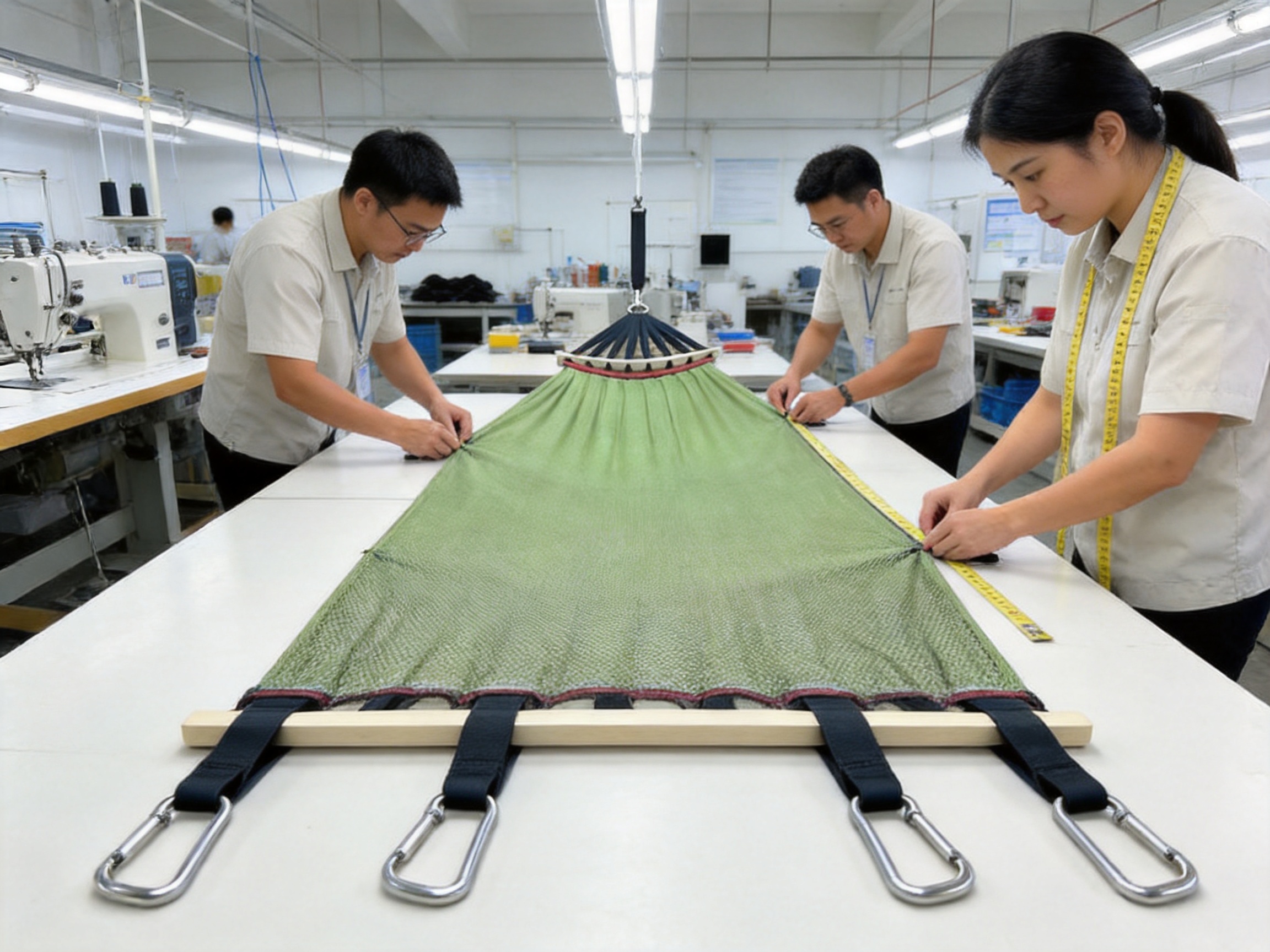
A reliable hammock is produced through a sequence of controlled operations rather than a single sewing step. The following process describes the principal manufacturing considerations for this type of product. Exact machinery, materials, and inspection standards may vary according to the final specification and customer requirements.
Material Selection and Incoming Inspection
Production begins with the selection of fabric, webbing, thread, spreader bar components, metal hardware, labels, and packaging materials. The fabric should be evaluated for weight, width, color consistency, hand feel, tensile performance, and resistance to common forms of wear.
Webbing must be checked for width, thickness, weave consistency, edge quality, and strength. Thread should be compatible with the fabric and intended outdoor conditions. Metal components should be inspected for surface finish, dimensions, gate operation where applicable, and visible defects.
Incoming inspection helps ensure that inconsistent raw materials do not create avoidable production variation. Materials that fail specification can be isolated before they enter the cutting or assembly process.
Computer-Aided Pattern Development
The hammock body can be developed using measured patterns that define the final length, width, attachment zones, seam allowances, and reinforcement positions. Computer-aided pattern work can improve consistency across production batches and simplify modifications during product development.
Pattern development should account for fabric stretch, seam behavior, bar placement, and the way the hammock folds for packaging. The final dimensions must support the intended flat-lay experience without creating excessive tension that could damage seams or hardware.
Precision Cutting
Fabric cutting should produce clean, repeatable panels with accurate dimensions. Depending on the material, cutting may be performed with industrial blades or other suitable equipment. Operators should control fraying, distortion, and alignment during the cutting process.
Accurate cutting is important because small dimensional differences can affect the final symmetry of the hammock. If one side is longer or wider than the other, the spreader bars may sit unevenly and the load may not distribute as intended.
Reinforcement and Sewing
Reinforcement areas receive special attention because suspension loads are concentrated at the ends and connection points. Additional layers of fabric, webbing, or carefully designed seam structures may be used to distribute stress.
Industrial sewing machines should be configured for the selected fabric thickness and thread. Stitch density, seam type, back-tacking, edge finishing, and thread tension should be controlled. Operators should follow standardized work instructions rather than relying solely on visual judgment.
After sewing, inspectors can examine seam straightness, reinforcement placement, loose threads, skipped stitches, puckering, and evidence of needle damage. These checks are simple but valuable. A neat appearance often reflects better process control, while hidden defects can become more serious during loading.
Spreader Bar Assembly
The spreader bars should be fitted in a way that maintains consistent spacing and avoids sharp contact with the textile. End components, protective caps, sleeves, or attachment elements should be installed according to the approved design.
Assembly workers should verify that both bars are aligned and that the fabric is not twisted. A twist may not be obvious when the product is packed, but it can affect comfort and stability when the hammock is suspended.
Hardware Attachment and Inspection
Tree straps and carabiners should be matched to the intended suspension points and packed with the correct hammock body. Hardware verification can include dimensional checks, visual inspection, operation of gates, and confirmation that the supplied components correspond to the approved sample.
Hardware should not be mixed between product versions without authorization. A change in carabiner design, strap width, or connection loop can affect installation instructions and the product’s overall performance.
Load and Durability Testing
Load testing is an important part of validating the stated capacity. A manufacturer may use controlled static loading, repeated loading, seam testing, and suspension-point evaluations. The test method should be appropriate to the product and market requirements.
Testing does not eliminate the need for safe use. Instead, it provides evidence that the design and construction have been evaluated under controlled conditions. Production samples should be compared against approved standards so that the quality of mass-produced units remains consistent with the tested configuration.
Final Inspection and Packaging
Before packing, each unit should be checked for fabric defects, stitching quality, bar alignment, hardware completeness, carry-bag condition, and instruction materials. The hammock should be folded in a way that protects the fabric and prevents unnecessary pressure on the spreader bars.
Packaging should protect the product during handling and international transportation. Cartons should be sized to balance protection with shipping efficiency. For retail customers, packaging may also include product features, safety guidance, care instructions, barcode labels, and multilingual content.
8. OEM, Wholesale, and Customization Opportunities
The manufacturer’s design and factory capabilities create opportunities beyond the standard product. Retailers, distributors, resorts, online brands, and outdoor-equipment companies may request private-label or OEM versions of the hammock.
Potential customization areas include fabric color, logo labels, woven tags, carry-bag graphics, instruction sheets, packaging design, strap color, hardware finish, carton markings, and order quantities. Buyers may also discuss adjustments to dimensions, provided that any change is evaluated for comfort, stability, load performance, and packaging impact.
Color customization can help the product fit different sales channels. Neutral tones may appeal to minimalist home and garden retailers, while brighter colors may be suitable for family-oriented outdoor stores. Resort customers may request coordinated colors that match existing furniture, umbrellas, or poolside branding.
Packaging is especially important for e-commerce. The product should be compact enough to control shipping costs while still communicating quality when it reaches the customer. Clear product photography, concise feature explanations, safety information, and accurate dimensions can reduce returns caused by misunderstandings.
What Wholesale Buyers Should Confirm
Before placing an order, buyers should confirm the product dimensions, fabric composition, weight, packed size, gross carton weight, included components, load rating, care instructions, warranty policy, lead time, sample procedure, and inspection arrangement.
They should also clarify whether the product is intended for private residential use, commercial hospitality use, or general outdoor retail. Commercial use may involve higher frequency, more users, and stricter maintenance requirements. A resort or rental operator may need spare straps, replacement hardware, and a documented inspection routine.
Buyers should request current photographs or samples rather than relying on an old catalog image. Any approved changes should be recorded in a specification sheet. This protects both the buyer and manufacturer by ensuring that production, inspection, and packaging refer to the same agreed version.
9. Care, Safety, and Service Life
Proper care supports the service life of the hammock. The fabric should be kept clean and allowed to dry fully before storage. Mild cleaning methods are generally preferable to aggressive chemicals, abrasive brushes, or procedures that may damage the textile and protective finishes.
The hammock should be inspected regularly, especially before use after long storage. Look for frayed webbing, damaged stitching, stretched or torn fabric, bent spreader bars, corrosion, cracks, or carabiners that do not close correctly. Any component showing significant damage should be replaced or evaluated before the hammock is used again.
Users should avoid dragging the hammock across rough ground, placing it against sharp edges, or leaving it exposed to severe weather for prolonged periods. Although the product is intended for outdoor relaxation, outdoor use does not mean that it should remain permanently exposed to rain, intense ultraviolet radiation, snow, or strong winds.
The hammock should never be used as a swing, trampoline, climbing structure, or substitute for playground equipment. Pets may damage fabric or suspension components with claws and teeth, so pet access should be supervised. Children should use the product only under responsible adult supervision.
The 500-pound stated capacity includes the combined weight of all users and should not be exceeded. A user should not add heavy equipment, rigid furniture, or suspended accessories unless they have been specifically approved. Safe installation requires suitable anchor points, appropriate clearance, properly attached straps, and careful movement.
10. Suitability for Retail and Hospitality Markets
The hammock’s appearance and functionality make it suitable for several commercial channels. Outdoor retailers can present it as a premium alternative to basic gathered hammocks. Garden centers can position it as a seasonal relaxation product. Home and lifestyle stores can emphasize the flat-lay design, elegant appearance, and patio suitability.
Resorts, boutique hotels, vacation rentals, and wellness facilities may use the hammock in gardens, private terraces, poolside areas, or relaxation zones. Its visual structure can help create an intentional atmosphere rather than the informal appearance associated with low-cost recreational gear.
For hospitality use, operators should establish a routine inspection and cleaning schedule. The product may experience more frequent use than a household hammock, so staff should inspect attachment points and fabric condition regularly. Operators should also display or communicate safe-use instructions to guests.
Online sellers can emphasize several clear benefits: a wide flat surface, spreader bars that reduce bunching, breathable fabric, reinforced stitching, a high stated weight capacity, included suspension components, compact storage, and suitability for outdoor or indoor relaxation where safe anchor points exist.
Marketing should remain accurate. The hammock should not be described as a permanent bed, a guaranteed weatherproof structure, or a replacement for certified climbing equipment. Clear claims build customer confidence and reduce the risk of improper use.
11. Why Manufacturer Capability Matters to Product Performance
A hammock may look simple, but its quality depends on the interaction of textile engineering, sewing precision, hardware selection, structural design, testing, and packaging. A manufacturer with experience in outdoor products is better positioned to manage these interactions than a supplier focused only on low-cost assembly.
Tiansai Leisure’s background in tent design and production is relevant because tents and hammocks share several manufacturing challenges. Both rely on technical textiles, reinforced seams, portable structures, outdoor use considerations, compact packing, and international distribution. Experience in one category can support disciplined development in another, although each finished product still requires its own testing and quality control.
The company’s reported investment in product innovation and lightweight, environmentally considerate materials also aligns with current market expectations. Outdoor consumers increasingly seek products that are comfortable to carry, efficient to package, durable in use, and thoughtfully designed. Material decisions should nevertheless be evaluated through actual product testing rather than marketing language alone.
Its location in Ningbo provides access to a major manufacturing and export environment. This can support component sourcing, factory coordination, container loading, and international shipping. For global brands, a capable factory partner can simplify communication across development, production, quality inspection, and delivery.
12. Q&A
Q1: What makes this hammock different from a traditional hammock?
The primary difference is the pair of spreader bars at both ends. They hold the fabric open, producing a wider and flatter surface. A traditional gathered hammock usually forms a deeper curve and may bunch around the user. The spreader bar design provides a more bed-like relaxation experience while retaining the gentle movement of a suspended hammock.
Q2: How much weight can the hammock support?
The stated capacity is up to 500 pounds. This refers to the combined weight of users and should be respected together with all installation and safety instructions. The hammock should be used only with suitable anchor points and properly connected suspension hardware.
Q3: Are straps and carabiners included?
Yes. The product description identifies heavy-duty tree straps and carabiners as included setup components. Buyers should confirm the exact quantity, dimensions, and hardware configuration when ordering a specific product version or customized package.
Q4: Can two people use the hammock at the same time?
It is designed as a spacious relaxation hammock and can accommodate shared use when the combined weight remains within the stated 500-pound capacity. Both users should enter slowly, avoid sudden movements, and distribute their weight carefully.
Q5: Can the hammock be used indoors?
It can be used indoors if appropriate structural anchor points are available and installed correctly. Ordinary walls, ceilings, railings, and furniture should not be assumed to support a suspended load. Professional installation guidance may be necessary.
Q6: Is the hammock permanently weatherproof?
The hammock is intended for outdoor relaxation and uses breathable fabric, but it should not be treated as permanently weatherproof. Prolonged exposure to rain, intense sunlight, snow, and high winds can shorten product life. The hammock should be dried and stored in its carry bag when not in use for extended periods.
Q7: How does the carry bag improve usability?
The carry bag keeps the hammock, straps, carabiners, and related components together. It simplifies storage, protects the product during transport, and makes the hammock more suitable for weekend trips, seasonal storage, and retail presentation.
Q8: What should users inspect before hanging the hammock?
Users should examine the fabric, reinforced stitching, suspension loops, tree straps, carabiners, and spreader bars. They should check for tears, fraying, corrosion, bent components, loose stitching, and gates that do not close fully. Damaged components should not be used.
Q9: Is the hammock suitable for commercial resorts?
Its structured appearance, portable design, and broad relaxation surface make it suitable for resorts, vacation rentals, and outdoor hospitality areas. Commercial operators should create a regular inspection and cleaning routine because frequent guest use can increase wear.
Q10: Can the product be customized for private-label sales?
Potential customization may include fabric colors, labels, carry-bag graphics, packaging, instruction sheets, straps, and selected product dimensions. Buyers should discuss technical limits, minimum order quantities, sample approval, testing, and packaging requirements with the manufacturer before production.
Q11: What should a buyer request from the factory?
A buyer should request a current sample, complete product specifications, packed dimensions, component details, load-test information, inspection standards, lead time, packaging information, and applicable compliance documents for the destination market.
Q12: Why is reinforced stitching important?
Suspension loads are concentrated around the ends and attachment points. Reinforced stitching helps distribute those forces through the fabric and connection areas. It is one of the most important construction features for safety, durability, and long-term user confidence.
Conclusion
The spreader bar hammock offers a distinctive combination of comfort, stability, appearance, and portability. Its wide flat-lay design addresses several common limitations of basic gathered hammocks, including narrow sleeping areas, excessive fabric bunching, difficult entry, and an informal appearance. The solid bars at both ends help maintain an open surface, while breathable fabric and reinforced stitching support comfortable and durable use.
The included tree straps and carabiners simplify setup, and the compact carry bag makes the product easy to store or transport. With a stated capacity of up to 500 pounds, it can serve individual users or shared relaxation within the specified limit. It is appropriate for gardens, patios, campsites, vacation settings, hospitality spaces, and safe indoor installations with suitable structural support.
From a manufacturing perspective, Ningbo Zhenhai Tiansai Leisure Products Co., Ltd. brings factory capacity, outdoor-product experience, design resources, international export experience, and a reported quality-management approach to the product-development process. Its more than 13,000-square-meter factory and focus on product innovation provide a strong foundation for standard production, wholesale supply, and private-label development.
For consumers, the product represents a more spacious and refined way to enjoy hammock relaxation. For retailers and global outdoor brands, it offers a differentiated item with clear selling points and opportunities for customization. As with any suspended product, safe installation, responsible loading, regular inspection, and proper storage remain essential. Used and maintained correctly, this spreader bar hammock can become a comfortable, attractive, and versatile addition to outdoor leisure collections.
References
1. Product specification and descriptive materials supplied for the spreader bar hammock with stand-style flat-lay design.
2. Company profile and manufacturing information supplied for Ningbo Zhenhai Tiansai Leisure Products Co., Ltd.
3. General outdoor textile product-design principles concerning breathable fabrics, reinforced stitching, load distribution, and portable construction.
4. General hammock installation and maintenance practices concerning anchor selection, suspension hardware, inspection, storage, and responsible use.
5. General quality-control principles for sewn outdoor products, including incoming-material inspection, process control, load testing, final inspection, and packaging verification.
Product: Spreader Bar Hammock with Stand Style Flat Lay Design for Outdoor Relaxation

Message Us Right Now!
-
Mp: +86-18858091910
E-mail: sales@tenplaytent.com
ADD: No. 529, Guangyuan Road, Xiepu Town, Zhenhai District, Ningbo City, Zhejiang Province, China
-
Quick Links
Home Products About Us Advantage News Contact Us -
Product
Inflatable & Air Tents Glamping & Resort Tents Backpacking & Trekking Tents Automatic & Pop-Up Tents Family & Camping Tents Specialty Tents & Shelters Kids Tents Pet Tents Humanitarian & Large Tents Hammock -
Get Connected
 Camping Tent Manufacturer in China