

 English
 عربى

Windproof Dome Tent: A Practical Guide to Quick Setup, Weather Protection, and OEM Performance
Outdoor shelter design is often a balance between portability, weather resistance, comfort, and manufacturing efficiency. A tent may be light enough to carry, but difficult to pitch. It may offer generous interior space, but perform poorly in exposed wind. It may use durable fabric, but lack sufficient ventilation. The Windproof Dome Camping Tent for two people is designed to address these common compromises through a compact dome structure, a streamlined frame, configurable waterproof materials, and a ventilation layout intended for real outdoor use.
This quick-setup shelter is suited to weekend camping, hiking, fishing, festivals, short-stay recreation, and outdoor retail programs. Its two-person format offers a practical middle ground: more comfortable than a single-person shelter while remaining substantially easier to transport and pitch than a large family tent. For outdoor brands, distributors, and project buyers, the design also provides a useful foundation for OEM and ODM development.
The tent is produced by Ningbo Zhenhai Tiansai Leisure Products Co., Ltd., a China-based outdoor-product manufacturer with a factory covering more than 13,000 square meters. The company combines product design, material selection, manufacturing, quality management, and export support in one supply chain. This integrated capability allows the product to be adapted for different climates, price levels, brand identities, and end-user requirements.
Unlike a basic entry-level dome tent that may focus only on low price, this shelter is developed around the complete camping experience. Wind stability, setup speed, waterproofing, ventilation, reinforcement, packaging, and branding are considered together. That approach gives the tent advantages over competitors that rely on a generic frame or an inflexible standard specification.
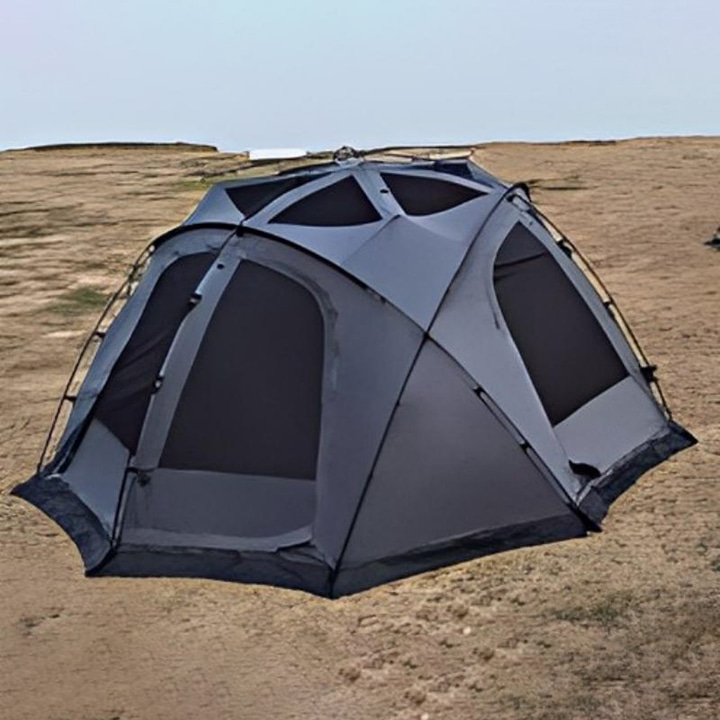
Windproof Dome Tent Quick Setup 2 Person Outdoor Shelter
Understanding the Product Concept
The Windproof Dome Camping Tent is a compact outdoor shelter designed for two occupants. Its structure uses a curved dome profile supported by a crossed-pole frame. This geometry creates a balanced shelter with sloping walls, a relatively low wind profile, and a straightforward pitching process.
The intended user does not necessarily need a large expedition shelter or a full cabin-style camping system. Many outdoor trips require something faster and simpler. A hiker may arrive at camp after sunset. A festival visitor may have limited space and little time for assembly. An angler may move between lakeside locations. A weekend camper may want reliable overnight protection without carrying a bulky family tent.
For these situations, a two-person dome tent is a practical choice. It provides sleeping space for two people, room for essential personal equipment, and an efficient packed size. The curved structure also makes good use of the available fabric and pole length, helping maintain a useful strength-to-weight relationship.
The product can be positioned in several market segments. It may serve as an affordable recreational camping tent, a mid-range outdoor shelter, a promotional product for outdoor campaigns, or a private-label model for a camping brand. Through OEM and ODM adjustment, the same basic concept can be developed into different versions for retail, rental, travel, education, event, or field-use applications.
Why the Dome Structure Performs Well in Wind
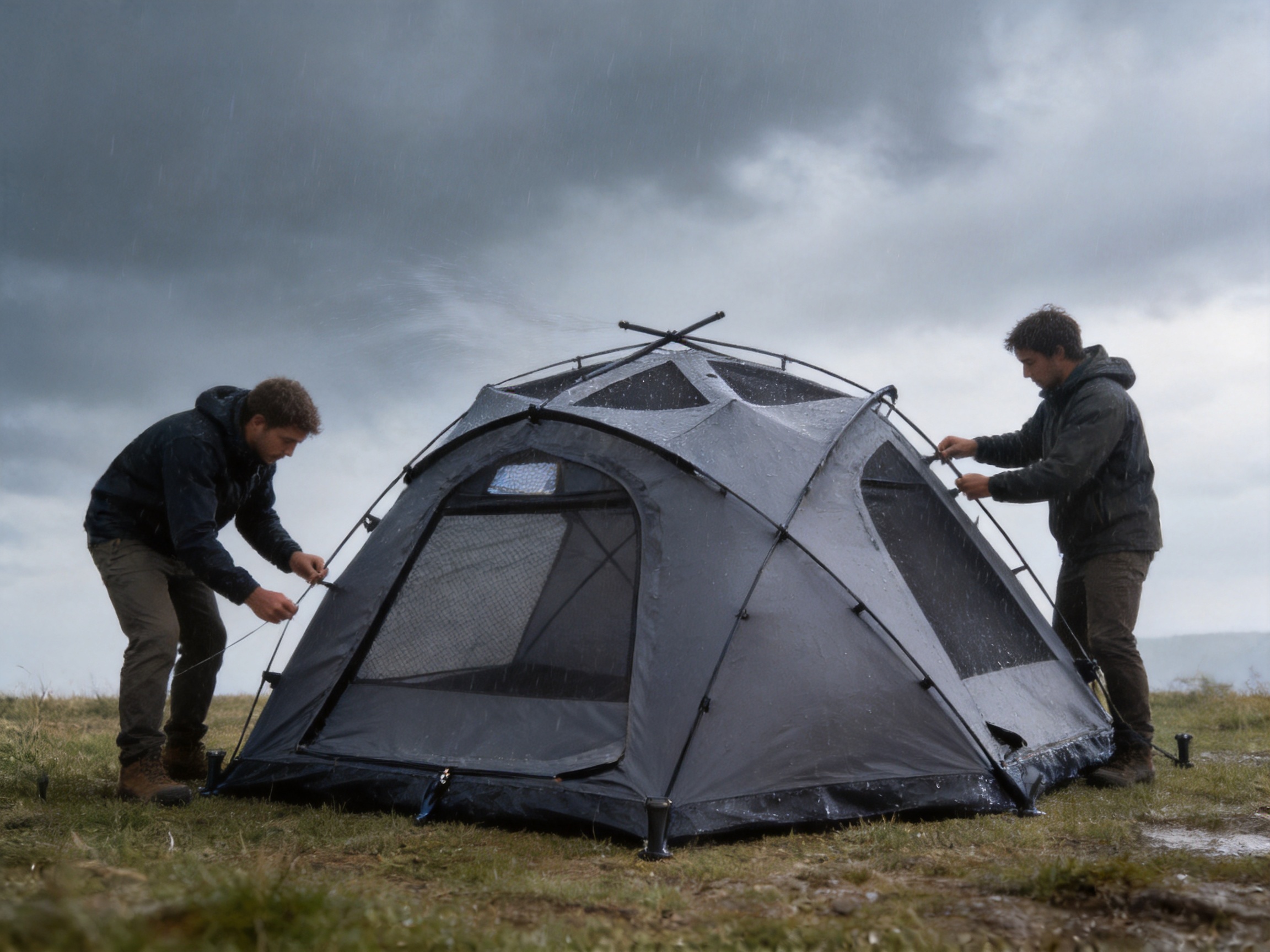
Wind is one of the most important variables affecting tent performance. A shelter positioned in an open field, beside a lake, on a coastal campsite, or on elevated terrain may receive wind from changing directions. A structure with broad vertical walls can act like a sail, allowing gusts to place concentrated pressure on the fabric, poles, and anchoring points.
The dome form reduces this effect by presenting a curved surface to the airflow. Instead of meeting a large flat wall directly, the wind can move around the rounded profile. The sloping sides also reduce the height of the exposed fabric and lower the center of the structure compared with a tall cabin-style design.
The crossed-pole arrangement contributes to the stability of the shelter. When the poles intersect at the top, they form a supportive framework that distributes tension across the tent body. The crossed structure helps prevent the load from being concentrated at one isolated pole or corner. This is especially useful when a gust arrives from an angle rather than directly from the front.
It is important to understand that no lightweight recreational tent is completely immune to severe weather. Proper site selection, correct staking, suitable guy lines, and appropriate setup remain essential. However, the dome geometry gives the product a sound structural starting point. Compared with a basic flat-walled shelter, it is better prepared to manage ordinary outdoor wind conditions.
Competitor products may use similar dome shapes, but performance depends on the relationship between geometry, pole tension, fabric cut, seam placement, corner reinforcement, and anchoring details. A poorly balanced frame can still flex excessively even when the overall silhouette appears stable. This product concept focuses on those elements as part of one coordinated structure.
Wind-Related Design Advantages
The low and rounded profile helps reduce direct wind resistance. This makes the shelter appropriate for open grassland, exposed campsites, lakeside locations, and other areas where natural windbreaks may be limited.
The crossed-pole frame supports the roof and sidewalls simultaneously. The load is spread through multiple contact points rather than depending on one central support.
The extended lower fabric edge helps protect the area where the tent meets the ground. This can reduce the entry of wind-driven splash and improve the connection between the tent body and the campsite surface.
Reinforced corners provide stronger attachment areas for the frame, stakes, and tension points. These locations often experience repeated stress during pitching, packing, and windy conditions.
Optional structural reinforcement can be developed for buyers who require increased durability. Depending on the project, this may include changes to pole material, frame thickness, webbing, corner construction, or stress distribution.
Quick Setup for Real Outdoor Situations
A tent’s setup process affects the entire user experience. Complicated pitching can be frustrating after a long hike, during poor weather, or when a campsite is reached late in the day. It can also create incorrect assembly, which may reduce the tent’s stability and waterproof performance.
The streamlined pole arrangement of this two-person dome tent is intended to make pitching easier. The frame is compact and logically organized, allowing users to identify the main structural components without dealing with a large number of separate sections. The design is suitable for users who want a practical shelter rather than a time-consuming construction project.
A simple setup process also benefits retailers and outdoor program operators. Customers are more likely to enjoy and recommend a tent that is easy to understand. Rental companies and event organizers can reduce training time when the product has a consistent assembly method. For promotional or seasonal products, straightforward use can also reduce customer complaints and returns.
Packing the tent away is equally important. A product that is easy to pitch but difficult to fold can become inconvenient during multi-stop trips. The compact dome format, coordinated pole system, and carry-bag configuration allow the product to be developed for practical transport and storage.
Setup performance can be improved further through OEM adjustments. Buyers may request color-coded pole sleeves, printed setup instructions, larger carry bags, quick-reference diagrams, or packaging that emphasizes key assembly steps. These details do not necessarily change the overall structure, but they can significantly improve the user experience.
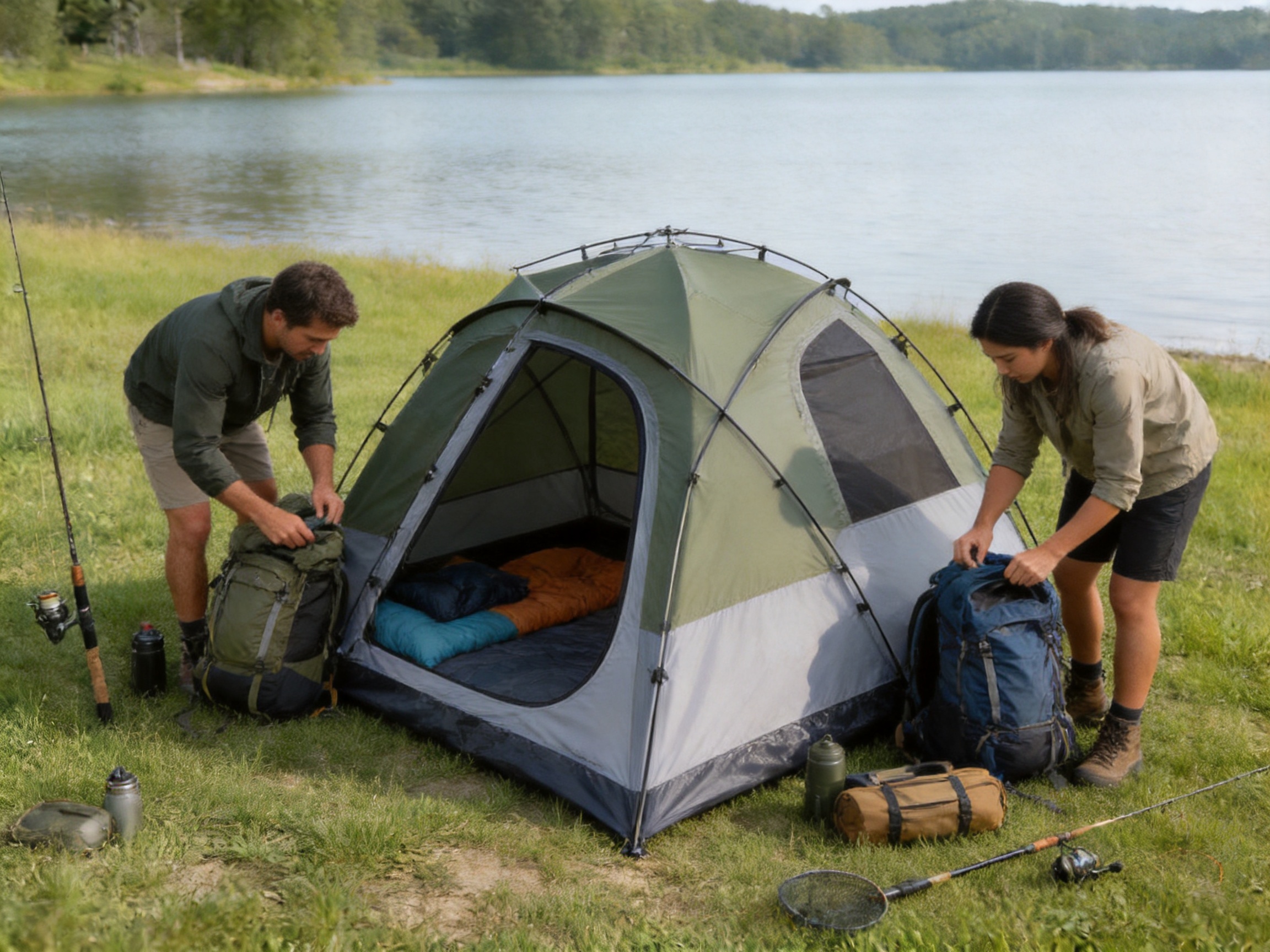
Waterproof Protection and Fabric Options
Waterproofing is not determined by fabric alone. A tent’s weather resistance depends on the combined performance of the fabric, coating, seams, zippers, corner construction, door design, ground contact area, and rainwater management. The product is therefore available as a configurable platform rather than a single fixed material specification.
Coated polyester is suitable for many everyday camping applications. It offers a practical combination of weight, handling, cost, and water resistance. It can be developed in different weights and coating grades to meet the needs of entry-level, mid-range, or more performance-focused product lines.
Oxford fabric may be selected when the market places greater emphasis on abrasion resistance and a heavier hand feel. This option can be useful for customers who expect more frequent use, rougher handling, or a stronger visual impression. Fabric selection can be matched to the target retail price and the intended environmental conditions.
Custom waterproof treatments can be considered for specific regional requirements. Different markets may prioritize rain resistance, UV performance, fabric durability, low weight, color stability, or ease of cleaning. The manufacturing team can work with customers to identify a suitable combination of material type, coating level, fabric weight, and finishing requirements.
Seam construction is another important part of the design. Water may enter through needle holes, poorly finished intersections, or areas where fabric tension is uneven. Reinforced seams and appropriate seam treatment help reduce these risks. Zippers must also be selected and installed with attention to alignment, flap coverage, and repeated operation.
The lower perimeter of the tent plays a particularly important role in wet conditions. An extended edge helps shield the base from splash and damp ground. It also provides an additional surface for anchoring and tension control. When combined with suitable site preparation, this design detail can improve the shelter’s protection during ordinary rain.
Weather Protection Compared with Basic Competitor Models
Low-cost competitor tents often reduce material specifications to achieve the lowest possible purchase price. This may result in thinner fabrics, limited seam reinforcement, less durable zippers, or minimal attention to corner stress. Such products can be acceptable for occasional fair-weather use, but they may offer less confidence when conditions become unpredictable.
This dome tent is positioned around a more balanced specification. It can be built with fabric and reinforcement choices appropriate to the customer’s market rather than being restricted to one inexpensive material. The result is a product that can compete on value without relying solely on low manufacturing cost.
For brands seeking a distinctive product range, the ability to adjust waterproofing and durability is particularly valuable. A retailer can request a lightweight version for backpacking-oriented customers, a more durable version for general camping, or a branded model for promotional distribution. The manufacturing platform remains recognizable while the specification is adapted to the application.
Ventilation and Interior Comfort
A waterproof tent must also manage internal moisture. Two people sleeping inside a compact shelter release heat and humidity through normal breathing. If the air cannot move, condensation may collect on the inner surface of the rainfly or tent walls. A shelter that blocks rain but allows excessive moisture to accumulate can feel uncomfortable overnight.
The design incorporates mesh ventilation panels to encourage airflow while helping keep insects outside. Mesh areas may be positioned on doors, side sections, or upper portions of the shelter depending on the selected configuration. Their location and size can be adjusted during OEM development.
Upper ventilation zones allow warm air to escape. Since warm air naturally rises, high vents can help reduce the buildup of heat near the roof. The effectiveness of ventilation depends on the relationship between low-level air entry and high-level air exit, which is why the design considers multiple airflow points rather than a single opening.
The large front entrance adds flexibility. It can remain closed during rain or wind, but it may be opened when conditions are calm to increase airflow and improve access. The entrance also makes it easier for two occupants to enter, exit, organize equipment, and change clothing.
Ventilation is a key area where this product can outperform very basic tents. Some inexpensive shelters include only a small mesh door, leaving warm air with few escape routes. By combining mesh panels, upper vent areas, and a larger entrance, this design aims to create a more comfortable interior without sacrificing basic weather protection.
Mesh density can be customized according to the expected insect environment, airflow requirement, and market preference. A buyer serving a humid region may place greater emphasis on ventilation. A buyer targeting cooler conditions may request a configuration that balances airflow with warmth. These decisions can be addressed during product development rather than after production begins.
Interior Layout for Two People
The two-person format is one of the product’s strongest practical advantages. A single-person tent can feel restrictive, while a larger family tent may be unnecessarily heavy and time-consuming for short trips. This shelter provides a compact sleeping space for two people while remaining suitable for transport by car, motorcycle, bicycle, or on foot, depending on the final packed specification.
The dome shape creates usable headroom near the center of the tent. Although the sides slope toward the ground, the central area can support sitting, changing clothes, and organizing small equipment. This balance between floor area and overall volume makes the structure efficient for overnight use.
A two-person shelter is also attractive to a broad customer group. Couples, friends, parents traveling with one child, fishing partners, and individual campers who prefer additional space can all find a use for the format. Outdoor retailers can position it as an accessible entry point into camping without committing customers to a large shelter system.
Interior comfort also depends on the door design and ventilation openings. A sufficiently large entrance reduces the feeling of confinement and makes the tent easier to use in changing weather. With appropriate internal organization, occupants can separate sleeping areas from small personal items and footwear.
For OEM projects, the interior can be adjusted through floor dimensions, peak height, vestibule development, door orientation, storage pockets, hanging loops, and other practical features. These changes allow brands to create a model that meets specific customer expectations while retaining the core benefits of the dome structure.
Manufacturing Strength and Factory Capability
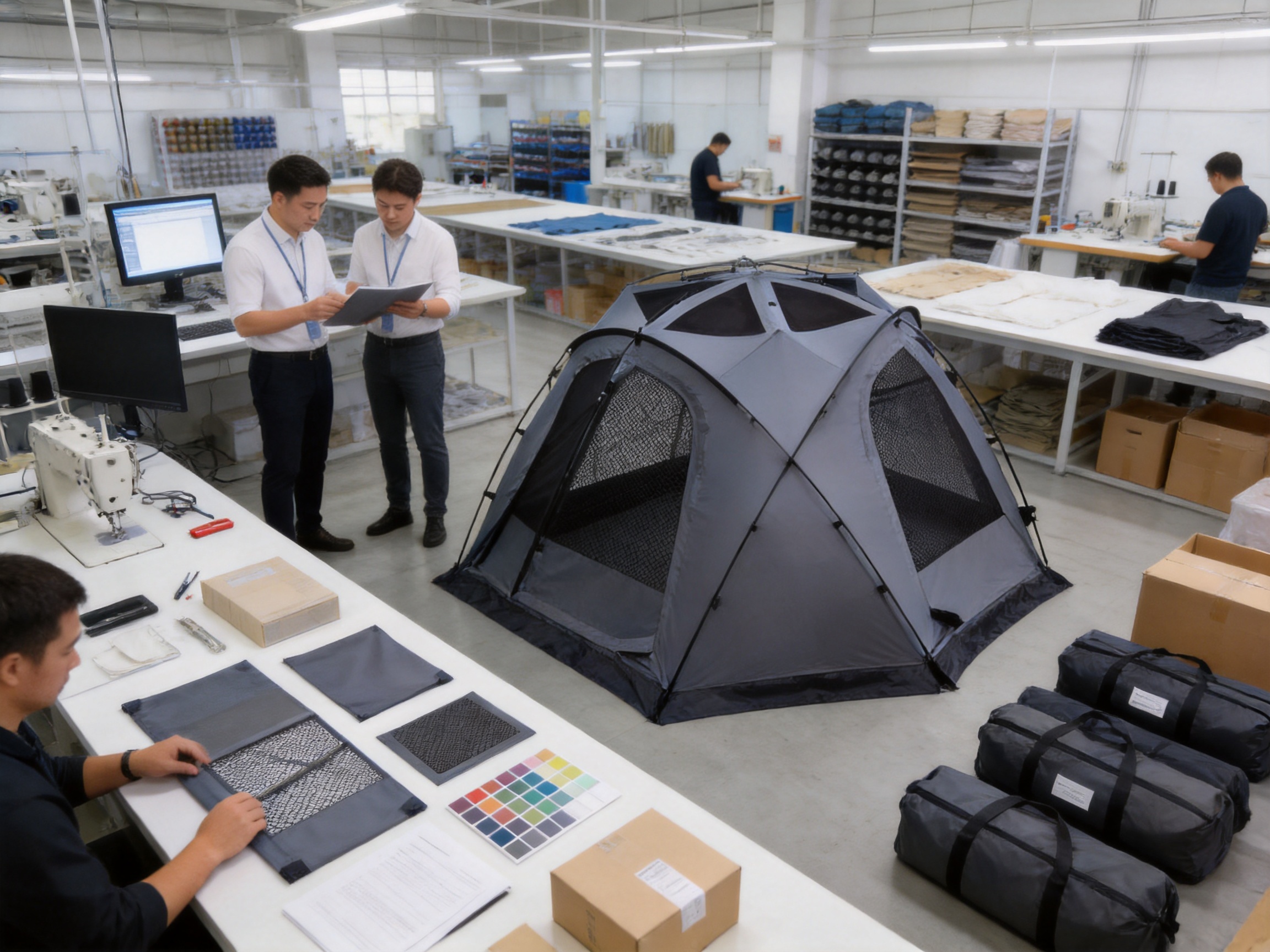
The product is manufactured by Ningbo Zhenhai Tiansai Leisure Products Co., Ltd., an established outdoor-product enterprise based in Zhenhai District, Ningbo, Zhejiang Province. The factory covers more than 13,000 square meters, providing a substantial production base for tent development, material handling, assembly, inspection, and order fulfillment.
Ningbo is an important port city with strong connections to international trade and manufacturing. This location supports the efficient movement of raw materials and finished goods for global customers. For importers and outdoor brands, supply-chain access is an important part of supplier selection because reliable production must be supported by dependable export coordination.
The company specializes in the design, production, and sales of tents and related outdoor equipment. Its experience includes recreational shelters, camping products, and specialized designs. The business has also served as a designated global supplier for TENTSILE, demonstrating experience in working with an international outdoor brand and meeting demanding product-development expectations.
A professional design team supports the transition from concept to finished product. This is important because successful tent development involves more than selecting a fabric and copying a silhouette. The team must consider pattern design, frame geometry, seam placement, fabric behavior, packing requirements, usability, and appearance.
The company has developed and obtained appearance patents and utility model patents. These achievements indicate an ongoing focus on product innovation and structural development. For OEM and ODM customers, this design experience can shorten the distance between an initial idea and a manufacturable product.
The factory’s manufacturing strength is also supported by a quality management approach intended to ensure consistent product performance. Quality control should be applied throughout the process, including incoming material inspection, cutting, sewing, frame preparation, assembly, functional checking, and final packing. This process-oriented approach is more dependable than relying only on visual inspection at the end of production.
Integrated Product Development
An integrated manufacturer can evaluate product decisions across multiple departments. When a customer requests a heavier fabric, for example, the change may affect the pole strength, seam construction, packing volume, carton size, and shipping cost. A supplier with design and production experience can identify these relationships early.
Similarly, a request for a lighter tent may require more than reducing fabric weight. The frame, reinforcement points, zipper selection, and pattern efficiency may all need review. The product must remain stable and practical rather than simply becoming thinner in every area.
The company’s product-development philosophy emphasizes practicality and comfort. Outdoor enthusiasts and professional users can provide valuable feedback about pitching, ventilation, access, durability, and packing. By incorporating testing and customer feedback into development, the manufacturer can refine products for actual use rather than designing only for appearance.
OEM and ODM Customization Options
The Windproof Dome Camping Tent can serve as a standard product or as the starting point for a customized program. OEM customers may request their own logo, colors, packaging, labels, and selected material specifications. ODM customers may work with the design team to modify the structure and create a more distinctive product.
Fabric customization may include polyester or Oxford construction, fabric weight, coating grade, waterproof treatment, UV resistance, color, and surface finish. These options allow the product to target different climates and price levels.
Frame customization may include pole material, diameter, section length, joint design, and structural reinforcement. The appropriate choice depends on the required balance between weight, cost, packability, and stability.
Ventilation customization can involve mesh density, panel size, vent placement, door configuration, and airflow control. These details are useful when a product is intended for a specific region or season.
Branding may include printed logos, woven labels, color matching, branded zipper pulls, interior labels, instruction cards, and retail packaging. Consistent brand presentation can help a tent stand out in a crowded outdoor market.
Packaging can be adapted to the customer’s distribution model. Options may include a customized carry bag, retail box, color carton, shipping carton format, multilingual instructions, barcode labels, and protective packaging for international transport.
| Specification Area | Available Development Options | Commercial Benefit |
| Fabric and Waterproofing | Coated polyester, Oxford fabric, fabric weight, coating grade, UV resistance, custom treatments | Supports different climates, durability levels, and retail price positions |
| Frame | Pole material, pole diameter, section design, structural reinforcement | Balances stability, weight, pack size, and production cost |
| Ventilation | Mesh density, vent size, vent placement, entrance configuration | Improves airflow and adapts the product to regional conditions |
| Exterior Appearance | Color matching, contrast panels, trims, logo placement | Strengthens brand identity and shelf recognition |
| Interior Features | Storage pockets, hanging loops, floor dimensions, peak height | Improves usability and creates product differentiation |
| Packaging | Carry bag, instruction sheet, retail carton, outer carton, labeling | Supports retail presentation and organized global distribution |
Manufacturing Process from Concept to Finished Tent
A reliable tent begins with a clear product brief. The manufacturer and customer first define the intended market, user group, climate, target price, fabric expectations, packed size, color direction, order volume, and branding requirements. This information provides a practical framework for technical development.
The next stage is structural and pattern development. The design team evaluates the dome profile, pole crossing points, door opening, vent locations, floor shape, seam lines, and stress areas. Pattern efficiency is important because it influences fabric consumption and production yield. A well-planned pattern can reduce unnecessary waste while maintaining the required shape.
Material selection follows the product brief. Fabric, mesh, webbing, zippers, buckles, pole components, guy lines, and carry-bag materials are reviewed as a complete system. Material compatibility matters because different fabrics may behave differently during cutting, sewing, coating, folding, and packing.
Sample production allows the team to evaluate the physical product. A sample can reveal whether the poles assemble smoothly, whether the fabric tension is balanced, whether the entrance is sufficiently large, and whether the packed size is practical. Sample review is also the stage at which branding, colors, labels, and packaging can be checked.
Once the specification is confirmed, cutting and sewing can proceed under controlled production requirements. Panels must be cut accurately so the completed tent maintains the intended geometry. Sewing quality is important at seams, corners, pole sleeves, door openings, and webbing attachment points.
Frame components are prepared and checked for dimensions, connection quality, and smooth operation. The poles must fit their sleeves or attachment points correctly. A frame that is too tight may be difficult to assemble, while a frame that is too loose may not maintain the desired tension.
Assembly and functional inspection bring the separate components together. The tent may be checked for overall appearance, symmetry, zipper operation, mesh condition, stitching, attachment points, and compatibility between the tent body, poles, rainfly, stakes, and carry bag.
Final packing should preserve the product and ensure that all components are included. Instructions and accessories must be organized so the customer can identify them quickly. Consistent packing also helps reduce errors during warehouse handling and export shipment.
Quality Management and Product Reliability
Outdoor equipment is exposed to repeated handling, changing weather, transport vibration, ground contact, and user assembly. Quality management must therefore address both appearance and function. A tent can look attractive in a showroom but still disappoint customers if the zipper jams, a pole sleeve tears, or the carry bag cannot accommodate the packed product.
Incoming material checks help verify that fabrics, mesh, poles, webbing, zippers, and accessories meet the approved specification. Material consistency is especially important for OEM programs because color, weight, coating, and texture should remain stable between production batches.
In-process inspection helps identify problems before the product reaches final assembly. Sewing operators and quality personnel can monitor seam alignment, thread tension, reinforcement placement, and panel matching. Early correction is usually more efficient than repairing a completed tent.
Final inspection can include visual checks, dimensional review, opening and closing tests, pole assembly checks, accessory confirmation, and packaging verification. Where required by the project, customers may also define additional inspection procedures or sampling requirements.
The manufacturer’s experience in product design and international supply supports a practical understanding of quality from both technical and commercial perspectives. A successful outdoor product must not only function correctly; it must also arrive consistently, match the approved sample, and be suitable for the customer’s distribution channel.
Advantages Over Generic Competitor Tents
The first competitive advantage is structural balance. The curved dome shape and crossed-pole frame provide a more considered response to wind than a simple flat-sided shelter. The design does not depend on appearance alone; it uses geometry and tension distribution to support stability.
The second advantage is practical setup. Some competing tents introduce unnecessary complexity through multiple poles, large connector systems, or confusing sleeve arrangements. This product focuses on a streamlined frame suitable for fast pitching and straightforward packing.
The third advantage is specification flexibility. Many standard tents are offered in one fixed fabric, one color range, and one package format. This product can be configured with different fabrics, coatings, mesh options, colors, logos, and packaging. That flexibility allows outdoor brands to create a product that fits their market instead of accepting a generic solution.
The fourth advantage is balanced ventilation. A basic budget tent may provide waterproof fabric but limited airflow. The use of mesh panels, upper vents, and a large entrance gives this design a stronger foundation for managing condensation and interior comfort.
The fifth advantage is manufacturer support. Buyers are not limited to placing a repeat order for an existing model. They can work with a professional design and production team to adjust dimensions, materials, frame components, branding, and packaging. This is valuable for brands that want to develop a long-term product line.
The sixth advantage is suitability for multiple commercial applications. The same core shelter can be positioned for recreational camping, festivals, hiking, fishing, promotional campaigns, outdoor education, and private-label retail. This broad application range can help buyers reduce the need to source completely different products for related market segments.
Applications and Target Markets
For weekend camping, the tent offers a compact shelter that can be transported easily and pitched without an extended assembly process. It is suitable for users who want dependable overnight protection without the size of a family cabin tent.
For hikers and trekking beginners, the two-person format provides a practical introduction to shared camping. Depending on the final material and frame specification, the product can be adapted toward a lighter pack weight or a more durable general-use configuration.
For festival and event use, quick setup and clear branding are important. Custom colors, printed logos, and retail-ready packaging can make the tent more visible and easier to identify. The straightforward structure is also useful when many tents must be assembled within a limited time.
For anglers, the dome profile and weather protection are valuable at exposed lakeside locations. A larger entrance can improve access, while stronger fabric and reinforced attachment points can be selected for repeated transport and use.
For outdoor retailers, the product can fill a middle category between low-cost temporary shelters and more expensive technical tents. It offers recognizable features such as waterproof fabric, a wind-conscious structure, ventilation, and OEM support without requiring the complexity of a large expedition system.
For promotional campaigns, the tent provides a functional product that can carry a brand message beyond a single event. Custom colors, logos, packaging, and printed materials can be coordinated with the campaign identity.
Responsible and Practical Product Development
Outdoor brands increasingly consider the environmental and practical impact of materials. The company’s development direction includes greater attention to lightweight and environmentally friendly materials. This does not mean that every project must use the same material solution; instead, customers can discuss the balance between durability, weight, longevity, cost, and material preference.
A durable tent can support more responsible consumption by remaining useful across multiple seasons. Strengthening high-stress points, selecting suitable fabric, improving zipper reliability, and designing a practical carry system can reduce premature replacement.
Efficient pattern development may also help reduce fabric waste. Packaging can be reviewed to avoid unnecessary size and material while still protecting the product during transport. These decisions should be evaluated together because a change intended to reduce packaging may affect protection, warehouse handling, or retail presentation.
For buyers seeking a more environmentally focused product, the specification can be discussed during the development stage. Possible considerations may include recycled-content fabrics where suitable, reduced packaging, repairable components, long-life construction, and optimized transport volume. The final choice should be based on verified material availability and the intended product performance.
How Buyers Can Define the Right Specification
Before requesting a quotation, buyers should identify the primary user and intended environment. A tent for occasional festival use may not require the same reinforcement as a tent for frequent fishing trips or rental operations.
The target climate should also be considered. Regions with frequent rain may require a stronger focus on fabric coating, seam treatment, ground protection, and drainage. Hot and humid regions may prioritize mesh area, upper ventilation, and breathable interior design. Cooler climates may require a different balance between airflow and warmth.
Buyers should define the expected packed size and transport method. A product intended for backpacking must be evaluated differently from one transported in a car. Pole material, fabric weight, carry-bag dimensions, and carton configuration all influence logistics.
The target price range should be established early, but price should not be evaluated without considering expected use. A lower-cost specification may be appropriate for promotional distribution, while a more durable fabric and stronger frame may offer better value for a premium retail line.
Branding requirements should include more than a logo. Color standards, label locations, instruction language, packaging format, barcode information, and retail display needs should be discussed before sampling. Clear requirements reduce revisions and help the production team prepare an accurate sample.
Q&A: Windproof Dome Camping Tent
What type of tent is this?
It is a two-person dome camping tent designed for quick setup, waterproof protection, ventilation, and practical wind resistance. It is suitable for camping, hiking, festivals, fishing, and short outdoor stays.
Why is the dome shape useful in windy conditions?
The curved profile allows wind to move around the shelter more easily than a large flat wall. The crossed-pole frame also helps distribute pressure across the structure. Proper staking and site selection are still necessary, especially in strong weather.
How quickly can the tent be assembled?
The frame is designed with a streamlined pole structure to simplify pitching. Actual setup time depends on user experience, ground conditions, weather, and the final customized specification.
Can the tent be used in rain?
Yes. The product is designed as a waterproof dome shelter, with configurable coated polyester, Oxford fabric, and other waterproof treatment options. Seam construction, zipper coverage, correct setup, and suitable site selection all contribute to rain protection.
What fabric choices are available?
Common options include coated polyester and Oxford fabric. Buyers may also discuss fabric weight, coating grade, UV resistance, color, and customized waterproof treatments according to market requirements.
Does the tent have ventilation?
Yes. The design includes mesh ventilation panels, upper vent zones, and a large front entrance that can provide additional airflow when conditions permit. Vent placement and mesh density can be adjusted for OEM projects.
Can the product be customized with a logo?
Yes. Branding options may include logo printing, labels, color matching, branded packaging, instruction cards, and other visual details. The final method depends on the material, logo size, color requirements, and order specification.
Can the dimensions be changed?
The core model is designed for two people, but selected dimensions and interior features can be reviewed for OEM or ODM development. Changes to dimensions may affect fabric consumption, pole length, packing size, and cost.
Can the frame be customized?
Yes. Buyers can discuss pole material, structural reinforcement, pole diameter, and related frame requirements. The final frame should be selected according to the desired balance between stability, weight, durability, and price.
Is this product suitable for retail brands?
Yes. The tent can be developed for private-label and retail programs with customized colors, logo placement, packaging, labels, and instruction materials. Its broad application range makes it suitable for camping, hiking, festival, and general outdoor product lines.
What makes the manufacturer suitable for OEM and ODM cooperation?
The manufacturer has a factory of more than 13,000 square meters, a professional design team, experience in tent development, international supply experience, patented product development, and support for material, structural, branding, and packaging customization.
Can the tent be used for professional field applications?
The product can be adapted for selected professional or project-based applications, depending on the required performance. Buyers should define the environmental conditions, duration of use, loading expectations, fire or safety requirements, and inspection standards before confirming a specification.
How should the tent be maintained?
Users should dry the tent fully before long-term storage, remove dirt with suitable cleaning methods, avoid storing it while damp, inspect poles and seams regularly, and pack the components without forcing them into the carry bag. Maintenance requirements may vary according to the selected materials.
Conclusion
The Windproof Dome Camping Tent is designed around the practical needs of modern outdoor users. Its curved dome profile helps manage wind from changing directions, while the crossed-pole frame supports a stable and efficient structure. The streamlined setup process makes it useful for hikers, weekend campers, festival visitors, anglers, and other users who value fast deployment.
Its waterproof performance can be adapted through coated polyester, Oxford fabric, coating grades, and custom treatments. Reinforced seams, durable zippers, strengthened corners, and an extended lower edge address common areas of wear and water exposure. Mesh panels, upper vents, and a large entrance help improve airflow and reduce condensation inside the two-person shelter.
For outdoor brands, the product’s greatest advantage may be its development flexibility. Fabric, frame, ventilation, color, branding, interior layout, and packaging can be adjusted to match different market positions. This makes the tent more adaptable than a fixed generic model and allows buyers to build a product around their own customers.
Supported by a factory covering more than 13,000 square meters, a professional design team, international production experience, patented development work, and an integrated OEM/ODM process, Ningbo Zhenhai Tiansai Leisure Products Co., Ltd. provides more than a basic finished tent. It provides a practical manufacturing platform for outdoor brands seeking dependable, customizable, and commercially suitable shelter products.
For buyers comparing suppliers, the key value is the combination of product performance and manufacturing support. A well-designed dome structure, quick setup, configurable weather protection, comfortable ventilation, and professional customization create a strong foundation for a versatile two-person camping tent that can compete across multiple outdoor markets.
References
1. Outdoor Industry Association. Principles of Outdoor Recreation Product Development.
2. International Organization for Standardization. General Guidance for Textile and Outdoor Product Quality Management.
3. European Committee for Standardization. Principles Relating to the Structural Design and Performance Evaluation of Temporary Outdoor Shelters.
4. American Society for Testing and Materials. Textile Fabric Testing and Water Resistance Evaluation Practices.
5. International Organization for Standardization. Guidelines for Quality Management Systems in Manufacturing.
6. Outdoor Gear Manufacturers Association. Best Practices for Tent Materials, Seams, Frames, and Field Durability.
7. Ningbo Zhenhai Tiansai Leisure Products Co., Ltd. Product Development and Manufacturing Information.
Product: Windproof Dome Tent Quick Setup 2 Person Outdoor Shelter

Message Us Right Now!
-
Mp: +86-18858091910
E-mail: sales@tenplaytent.com
ADD: No. 529, Guangyuan Road, Xiepu Town, Zhenhai District, Ningbo City, Zhejiang Province, China
-
Quick Links
Home Products About Us Advantage News Contact Us -
Product
Inflatable & Air Tents Glamping & Resort Tents Backpacking & Trekking Tents Automatic & Pop-Up Tents Family & Camping Tents Specialty Tents & Shelters Kids Tents Pet Tents Humanitarian & Large Tents Hammock -
Get Connected
 Camping Tent Manufacturer in China