

 English
  عربى
عربى 
What Does a Car Rear Awning Tent Manufacturer Really Offer
Outdoor buyers usually look at a rear awning setup from a simple angle: how it fits, how it holds up, how it feels to use, and how much effort it asks from the person setting it up. For a Car Rear Awning Tent Manufacturer, those points shape the product from the start. The focus is not only shelter, but also compatibility, handling, and the way the structure behaves beside a vehicle in everyday use.
What Car Rear Awning Tent Manufacturer Means and How These Systems Are Designed
A rear awning system is built around the back section of a vehicle, so the shape of the opening and the way the door moves both matter. The design has to support easy access, stable coverage, and a layout that does not feel awkward during travel stops or outdoor rest breaks.
A Car Rear Awning Tent Manufacturer usually works with a few core ideas at the same time:
- The connection must stay secure without making the vehicle hard to use.
- The canopy should create usable shade or cover without feeling bulky.
- The layout should support quick handling for one person or two people.
- The folded form should stay manageable for storage and transport.
The structure is often planned in layers rather than as one fixed piece. There may be a rear connection area, a main cover section, support parts, and optional side coverage. Each part affects the way the whole unit behaves once it is opened. If one part feels awkward, the user experience changes fast.
A useful way to think about this design process is through function rather than appearance.
| Design Element | What It Changes | Why It Matters |
|---|---|---|
| Rear connection area | How the unit attaches to the vehicle | Affects fit and daily handling |
| Main cover section | How much sheltered space is created | Shapes comfort during stops |
| Support parts | How stable the structure feels | Helps the setup stay usable |
| Side coverage | How much privacy or shade is added | Extends the use of the space |
| Folded form | How easy it is to store | Matters for travel and packing |
This is why the same product type can look simple from the outside while still having several design choices behind it. A Car Rear Awning Tent Manufacturer has to make those choices with both the vehicle and the user in mind.
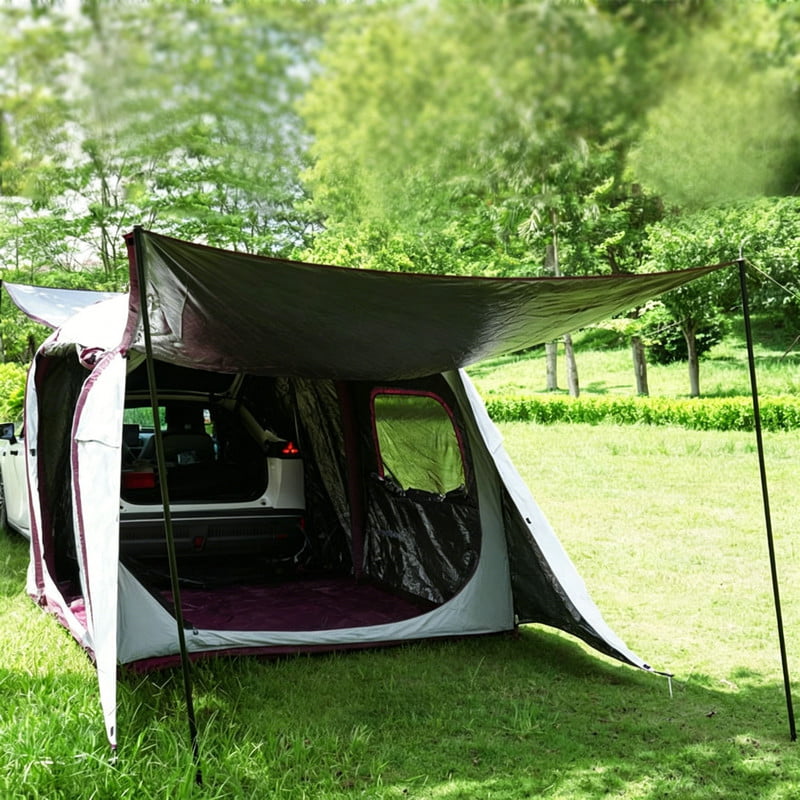
How Car Rear Awning Tent Manufacturer Solutions Adapt to Different Vehicle Types and Camping Needs
Not every vehicle creates the same kind of rear space. Some have a taller back opening, some have a narrower tail area, and some leave more room for standing or moving around. That is where adaptation becomes important. The rear awning has to match the shape and behavior of the vehicle instead of forcing the same layout onto every use case.
A Car Rear Awning Tent Manufacturer may adjust the design in several ways:
- The connection point can be changed to suit a higher or lower rear opening.
- The cover depth can be adjusted for small or larger outdoor spaces.
- The side drop can be shaped for privacy, shade, or simple weather cover.
- The overall profile can be made lighter or more enclosed depending on use.
The goal is not only a fit that works on paper. It is a fit that feels natural when someone opens the back, reaches into storage, or uses the space during a short stop.
For different vehicle shapes, the design focus shifts in a noticeable way.
| Vehicle Shape | Common Design Focus | What Users Usually Care About |
|---|---|---|
| Taller rear opening | Balanced height and easier entry | Standing room and access |
| Narrower rear opening | Clean edge fit and stable attachment | Secure coverage without loose fabric |
| Wider rear opening | Broader shaded area | Shared use and easier movement |
| Lower rear opening | Compact structure and simple setup | Less bulk and easier handling |
Camping needs also shape the product. A person using the setup for a quiet stop has different priorities from someone who wants a covered space for gear, food prep, or resting beside the vehicle. The same rear awning can feel suitable in one setting and less useful in another if the structure does not match the purpose.
That is why the product is often designed as a flexible outdoor companion rather than a fixed shelter. The better the adaptation, the more naturally the structure fits daily use.
Which Materials Car Rear Awning Tent Manufacturer Uses to Balance Durability and Outdoor Performance
Material choice affects more than appearance. It influences handling, weather response, foldability, and how the product feels after repeated use. In this kind of outdoor item, the material mix has to support both comfort and resilience without making the unit hard to manage.
A Car Rear Awning Tent Manufacturer usually looks at several material layers:
- The outer cover needs to handle sun, moisture, and regular packing.
- The support pieces need to hold shape without feeling heavy.
- The connectors need to stay dependable through repeated setup.
- The seams and edge areas need to keep their form during use.
The right material choice is often a balance between a firm feel and a manageable weight. If the product feels too light, users may worry about stability. If it feels too heavy, setup and storage may become inconvenient. That balance is part of the design logic, not an afterthought.
| Material Group | Main Role | User Impact |
|---|---|---|
| Outer cover | Shelter from weather and sun | Comfort and daily usability |
| Support pieces | Shape and holding power | Stability during use |
| Connectors | Secure joining points | Easier setup and fewer loose parts |
| Edge finishing | Clean structure and wear control | Helps the product age more evenly |
Outdoor performance is not only about standing up to weather. It also includes how the surface folds, how the fabric behaves after repeated packing, and whether the item still feels easy to use after regular travel. The product has to do several jobs at once, which is why material selection is rarely a single-choice decision.
A good material balance helps the rear awning feel steady without becoming difficult to carry or store. That matters to buyers who need a product that works across different trips, not only in a narrow set of conditions.
How Car Rear Awning Tent Manufacturer Designs Improve Installation Speed and User Experience
Installation speed matters because outdoor users often deal with changing conditions, limited space, and short pauses during travel. If a rear awning takes too many steps, the product may be left unused even when it would have been helpful.
A Car Rear Awning Tent Manufacturer may improve the design by reducing awkward steps and keeping the assembly order clear. That can mean fewer loose parts, a more natural fold pattern, or connection points that are easier to recognize by touch and position.
The user experience often depends on small design choices rather than one large feature. For example:
- A clearer attachment shape can reduce confusion during setup.
- A simpler support layout can make the structure feel more manageable.
- A folded form that opens in a predictable way can save time and effort.
- Better alignment between parts can reduce repeated adjustments.
The real value shows up when the user can move from storage to use without dealing with unnecessary friction. That is especially important when the space is used in a travel stop, a parking area, or a changing outdoor setting.
The following points show where design details often affect use the most:
- Setup order
- Part handling
- Folded storage
- Rear access while in use
- Comfort around the covered area
A well-placed design decision can change the entire feel of the product. Not by making it flashy, but by making it easier to live with. That is where the work of a Car Rear Awning Tent Manufacturer becomes visible to the user, even if the individual parts are not noticed directly.
Why Waterproof and Wind Resistance Testing Matters in Rear Awning Design
Rear awning structures sit outside the vehicle line, so weather exposure is not occasional. It is part of normal use.
Wind and moisture behave differently depending on surroundings. Open areas feel completely different from narrow parking spaces or tree-covered ground. Because of that, designers usually do not treat testing as a single condition check.
Instead, they look at how the structure reacts over time.
Small things matter here. Fabric tension can shift slightly after repeated folding. Seams may behave differently when humidity stays high for a while. None of these changes are dramatic on their own, but together they affect how stable the setup feels.
Wind behavior is similar. It does not always push evenly. Sometimes it comes in short bursts, sometimes it moves around edges of the vehicle. That is where structure response becomes noticeable.
- Fabric tension consistency
- Seam response after repeated use
- Airflow movement around open sides
- Stability of connection points
Water resistance is less about "blocking water completely" and more about how long the surface keeps performing without weakening.
What Custom Options Are Typically Available in OEM and ODM Production
Customization is rarely about appearance alone. In most cases, it starts from how the product will actually be used beside a vehicle.
Some users want more open space, others prefer a more enclosed feel. That difference changes structure decisions more than it changes design language.
Adjustments usually happen in layers rather than one fixed change.
- Connection style adapted to different rear layouts
- Coverage depth adjusted for space preference
- Fabric treatment adjusted for climate exposure
- Folding behavior adjusted for storage limits
- Optional side components added when needed
These changes often influence each other. A deeper cover may require stronger support. A simpler fold may reduce extension options.
Nothing is fully independent here.
How Rear Awning Products Are Used Across Different Outdoor Scenarios
Usage depends more on situation than on product design alone.
A short stop near a road feels different from a long stay near open land. Even the same setup can be used in slightly different ways.
In quick stops, the structure is often half-open, just enough to create shade or cover. In longer stays, it becomes part of the space around the vehicle, not just an attachment.
- Quick stops tend to focus on speed of use
- Longer stays rely more on stability and comfort
- Tight spaces make compact setup more important
- Open areas shift attention to coverage and shade control
The interesting part is that usage often changes during the same trip. One setup can shift roles without being reconfigured.
What Influences Cost and Production Planning in Manufacturing
Production planning is shaped by structure, materials, and how many steps are needed before the product is ready.
More parts usually mean more handling. But fewer parts can sometimes make use less flexible. So the balance is not simple.
Fabric choice also changes how production flows. Some materials require more careful processing, while others are easier to fold and assemble but may not offer the same feel in use.
- Structure complexity and number of components
- Fabric layering and treatment process
- Assembly sequence during production
- Storage and packaging form after completion
There is always a trade off between simplicity and flexibility. One affects the other.
In practical manufacturing coordination, design decisions are often aligned with production feasibility, and in real supply chain communication, companies such as Ningbo Zhenhai Tiansai Leisure Products Co., Ltd. are sometimes involved in connecting product structure ideas with actual manufacturing execution in a controlled way.
Message Us Right Now!
-
Mp: +86-18858091910
E-mail: sales@tenplaytent.com
ADD: No. 529, Guangyuan Road, Xiepu Town, Zhenhai District, Ningbo City, Zhejiang Province, China
-
Quick Links
Home Products About Us Advantage News Contact Us -
Product
Inflatable & Air Tents Glamping & Resort Tents Backpacking & Trekking Tents Automatic & Pop-Up Tents Family & Camping Tents Specialty Tents & Shelters Kids Tents Pet Tents Humanitarian & Large Tents Hammock -
Get Connected
 Camping Tent Manufacturer in China