

 English
 عربى

Beach Shade Canopy Tent UV Protection Shelter for Comfortable Coastal Days
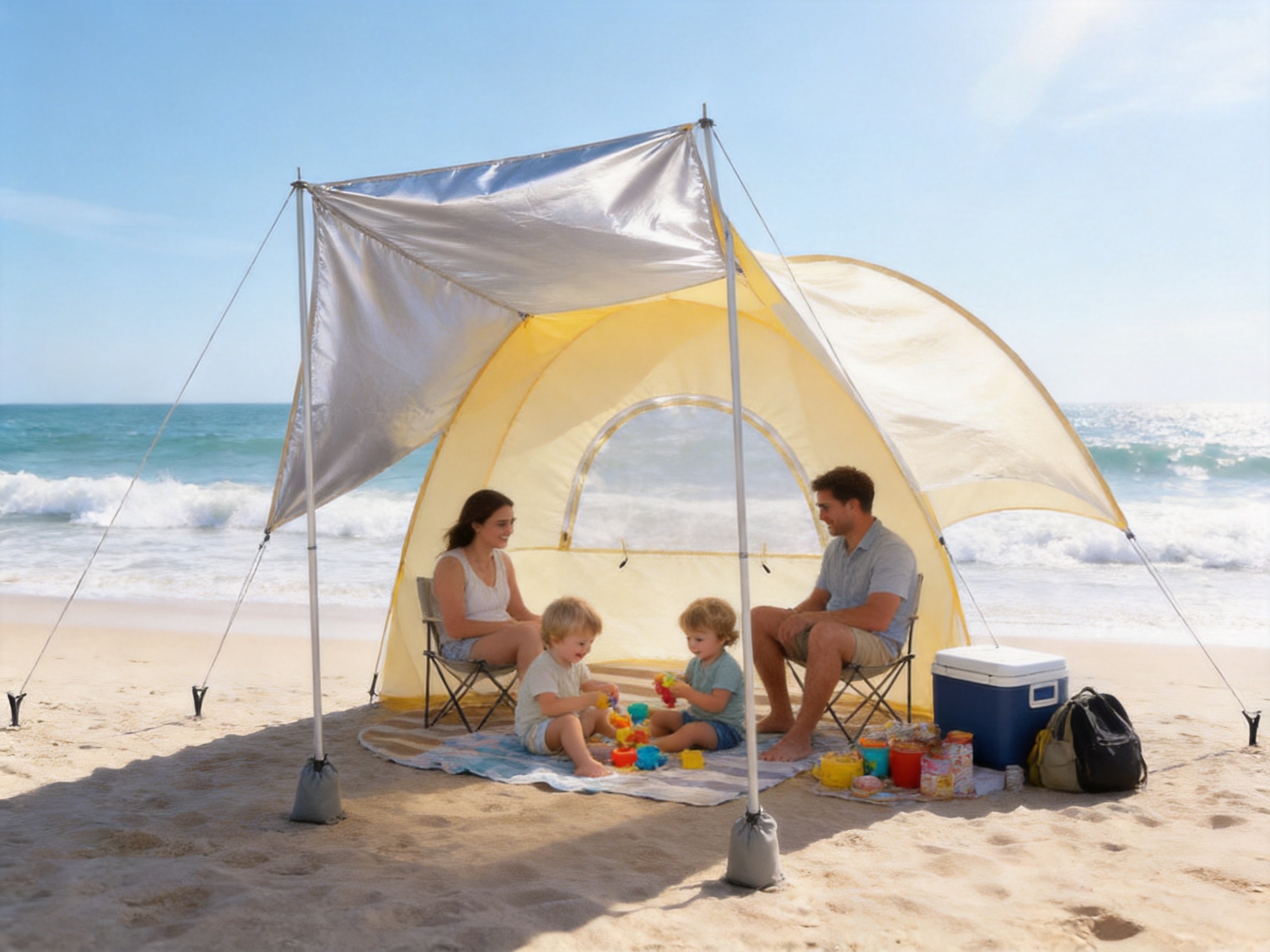
A successful beach day depends on more than clear skies and warm water. Families, children, travelers, and outdoor enthusiasts also need a dependable place to rest, change clothes, store personal items, enjoy a snack, or take a break from direct sunlight. The Beach Shade Canopy Tent UV Protection Shelter is designed to provide that practical coastal retreat in a lightweight, portable, and easy-to-use format.
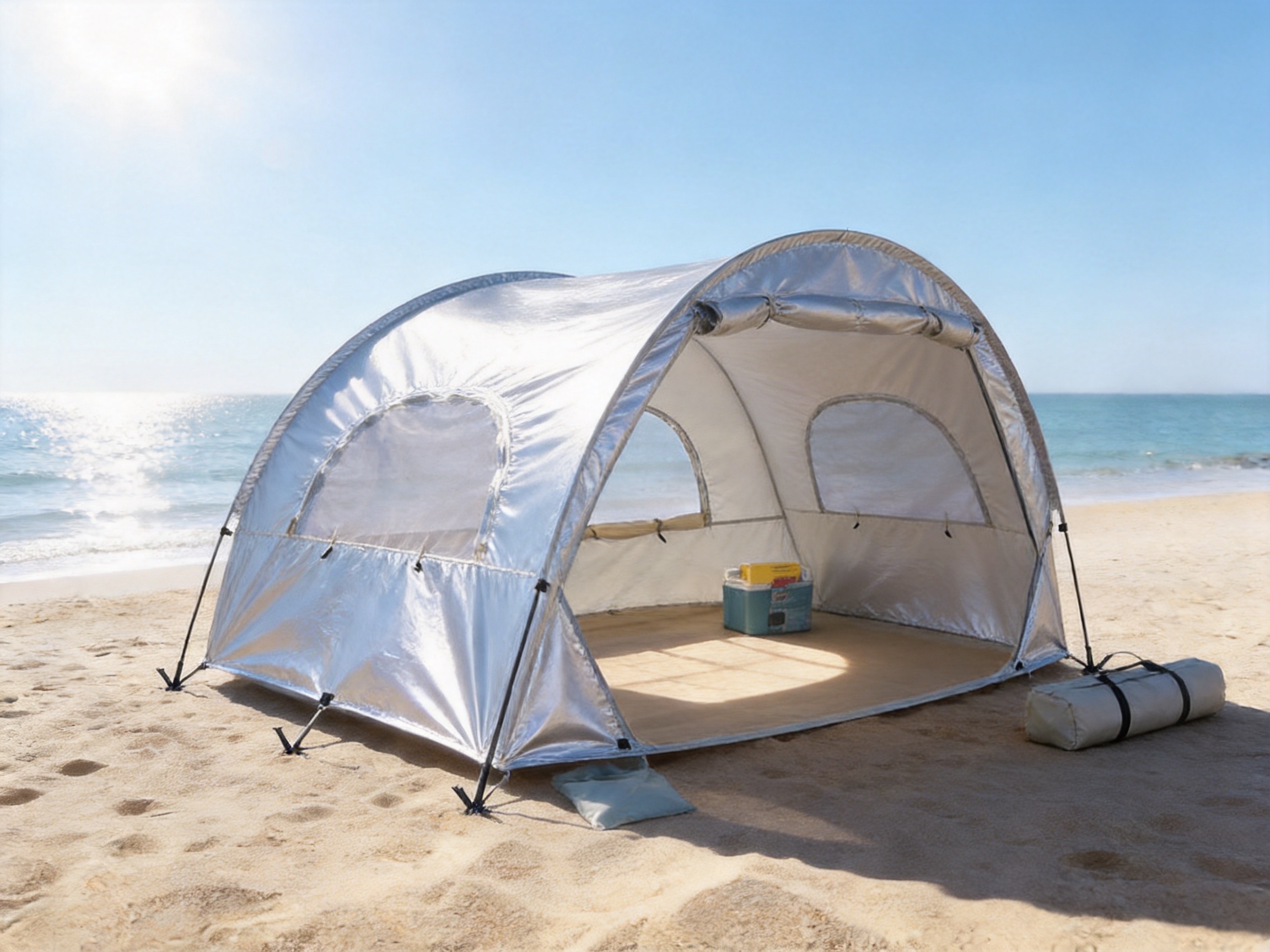
Combining a silver-coated polyester canopy, fiberglass support rods, ventilation-focused construction, quick automatic opening, and reinforced anchoring options, this picnic-style shelter delivers useful protection without the bulk associated with larger family tents. Its compact structure is suitable for beaches, parks, lakesides, gardens, festivals, sporting events, and short outdoor excursions where shade and convenience are essential.
The shelter measures approximately 145 × 145 × 110 centimeters and weighs about 1.8 kilograms. When packed, it fits into a compact carrying package measuring approximately 60 × 60 × 10 centimeters. This balance between usable interior space and low transport weight makes the tent particularly attractive for families with children, casual beach users, retailers, rental operators, hospitality providers, and outdoor brands seeking a practical seasonal shelter.
Unlike a simple beach umbrella, this canopy creates a partially enclosed personal zone. Unlike a conventional camping tent, it prioritizes ventilation, rapid deployment, open access, and daytime shade rather than overnight accommodation. That focused design allows it to perform its intended role efficiently while remaining easier to carry and faster to assemble than many competing outdoor shelters.
Designed for Modern Outdoor Comfort
The product is categorized as a kids’ tent, but its usefulness extends beyond children. Parents can use it as a shaded resting area, a safe play space, or a place to organize beach accessories. Adults can use it as a personal retreat during a long day outdoors. Retailers can present it as a family-friendly picnic tent, beach shelter, sunshade canopy, or portable outdoor rest station.
The open-front layout encourages easy entry and exit. There is no need to crawl through a narrow door or repeatedly unzip a fully enclosed cabin. This is valuable when children are moving in and out, when users are carrying towels and food, or when the tent is positioned close to the shoreline. The open front also supports a stronger visual connection with the surrounding environment.
At the same time, the rear and side sections create a meaningful barrier against intense sunlight and blowing sand. High-density mesh window areas help maintain airflow while limiting the feeling of being sealed inside. This combination of shade, openness, and ventilation is one of the shelter’s main functional advantages.
Many low-cost beach shelters focus on appearance but provide limited structural detail. This model is built around practical features that address common outdoor complaints: excessive heat, difficult setup, poor portability, weak anchoring, and uncomfortable interior conditions. Its design is intended to make a short outdoor stop more enjoyable without turning preparation into a lengthy task.
UV Protection and Silver-Coated Fabric
Sun exposure is one of the most important considerations for beach equipment. Sand and water can reflect sunlight, increasing the amount of glare and making a shaded area especially valuable. The shelter uses 190T polyester fabric with a silver-coated surface option designed to improve solar protection and reduce the amount of direct heat entering the resting area.
The product content identifies UPF 50+ protection and states that the fabric can block more than 98 percent of harmful ultraviolet rays under applicable testing conditions. This feature helps create a more comfortable daytime environment for children and adults who need a break from direct exposure. It is especially useful during midday periods when sunlight is strongest.
UV protection should not be interpreted as a substitute for responsible sun safety. Users should continue to apply suitable sunscreen, wear protective clothing, drink water, and limit prolonged exposure. Nevertheless, a well-designed shade shelter can provide an important additional layer of protection and make it easier for families to manage time outdoors.
The silver coating also contributes to the visual performance of the canopy. A reflective surface can help reduce solar loading compared with an untreated dark fabric, although actual cooling performance depends on weather, wind, humidity, placement, and surrounding temperature. The open-front configuration is equally important because it prevents the shelter from trapping still, hot air.
Compared with a basic uncoated picnic canopy, the silver-coated fabric offers a more purpose-built solution for bright coastal conditions. Compared with a fully enclosed tent, the open front and mesh sections allow more natural ventilation and make the shelter feel less confined. This balance is particularly suitable for short rest periods, children’s play, and casual recreation.
Ventilation for Hot Coastal Conditions
A beach shelter must solve two problems at the same time: it needs to block sunlight while allowing air to move. A completely closed shelter may provide shade but can become warm and stuffy. The Beach Shade Canopy Tent addresses this concern through its open-front construction and high-density mesh window areas.
Air can enter through the front and circulate through the mesh sections, helping reduce the accumulation of hot air. This arrangement is useful when the sea breeze is mild or moderate. It also allows parents to observe children from outside and enables users to maintain a more open, connected feeling while still enjoying a shaded space.
Mesh panels have another practical benefit. They can help limit the entry of insects and reduce the amount of airborne sand reaching the interior compared with a completely open umbrella-style arrangement. Mesh is not an absolute barrier, particularly in strong wind or fine sand conditions, but it adds useful separation between the occupants and the surrounding environment.
Ventilation also influences drying and everyday maintenance. After use, users should shake out sand, allow damp fabric to dry fully, and store the shelter only when it is clean and dry. Proper ventilation during storage helps reduce the risk of persistent odor, mildew, or fabric deterioration.
Stability on Sand and Soft Ground
Wind is one of the most challenging conditions for beach shade equipment. A lightweight shelter is easy to carry, but it can also be vulnerable if it is not anchored correctly. This product includes reinforced sandbag anchoring provisions and heavy-duty ground stakes to help maintain stability on coastal surfaces.
Sandbags are particularly helpful where ordinary stakes cannot achieve strong holding power. Users can fill them with available dry sand, position them at appropriate anchor points, and distribute the load around the shelter. Ground stakes can provide additional support on firmer soil, grass, or compacted ground where they can be inserted securely.
The shelter’s aerodynamic shape is intended to allow wind to move over and around the structure more smoothly than a tall, flat-sided enclosure. This does not make the product suitable for severe weather, storms, or dangerous wind conditions. Instead, it provides a sensible design advantage for ordinary beach breezes when the shelter has been properly positioned and anchored.
Correct placement remains essential. The front opening should generally face away from the strongest wind direction when possible. Anchors should be used every time the shelter is placed outdoors, not only when conditions appear windy. The structure should never be left unattended in changing weather, and it should be packed away if strong gusts, thunderstorms, or unsafe conditions develop.
Compared with a simple fabric sunshade supported by thin poles, the reinforced anchoring system provides a more complete approach to outdoor stability. Compared with a large family tent, the smaller profile requires fewer anchoring points and is easier to reposition. This makes it practical for users who need a stable but uncomplicated daytime shelter.
Quick Automatic Opening and Simple Assembly
Time spent assembling equipment can affect the entire outdoor experience. Families often arrive carrying coolers, towels, beach toys, chairs, and personal bags. A shelter that requires complicated pole routing or a long instruction process can become frustrating, especially when children are waiting in the sun.
The product uses a quick automatic opening structure supported by fiberglass rods. Depending on the specific configuration, users can unfold or snap the components into position in approximately two minutes. The process is intended to be straightforward enough for routine family use while still providing a stable framework for the fabric canopy.
Fiberglass is widely used in portable outdoor products because it offers a practical balance between flexibility, weight, and cost. The rods can bend to form the shelter’s curved or angled profile while remaining light enough for transportation. When handled correctly, they provide the spring-like action needed for fast deployment.
Fast setup is especially valuable for commercial applications. Hotels, resorts, beach clubs, event organizers, children’s activity providers, and rental companies can deploy multiple units more efficiently than heavier framed shelters. Retail customers also benefit because a product that is easy to understand and assemble is more likely to be used regularly.
Users should avoid forcing the frame, sharply twisting the rods, or folding the shelter against its natural direction. Following the folding sequence supplied with the product can extend the service life of both the fiberglass structure and the fabric. A short setup time should be supported by careful handling during storage and transport.
Lightweight Portability for Travel
At approximately 1.8 kilograms, the shelter is light enough for many adults to carry with other beach equipment. Its compact packed form is designed for a shoulder bag or similar carrying case, helping users transport it from a vehicle to a beach, park, campsite, or outdoor event without requiring a dedicated cart.
Portability is not only about weight. The packed dimensions also determine whether a product fits into a trunk, luggage area, storage closet, or retail carton. With a single-package size of approximately 60 × 60 × 10 centimeters, the shelter is easier to store than rigid shade structures that occupy a fixed volume.
For families, the compact form can make it possible to bring a dedicated shade shelter without sacrificing space for food, clothing, toys, or recreational equipment. For travelers, it can serve as a multi-purpose outdoor accessory for beaches, picnic areas, garden visits, and day trips.
The lightweight design also benefits distributors. More units can be handled through warehouses and retail channels without the logistical challenges associated with heavy metal-frame gazebos. The single-item packaging supports straightforward inventory management, parcel delivery, showroom display, and bulk shipment planning.
Portability does require reasonable expectations. The shelter is designed for daytime recreational use rather than long-term installation. Users should not treat its low weight as evidence that it can withstand severe weather without anchoring. Its advantage is that it is easy to carry, deploy, reposition, and store when conditions change.

Beach Shade Canopy Tent UV Protection Shelter
Material Construction and Functional Specifications
The main canopy material is 190T polyester cloth. Polyester is commonly selected for outdoor shelters because it is lightweight, dries relatively quickly, can accept coatings and printed graphics, and offers useful dimensional stability. The fabric is paired with fiberglass rods that provide the primary support structure.
The stated waterproof index for the outside fabric and bottom is below 1,000 millimeters. This specification indicates light water resistance suitable for brief exposure to minor moisture, splashes, or a passing drizzle. It should not be regarded as a guarantee of full waterproof performance during prolonged rain, heavy storms, or water pooling.
The shelter is identified as a summer tent with a one-bedroom structure and a tube-type tent stake design. These descriptions reflect its intended role as a compact seasonal shade and picnic shelter rather than a four-season camping tent. Its strengths are ventilation, sun protection, convenience, and portability.
| Specification | Product Information | Practical Meaning |
|---|---|---|
| Product type | Picnic and beach shade tent | Designed for daytime recreation and sun shelter |
| Primary fabric | 190T polyester cloth | Lightweight outdoor textile suitable for coated applications |
| Frame material | Fiberglass rods | Flexible, portable support system |
| Approximate size | 145 × 145 × 110 cm | Compact shaded area for children, individuals, and short family breaks |
| Approximate weight | 1.8 kg | Easy to carry and reposition |
| Waterproof index | Below 1,000 mm | Suitable for limited moisture exposure, not severe rain |
| Opening system | Quick automatic opening | Rapid setup with minimal assembly |
| Available colors | Beige and yellow | Bright, consumer-friendly appearance |
| Approximate package size | 60 × 60 × 10 cm | Convenient storage and shipment format |
The listed dimensions may vary slightly between production batches or product presentations. Buyers placing wholesale or OEM orders should confirm final measurements, fabric specifications, coating requirements, packaging details, and color references before mass production.
Advantages Compared with Common Alternatives
Compared with Beach Umbrellas
Beach umbrellas are familiar and quick to open, but they often provide a limited circular area of shade. Their angle can change as the sun moves, and their exposed sides offer little protection from low-angle sunlight or blowing sand. A canopy tent creates a more defined resting zone and can provide shade to the rear and sides as well as overhead.
The tent format is also more suitable for children who want a protected place to sit or play. A low shelter reduces the risk of an umbrella tipping or turning unexpectedly when properly anchored, although all outdoor shade products require responsible setup and supervision.
Compared with Large Gazebos
Gazebos and framed canopies can cover larger groups, but they generally require more parts, more assembly time, and more storage space. They may also be excessive for a parent and child, a couple, or a small group taking a short beach break.
This product offers a more focused solution. Its smaller footprint is easier to place between towels and chairs, easier to carry across sand, and faster to put away. It is not intended to replace a large event canopy, but it avoids the unnecessary bulk of one when only personal shade is needed.
Compared with Fully Enclosed Tents
Traditional camping tents offer greater privacy and weather protection, but their enclosed walls can reduce airflow and make daytime use uncomfortable in hot weather. They also often require more careful pole assembly and may include features that are unnecessary for a few hours at the beach.
The open-front design of this shelter supports faster access, better visibility, and a cooler interior experience. It is more appropriate for daytime shade, changing, resting, and children’s play than for overnight sleeping or severe-weather protection.
Compared with Basic Pop-Up Shelters
Some inexpensive pop-up shelters focus mainly on low price and minimal fabric coverage. They may not include a silver-coated fabric, mesh ventilation, dedicated sandbag provisions, or a defined fiberglass support structure. The Beach Shade Canopy Tent brings these features together in a more purpose-built recreational product.
Its value comes from the combination rather than from one isolated feature. UV protection, airflow, lightweight construction, rapid opening, and anchoring support work together to improve the overall outdoor experience.
Manufacturing Strengths and Product Development Capability
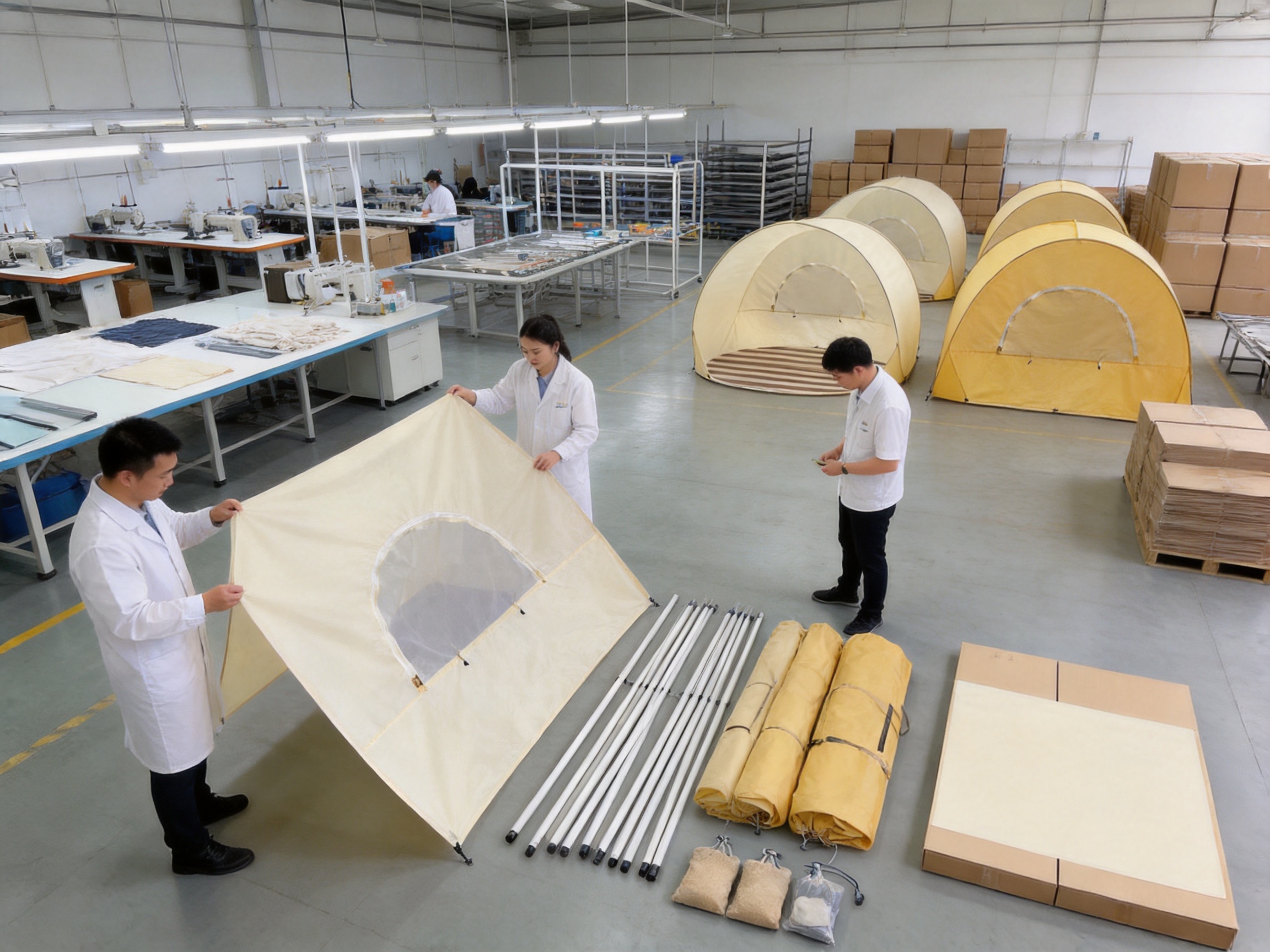
The manufacturer behind this product is Ningbo Zhenhai Tiansai Leisure Products Co., Ltd., a China-based outdoor product enterprise located in Ningbo, Zhejiang Province. The company operates a factory covering more than 13,000 square meters and serves international markets through the logistics advantages of Ningbo as a major port city.
A substantial production base can support more than volume. It can provide dedicated areas for material preparation, cutting, sewing, frame assembly, quality inspection, packaging, warehousing, product development, and export coordination. For buyers seeking a dependable supply partner, this type of infrastructure is important because it helps connect design concepts with repeatable production.
The company specializes in the design, production, and sale of tents and related outdoor equipment. Its product experience includes outdoor shelters, camping tents, glamping products, backpacking equipment, inflatable structures, and customized tent solutions. This broad category knowledge can be valuable when adapting one product for different markets or use cases.
The manufacturer has also worked as a global designated supplier for the British company TENTSILE and has developed products associated with appearance patents and utility model patents. These experiences indicate familiarity with specialized outdoor design, international customer expectations, and the importance of protecting functional and visual innovation.
Material Selection and Preparation
Manufacturing quality begins with material selection. For this type of shelter, the production team must evaluate polyester fabric weight, weave consistency, coating uniformity, color stability, tear resistance, sewing performance, and compatibility with printing or custom branding. Fiberglass rods require inspection for straightness, flexibility, surface quality, connector fit, and dimensional consistency.
Material preparation also includes cutting-plan optimization. Efficient nesting of fabric panels can reduce waste while maintaining the correct grain direction and seam allowances. Consistent panel dimensions are essential because small variations can affect the final tension of the canopy and the smooth operation of the automatic opening frame.
Cutting and Sewing Control
After the fabric is inspected, panels can be cut according to approved patterns. The cutting process must account for curved edges, mesh sections, sleeve areas, reinforcement patches, and attachment points. Accurate cutting helps ensure that the assembled canopy fits the frame correctly without unwanted wrinkles or excessive tension.
Sewing quality is equally important. Stress points around rod sleeves, anchor loops, stake points, and corners should receive appropriate reinforcement. Seam construction must be selected according to the load and movement expected in each area. Consistent stitch density, clean thread trimming, and secure backstitching contribute to durability and appearance.
For OEM orders, the same controls apply to custom logos, labels, color panels, and packaging components. Artwork should be approved before production, and sample units should be reviewed for logo placement, print clarity, color accuracy, and visual balance.
Frame Assembly and Functional Testing
Fiberglass rods and connectors must be assembled according to the approved structural design. The frame should open smoothly, maintain the intended canopy shape, and fold into the designated carrying configuration. Functional testing can identify problems such as excessive resistance, loose joints, incorrect rod lengths, or interference between the frame and fabric sleeves.
Quality teams may inspect sample units through repeated opening and closing cycles. Such testing is useful because a tent can look correct when fully assembled but still suffer from problems during folding or deployment. A reliable quick-opening mechanism should be intuitive, smooth, and resistant to ordinary handling by consumers.
Inspection, Packing, and Shipment
Finished units can be inspected for dimensions, fabric appearance, stitching, frame performance, accessory completeness, color, labels, and packaging. The carrying bag should accommodate the folded product without excessive compression, while the outer package should protect the unit during handling and transport.
For wholesale customers, packaging can be adjusted to suit retail shelves, e-commerce fulfillment, container loading, or multi-unit distribution. Carton marks, instruction sheets, barcode labels, and language requirements can be reviewed during the order-development stage. These details help reduce confusion after the goods leave the factory.
Customization and OEM Opportunities
One of the manufacturer’s major strengths is the ability to support customization according to buyer specifications. The basic beach shelter can be adapted through color, logo placement, dimensions, fabric options, packaging, labels, and accessory configuration, subject to technical feasibility and order requirements.
Custom colorways are useful for retailers and outdoor brands that need products aligned with an existing visual identity. Beige and yellow provide a bright consumer-oriented starting point, but buyers may request alternative colors for resort collections, children’s product ranges, private-label programs, promotional campaigns, or seasonal retail themes.
Logo customization can be applied to selected fabric panels, carrying bags, labels, or packaging. The best placement depends on the available surface area, the viewing angle, the printing method, and the intended use. A pre-production sample is recommended to confirm that the logo remains clear on the finished product.
Dimensions can also be reviewed for different market needs. A buyer may request a more compact children’s version, a wider family shade model, or a modified height for a hospitality application. Any dimensional change should be assessed together with frame geometry, fabric tension, packed size, weight, stability, and shipping cost.
Material customization may include recycled polyester fabrics, alternative coating systems, non-toxic finishing options, upgraded mesh, different waterproofing targets, or modified frame components. Environmentally preferable materials can help brands meet sustainability objectives, although buyers should request appropriate documentation and confirm that performance remains suitable for the intended use.
OEM and wholesale cooperation can include rapid prototyping, sample approval, bulk manufacturing, and global shipping support. A professional development process normally begins with a clear product brief covering target users, market regulations, required performance, design references, packaging expectations, order quantity, delivery schedule, and inspection standards.
Eco-Conscious Product Development
Outdoor consumers are increasingly interested in products that balance performance with responsible material choices. The manufacturer offers options involving recycled fabrics and non-toxic coatings for customers who want to reduce the environmental impact of their product lines.
Recycled polyester can provide an alternative to virgin polyester when the supply chain, certification, and performance requirements are properly managed. However, material claims should be supported by relevant documentation, and the final fabric should still be evaluated for strength, colorfastness, coating compatibility, sewing behavior, and durability.
Non-toxic coating options can be considered for products intended for family use, children’s environments, hospitality settings, or markets with specific chemical requirements. The appropriate coating depends on the desired balance of UV performance, water resistance, hand feel, flexibility, odor, and manufacturing cost.
Sustainability also involves product longevity. A shelter that is used for several seasons, repaired when practical, and stored properly may offer better overall resource efficiency than a cheaper item that fails quickly. Reinforced seams, replaceable or carefully handled accessories, and clear care instructions can all contribute to a longer useful life.
Packaging optimization is another area for improvement. Compact packaging can reduce warehouse volume and transport inefficiency. Buyers may evaluate recyclable packaging materials, reduced plastic use, right-sized cartons, printed care instructions, and consolidated accessories as part of a broader environmental strategy.
Suitable Applications and Customer Groups
Family Beach Days
Families can use the shelter as a shaded base for towels, snacks, toys, and personal belongings. Children can rest inside after swimming or playing, while adults maintain visibility through the open front and mesh sections. The 145 × 145 centimeter floor area is compact but useful for short breaks and organized storage.
Picnics and Parks
The shelter is also suitable for grassy parks, gardens, lakesides, and outdoor picnic areas. On firmer ground, stakes can support the structure, while the open front allows easy interaction with the surrounding group. Its lightweight carrying format makes it practical for day trips where a large gazebo would be excessive.
Resorts and Hospitality Venues
Hotels, resorts, beach clubs, and vacation properties can use customized shelters as guest amenities. Branded units can create a consistent visual identity across a poolside or beach area. The quick setup format can help staff reposition or store the shelters according to occupancy, weather, or event requirements.
Retail and Promotional Programs
Outdoor retailers can position the product as a family beach essential, children’s sun shelter, portable picnic tent, or summer travel accessory. Brands can also use customized models for promotional campaigns, sporting events, community activities, and seasonal gift programs.
Children’s Outdoor Activities
The shelter can create a defined shaded area for supervised outdoor activities. It may be used for reading, quiet play, craft sessions, or rest periods. Adult supervision remains necessary, and the shelter should not be treated as a substitute for formal childcare equipment or a certified play structure.
Setup, Use, and Care Recommendations
Before setup, users should select a level area free of sharp stones, broken shells, branches, glass, or other objects that could damage the floor or cause injury. The shelter should be positioned away from unstable edges, rising water, or areas exposed to sudden wave action.
Remove the tent from its carrying bag and unfold it carefully. Extend or activate the fiberglass frame according to the supplied instructions. Check that the fabric is evenly distributed and that no rod is trapped, twisted, or forced against a seam.
Once open, attach the available sandbags or fill the anchoring pockets with suitable sand. Insert stakes into firm ground where appropriate, angling them according to the manufacturer’s instructions. Inspect every anchor before allowing children or other users to enter.
During use, keep food, liquids, sharp objects, and heavy equipment organized so they do not strain the fabric or block ventilation. Do not hang objects from the frame unless the product is specifically designed for that purpose. Avoid placing the shelter near open flames, portable stoves, cigarettes, or other heat sources because polyester fabric can burn or melt.
To pack the shelter, remove all sand and accessories, release the anchors, and fold the fiberglass structure using the correct sequence. Never force the frame into the carrying bag. Shake out loose sand before folding, and wipe away saltwater or dirt with clean water when necessary.
Allow the shelter to dry completely in a ventilated place before long-term storage. Store it in a cool, dry location away from direct sunlight, excessive heat, chemicals, and rodents. Regularly inspect seams, mesh, rod sections, anchor loops, and the carrying bag before each use.
Wholesale Evaluation and Purchasing Considerations
Buyers evaluating this shelter for wholesale or private-label distribution should first define the intended market. A beach retailer may prioritize UV protection, bright colors, and compact packaging. A resort may focus on branding, repeated deployment, and cleaning requirements. A children’s product distributor may require specific testing, labeling, and documentation.
Sample approval should cover more than appearance. Buyers should review setup time, folding method, frame action, fabric feel, seam construction, mesh airflow, anchor design, packed dimensions, and instruction clarity. Samples should be evaluated under realistic conditions, including sand, grass, moderate wind, direct sunlight, and repeated handling.
Final specifications should be documented before mass production. Important details include fabric composition, coating requirements, color references, dimensions, tolerance ranges, waterproofing targets, logo artwork, labels, accessories, packaging, carton quantities, inspection procedures, and delivery schedules.
For international markets, buyers should confirm product safety, chemical, labeling, packaging, and consumer-information requirements applicable to their destination. Responsibility for compliance may be shared between the manufacturer, importer, distributor, and retailer depending on the market and sales arrangement.
Order planning should consider seasonal demand. Beach and summer products may require production and shipping well before peak retail periods. Early forecasting can support better material planning, prototype review, quality control, and freight scheduling.
Why This Shelter Is a Strong Product Choice
The Beach Shade Canopy Tent UV Protection Shelter is not designed to be the largest or most rugged shelter in the outdoor market. Its strength lies in specialization. It is a compact daytime canopy developed for people who want shade, ventilation, portability, and quick setup without carrying a heavy framed structure.
Its silver-coated polyester fabric supports a high level of sun protection, while the open-front and mesh construction encourage airflow. Its fiberglass frame keeps the product light and flexible. Its quick automatic opening design reduces setup effort. Its sandbag and stake provisions address the practical challenge of maintaining stability on beaches and soft ground.
For consumers, these features simplify outdoor recreation. For retailers, they create a clear product story that is easy to explain and demonstrate. For hospitality operators, the customizable design provides opportunities for branded guest amenities. For wholesale and OEM buyers, the manufacturer’s production capability supports adaptation across colors, fabrics, dimensions, and packaging formats.
The product’s limitations are also clear and manageable. It is a summer shade shelter, not an all-season expedition tent. Its waterproof index below 1,000 millimeters indicates limited moisture resistance rather than storm protection. Its lightweight construction requires proper anchoring and responsible weather judgment. Communicating these facts accurately helps customers select the product for the right purpose and increases satisfaction after purchase.
Quality, Innovation, and Long-Term Partnership
A reliable outdoor product supplier must provide more than a finished sample. Buyers need a partner capable of translating requirements into repeatable production, maintaining quality across batches, communicating during development, and supporting changing market needs.
Ningbo Zhenhai Tiansai Leisure Products Co., Ltd. emphasizes product innovation, practical design, professional development, and international service. Its design team draws on outdoor product experience and uses testing, professional collaboration, user feedback, and continuous optimization to improve product performance.
The company also maintains a quality management approach intended to ensure that products meet applicable international expectations. Quality systems are most valuable when they are applied throughout the process, from incoming material inspection through cutting, sewing, assembly, final inspection, packing, and shipment.
More than ten years of experience among the core team in outdoor product research and development, production, and overseas operations can help support communication with international customers. Such experience is especially useful when product requirements involve multiple departments, custom branding, technical adjustments, and time-sensitive seasonal delivery.
For outdoor brands seeking a one-stop manufacturing partner, the combination of factory infrastructure, tent specialization, customization capability, export experience, and product development support can reduce the complexity of sourcing. A successful partnership still depends on clear specifications, realistic performance targets, sample approval, transparent communication, and shared quality expectations.
Questions and Answers
What is the main purpose of this tent?
The main purpose is to provide portable daytime shade and a comfortable resting area for beaches, picnics, parks, gardens, lakesides, and similar outdoor locations. It is especially suitable for children and families but can also be used by adults, travelers, resorts, and event operators.
Does the fabric provide UV protection?
The product description identifies a silver-coated fabric with UPF 50+ protection and states that it blocks more than 98 percent of harmful UV rays under applicable testing conditions. Users should still use sunscreen, protective clothing, and sensible exposure limits.
How quickly can it be set up?
The quick automatic opening structure is designed to be assembled in under approximately two minutes when users follow the intended procedure. Actual setup time may vary depending on experience, ground conditions, anchoring, and whether the product includes a modified custom design.
Is the tent waterproof?
The listed outside and bottom waterproof indices are below 1,000 millimeters. This indicates limited water resistance suitable for minor moisture exposure, but the shelter should not be used as protection against prolonged heavy rain, storms, flooding, or water pooling.
Can it withstand beach wind?
The aerodynamic profile, sandbag provisions, and ground stakes are designed to improve stability in ordinary coastal breezes. The shelter must be anchored correctly and monitored continuously. It should be taken down in strong winds, storms, thunderstorms, or any unsafe weather.
Is it suitable for overnight camping?
It is primarily a summer picnic and beach shade shelter. The open-front design, compact dimensions, and ventilation-focused construction make it better suited to daytime use than overnight camping, cold weather, heavy rain, or demanding backcountry conditions.
What materials are used?
The standard product uses 190T polyester cloth and fiberglass rods. Buyers may discuss recycled fabrics, non-toxic coatings, alternative colors, or other material options with the manufacturer during customization and product development.
What are the product dimensions and weight?
The listed size is approximately 145 × 145 × 110 centimeters, with a floor area of roughly 145 × 145 centimeters. The product weighs about 1.8 kilograms. Buyers should confirm the final specification for any customized version.
What colors are available?
The standard information lists beige and yellow. Custom colorways can be discussed for wholesale, OEM, private-label, resort, promotional, and seasonal programs.
Can the tent include a custom logo?
Yes. The manufacturer offers customization that may include logos, colorways, dimensions, labels, packaging, and selected material options. Artwork, placement, printing method, minimum order quantity, and sample approval should be confirmed before production.
How should the tent be cleaned?
Users should remove sand and loose dirt, wipe the fabric with clean water when necessary, and allow the shelter to dry fully before storage. Harsh chemicals, abrasive brushes, and high heat should be avoided unless specifically approved for the fabric.
What makes this product different from a standard sunshade?
It combines a silver-coated polyester canopy, UV protection, mesh ventilation, an open-front layout, fiberglass support rods, quick automatic opening, sandbag anchoring provisions, and compact portability. The combined design provides more structured protection than a simple fabric shade.
Who can purchase this product in bulk?
Outdoor retailers, beach stores, travel brands, resorts, hotels, event companies, promotional distributors, children’s product suppliers, rental operators, and private-label businesses can discuss wholesale and OEM cooperation with the manufacturer.
Conclusion
The Beach Shade Canopy Tent UV Protection Shelter offers a practical solution for modern outdoor recreation. Its design responds to the most common needs of a day at the beach: protection from intense sunlight, a cooler and better-ventilated resting area, fast setup, dependable anchoring, and easy transportation.
Its 190T polyester construction, fiberglass frame, compact dimensions, approximately 1.8-kilogram weight, quick automatic opening, and available sandbag and stake support make it a well-balanced product for families, children, travelers, retailers, and hospitality providers. It is more defined and protective than a basic umbrella while remaining easier to transport than a large gazebo or family tent.
The manufacturer adds value through a substantial factory base, specialized tent knowledge, international production experience, custom OEM support, product development capabilities, and options for recycled materials and non-toxic coatings. These strengths make the shelter suitable not only as a standard retail item but also as a foundation for branded and customized outdoor product programs.
Used within its intended limits and anchored responsibly, the shelter can make coastal and park activities more comfortable, organized, and enjoyable. For buyers seeking a lightweight summer canopy with useful sun protection and flexible manufacturing support, it represents a practical combination of consumer convenience and professional production capability.
References
1. Product specification sheet for the Beach Shade Canopy Tent UV Protection Shelter, including dimensions, materials, weight, packaging, and waterproofing information.
2. Manufacturer-provided product description covering UV protection, ventilation, anchoring, rapid setup, portability, customization, and OEM services.
3. General principles of outdoor textile construction, polyester fabric performance, fiberglass frame design, and portable shelter engineering.
4. General consumer guidance for ultraviolet exposure reduction, outdoor shade use, hydration, and responsible sun protection.
5. General product-care practices for polyester outdoor equipment, including cleaning, drying, folding, storage, and inspection.
6. Manufacturer-provided company information concerning factory capacity, product development, quality management, international supply, and outdoor equipment expertise.
Product: Beach Shade Canopy Tent UV Protection Shelter

Message Us Right Now!
-
Mp: +86-18858091910
E-mail: sales@tenplaytent.com
ADD: No. 529, Guangyuan Road, Xiepu Town, Zhenhai District, Ningbo City, Zhejiang Province, China
-
Quick Links
Home Products About Us Advantage News Contact Us -
Product
Inflatable & Air Tents Glamping & Resort Tents Backpacking & Trekking Tents Automatic & Pop-Up Tents Family & Camping Tents Specialty Tents & Shelters Kids Tents Pet Tents Humanitarian & Large Tents Hammock -
Get Connected
 Camping Tent Manufacturer in China