


 English
 عربى


Blog
Home / Blog
News Center
Blog
-
2026-08-30Waterproof Inflatable Camping Tent: A Practical Guide to Heavy-Duty Four-Season Shelter
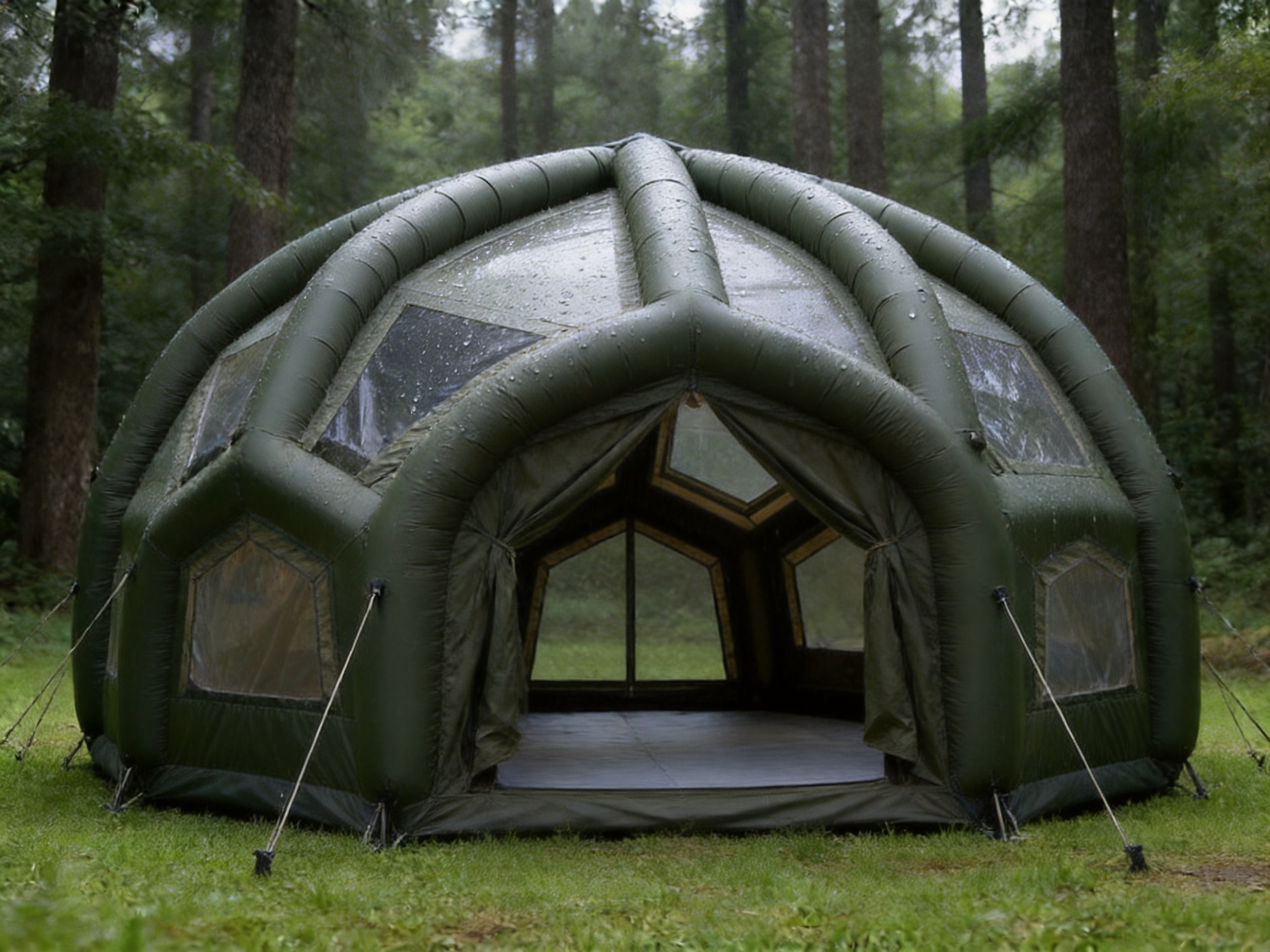 Modern outdoor travelers increasingly want a shelter that combines the comfort of a cabin, the portability of camping equipment, and the simplicity of a rapid setup system. The waterproof inflatable camping tent described in this article is designed to answer that need. With a spacious round architectural profile, integrated pneumatic air columns, durable Oxford fabric, mesh ventilation, and a large interior footprint, it offers a practical alternative to conventional pole-supported tents for family camping, glamping, resort accommodation, outdoor events, and temporary recreational shelters. Measuring approximately 380 by 380 by 270 centimeters, the tent provides a generous living area with enough height for comfortable movement and enough floor space for sleeping equipment, luggage, tables, chairs, and other camping necessities. Its high-ceiling design makes it feel more like a compact outdoor room than a traditional low-profile tent. At the same time, the inflatable structure avoids the weight, bulk, and complicated assembly associated with long metal poles. The product is manufactured by Ningbo Zhenhai Tiansai Leisure Products Co., Ltd., a China-based tent producer with experience in design, production, export, product development, and OEM cooperation. The company operates a factory covering more than 13,000 square meters and serves outdoor brands and customers in North America, Europe, Asia, and other markets. Its manufacturing capabilities extend across camping tents, inflatable tents, glamping structures, backpacking products, specialty shelters, and customized outdoor equipment. This article examines the product’s construction, setup system, comfort advantages, weather-resistant materials, manufacturing strengths, recommended applications, maintenance requirements, purchasing considerations, and competitive position. It also explains the difference between a weather-resistant inflatable tent and a permanent building, helping buyers select and use the shelter responsibly. 1. Product Overview The tent is a large inflatable camping shelter built around a pneumatic frame rather than a conventional collection of rigid poles. Its air columns support the roof and walls after inflation, creating a stable cabin-like structure. This design gives the tent a distinctive balance of portability and interior volume. The exterior uses high-density Oxford fabric with a waterproof coating. The supplied product information also identifies a PVC waterproof bottom cloth and upgraded PVC air columns with mesh-related construction elements. These materials are selected to support outdoor use, improve resistance to moisture, and help the structure maintain its shape during normal camping conditions. The tent is intended for spring, summer, autumn, and winter use when properly installed and used within suitable environmental limits. It is described as rain-resistant, snow-resistant, ultraviolet-resistant, wind-resistant, and insect-resistant. However, responsible use remains essential. Weather resistance does not mean that the tent is a substitute for a permanent storm shelter, and use during extreme winds, severe storms, flooding, or dangerous snowfall should be avoided. The large footprint and round luxury-canopy style make the product especially suitable for users who prioritize comfort. It can serve as a family camping tent, a glamping accommodation unit, a guest shelter, a temporary hospitality structure, or an outdoor leisure space. The interior can be configured with sleeping beds, mattresses, chairs, storage units, rugs, lighting, and decorative accessories. Unlike many small inflatable tents designed only for short overnight trips, this model is oriented toward a more spacious and comfortable camping experience. Its dimensions allow campers to stand and move around more naturally. That makes it attractive to families, couples seeking extra room, resort operators, and event organizers who need a visually appealing shelter with practical interior capacity. 2. Main Specifications Specification Product Information Product type Inflatable camping and glamping tent Approximate size 380 × 380 × 270 centimeters Primary fabric 600D high-density Oxford cloth with waterproof treatment Floor material PVC waterproof bottom cloth Structural system Inflatable PVC air columns with a reinforced pneumatic frame Ventilation High-density mesh windows and multiple openings Seasonal positioning Designed for spring, summer, autumn, and winter camping when conditions are suitable Typical applications Family camping, glamping, resorts, outdoor events, leisure shelters, and temporary accommodation Setup method Inflation with the matching pump and anchoring with appropriate guy lines and stakes Manufacturing location Ningbo, Zhejiang Province, China The dimensions should be considered together with transport and installation requirements. A shelter of this size offers substantial interior room, but it also requires a sufficiently level site, adequate anchoring space, and a clear understanding of local weather conditions. Buyers should confirm the packed size, total shipping weight, pump configuration, accessory list, and final production specifications before placing a bulk order or planning commercial deployment. 3. A More Convenient Alternative to Rigid Pole Tents One of the product’s most important advantages is its inflatable structural system. Traditional large tents often require several metal or fiberglass poles. These components can be heavy, difficult to organize, and time-consuming to connect. In some cases, two or more people are needed to lift the roof, align the pole sections, and secure the structure properly. An inflatable tent simplifies this process by replacing much of the rigid framework with air columns. Once the matching pump is connected and the air chambers are filled to the recommended pressure, the frame rises into position. The user then secures the tent with guy lines and stakes. According to the supplied information, the tent can be built in approximately 15 minutes under suitable conditions and with an appropriate pump. Rapid setup is valuable for recreational campers who do not want to spend the first part of a trip assembling complicated equipment. It is also important for commercial operators. A glamping business may need to prepare several accommodation units at a campsite, while an event organizer may need to install temporary guest areas, dining spaces, or display shelters within a limited schedule. The absence of numerous long poles also improves packing convenience. Air columns can be deflated and folded, making the tent easier to store than a comparable rigid-frame shelter. This does not mean that the tent is weightless or suitable for every type of backpacking. Its generous dimensions make it more appropriate for vehicle-assisted camping, resort transport, organized outdoor activities, and basecamp use than for minimalist trekking. Another benefit is the reduced risk of pole breakage during normal handling. A bent or cracked pole can make a traditional tent difficult or impossible to use. Inflatable systems have different maintenance requirements, including air-pressure checks and puncture repair, but they eliminate many of the alignment and connection problems associated with multi-section rigid poles. How the Pneumatic Frame Works The air columns function as load-bearing members within the tent structure. When inflated, they create the curved roof and supporting walls. The rounded geometry distributes tension through the fabric and helps the shelter maintain its form. The frame must still be anchored correctly because an inflatable structure can be moved or lifted by strong wind if it is not secured. High-quality valves are especially important in this type of product. The supplied description refers to military-grade air valves and puncture-resistant tubes. In manufacturing, valve attachment, seam strength, chamber integrity, and material consistency are essential quality-control points. A carefully constructed air system helps reduce leakage and supports more reliable operation over repeated setup and deflation cycles. Users should always use the compatible pump and follow the recommended inflation procedure. Over-inflation may place unnecessary stress on seams, valves, and air chambers. Using unsuitable tools may also damage the valve or cause pressure to rise too quickly. The correct approach is to inflate gradually, inspect the shape of the frame, and stop when the structure reaches the specified firmness. 4. Durable Fabric and Waterproof Protection A tent’s performance depends heavily on its fabric system. The product uses 600D high-density Oxford cloth, a material widely used in outdoor equipment because it offers a useful combination of strength, flexibility, abrasion resistance, and manageable weight. The fabric is treated to improve its resistance to water and outdoor exposure. The waterproof bottom is another significant feature. Ground moisture can enter through the floor when a shelter is placed on wet soil, grass, or a damp campsite. A PVC waterproof bottom helps create a more protective barrier between the interior and the ground. It also makes the floor easier to clean after use, particularly when the tent is used at family campsites, festivals, or commercial glamping locations. Waterproof performance is not determined by fabric alone. Seams, zippers, doors, attachment points, windows, valve areas, and floor joins all require careful construction. Heat-welded or reinforced seams can reduce the possibility of water entering through stitched junctions. The final performance also depends on correct installation, proper tension, closed doors and windows, and the condition of the coating after repeated use. The product description presents the shelter as suitable for all four seasons, while also recommending use in good weather. These statements can be understood together: the materials and structure are intended to support use throughout the year, but the shelter should be operated within reasonable environmental conditions. It is suitable for ordinary rain, moderate cold, seasonal moisture, and occasional light snow when correctly installed. It should not be treated as an emergency shelter for hurricanes, violent thunderstorms, blizzards, avalanche zones, or flood-prone locations. For users camping in snowy conditions, snow should not be allowed to accumulate heavily on the roof. Accumulated snow adds weight and may affect the air-frame geometry. Campers should monitor the weather, clear snow carefully when necessary, and follow the manufacturer’s instructions for seasonal use. In cold environments, ventilation remains important because breathing, cooking, and wet clothing can create condensation inside the tent. Protection Against Sun and Insects Outdoor shelters must manage more than rainfall. Ultraviolet exposure can gradually weaken fabric coatings and cause color fading. The tent’s UV-resistant treatment helps reduce the impact of sunlight, but long-term exposure should still be managed. When the shelter is not in use, it should be dried, folded, and stored away from direct sunlight. High-density mesh windows provide a practical balance between airflow and insect protection. They allow fresh air to circulate while helping block mosquitoes, flies, and other small insects. This is particularly valuable in humid summer environments, near lakes, in forested areas, and at family campsites where doors may be opened frequently. The mesh also contributes to privacy when used with the tent’s fabric panels. By adjusting doors, curtains, and ventilation openings, occupants can manage light, airflow, visibility, and personal comfort. Commercial operators can use this feature to create a more refined guest environment than a basic open-sided canopy. Waterproof Inflatable Camping Tent Heavy Duty All Season Shelter 5. Interior Space, Comfort, and Layout Flexibility At approximately 380 by 380 centimeters with a peak height of about 270 centimeters, the tent provides a spacious interior for a camping shelter. The high ceiling is one of its strongest comfort advantages. Occupants can stand, change clothes, organize equipment, and move between sleeping areas without the cramped feeling common in low-profile tents. The interior can be adapted for different purposes. A family may install air mattresses or folding beds along the perimeter and keep a central area open for luggage and movement. A couple may create a luxury sleeping suite with a bed, small table, lighting, and storage. A resort operator may furnish the structure with a bed platform, chairs, rugs, and decorative elements to create a glamping unit. The rounded architectural form can also improve the visual impression of an outdoor venue. Instead of appearing like a purely technical shelter, the tent has a welcoming cabin or canopy appearance. This makes it suitable for campsites, garden events, recreational resorts, brand activations, and hospitality environments where appearance is important as well as function. Interior comfort is affected by the installation site. A level surface will make beds and furniture more stable and reduce stress on the floor. Before setup, the user should remove sharp stones, sticks, glass, and other objects that could damage the PVC base or the air columns. A protective groundsheet may further reduce abrasion and simplify cleaning. The tent should not be overcrowded. The exact sleeping capacity depends on the furniture arrangement, the size of sleeping equipment, and the intended level of comfort. Buyers should request an official capacity recommendation if the product will be used for commercial accommodation or group camping. Ventilation and Condensation Management Large mesh windows support cross-ventilation by allowing air to enter from one side and exit through another opening. This helps remove warm, humid air and improves comfort in summer. Ventilation is also important during cool weather because condensation can form when warm indoor air contacts the cooler inner surface of the fabric. Condensation is not necessarily a sign that the tent leaks. It can result from occupants breathing, wet clothing, damp ground, cooking, or a significant difference between indoor and outdoor temperatures. Users should keep suitable vents open whenever weather conditions permit, avoid drying wet gear directly beside sleeping areas, and use a separate cooking arrangement rather than operating a stove inside the tent. Good airflow also reduces odors and helps the tent dry after rain. If the shelter becomes wet, it should be fully opened and dried before long-term storage. Folding a damp tent can lead to mildew, unpleasant smells, coating deterioration, and fabric damage. 6. Advantages Compared with Competing Tent Types The inflatable camping tent occupies a position between a conventional family tent and a semi-permanent glamping structure. Its competitive value becomes clearer when compared with other common shelter categories. Compared with Conventional Pole Tents Traditional pole tents may be less expensive in some small sizes, but large models often require a substantial pole set and more assembly time. Their rigid components can be awkward to transport and may become damaged through bending or incorrect connection. The inflatable design offers a simpler setup sequence and a more flexible packing format. The air-frame concept also creates a smooth, rounded interior without numerous poles crossing the living space. This can make furniture placement easier. Instead of working around roof supports, users can arrange beds, tables, and storage more freely. Compared with Small Pop-Up Tents Pop-up tents are convenient for short trips, but many are limited in height, floor area, weather resistance, or ventilation. They are usually optimized for quick personal shelter rather than spacious family living. The inflatable cabin provides substantially more interior volume and a more comfortable experience for extended stays. The trade-off is that a larger shelter requires more storage space and a vehicle or organized transport. Therefore, the product is not intended to replace compact pop-up tents for hikers who carry all equipment on their backs. Compared with Rigid Glamping Cabins Wooden cabins, modular pods, and permanent resort structures offer excellent durability but require significant construction cost, land preparation, and installation time. An inflatable glamping tent can provide a hospitality-style environment with much lower site commitment. It can be relocated, stored seasonally, or used for temporary expansion during peak demand. For resorts and outdoor businesses, this flexibility can reduce the risk of investing in permanent structures before demand is fully established. Operators can test a new campsite layout, add seasonal accommodation, or create temporary event spaces without extensive construction work. Compared with Lightweight Backpacking Tents Backpacking tents are designed for minimum weight and compact carrying. Their priorities differ from those of this large inflatable shelter. The product described here emphasizes comfort, interior volume, durability, and rapid vehicle-based setup. It is better suited to car camping, family holidays, basecamps, glamping sites, and organized outdoor use. Understanding this distinction prevents incorrect comparisons. The tent’s advantage is not that it is the lightest option. Its advantage is that it offers a large, comfortable, weather-resistant shelter without the complexity of a full rigid frame. 7. Manufacturing Strengths and Production Capability The product is manufactured by Ningbo Zhenhai Tiansai Leisure Products Co., Ltd., a company focused on the design, production, and sale of tents and outdoor leisure equipment. Its factory covers more than 13,000 square meters, providing a substantial base for material handling, cutting, sewing, assembly, inspection, packing, and product development. A factory of this scale can support more organized production than a small workshop. Large tent manufacturing requires careful coordination of fabric rolls, pattern pieces, reinforcement materials, air-frame components, valves, zippers, windows, webbing, stakes, guy lines, and packaging. Efficient internal processes help reduce production delays and improve consistency between batches. The company’s location in Ningbo provides access to an important international port and an established manufacturing ecosystem. This can support export logistics, supplier coordination, container loading, and international order fulfillment. For overseas buyers, a factory with export experience is valuable because commercial success depends on more than product assembly. Documentation, packaging, quality checks, shipping coordination, and communication also matter. Product Design and Development The company maintains a professional design team that develops products from the perspectives of practicality and comfort. This approach is especially important for inflatable tents because structural performance, user experience, appearance, ventilation, packability, and manufacturing feasibility must be considered together. Product development may involve pattern refinement, prototype construction, inflation testing, seam evaluation, fabric selection, installation trials, and feedback from outdoor users. The company states that it collaborates with professionals and invites outdoor enthusiasts to participate in testing. Such feedback can reveal practical issues that may not be obvious in a purely technical design review, including door placement, ventilation control, furniture compatibility, setup sequence, and cleaning convenience. The company has also designed products associated with appearance patents and utility model patents. Intellectual property development indicates an effort to create differentiated outdoor products rather than relying only on generic forms. For buyers seeking private-label or OEM products, a manufacturer with design capability can be better positioned to adjust colors, graphics, layouts, accessory packages, and product functions. Material and Component Control Inflatable shelters require more than a strong outer fabric. The air columns, valves, connection points, floor material, window mesh, zippers, webbing, and guy-line anchors must work together. A weakness in any one component can affect the user’s overall experience. Material control begins with the selection and inspection of fabric, PVC, mesh, thread, webbing, and hardware. Cutting accuracy is important because large panels must align correctly during sewing or welding. Reinforced stress points help distribute loads around doors, windows, air-column sleeves, guy-line anchors, and floor joins. Air-column production requires particular attention to airtightness. Valves must be securely attached, internal chambers must be properly formed, and finished tubes should be checked for leakage. Repeated inflation and deflation can place stress on components, so durability testing is relevant for products intended for commercial use. Quality Management and International Service The company states that it implements a quality management system intended to ensure that products meet international standards. Buyers should still request specific test reports, certifications, inspection records, or compliance documents relevant to their destination market and application. Requirements may differ depending on whether the tent is sold to consumers, used in a resort, supplied to an event organizer, or deployed as a temporary public structure. International buyers also benefit from full-link service. This may include product consultation, sample development, packaging design, order coordination, production communication, inspection assistance, and shipment preparation. A manufacturer that can support the entire process may reduce the number of intermediaries involved in an OEM project. The company’s core team includes outdoor-product professionals with more than ten years of experience in research and development, production, and overseas operations. Such experience can help with product customization, market positioning, usage scenarios, and communication with distributors. For wholesale buyers, practical manufacturing knowledge is often as important as the initial product concept. 8. Recommended Applications Family Camping The tent is well suited to families who want more than a place to sleep. Its height allows adults to move comfortably, while the large floor plan provides room for children, luggage, chairs, and recreational equipment. Mesh windows can improve airflow, and the waterproof floor helps protect the living area from ordinary ground moisture. Families should select a campsite with sufficient clearance around the tent. The area must provide room for guy lines, door access, safe cooking separation, and vehicle movement. Children should also be taught not to climb on air columns, hang heavy objects from the roof, or pull on guy lines. Glamping and Resort Accommodation The tent’s spacious interior and luxury-canopy appearance make it suitable for glamping operators. A well-furnished interior can include a bed, bedside tables, lighting, rugs, storage, and decorative accessories. The structure can create an attractive accommodation option without the construction expense of a permanent cabin. Commercial operators should establish a maintenance schedule. Each unit should be inspected between guests, including the floor, zippers, mesh, seams, valves, air pressure, anchor points, and interior cleanliness. Operators should also create written procedures for high-wind warnings, evacuation, storm storage, and seasonal shutdown. Outdoor Events The tent can function as a private lounge, hospitality room, registration shelter, staff area, merchandise space, or temporary guest facility. Its quick inflation can simplify event setup when the installation window is short. The attractive shape may also contribute to the visual identity of an outdoor venue. Event organizers should verify local regulations, fire-safety requirements, public-access rules, anchoring standards, and emergency exit provisions. The tent should not obstruct public pathways or emergency access, and any electrical equipment must be installed safely by qualified personnel. Basecamp and Recreational Shelters Outdoor instructors, expedition organizers, photography teams, and recreational groups may use the shelter as a comfortable basecamp. It can provide a communal space for rest, planning, equipment organization, and meals when used with proper ventilation and safe cooking arrangements. Its size and comfort make it more appropriate for established campsites or vehicle-supported operations than remote lightweight expeditions. Transport planning should account for the tent, pump, ground protection, anchoring equipment, furniture, and drying or repair supplies. 9. Setup Procedure Correct setup is essential for performance. The first step is choosing a suitable site. The ground should be reasonably level, free from sharp objects, and large enough to accommodate the tent body, doors, guy lines, and drainage space. Avoid depressions where rainwater may collect and avoid locations beneath unstable trees or branches. Lay down a protective groundsheet if one is available. Unpack the tent carefully and identify the air valves, guy lines, stakes, doors, windows, and accessories. Position the tent so that the entrance faces a convenient and safe direction. If strong wind is expected, orient the structure according to the recommended anchoring plan rather than relying only on convenience. Connect the matching pump to the correct valve. Inflate the air columns gradually and observe the frame as it rises. Do not force fabric panels into position while the structure is still partially inflated. Check that the air tubes are correctly seated in their sleeves and that no fabric is trapped under an attachment point. Once the frame is fully formed, close the valves and inspect the overall shape. Attach all required guy lines and drive stakes into suitable ground. Guy lines should be tensioned evenly without distorting the tent. Check the base perimeter, door alignment, windows, floor, and air pressure before moving furniture inside. The stated setup time of approximately 15 minutes is achievable under favorable conditions with an appropriate pump and an experienced user. First-time users may require longer. Commercial operators should practice setup and pack-down before using the product with guests or at a public event. Important Setup Precautions Never inflate the tent near sharp tools, open flames, or exposed electrical hazards. Do not drag the tent across rough ground while inflated or deflated. Avoid placing heavy furniture directly against air columns or attaching unauthorized equipment to the frame. Do not over-inflate the air system. Excessive pressure can damage valves, seams, or internal chambers. If the frame appears unusually distorted, stop inflation and inspect the installation. When wind conditions increase, check every anchor and guy line rather than assuming the tent’s shape alone provides sufficient stability. 10. Maintenance, Storage, and Repair Regular maintenance helps extend the service life of any outdoor shelter. After each trip, remove dirt, grass, leaves, and sand from the fabric and floor. Clean surfaces with mild soap and water when necessary. Avoid strong solvents, abrasive brushes, and harsh chemicals that could damage coatings, mesh, PVC, or printed surfaces. The tent must be completely dry before storage. If weather prevents immediate drying, unpack it as soon as possible in a clean, ventilated area. Pay special attention to the floor folds, air-column sleeves, corners, and areas around doors and windows because moisture can remain hidden in these locations. Inspect the air columns for visible cuts, abrasions, unusual bulges, or slow pressure loss. Check valves for dirt and confirm that caps close properly. Examine guy-line loops, webbing, stakes, zippers, mesh panels, and seam areas. Minor issues are easier to repair before they become major failures. A puncture-repair kit should be stored with the tent. The repair area must be clean and dry, and the repair method should match the air-column material. Users should follow the supplied repair instructions rather than applying random adhesives. For substantial damage, the air column should be professionally evaluated. Fold the tent according to the manufacturer’s recommended method. Avoid sharp creases in the same location every time, as repeated folding can stress coatings and materials. Store the shelter in a cool, dry place away from rodents, direct sunlight, fuel, oils, and objects that could puncture the packed fabric. 11. Purchasing Considerations for Wholesale Buyers Wholesale buyers should evaluate more than the appearance of a sample. The intended market, climate, installation method, product certifications, packaging, warranty, replacement parts, and order quantities should all be discussed before production begins. For retailers, the most important points may include consumer-friendly setup, pump compatibility, packed dimensions, retail packaging, product photography, spare-parts availability, and clear safety instructions. For resorts, the focus may shift toward repeated installation, cleaning, replacement air columns, commercial warranty support, and seasonal storage. OEM buyers can discuss fabric colors, logo printing, window arrangements, interior partitions, floor specifications, accessory kits, packaging, and instruction manuals. A manufacturer with its own design and production team may provide more practical assistance than a trading company that simply resells standard products. Buyers should request a pre-production sample or approval sample when ordering customized products. The sample should be checked for size, color, logo position, fabric hand feel, zipper operation, ventilation, air retention, floor construction, and included accessories. Any approved details should be recorded clearly in the purchase agreement. Inspection procedures can include fabric inspection, dimensional checks, seam inspection, air-leak testing, inflation testing, accessory verification, carton inspection, and random product sampling. Commercial customers should consider independent inspection for large orders or high-value deployments. Questions to Ask the Manufacturer What is the exact packed size and shipping weight? Which pump is included, and is the pump suitable for the local electrical standard? What are the recommended inflation pressure and normal air-retention expectations? Are replacement valves, air columns, repair kits, and fabric components available? What weather conditions are covered by the product warranty? Which certifications and test documents are available for the target market? Can the fabric color, logo, floor, windows, doors, and interior layout be customized? What are the minimum order quantity, sample policy, production lead time, and packaging options? 12. Sustainability and Long-Term Value A durable tent can offer better long-term value when it is maintained properly and used repeatedly. Instead of purchasing a disposable shelter for occasional use, families, campsites, and resorts can use a well-constructed inflatable structure across multiple seasons. Repairable air columns and replaceable components may further extend the product’s useful life. The company states that it plans to increase investment in lightweight and environmentally friendly materials. Material selection should balance durability, recyclability, weather resistance, safety, and production efficiency. Buyers interested in sustainability should ask for specific information about fabric composition, packaging materials, repairability, and end-of-life disposal. Operational practices also influence environmental performance. Keeping the tent clean and dry, repairing small defects promptly, using protective groundsheets, and storing it correctly can reduce premature replacement. Resorts can improve efficiency by creating standardized inspection and cleaning procedures for each unit. Inflatable structures may also reduce site impact compared with permanent construction. They can be installed without extensive foundations and removed when a seasonal operation ends. Nevertheless, responsible site management remains important. Anchoring equipment should be removed completely, and the ground should be restored after temporary use. 13. Limitations and Responsible Use No camping shelter is suitable for every environment. The tent’s strengths are its space, comfort, inflatable setup, weather-resistant materials, and flexible applications. Its limitations include the need for a pump, the requirement for proper anchoring, the larger transport footprint compared with backpacking tents, and the need for careful protection from sharp objects. The term “all-season” should be interpreted as a design intention rather than an unlimited weather guarantee. Winter use requires suitable site selection, ventilation, snow management, and monitoring of local forecasts. In severe weather, occupants should follow local safety advice and move to a more secure shelter when necessary. Cooking, heating, and the use of fuel-burning appliances inside the tent can create fire and carbon-monoxide hazards. Such activities should be avoided unless the equipment is specifically designed and approved for the environment and the ventilation requirements are fully understood. Open flames should never be placed near tent fabric, air columns, or synthetic floor materials. Commercial operators are responsible for establishing their own safety procedures. These should cover capacity, emergency exits, fire prevention, weather monitoring, guest instructions, electrical systems, cleaning chemicals, and staff training. A tent can be a high-quality product, but safe operation depends on the complete installation and management system. 14. Why Work with an Experienced Tent Manufacturer? Working directly with an experienced manufacturer can improve consistency, communication, and customization. Tiansai Leisure combines product design, factory production, export experience, and outdoor-market knowledge. This combination is useful for buyers who need more than a standard catalog item. The company’s factory scale supports the coordination of multiple production stages. Its design team can help adapt a product to market preferences, while its manufacturing experience can identify whether a requested change is practical, durable, and cost-effective. Its international customer experience can also support communication across different languages, shipping requirements, and regional expectations. The company’s broader product background includes outdoor tents, glamping tents, inflatable tents, backpacking products, and specialty shelters. This range can help buyers develop a product collection rather than sourcing each tent type from a different supplier. A unified supplier may simplify branding, packaging, quality coordination, and after-sales support. The company also emphasizes innovation, professional service, and cooperation with global outdoor brands. Its stated business philosophy centers on encouraging people to explore nature and enjoy outdoor life. For distributors and hospitality businesses, a manufacturer aligned with these values may be a suitable partner for building a long-term outdoor product program. 15. Frequently Asked Questions Q1: Is this tent truly waterproof? The tent uses waterproof-treated Oxford fabric, a PVC waterproof floor, and protective construction intended to resist ordinary rain and ground moisture. It should be correctly installed with all doors, windows, seams, and anchors properly secured. Waterproof performance can vary with age, maintenance, installation, and weather intensity. It should not be treated as a guaranteed shelter during extreme storms or flooding. Q2: How long does setup take? The supplied information indicates that the tent can be built in approximately 15 minutes using the matching pump. Actual setup time depends on user experience, wind, ground conditions, unpacking, and the need to install guy lines and stakes. First-time users should allow additional time. Q3: Does the tent require metal poles? No. The primary structural support comes from integrated inflatable air columns. The tent still requires anchoring equipment such as guy lines and stakes. The air columns must be inflated to the recommended pressure with a compatible pump. Q4: Can it be used in winter? It is designed for use across spring, summer, autumn, and winter when environmental conditions are suitable. Users should monitor snowfall, wind, temperature, and condensation. Heavy snow accumulation, severe storms, and dangerous weather require additional precautions or relocation to a safer shelter. Q5: Is it suitable for backpacking? Because of its large dimensions and spacious design, it is better suited to car camping, glamping, resort use, basecamps, and organized outdoor activities. It is not intended to replace a lightweight trekking tent carried over long distances. Q6: How many people can sleep inside? Sleeping capacity depends on the size of beds or mattresses and the amount of space reserved for luggage and movement. Buyers should request the manufacturer’s official capacity recommendation for their preferred layout. The large floor plan can support flexible family or hospitality arrangements. Q7: How should the tent be cleaned? Use mild soap, clean water, and a soft cloth or sponge. Avoid harsh solvents, abrasive tools, and aggressive chemicals. The tent must be fully dried before folding and storage to reduce the risk of mildew and coating damage. Q8: What happens if an air column is punctured? A small puncture may be repairable with a suitable repair kit and the correct patching method. The damaged area must be clean and dry. Serious damage, valve failure, or continued air loss should be assessed by the manufacturer or a qualified repair technician. Q9: Can the product be customized? The manufacturer offers design and OEM capabilities, so buyers can discuss possible changes such as fabric color, branding, packaging, accessories, and layout. Customization depends on order quantity, technical feasibility, tooling, and production requirements. Q10: What should commercial buyers inspect before placing an order? Commercial buyers should review samples, dimensions, materials, air retention, seam quality, floor construction, accessories, safety documents, packaging, warranty terms, replacement parts, lead times, and inspection procedures. The final specifications should be confirmed in writing. 16. Final Assessment This waterproof inflatable camping tent is a strong option for users who want a spacious, comfortable, and relatively simple-to-install outdoor shelter. Its 380 by 380 by 270 centimeter dimensions provide a roomier experience than most compact tents, while the pneumatic frame removes much of the complexity associated with large pole systems. The 600D Oxford fabric, waterproof PVC floor, high-density mesh windows, rounded cabin architecture, and inflatable support system work together to create a practical shelter for family camping, glamping, resorts, temporary events, and basecamp operations. Its most important competitive advantages are interior volume, standing height, rapid inflation, flexible layout, and a more hospitality-oriented appearance. The product’s performance depends on correct use. It must be installed on suitable ground, inflated with the matching pump, anchored carefully, ventilated properly, dried before storage, and protected from extreme weather and sharp objects. Buyers should evaluate the product according to their actual application rather than assuming that an all-season description means unlimited storm protection. Behind the product is a manufacturer with a substantial factory, a professional design team, international export experience, patent-related development work, and capabilities across multiple categories of outdoor equipment. These strengths make the company relevant not only to individual campers but also to distributors, resorts, event organizers, and brands seeking OEM camping-tent solutions. For outdoor businesses and consumers seeking a balance between convenience and comfort, this inflatable shelter provides a compelling alternative to traditional tents. With responsible installation, regular maintenance, and appropriate weather judgment, it can become a dependable centerpiece for memorable outdoor experiences across multiple seasons. References 1. Product specification and selling-point information supplied for the inflatable camping and glamping tent. 2. Manufacturer-provided information concerning product dimensions, materials, construction, applications, and recommended use. 3. Manufacturer profile describing factory capacity, design development, export experience, patent activity, and quality-management objectives. 4. General outdoor shelter maintenance principles concerning waterproof fabrics, inflatable air structures, ventilation, condensation, anchoring, and storage. 5. General camping safety guidance concerning site selection, severe weather awareness, fire prevention, ventilation, and safe use of outdoor equipment. Product: Waterproof Inflatable Camping Tent Heavy Duty All Season Shelter .profile-card { display: flex; align-items: flex-start; gap: 2rem; background-color: white; padding: 2rem; border-radius: 12px; box-shadow: 0 2px 10px rgba(0,0,0,0.05); } .profile-avatar { width: 120px; height: 120px; border-radius: 50%; overflow: hidden; flex-shrink: 0; } .profile-avatar img { width: 100%; height: 100%; object-fit: cover; display: block; } .profile-info { flex-grow: 1; } .profile-name { font-size:27px; font-weight: 900; margin-bottom: 1rem; color: #1a1a1a; } .profile-bio { line-height: 1.6; color: #333; } @media (max-width: 600px) { .profile-card { flex-direction: column; align-items: center; text-align: center; gap: 1.5rem; } } Qiao Ruxin — After-Sales Service Supervisor more than six years of experience handling product inspections, installation guidance, warranty cases, and customer feedback for camping and inflatable tent orders, coordinating closely with production and overseas clients.
-
2026-08-28Luxury Inflatable Camping Tent for Large-Family Glamping and Outdoor Living
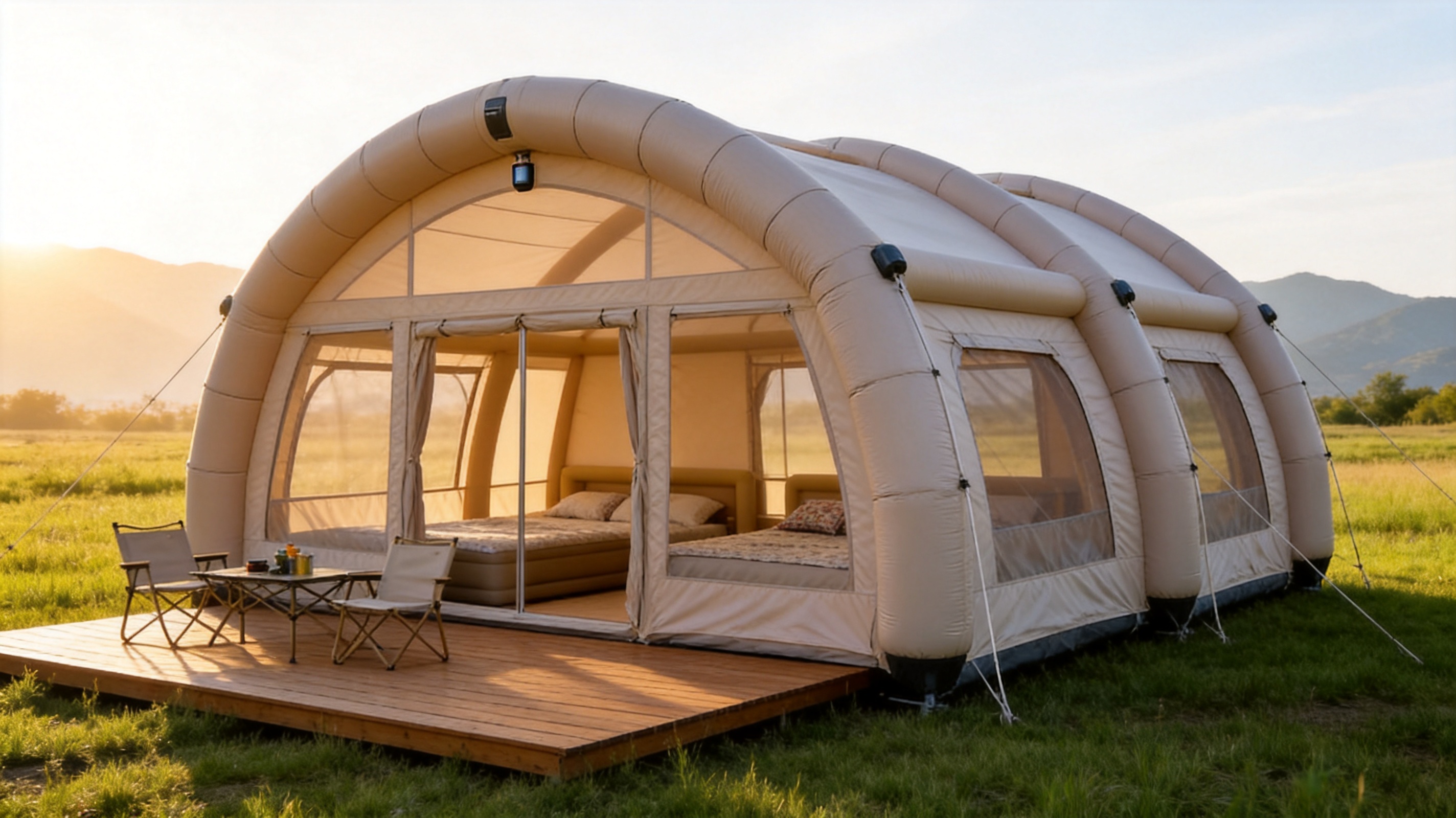 A successful outdoor shelter must do more than keep rain away. For families, resort operators, event organizers, and experienced campers, a tent should provide reliable weather protection, comfortable living space, practical organization, attractive design, and a setup process that does not consume an entire day. The Luxury Inflatable Camping Tent Large Family Glamping Cabin Shelter is designed around this broader definition of outdoor comfort. Developed as a spacious inflatable accommodation solution, this four-season-style shelter combines a pneumatic air-beam structure, waterproof fabric construction, large-scale interior volume, two-bedroom planning, ventilation features, and a refined appearance. It is intended for customers who want more than a basic sleeping tent but still require the portability and flexibility of a temporary outdoor structure. With several available size options, including approximately 300 × 300 cm, 400 × 400 cm, 500 × 500 cm, 600 × 600 cm, and 700 × 700 cm configurations, the product can support different uses. It may serve as a family camping shelter, a private glamping cabin, a hospitality unit, a temporary outdoor lounge, a resort accommodation module, or a spacious basecamp for extended stays. The product is supplied by Ningbo Zhenhai Tiansai Leisure Products Co., Ltd., a China-based tent manufacturer with experience in product design, production, export, and OEM/ODM cooperation. The company operates a factory of more than 13,000 square meters and develops a broad range of outdoor shelters, including camping tents, inflatable tents, glamping tents, backpacking products, and customized structures. A More Comfortable Alternative to Conventional Family Tents Traditional family tents commonly depend on multiple metal or fiberglass poles. While these systems can be dependable, they often require several people to assemble them correctly. Heavy pole sections must be connected, sleeves must be threaded, tension must be balanced, and the completed structure may need repeated adjustment before it becomes stable. An inflatable tent replaces much of this process with air beams. Instead of building a rigid framework from numerous separate components, the user unfolds the tent, positions it, secures the anchoring points, and inflates the integrated pneumatic structure with the matching pump. The air-filled beams create the primary support system, allowing the shelter to rise in a short period when the recommended setup procedure is followed. This design is particularly valuable for families with children, older campers, hospitality teams, and commercial users who may need to install several shelters at the same location. Fewer loose structural components also mean fewer parts to organize, transport, clean, and store after use. The product is not positioned as a lightweight backpacking shelter. Its purpose is different. It prioritizes interior room, livability, visual appeal, and long-duration comfort. The approximately 40-kilogram gross weight and packed dimensions of about 80 × 30 × 35 cm reflect its large, durable construction. In return for carrying a heavier package, users gain an accommodation-style shelter with substantially more usable space than a compact trekking tent. Designed as an Outdoor Living Space The defining characteristic of this inflatable cabin shelter is its large interior volume. The high-clearance design creates a more natural standing and moving environment, reducing the crouching and crawling commonly associated with low-profile tents. This makes everyday activities such as changing clothes, preparing meals, arranging luggage, and spending time indoors more comfortable. The two-bedroom configuration is another important advantage. Rather than treating the entire tent as one undivided sleeping area, the layout can provide a greater sense of privacy and order. Families may use separate sleeping areas for adults and children, while glamping operators can organize the interior into sleeping and living zones. Depending on the selected size and configuration, the central area may accommodate chairs, a small table, storage furniture, luggage, or leisure equipment. A spacious shelter also improves the camping experience during poor weather. Rainy afternoons, strong sunlight, cool evenings, or unexpected changes in conditions can force campers to spend more time inside. A small tent quickly becomes crowded when people, clothing, food, and equipment share the same floor area. A larger cabin-style shelter gives occupants room to sit, move, organize personal belongings, and maintain a more comfortable daily routine. The design is therefore suitable for customers who view camping as temporary outdoor living rather than simply overnight sleeping. It can support family holidays, extended weekend trips, private glamping sites, outdoor retreats, seasonal events, and resort accommodations where guests expect a residential atmosphere. Luxury Inflatable Camping Tent Large Family Glamping Cabin Shelter Inflatable Air-Beam Construction The air-beam system is central to the product’s convenience and appearance. The reinforced pneumatic skeleton provides the shape and support required for a large shelter while eliminating the visual clutter of a complex external pole network. This contributes to a cleaner cabin-like profile that is especially suitable for luxury camping and hospitality environments. High-pressure valves are incorporated into the inflatable structure to support controlled inflation. When used with the matching pump, the air columns can be filled efficiently. The stated setup target is approximately five minutes under suitable conditions, although actual installation time may vary according to the selected size, wind conditions, ground surface, user experience, anchoring method, and whether the shelter is being erected for the first time. Inflatable construction also provides practical packing benefits. The air beams can be deflated and folded with the tent body, reducing the need to carry long rigid poles. This makes vehicle transport, warehouse storage, and seasonal handling more straightforward. For resorts and event companies, compact packed dimensions can improve logistics when multiple units must be delivered or stored. Users should follow the supplied instructions carefully. The matching pump should be used, and the tent should not be over-inflated or inflated with unsuitable equipment. Correct pressure helps preserve the performance of the air-beam system and reduces the risk of damage caused by improper inflation. Before use, the air columns, valves, seams, guy lines, anchors, doors, and windows should be checked. Why Air-Beam Structures Appeal to Commercial Users For a private family, rapid deployment means more time for recreation. For a commercial operator, it can directly improve labor efficiency. A shelter that can be erected without assembling a large pole frame may reduce installation time and simplify staff training. This can be useful when preparing a seasonal campsite, changing a resort layout, supporting an outdoor exhibition, or creating temporary accommodation for a special event. Air-beam structures may also reduce the likelihood of losing individual pole sections during repeated use. A conventional pole system consists of numerous separate parts that can be misplaced, bent, or damaged. The integrated inflatable frame keeps the primary support structure connected to the tent body, although valves, pumps, repair materials, and anchoring equipment still require proper maintenance. The system offers an attractive combination of convenience and visual refinement. It is more substantial than a simple pop-up tent and less mechanically complicated than a framed cabin. This makes it a strong option for buyers seeking a balance between residential comfort and mobile outdoor practicality. Materials Engineered for Outdoor Use The shelter uses waterproof fabric together with a full PVC waterproof bottom cloth. This layered approach addresses two major sources of moisture: precipitation from above and ground moisture from below. A reliable floor is essential in a large family shelter because occupants may remain inside for long periods and may place bedding, luggage, furniture, and electrical accessories on the interior surface. The waterproof floor also helps separate occupants from damp soil, morning dew, and minor surface water. Nevertheless, site selection remains important. The tent should be installed on ground that is reasonably level, free of sharp stones and branches, and not located in a depression where water may collect. No fabric shelter should be treated as a substitute for proper drainage and responsible weather judgment. Heat-sealed construction is intended to strengthen water resistance around fabric joins and seams. Seam quality is especially important in a large shelter because the total surface area and number of connection points are greater than those of a small dome tent. Properly sealed seams help reduce the chance of water penetration during ordinary rain and improve the overall serviceability of the structure. The fabric is also described as UV resistant. Exposure to sunlight can gradually weaken textile fibers, fade colors, and reduce the lifespan of outdoor materials. UV-resistant treatment helps the tent withstand regular outdoor exposure, while shade, ventilation, proper drying, and careful storage remain necessary for long-term performance. When the shelter is not being used, it should be fully dry before packing to help prevent mildew and odor. Protection from Wind, Rain, Snow, and Insects The product is designed with a reinforced air-beam frame and weather-resistant fabric to provide stability in changing outdoor conditions. Its stated functional features include water resistance, wind resistance, UV resistance, snow resistance, and insect resistance. The high-density mesh used in ventilation areas helps keep insects outside while allowing air to circulate through the interior. These features make the tent appropriate for a broad range of outdoor seasons. However, “four-season” should be understood as a product classification rather than a guarantee of safety in every extreme environment. Heavy snow loading, severe storms, hurricanes, extreme mountain winds, freezing conditions, and prolonged exposure to harsh weather require additional planning and may exceed the intended use of a temporary inflatable shelter. For the best experience, the manufacturer recommends using the shelter in suitable weather conditions. Campers should always evaluate local forecasts, wind direction, ground conditions, temperature, and emergency access before setting up. All guy lines and anchoring points should be used as instructed, and the tent should not be left unattended in dangerous weather. Ventilation, Privacy, and Everyday Livability Large tents can become uncomfortable if they do not release heat and moisture effectively. The cabin-style shelter addresses this through high-density mesh windows, door openings, and panoramic ventilation. These features encourage cross-ventilation, allowing fresh air to enter while warm, humid air exits. Good ventilation is useful in several situations. During summer, it helps reduce heat buildup under the fabric. At night, it helps manage condensation caused by breathing, cooking, wet clothing, and temperature changes. In humid climates, improved airflow can make the living environment feel less enclosed and more pleasant. The mesh must be kept in good condition because even a small tear can reduce insect protection. Users should avoid forcing zippers, placing sharp objects against mesh panels, or folding the tent while it is dirty and damp. Routine inspection of windows, door closures, stitching, and ventilation panels can help maintain performance throughout repeated use. Ventilation also supports privacy. High-density mesh can allow airflow while limiting direct visibility, especially when combined with fabric door panels or curtains. This is a valuable feature for family camping and resort applications, where occupants may want an open, bright interior without sacrificing personal space. The internal organizers further support daily use. Small storage pockets or customized organizers help keep phones, flashlights, keys, maps, chargers, and personal accessories off the floor. In a large tent shared by several people, organization is not merely a convenience; it reduces clutter and helps occupants move safely through the interior. Suitable Applications Family Camping Families need a shelter that accommodates different routines. Children may sleep earlier than adults, parents may need space to organize clothing and food, and everyone benefits from a dry indoor area during bad weather. The two-bedroom layout and large floor plan provide a more practical family environment than a single-room tent with limited headroom. The shelter can be used for weekend camps, school-holiday trips, lakeside stays, garden-based outdoor experiences, and road trips where transport is available. Its size makes it especially appropriate for families who travel by car and want to bring bedding, chairs, storage containers, and recreational equipment. Glamping Sites and Resorts Glamping guests usually expect more than basic protection from the elements. They value attractive design, generous space, ventilation, privacy, and the feeling of staying in a distinctive accommodation unit. The inflatable cabin profile can support this hospitality concept while offering a structure that can be installed, relocated, or stored more flexibly than a permanent building. Operators may furnish the interior with beds, rugs, low furniture, lighting, decorative textiles, and storage solutions, provided the load, fire safety, ventilation, and local regulations are considered. The available size range allows a site owner to select more compact units for individual guests or larger structures for families and groups. As with all commercial accommodation, operators should establish a documented inspection routine. Air pressure, seams, fabric, floor, zippers, anchors, mesh panels, and electrical installations should be checked between guest stays. Clear instructions should be provided regarding cooking, heaters, candles, storms, and evacuation. Outdoor Events and Retreats Companies, schools, wellness organizers, and event planners can use spacious inflatable shelters as temporary lounges, meeting areas, activity rooms, changing spaces, or sheltered dining areas. Their rapid deployment can be helpful when a site must be prepared within a limited time frame. The shelter’s residential appearance can also improve the atmosphere of an outdoor event. Rather than using a purely utilitarian temporary structure, organizers can create a more welcoming environment for guests, customers, or participants. Branding, interior layout, and external decoration may be customized through OEM/ODM cooperation, subject to technical review and production requirements. Emergency and Temporary Accommodation Large inflatable shelters may also be considered for temporary accommodation, field operations, and humanitarian support. Their spacious layout, transportable format, and comparatively simple installation can be useful where rapid deployment is required. However, humanitarian or emergency applications must be evaluated against local safety standards, climate conditions, fire regulations, sanitation requirements, and project-specific specifications. The product should not automatically be assumed to meet every humanitarian procurement standard. Buyers in this sector should request technical documentation, material information, testing records, packing details, repair procedures, and customization options before placing an order. Available Sizes and Configuration Planning The listed product sizes range from approximately 300 × 300 cm to 700 × 700 cm. This broad selection allows buyers to align the shelter with available land, expected occupancy, furniture plans, transport capacity, and budget. Approximate Size Potential Use Planning Considerations 300 × 300 cm Compact family shelter or private leisure room Suitable for fewer occupants and limited furnishings 400 × 400 cm Small family camping or compact glamping unit Allows sleeping space with modest storage and seating 500 × 500 cm Family accommodation or comfortable weekend basecamp Offers more flexible separation between sleeping and living areas 600 × 600 cm Large family, resort, or group shelter Requires adequate installation space and careful anchoring 700 × 700 cm Large glamping cabin, event shelter, or spacious group accommodation Requires a level site, transport planning, and sufficient setup crew These dimensions should be confirmed with the supplier before purchase because final layouts, room divisions, door positions, windows, air-beam placement, and usable interior dimensions may vary by model. Buyers should also check the total footprint, guy-line clearance, entrance orientation, and required space around the shelter for safe movement and drainage. For a resort or commercial project, size selection should begin with a floor-plan study. The operator should identify bed dimensions, furniture locations, guest circulation paths, luggage storage, ventilation requirements, emergency exits, and maintenance access. A large floor plan is valuable only when it is arranged efficiently. Advantages over Conventional Pole Tents The product offers several practical advantages compared with conventional large family tents. First, installation is simplified. The air-beam frame avoids the need to assemble and insert numerous poles. This can shorten setup time and reduce the number of people required for erection. Second, the interior is designed around living comfort. Large vertical clearance, multiple rooms, and a substantial floor plan create a more residential experience than many standard camping tents. Third, the integrated frame eliminates long pole sections from the packed system. This can make transport and storage easier, particularly for car-based camping, resorts, and event inventory. Fourth, the visual design is appropriate for premium outdoor hospitality. A clean inflatable structure can appear more sophisticated than a basic utility shelter, helping operators build a consistent glamping environment. Fifth, the product supports customization. The supplier identifies OEM/ODM orders as acceptable, giving buyers the possibility of discussing materials, colors, layouts, logos, room arrangements, accessories, packaging, and project-specific requirements. It is important to recognize the trade-offs. Inflatable shelters generally require a pump and careful pressure management. They can be heavier than lightweight trekking tents, and their performance depends on correct anchoring and maintenance. A pole tent may be preferable for users who prioritize the lowest possible purchase weight or who frequently travel on foot. This inflatable cabin is better suited to customers who prioritize comfort, space, rapid assembly, and premium presentation. Advantages over Small Pop-Up Tents Pop-up tents are valued for their convenience, but their compact folding mechanisms and lightweight structures usually limit interior volume. They are often appropriate for short stays, festivals, children’s activities, or simple overnight use. They may not provide two bedrooms, standing room, substantial storage, or the robust weather-oriented fabric required for extended family camping. The inflatable cabin offers a different level of accommodation. It is designed to function as a large outdoor room rather than merely a sleeping pod. Users can move around more naturally, create zones for different activities, and remain comfortable when the weather keeps them indoors. The comparison should therefore be based on intended use. A pop-up tent may be more convenient for a single traveler attending a weekend event. The inflatable family shelter is more appropriate for a family, a glamping operator, or a customer who expects the tent to act as a portable living suite. Advantages over Lightweight Trekking Tents Backpacking and trekking tents are optimized for low weight, compact packing, and mobility over long distances. Their materials and dimensions are designed around carrying efficiency. These benefits are essential for hiking but are not the primary objectives of a large inflatable family shelter. The inflatable cabin instead maximizes interior comfort and usable space. Its heavier packed weight is justified when the tent is transported by vehicle, installed at a campsite, or used as part of a hospitality business. The larger floor area provides room for beds, luggage, furniture, and multiple occupants, while the two-bedroom structure gives the shelter a level of privacy not typically found in compact trekking equipment. Customers should select the product category according to their travel method. Hikers crossing several kilometers of difficult terrain may need a lightweight trekking tent. Families driving to a destination, resort owners furnishing a glamping site, and event organizers seeking a comfortable temporary shelter may gain greater value from the inflatable cabin format. Manufacturing Strengths and Product Development Capability The supplier, Ningbo Zhenhai Tiansai Leisure Products Co., Ltd., specializes in the design, production, and sales of tents and related outdoor products. Its factory covers more than 13,000 square meters, providing a substantial base for material handling, cutting, sewing, assembly, inspection, packing, and order management. A factory of this scale can support more organized production than a purely trading-based operation. Dedicated processes may be arranged for fabric preparation, pattern cutting, seam construction, air-beam integration, accessory installation, finished-product inspection, and packaging. For buyers, this can improve communication between product design and manufacturing teams, particularly when technical modifications are required. The company’s location in Ningbo offers access to an important international port city. This is a practical advantage for overseas customers because export-oriented production depends not only on product quality but also on efficient freight coordination, documentation, packaging, and shipment scheduling. The manufacturer has developed products for international markets and states that its tents are exported to countries and regions in North America, Europe, Asia, and elsewhere. Experience with overseas customers can help a supplier understand differences in climate, consumer expectations, packaging needs, labeling requirements, and product customization. Design and Engineering Experience Outdoor shelters must balance multiple factors at the same time. A larger floor plan can improve comfort but may increase fabric tension and wind exposure. A thicker fabric can improve durability but also add weight. More windows can improve ventilation but must be integrated without compromising weather resistance. An inflatable frame can simplify assembly but requires reliable valves, air channels, and repair provisions. The manufacturer’s product development approach considers practicality and comfort together. Its professional design team works on outdoor products from the perspectives of usability, performance, and customer feedback. Collaboration with outdoor professionals and product testing by outdoor enthusiasts can help identify problems that may not be visible in a purely factory-based evaluation. The company also reports experience with appearance patents and utility model patents. Intellectual property development can indicate an emphasis on creating differentiated products rather than simply reproducing generic market designs. For buyers seeking a private-label or custom product, this design capability may provide a stronger starting point for developing a distinctive shelter. Quality Management and Production Control Quality control for an inflatable tent must cover more than visual appearance. Critical inspection areas include fabric consistency, coating condition, seam strength, heat-sealed sections, air-beam integrity, valve installation, zipper operation, mesh attachment, floor waterproofing, guy-line points, and accessory completeness. A professional manufacturing process should also include checks at several stages. Incoming material inspection verifies that fabric, PVC components, mesh, webbing, zippers, valves, and other parts meet the approved specifications. In-process inspection identifies cutting, sewing, or welding issues before the complete shelter is packed. Final inspection verifies dimensions, appearance, inflation performance, folding, labeling, and packaging. The company emphasizes quality assurance and implements a quality management system intended to ensure that products meet international standards. Buyers should still request the specific test reports, certificates, and compliance documents relevant to their destination market and intended use. Requirements may differ depending on whether the product is sold to consumers, used in a resort, supplied to an institution, or deployed in an emergency project. OEM and ODM Cooperation Customization is an important advantage for importers, outdoor brands, distributors, and hospitality businesses. The supplier accepts OEM/ODM cooperation, allowing customers to discuss private-label production and product development. Potential customization areas may include exterior color, fabric selection, logo application, packaging design, internal organizers, room layouts, doors, windows, ventilation arrangements, accessory kits, and size adjustments. Not every request will be technically or economically suitable, so the process should begin with a clear product brief. A useful customization brief should specify the target market, expected climate, number of occupants, preferred dimensions, branding requirements, retail packaging, intended sales channel, target price, order quantity, and necessary compliance documentation. If the tent will be used in a commercial hospitality setting, the buyer should also describe expected installation frequency, seasonal storage, cleaning procedures, and replacement-part requirements. Prototype approval is essential. Before mass production, the buyer should review a sample or pre-production unit and verify the fabric, colors, layout, inflation process, room configuration, dimensions, accessories, labels, and packing method. Any approved changes should be documented to reduce misunderstandings during later production. Installation Procedure and Best Practices Although the product is designed for rapid deployment, careful installation remains necessary for safety and performance. 1. Select the Site Choose a level, stable area with adequate clearance. Remove sharp stones, sticks, branches, and other objects that could damage the floor or fabric. Avoid riverbeds, low-lying areas, unstable slopes, and locations beneath dead branches. Consider drainage, wind direction, access routes, and the position of the entrance. 2. Unpack and Position the Tent Spread out the groundsheet or tent body according to the instructions. Identify the entrance, air beams, valves, guy lines, and anchoring points. Position the shelter before inflation so it does not need to be dragged after the air frame becomes rigid. 3. Secure the Main Anchors Install the recommended anchors in suitable ground. Soft soil, sand, gravel, and hard surfaces may require different anchoring solutions. Do not rely solely on the weight of the tent. A large shelter presents a significant surface area to wind and should be secured using all supplied anchoring points where conditions require. 4. Inflate with the Matching Pump Connect the pump to the correct valve and inflate each air beam according to the manufacturer’s instructions. Do not over-inflate and do not use an unsuitable inflating tool. Check that the air beams expand evenly and that the fabric is not caught, twisted, or placed under abnormal tension. 5. Attach Guy Lines and Adjust Tension After the main structure is upright, attach and tension the guy lines. Lines should stabilize the shelter without pulling the fabric excessively. Recheck the anchors and structure after the tent has been fully erected. 6. Inspect Before Occupancy Confirm that doors and windows operate correctly, mesh panels are closed, the floor is properly positioned, and the air valves are sealed. Check the interior for sharp objects and ensure that cooking or heating equipment is not used in a way that creates a fire or carbon monoxide hazard. Actual setup time depends on the size selected and the conditions at the site. The advertised rapid setup refers to the inflation and basic erection process, not necessarily the entire task of clearing the site, anchoring every point, arranging furniture, and preparing the interior for guests. Maintenance and Long-Term Care Proper maintenance protects the investment and helps preserve the tent’s appearance and performance. After each trip, remove dirt, leaves, sand, and organic material. Clean the fabric with appropriate mild cleaning methods recommended by the supplier. Avoid harsh chemicals, abrasive brushes, and solvents that may damage waterproof coatings, printed areas, PVC surfaces, or seam treatments. Allow the tent to dry completely before folding. If the shelter must be packed during rain, unpack and dry it as soon as possible. Moisture trapped in folded fabric can encourage mildew and produce persistent odors. The storage area should be cool, dry, clean, and protected from rodents, sharp objects, and prolonged sunlight. Inspect the air beams and valves regularly. Listen for unusual air loss, examine valve connections, and check for visible abrasions or punctures. A repair kit and maintenance instructions should be kept with the product. Small problems are generally easier to address before they become large failures. Inspect zippers and mesh panels for dirt or misalignment. Do not force a zipper that is obstructed by fabric or debris. Check webbing, guy lines, buckles, anchors, and floor seams for wear. Commercial operators should record inspections and repairs so that each unit has a clear service history. Do not store heavy objects on top of the folded tent. When moving the packed shelter, use appropriate lifting technique because the gross package weight is approximately 40 kilograms. For larger models or commercial installations, two or more people may be needed for safe handling. Safety Considerations Every temporary shelter requires responsible use. The tent should be anchored correctly and monitored during changing weather. If severe wind, thunderstorms, flooding, heavy snow, or other dangerous conditions are forecast, occupants should follow local safety guidance and move to a suitable permanent shelter when necessary. Open flames, stoves, lanterns, heaters, and fuel-burning appliances must be managed with extreme care. Fabric structures can burn, and combustion appliances can create carbon monoxide. Cooking should only take place where permitted and where adequate ventilation, clearance, and fire safety controls are available. Electrical equipment should be installed in accordance with local regulations. Cables should be protected from water and foot traffic, and connections should not be overloaded. In commercial applications, operators should provide clear emergency procedures and ensure that exits are not blocked by beds, furniture, luggage, or decorations. The product’s water-resistant and weather-resistant features improve outdoor usability but do not remove the need for judgment. A responsible purchasing decision includes understanding the intended climate, local regulations, installation surface, occupancy level, and maintenance capacity. Purchasing Considerations for Importers and Distributors Wholesale customers should evaluate the complete supply arrangement rather than focusing only on the unit price. Important factors include material specifications, size, color, packaging, minimum order quantity, production lead time, sample approval, spare parts, repair kits, inspection procedures, warranty terms, shipping method, and after-sales communication. The listed packaging information identifies a single-item package of approximately 80 × 30 × 35 cm with a gross weight of about 40 kilograms. Buyers should confirm whether this information applies to every size option, because larger configurations may require different packing dimensions or weights. Distributors should also determine how the product will be presented to end users. An inflatable family shelter requires clearer instructions than a simple small tent. Retail packaging should explain the pump requirement, inflation precautions, anchoring, drying, storage, weather limitations, and basic repair procedures. For resort projects, the buyer should request a complete product specification and discuss the expected number of installation cycles. A shelter used occasionally by private families may experience fewer stresses than one erected and dismantled every week. Commercial use may require additional reinforcement, spare air-beam components, replacement valves, customized flooring, or a service agreement. Because the supplier is located in Ningbo, buyers can also discuss export packaging and port logistics at the quotation stage. Accurate product dimensions and shipping weights are important for freight planning, container utilization, customs documentation, and landed-cost calculations. Why Work with an Experienced Tent Manufacturer? Outdoor shelters combine textile engineering, structural design, manufacturing precision, packaging, and user education. A supplier with experience across these areas can help buyers avoid common problems such as inadequate seam sealing, poorly positioned windows, weak anchor points, confusing instructions, insufficient spare parts, or packaging that causes damage during transportation. Tiansai Leisure has operated in the outdoor-product field for many years and has developed international business relationships. The company states that its core team includes professionals with more than ten years of experience in research and development, production, and overseas operations. Such experience can be valuable when a customer needs communication across design, manufacturing, inspection, and export stages. The company’s connection with international outdoor brands and its reported patent activity also support its position as a product-oriented manufacturer. While every project should be evaluated through samples and documentation, a manufacturer that invests in design and product development may be better equipped to deliver differentiated solutions than a supplier focused solely on catalog reselling. The company’s stated brand concept, “Explore Nature, Enjoy Outdoor,” reflects the purpose of this product category: bringing greater comfort and convenience to outdoor environments without eliminating the feeling of being close to nature. The inflatable cabin is a practical expression of that concept, combining open-air adventure with a more comfortable residential experience. Frequently Asked Questions What type of tent is this? This is a large inflatable camping and glamping shelter in the Inflatable & Air Tents category. It uses reinforced air beams instead of a conventional multi-pole support system and is designed for family camping, resort use, outdoor events, and spacious temporary accommodation. How quickly can it be installed? The product information indicates that it can be built in approximately five minutes when the matching pump is used and the site is properly prepared. The total setup process may take longer because users must clear the ground, position the tent, install anchors, attach guy lines, and arrange the interior. Does it include a pump? The product information instructs users to use the matching pump, but the supplied accessories should be confirmed with the manufacturer before ordering. Buyers should ask whether the pump is included, which pump specification is required, and whether replacement pumps or adapters are available. Is the tent suitable for all four seasons? The product is identified as a four-season tent and is described as rain-resistant, snow-resistant, UV-resistant, wind-resistant, and insect-resistant. It should still be used responsibly. Extreme storms, heavy snow, severe winds, flooding, and other hazardous conditions may exceed the suitable operating environment for a temporary inflatable shelter. How many people can sleep inside? Occupancy depends on the selected size, internal layout, bed dimensions, furniture, and the amount of storage required. The two-bedroom structure is designed for family or group use, but buyers should request a specific recommended occupancy figure for the selected model and configuration. What materials are used? The product information identifies waterproof fabric, a full PVC waterproof bottom cloth, and an upgraded PVC air column with mesh-related components. Exact fabric composition, thickness, coating, denier, flame-retardancy options, and seam specifications should be confirmed in the technical quotation. Can the tent be customized? Yes. OEM/ODM cooperation is identified as acceptable. Customers may discuss branding, colors, dimensions, layouts, materials, packaging, organizers, windows, doors, and other features. Custom requests should be reviewed through drawings, samples, and written specifications before mass production. Is it suitable for backpacking? It is not primarily designed for backpacking. Its approximately 40-kilogram gross weight and large living area make it more suitable for vehicle-based camping, glamping resorts, events, and locations where the shelter can be transported without being carried long distances. How should the tent be stored? The tent should be cleaned, completely dried, deflated, folded according to the instructions, and stored in a cool, dry place. It should be protected from sharp objects, pests, excessive heat, and prolonged sunlight. The air beams, valves, seams, zippers, and mesh should be inspected before storage. What should buyers confirm before placing a wholesale order? Wholesale buyers should confirm the final size, material, color, layout, packaging, product weight, accessories, pump arrangement, order quantity, production time, inspection requirements, warranty, spare parts, compliance documents, shipping terms, and customization details. Conclusion The Luxury Inflatable Camping Tent Large Family Glamping Cabin Shelter is designed for customers who want a more comfortable and refined outdoor experience than a conventional small tent can provide. Its spacious floor plan, two-bedroom structure, high vertical clearance, waterproof floor, weather-resistant fabric, panoramic ventilation, insect-resistant mesh, and integrated air-beam frame make it suitable for family camping, glamping, resorts, events, and selected temporary accommodation applications. Its greatest competitive advantage is the way it combines residential-scale comfort with rapid inflatable deployment. Compared with a large pole tent, it can simplify installation and packing. Compared with a pop-up tent, it provides considerably more room and structure. Compared with a trekking tent, it offers a higher level of livability for customers traveling by vehicle or operating from a fixed outdoor site. The product also benefits from the manufacturing capabilities of Ningbo Zhenhai Tiansai Leisure Products Co., Ltd. The company’s factory capacity, export experience, product development focus, quality-management approach, patent activity, and OEM/ODM service provide a foundation for both standard orders and customized projects. For the best results, buyers should match the size to the intended occupancy, inspect technical specifications carefully, follow correct inflation and anchoring procedures, and plan for regular maintenance. When used within suitable weather conditions and supported by responsible site management, this inflatable shelter can transform a basic camping trip into a spacious outdoor living experience and provide hospitality operators with a distinctive, flexible glamping accommodation solution. References 1. Manufacturer-provided product specification for the Luxury Inflatable Camping Tent Large Family Glamping Cabin Shelter, model DYI-081. 2. Manufacturer-provided information concerning product materials, dimensions, packaging, setup guidance, and intended outdoor applications. 3. Manufacturer-provided company profile describing factory capacity, product development, export experience, quality management, and OEM/ODM services. 4. General principles of outdoor tent site selection, anchoring, ventilation, moisture management, and seasonal shelter maintenance. 5. General guidance for safe use of temporary textile structures, including fire prevention, severe-weather awareness, electrical safety, and carbon-monoxide prevention. Product: Luxury Inflatable Camping Tent Large Family Glamping Cabin Shelter .profile-card { display: flex; align-items: flex-start; gap: 2rem; background-color: white; padding: 2rem; border-radius: 12px; box-shadow: 0 2px 10px rgba(0,0,0,0.05); } .profile-avatar { width: 120px; height: 120px; border-radius: 50%; overflow: hidden; flex-shrink: 0; } .profile-avatar img { width: 100%; height: 100%; object-fit: cover; display: block; } .profile-info { flex-grow: 1; } .profile-name { font-size:27px; font-weight: 900; margin-bottom: 1rem; color: #1a1a1a; } .profile-bio { line-height: 1.6; color: #333; } @media (max-width: 600px) { .profile-card { flex-direction: column; align-items: center; text-align: center; gap: 1.5rem; } } Wenqiao Lu — International After-Sales Service Manager With over eight years of experience in outdoor equipment customer support, she manages warranty claims, technical inquiries, replacement parts, and post-delivery service for overseas distributors and camping brands.
-
2026-08-26Double-Layer Waterproof Pickup Truck Bed Camping Tent: A Practical Guide to Comfortable Mobile Camping
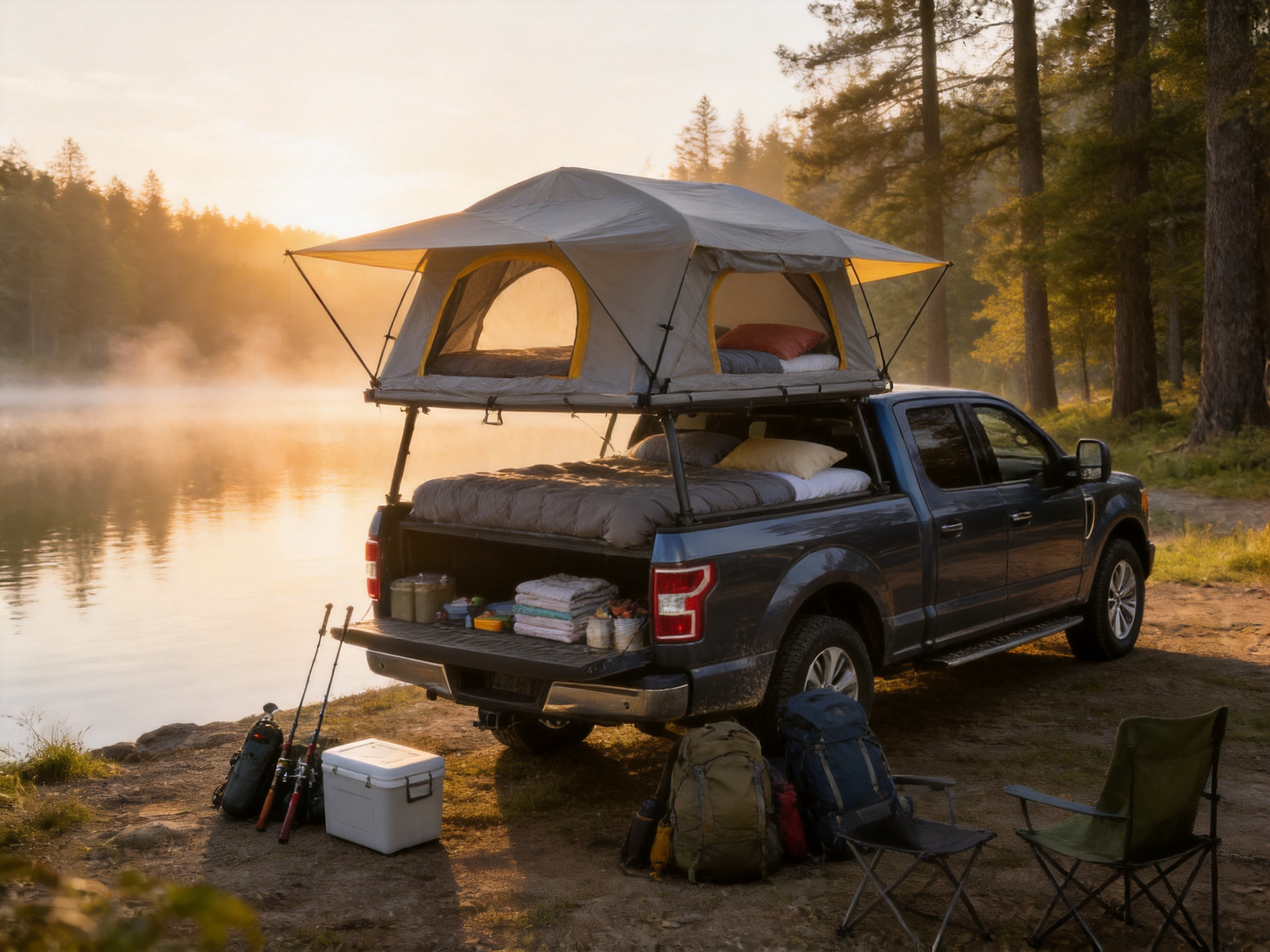 Pickup truck camping offers an appealing combination of mobility, flexibility, and direct access to the outdoors. Instead of towing a trailer or carrying a large freestanding shelter, travelers can convert the bed of a pickup truck into an elevated sleeping area with a purpose-built truck bed tent. The double-layer waterproof pickup truck bed camping tent described in this article is designed for that exact purpose. It creates a protected, comfortable, and portable shelter for camping trips, fishing excursions, road tours, family holidays, and extended outdoor travel. Unlike a conventional ground tent, a truck bed tent uses the vehicle as its foundation. This raises the sleeping area above wet soil, mud, uneven terrain, and many of the small inconveniences associated with ground-level camping. The result is a more organized campsite that can be assembled wherever the pickup truck can safely park. For users who want the freedom of a mobile shelter without the weight, cost, or complexity of a camper trailer, this type of tent provides a practical alternative. 1. Turning a Pickup Truck into a Mobile Campsite A pickup truck is already designed to transport equipment, supplies, and outdoor gear. However, the open truck bed is not naturally suited for sleeping. It may expose users to rain, wind, insects, dust, and temperature changes. A truck bed tent addresses these limitations by creating a dedicated enclosure that is secured directly to the vehicle. The tent forms a sheltered living space above the ground while preserving the vehicle’s mobility. Campers can use the truck for transportation during the day, then convert it into a sleeping shelter at night. This makes the product especially useful for travelers who do not want to set up a separate tent on every trip or who regularly camp in locations where the ground is unsuitable for sleeping. The design is also beneficial for short-notice trips. A traveler can keep the tent packed in the vehicle, drive to a scenic location, and establish a campsite without transporting a bulky cabin-style tent. When the journey is over, the shelter can be removed, folded, and stored until the next adventure. For families, the elevated sleeping platform can make camping feel more organized and secure. For individual travelers and couples, it provides a compact private shelter with a clear separation between sleeping equipment and the surrounding campsite. For anglers, hunters, photographers, and road-trip enthusiasts, the tent can function as a dependable base camp that moves with the vehicle. Double Layer Waterproof Pickup Truck Bed Camping Tent Portable SUV Sleeping Shelter 2. Product Overview and Intended Use This product is a double-layer waterproof pickup truck bed camping tent developed for use with most standard pickup truck beds. Its primary function is to convert a truck bed into a weather-ready sleeping and living space. The structure includes an inner tent layer and an external waterproof rainfly, supported by poles and secured through multiple attachment points. The tent is suitable for recreational camping, fishing trips, weekend getaways, family travel, long-distance road tours, outdoor photography, and other activities that require a portable shelter. It is also appropriate for users who want to reduce the amount of ground equipment they carry while maintaining a dedicated sleeping area. The product is not limited to one type of outdoor enthusiast. New campers may appreciate its relatively direct setup and elevated design, while experienced campers may value its efficient use of vehicle space and improved protection from the ground. Small businesses, travel operators, outdoor retailers, and private-label brands may also consider this type of tent for wholesale or OEM product programs. Although the product is designed around pickup truck beds, compatibility should always be verified before use. Truck bed length, width, sidewall shape, wheel-well position, tailgate configuration, and attachment clearance can vary by vehicle. Correct fit is essential for safety, weather resistance, and user comfort. 3. Double-Layer Construction for Improved Protection One of the most important advantages of this shelter is its double-layer construction. The inner tent creates the primary enclosed sleeping area, while the rainfly forms an additional protective barrier above and around the inner structure. This layered approach is more versatile than relying on a single fabric shell. The outer rainfly helps shield the inner tent from rain and ultraviolet exposure. When precipitation begins, water is directed away from the main sleeping compartment rather than falling directly onto the inner fabric. The air space between the two layers can also help reduce direct heat transfer from sunlight and support a more comfortable internal environment. The inner layer provides an enclosed area for sleeping, storing personal belongings, and organizing camping equipment. Depending on how the product is configured and used, the inner material may also support ventilation and insect protection. The separation between the outer fly and inner tent is valuable because it allows the shelter to perform multiple functions at once: weather defense outside, comfort and livability inside. Compared with a single-layer truck bed cover, a double-layer design offers a stronger balance between protection and practicality. A single layer may be lighter, but it can expose the interior more directly to condensation, solar heating, and rain impact. The double-layer structure provides another surface for managing these conditions while preserving the portability expected from a vehicle tent. For users who camp in changing weather, this layered construction provides additional peace of mind. A sunny afternoon, cool evening, unexpected rain shower, and windy morning may all occur during one trip. The tent is designed to address these changing conditions without requiring a complete change of shelter. Waterproofing Considerations Water resistance depends on several connected factors, including fabric treatment, seam construction, rainfly coverage, correct installation, and site selection. The product’s waterproof rainfly is intended to help keep precipitation away from the interior. Reinforced seams and a properly tensioned structure further support weather protection. Users should install the rainfly correctly and ensure that it does not press directly against the inner layer in a way that allows water to transfer inward. The truck should also be parked in a location that does not collect standing water. Even a well-designed shelter performs best when it is installed according to its intended use. Protection from Wind and Ultraviolet Exposure Wind can place stress on tent fabric, poles, attachment straps, and seams. This truck bed tent incorporates strong supporting poles, reinforced seams, and multiple attachment points to help maintain stability. The vehicle itself adds a firm foundation, while the attachment system helps prevent the shelter from shifting during normal outdoor conditions. The rainfly also helps reduce direct exposure to sunlight. Extended ultraviolet exposure can weaken outdoor fabrics over time, so the outer layer acts as a valuable first line of defense. Proper storage after use is equally important. The tent should be completely dry before packing whenever possible, because storing damp fabric can lead to odor, mildew, or material deterioration. 4. Elevated Sleeping Comfort Ground camping can be uncomfortable when the soil is hard, rocky, wet, uneven, or covered with roots. It can also require additional equipment, such as thick sleeping pads, ground tarps, and moisture barriers. By using the truck bed as the sleeping platform, the product provides an elevated alternative. Elevation can improve the overall camping experience in several ways. It separates the sleeping area from wet ground and reduces direct contact with mud, sand, and small debris. It also creates a clear boundary between the shelter and the surrounding campsite. For many campers, this makes it easier to keep bedding, clothing, and personal items clean. The raised position can be particularly valuable during rainy conditions. Water flowing across the ground may pass beneath the vehicle rather than directly under the sleeping area. However, elevation does not eliminate the need for responsible site selection. The vehicle should never be parked in a flood-prone area, beneath unstable trees, or on ground that presents a risk of sliding or rollover. Comfort also comes from organization. A truck bed tent creates a defined room rather than requiring users to spread sleeping equipment across the ground. Campers can arrange sleeping bags, pillows, clothing, and small personal items inside the enclosure. The surrounding truck and campsite remain available for cooking equipment, chairs, coolers, and other supplies. For long-distance travelers, this separation can make a major difference. A vehicle may carry food, tools, outdoor equipment, and luggage, but the tent establishes a dedicated area for rest. After a long day of driving, hiking, fishing, or sightseeing, users can settle into a prepared sleeping space without searching for a hotel or assembling a large freestanding shelter. 5. Compact Storage and Transport Efficiency Outdoor equipment must be useful not only when it is deployed but also when it is being transported. A truck bed tent is designed to pack down into a compact form for storage. This helps users preserve cargo space when the shelter is not in use and makes it easier to include the product in a broader travel kit. Traditional family tents can occupy considerable space in a vehicle, particularly when they include large poles, multiple rooms, extended vestibules, or heavy flooring systems. A truck bed shelter uses the existing vehicle structure, which can reduce the amount of separate ground equipment required. This may be especially helpful for travelers who need to carry fishing rods, bicycles, tools, cooking equipment, or recreational supplies. Compact storage also supports spontaneous travel. The tent can remain available in the vehicle without taking up the entire cargo area. When a suitable overnight location is found, the shelter can be deployed. After the trip, it can be folded and stored in a garage, storage room, vehicle compartment, or other dry location. To preserve the product’s service life, users should remove dirt before folding, allow all components to dry, and avoid compressing wet fabric. Poles and straps should be checked before long-term storage. A simple maintenance routine helps preserve waterproof performance and reduces the likelihood of damage during future setup. 6. Quick Setup and Practical Installation A major reason to choose a truck bed tent is the convenience of using the vehicle as the shelter’s structural base. The product is designed for direct installation onto the truck bed, avoiding the need to construct a separate ground platform. While setup time depends on the user’s experience, weather, and vehicle configuration, the basic process is straightforward. First, the truck should be parked on stable, reasonably level ground. The parking brake should be engaged, and the vehicle should be positioned away from hazards such as falling branches, unstable slopes, flood channels, or active traffic areas. The truck bed should be cleared of sharp tools, loose objects, and debris that could damage the tent floor. Next, the inner tent can be placed and aligned with the truck bed. The supporting poles are assembled according to the product instructions and inserted into the appropriate sleeves or attachment points. The tent should be extended evenly so that the fabric is not unnecessarily twisted or overstretched. The attachment straps or securing points are then connected to suitable sections of the truck. These connections should be firm but not excessively tightened. Over-tensioning may place avoidable stress on fabric loops, seams, or buckles. Once the inner tent is stable, the rainfly is positioned over the top and secured at its designated points. Before entering the shelter, users should inspect the installation from all sides. The rainfly should provide adequate coverage, the poles should be seated correctly, and the straps should not interfere with doors, tailgate movement, exhaust areas, or other vehicle components. A short inspection after the first few minutes of wind or rain can identify adjustments that improve stability. Setup Advantages over Conventional Ground Tents A conventional ground tent requires a suitable patch of soil, careful placement of a groundsheet, selection of stake locations, and sometimes extensive clearing of rocks or vegetation. A truck bed tent eliminates many of these steps because the sleeping area is already elevated on the vehicle. Ground tents can also become difficult to use when the soil is too hard for stakes, too wet for comfortable sleeping, or uneven enough to create pressure points. Although a truck bed tent still requires a safe parking area, the user does not need to prepare a full sleeping surface on the ground. This can make arrival and departure more efficient. The product is also less dependent on the condition of a campsite’s tent pad. At established campgrounds, the truck may be parked in a designated area while the tent remains above the ground. At dispersed campsites, users can take advantage of the vehicle’s mobility while maintaining a more structured sleeping arrangement. 7. Stability in Outdoor Conditions Stability is central to the performance of any portable shelter. A truck bed tent must resist movement while remaining flexible enough to accommodate normal outdoor conditions. This product uses reinforced seams, strong poles, and multiple attachment points to support a stable structure. Reinforced seams are important because tent fabric experiences concentrated stress at corners, pole sleeves, strap locations, and rainfly connection points. Strengthening these areas helps distribute tension more effectively. Strong poles maintain the tent’s shape, while multiple attachment points reduce the possibility that one connection must absorb all wind force. The truck itself provides a substantial and stable base compared with a lightweight ground tent. Nevertheless, the shelter should not be treated as an all-weather emergency structure. In severe storms, extreme winds, lightning, flooding, or heavy snowfall, users should follow local safety guidance and seek a more appropriate protected location. Correct tension is also part of stability. A tent that is too loose may flap excessively, while one that is over-tightened may experience unnecessary stress. The ideal installation creates a smooth, supported profile in which the rainfly sheds water and the inner structure remains properly aligned. For retailers and professional buyers, stability-related construction details are important selling points. Customers want to understand not only that a product is described as windproof or stable, but also why it can provide dependable performance. Reinforced seams, pole strength, and attachment design offer tangible explanations of the product’s construction advantages. 8. Ventilation, Livability, and Interior Organization A tent should do more than block rain. It should provide a reasonably comfortable environment for rest. The double-layer structure creates space between the rainfly and the inner layer, which can support airflow and help manage the temperature difference between the interior and exterior. Ventilation is important because occupants naturally produce moisture while breathing, and damp equipment can add more humidity inside the shelter. Good airflow helps reduce condensation on the inner surface. Users should avoid blocking ventilation openings with sleeping bags, clothing, or luggage. When weather permits, openings can be adjusted to improve air exchange while maintaining protection from insects and rain. The truck bed layout also supports efficient organization. Sleeping equipment can be placed toward the center, while shoes, small bags, and other items can be arranged along the sides. Campers should avoid placing sharp objects against the tent fabric and should keep heavy equipment from pressing on poles or seams. Because the shelter is elevated, users should be mindful when entering and exiting, especially at night. A small light, organized footwear location, and clear access path can improve convenience and reduce accidents. Children should be supervised when using the tent, and pets should be introduced carefully to prevent scratching or chewing of the fabric. 9. Applications for Different Outdoor Users Weekend Campers For occasional campers, the truck bed tent provides a simple way to turn a regular vehicle into an overnight shelter. It avoids the commitment of purchasing a trailer or permanently modifying the pickup. The product can be used for short trips, seasonal camping, or spontaneous weekends in nature. Fishing and Hunting Trips Fishing and hunting trips often require early starts, equipment storage, and access to remote areas. A truck bed tent allows users to sleep close to their vehicle and keep essential gear nearby. The elevated design can be more convenient than placing bedding on damp or muddy ground. Road Tours Long-distance road travelers can use the tent as a flexible alternative to hotels. It allows overnight stops at appropriate campgrounds and outdoor destinations without requiring a fixed accommodation schedule. The compact packed size helps preserve vehicle capacity for luggage and travel supplies. Family Outdoor Travel Families may use the shelter as a dedicated sleeping area while organizing chairs, cooking equipment, and activities around the vehicle. The product offers an alternative to a large family tent when the family already travels with a pickup truck. Parents should confirm dimensions and sleeping capacity before purchase, and younger children should always be supervised around the elevated truck bed. Photography and Field Work Outdoor photographers, survey teams, and field workers sometimes need a mobile rest area near a working location. The tent can provide a temporary shelter without requiring a trailer or permanent installation. Its portability makes it suitable for changing locations during a multi-day assignment. 10. Advantages over Competing Shelter Options The outdoor shelter market includes conventional ground tents, rooftop tents, vehicle awnings, camper shells, trailers, and inflatable shelters. Each option has its own strengths, but a pickup truck bed tent occupies a useful position between lightweight camping equipment and more permanent vehicle systems. Compared with Ground Tents The most obvious advantage over a ground tent is elevation. Users do not need to sleep directly on wet, rocky, or uneven ground. The truck bed provides a prepared platform, while the tent’s rainfly and inner layer create a more structured enclosure. A truck bed tent may also require less campsite preparation. Ground tents often need stakes and a carefully selected tent pad. The pickup shelter relies primarily on the vehicle and its attachment system. This can save time during both arrival and departure. Another advantage is the separation of the sleeping space from the surrounding campsite. Mud, insects, and water on the ground are less likely to come into direct contact with bedding. However, a ground tent may offer more freedom in terms of placement and may provide greater interior room depending on its design. Compared with Rooftop Tents Rooftop tents are elevated and can provide excellent views, but they often require a roof rack with sufficient load capacity. They may also add height to the vehicle, affect garage clearance, and remain installed during everyday driving. A truck bed tent avoids many of these concerns because it is installed in the pickup bed rather than on the roof. The lower installation position can make entry and exit easier for some users. It also allows the vehicle roof to remain available for other equipment. When the trip is finished, the truck bed tent can be removed and stored rather than becoming a permanent vehicle accessory. Compared with Camper Shells and Trailers Camper shells and trailers can provide more rigid protection and additional amenities, but they generally involve greater cost, weight, maintenance, and storage requirements. A truck bed tent is a lighter and more flexible option for users who want occasional sleeping capability without converting the pickup into a permanent camper. Trailers also reduce maneuverability and may require dedicated parking or towing equipment. The tent preserves the pickup’s normal driving characteristics when removed and does not require a separate registration or towing process in the same way a trailer may. Compared with Vehicle Awnings An awning provides shade and rain cover but does not necessarily create a complete sleeping enclosure. The truck bed tent is designed specifically as a shelter for overnight use. Its inner layer offers a more private sleeping environment, while the rainfly supplies additional weather protection. 11. Manufacturing Strengths and Product Development Capability The product is manufactured by Ningbo Zhenhai Tiansai Leisure Products Co., Ltd., an outdoor-products enterprise based in Ningbo, Zhejiang Province, China. The company specializes in the design, production, and sales of tents and related outdoor equipment. Its factory covers more than 13,000 square meters, providing a substantial foundation for product development, production coordination, quality management, and export operations. A factory of this scale can support multiple stages of the manufacturing process under coordinated management. These stages may include material preparation, fabric cutting, sewing, seam reinforcement, pole and accessory preparation, assembly inspection, packing, and shipment organization. Integrated production planning helps maintain consistency between product specifications and finished goods. The company’s location in Ningbo provides access to an important international port environment. This is valuable for an export-oriented manufacturer serving customers in North America, Europe, Asia, and other regions. Efficient logistics support can help international buyers manage production scheduling, container loading, documentation, and delivery planning. Design-Led Product Development Outdoor equipment must balance multiple requirements at the same time. A tent needs to be protective but not unnecessarily heavy, stable but not difficult to install, spacious but still compact when packed, and durable without losing practical convenience. Tiansai Leisure maintains a professional design team focused on these competing needs. The company develops products from the perspectives of practicality and comfort. This approach is particularly relevant to truck bed tents, because vehicle compatibility, attachment convenience, sleeping comfort, ventilation, storage, and weather resistance all influence the user experience. A product that performs well in only one of these areas may still disappoint customers. Balanced design is therefore a significant competitive advantage. Product development also benefits from collaboration with professionals and feedback from outdoor enthusiasts. Field testing can reveal problems that are difficult to identify in a factory or showroom, such as awkward strap placement, difficult pole insertion, poor rainfly tension, or inconvenient storage. Continuous refinement based on real use helps improve the final product. Patents and Technical Experience The company has designed products that have received appearance patents and utility model patents. These achievements indicate an ongoing emphasis on product innovation and design protection. For wholesale customers and outdoor brands, this can provide confidence that the supplier has experience creating differentiated products rather than simply copying standard market designs. The company’s core team includes experienced outdoor-product specialists with more than ten years of involvement in research and development, production, and overseas operations. That background is important for products intended for international markets, where buyers may require consistent quality, clear communication, packaging coordination, and support with customized specifications. 12. Advanced Manufacturing Process The quality of a tent depends heavily on production details that may not be visible in a product photograph. The manufacturing process must preserve fabric alignment, seam strength, pole fit, attachment accuracy, and final package completeness. For this reason, a reliable factory treats production as a sequence of controlled operations rather than a simple assembly task. Material Selection and Preparation The process begins with the selection and preparation of fabrics, webbing, thread, pole components, buckles, zippers, and other accessories. Materials should be checked for visible defects, color consistency, dimensional accuracy, and suitability for the intended construction. Fabric rolls are commonly inspected before cutting so that damaged sections can be identified and managed. For a double-layer truck bed tent, material preparation must account for the different functions of the inner tent and outer rainfly. The rainfly requires appropriate weather-resistant performance, while the inner layer must support enclosure, comfort, and practical ventilation. Accessories such as straps and buckles must be compatible with the expected attachment forces. Computer-Assisted Cutting and Pattern Accuracy Accurate cutting is essential for a tent because many panels must join together at specific angles and dimensions. Pattern errors can create wrinkles, uneven tension, poor pole alignment, or inadequate rainfly coverage. A professional production system uses standardized patterns and controlled cutting procedures to improve repeatability. Consistent cutting also helps reduce material waste and supports stable production costs. For OEM and wholesale orders, repeatable pattern control is particularly important because the buyer expects units from different production batches to maintain the same dimensions and appearance. Sewing and Seam Reinforcement Sewing is one of the most important stages in tent manufacturing. Seams connect fabric panels and transfer tension throughout the shelter. Stress points around pole sleeves, corners, straps, zippers, and attachment loops require careful construction. Reinforcement can include additional fabric layers, stronger stitching patterns, or carefully positioned support patches. The objective is to distribute force over a broader area rather than allowing one small section of fabric to absorb all the tension. Consistent stitch density and accurate seam alignment contribute to the durability and appearance of the finished tent. Workers must also manage the relationship between fabric layers. If the inner tent and rainfly are not aligned correctly, the finished shelter may be difficult to assemble or may not provide balanced coverage. Production guidelines and inspection procedures help reduce these risks. Pole and Attachment-System Preparation Poles provide the framework that creates interior volume and supports the rainfly. Each pole section must be checked for proper connection, length, finish, and compatibility with the corresponding sleeve or clip. A pole that is too long, too short, or incorrectly matched can affect the shape and stability of the entire tent. Attachment straps and connection points also require accurate positioning. Their location determines how the shelter sits on the truck bed and how tension is distributed during use. Careful assembly helps ensure that the product can be installed without unnecessary strain on the fabric or vehicle. Assembly Inspection and Functional Testing Finished tents should be inspected for sewing quality, fabric defects, missing components, zipper operation, pole fit, strap attachment, and package completeness. Where appropriate, samples can be opened and assembled to confirm that the parts work together as intended. Quality management is most effective when it is applied throughout production rather than only at the final packing stage. Incoming material checks, in-process inspections, and final product reviews create multiple opportunities to identify and correct problems. This approach supports more consistent performance for both individual customers and large wholesale orders. Packaging and Export Readiness Packaging must protect the product during handling, storage, and international transportation. The tent should be folded in a manner that minimizes unnecessary creasing and should be packed with its poles, straps, rainfly, and instructions. Carton labeling and packing lists must correspond with the order requirements. For global customers, export readiness includes communication about product specifications, carton dimensions, order quantities, delivery schedules, and customization needs. An experienced supplier can help coordinate these details as part of a complete service process. 13. Quality Management and International Service Tiansai Leisure states that it strictly implements a quality management system and works to ensure that its products meet international standards. For a camping tent manufacturer, quality management involves more than checking the final appearance. It includes the reliability of materials, consistency of construction, performance of hardware, and accuracy of product information. International customers often require dependable communication across the entire purchasing process. This may include product selection, sample confirmation, artwork or label approval, packaging decisions, production updates, inspection arrangements, and shipping coordination. A supplier with overseas operations experience can help reduce misunderstandings and improve order efficiency. The company serves as a one-stop partner for global outdoor brands and supports OEM camping tent wholesale solutions. OEM capability may include adjustments to color, branding, packaging, labels, accessories, or selected product details, subject to technical and order requirements. Buyers should confirm customization options, minimum order quantities, lead times, and testing documentation directly with the manufacturer. Efficient service is particularly important for vehicle tents because compatibility and customer expectations must be communicated clearly. Product listings should provide accurate dimensions, suitable truck-bed ranges, material information, setup guidance, care instructions, and safety recommendations. Clear information helps retailers reduce returns and gives end customers greater confidence before purchase. 14. Sustainability and Future-Oriented Development The outdoor industry is increasingly focused on lightweight construction, long service life, repairability, and environmentally responsible materials. A durable tent can support sustainability by remaining useful for many seasons rather than requiring frequent replacement. Proper care, repair, and responsible storage all contribute to longer product life. Tiansai Leisure has identified lightweight and environmentally friendly materials as areas for continued research and development. For truck bed tents, lightweight design can improve handling, packed storage, and transportation efficiency. However, weight reduction must be balanced with fabric strength, seam reliability, pole durability, and weather resistance. Environmental responsibility also involves reducing avoidable production waste and improving packaging efficiency. Accurate cutting patterns, controlled inventory, durable construction, and appropriate carton design can support more efficient use of resources. Buyers interested in sustainability should request specific material and packaging information when evaluating products for their own markets. 15. Buyer Guidance for Retailers and Wholesale Customers Retailers considering this product should evaluate both its consumer appeal and its operational requirements. The strongest selling points include the conversion of a pickup truck into a mobile campsite, double-layer weather protection, elevated sleeping comfort, compact storage, quick installation, and suitability for multiple outdoor activities. Product presentation should explain what the tent does without making unrealistic claims. Weather resistance is not the same as protection from every possible storm, and fit may vary among vehicles. Clear compatibility information is essential. Retailers should ask for product dimensions, recommended truck-bed configurations, packed size, gross weight, materials, available colors, and included accessories. Wholesale customers may also wish to confirm production capacity, sample policy, inspection procedures, carton details, logo options, instruction manual languages, and shipping arrangements. If the product will be sold under a private label, buyers should discuss artwork requirements and packaging approval before production begins. Customer support materials should include setup instructions, care guidance, safe-use warnings, and recommendations for drying and storage. These resources help users obtain better performance and reduce misuse. A well-supported product generally produces stronger customer satisfaction than a product sold with limited guidance. 16. Safe and Responsible Use Users should inspect the tent before every trip. Check the fabric for tears, examine seams and reinforcement points, confirm that poles are not bent or cracked, and ensure that straps and buckles are in good condition. Damaged components should be repaired or replaced before use. The pickup should be parked on stable ground with the engine turned off while the tent is occupied. Avoid installing the shelter near open flames, hot exhaust components, electrical hazards, unstable trees, or areas at risk of sudden flooding. Cooking, fuel storage, and portable heaters should be kept away from the tent fabric and used only according to their safety instructions. Never exceed the truck’s load capacity. The combined weight of occupants, bedding, equipment, and cargo must remain within the vehicle manufacturer’s limits. The tent itself does not increase the truck’s payload rating. Users should also confirm that the tailgate and truck-bed structure are suitable for the intended setup. In strong wind, lightning, extreme rain, heavy snow, or other severe conditions, users should consider leaving the tent and moving to a safer shelter. A portable recreational tent is not intended to replace an emergency building or a certified severe-weather shelter. 17. Care, Cleaning, and Storage Routine care helps preserve waterproofing and structural performance. After use, shake out loose dirt and remove leaves, sand, and debris. If the fabric becomes muddy, clean it with water and a mild product appropriate for outdoor textiles. Harsh chemicals, abrasive brushes, and aggressive scrubbing may damage coatings or fabric fibers. The tent should be dried completely before long-term storage. If rain prevents immediate drying, unpack the shelter as soon as practical and allow it to dry in a ventilated area. Folding a wet tent can encourage mildew and unpleasant odors, and it may reduce the life of the waterproof treatment. Poles should be stored without unnecessary bending or impact. Straps and buckles should be kept free from tangles, while zippers should be closed or protected from dirt during storage. The packed tent should be placed in a cool, dry location away from direct sunlight, rodents, sharp tools, and excessive heat. Before the next trip, users should perform a complete setup inspection. This confirms that all components are present and allows small issues to be addressed at home rather than at a remote campsite. 18. Frequently Asked Questions What type of vehicle is this tent designed for? The product is designed primarily for pickup trucks with suitable truck-bed dimensions and attachment clearance. It may fit many standard pickup beds, but users should confirm vehicle compatibility before purchase. Truck-bed length, width, wheel wells, tailgate design, and sidewall shape can affect installation. What does double-layer construction mean? Double-layer construction means that the shelter includes an inner tent and a separate outer rainfly. The rainfly helps protect the inner compartment from rain and sunlight, while the inner layer provides the enclosed sleeping area. The space between the layers can also support ventilation and comfort. Is the tent completely waterproof? The waterproof rainfly and reinforced construction are designed to provide strong protection from normal rain. However, waterproof performance depends on correct installation, closed openings, intact seams, suitable site selection, and weather conditions. No portable tent should be considered suitable for every extreme-weather situation. Can one person set it up? The product is designed for quick and practical installation, and many users may be able to set it up independently after becoming familiar with the process. Assistance may be helpful during the first setup, in strong wind, or when installing the shelter on a larger vehicle. Does the tent require ground stakes? Because the shelter is attached directly to the pickup truck bed, it does not rely on a conventional ground-tent layout. However, users must follow the supplied attachment method and ensure that all straps, poles, and connection points are correctly secured. Can the truck still be used after the tent is installed? The truck can remain parked as the base of the shelter, but users should not drive with the tent deployed unless the product instructions specifically permit it. Before driving, remove or fully secure the tent and ensure that no straps, poles, or fabric can contact wheels, exhaust components, or moving parts. Is this tent suitable for family camping? The tent is promoted for family use and provides an elevated shelter with useful sleeping space. Families should check the actual dimensions and recommended capacity before ordering. Occupants should distribute weight appropriately and supervise children when entering or leaving the truck bed. Can it be used for fishing and road trips? Yes. Fishing trips, road tours, weekend camping, and long-distance travel are among the product’s intended applications. Its compact packed form allows it to remain part of a vehicle-based travel kit. How should the tent be stored after a rainy trip? Allow the inner tent and rainfly to dry completely before long-term storage. Remove dirt and debris, inspect the poles and straps, fold the fabric carefully, and keep the packed product in a cool, dry location. What should wholesale buyers ask the manufacturer? Wholesale buyers should request product dimensions, compatible vehicle information, materials, packed size, gross weight, available colors, included components, sample terms, minimum order quantity, lead time, inspection standards, packaging specifications, OEM options, and shipping arrangements. Can the product be customized? The manufacturer provides OEM camping tent wholesale solutions and may support selected customization options. Buyers should discuss branding, colors, labels, packaging, accessories, order quantities, and technical limitations with the factory before confirming production. 19. Why This Product Is a Strong Market Choice The double-layer waterproof pickup truck bed camping tent responds to several major consumer needs at once. It provides a portable sleeping shelter, uses an existing vehicle platform, reduces dependence on ground conditions, packs compactly, and supports a broad range of outdoor activities. These advantages give it a clear position within the camping and vehicle-accessory market. Its strongest competitive distinction is the combination of elevated comfort and flexible ownership. A rooftop tent may require permanent mounting equipment, a trailer may involve high expense and reduced maneuverability, and a conventional ground tent may expose users to difficult terrain. The truck bed tent offers a middle path that is more mobile than a trailer, more accessible than many rooftop systems, and more elevated than a ground shelter. The double-layer design further strengthens the product’s appeal. Consumers increasingly expect outdoor equipment to perform in changing weather while remaining easy to transport. A waterproof rainfly, robust inner layer, reinforced seams, strong poles, and multiple attachment points address these expectations in a practical way. The manufacturer’s design experience, production facility, international export background, patent achievements, quality-management focus, and OEM capabilities also add value for commercial buyers. These strengths can help brands and distributors build a product range that combines practical consumer benefits with dependable manufacturing support. 20. Conclusion The double-layer waterproof pickup truck bed camping tent provides an efficient way to transform a pickup truck into a comfortable mobile campsite. By combining an elevated sleeping platform with a waterproof rainfly, inner enclosure, reinforced seams, strong poles, and multiple attachment points, it offers a practical shelter for camping, fishing, road travel, and outdoor exploration. Its advantages over many competing options include reduced contact with wet or uneven ground, compact storage, flexible installation, no need for a separate trailer, and convenient integration with an existing pickup truck. The product is designed to balance weather protection, stability, livability, and portability rather than focusing on only one feature. Behind the product is Ningbo Zhenhai Tiansai Leisure Products Co., Ltd., a specialized tent manufacturer with a factory of more than 13,000 square meters, an experienced outdoor-product team, international market reach, design and patent experience, quality-management procedures, and OEM wholesale capabilities. These manufacturing strengths support the development of outdoor shelters intended for both individual users and global outdoor brands. For consumers, the tent offers a more organized and comfortable way to camp from a pickup truck. For retailers and wholesale customers, it represents a versatile product category with clear practical benefits and broad application potential. With correct vehicle matching, responsible installation, regular inspection, and proper storage, it can become a dependable part of a mobile outdoor equipment system. References 1. Product information supplied for the double-layer waterproof pickup truck bed camping tent, including its construction, intended applications, setup characteristics, and storage benefits. 2. Company information supplied for Ningbo Zhenhai Tiansai Leisure Products Co., Ltd., including its manufacturing facility, design capabilities, export experience, patent achievements, quality-management practices, and OEM services. 3. General outdoor shelter principles concerning waterproof layers, seam reinforcement, ventilation, wind stability, fabric care, and safe campsite selection. 4. General vehicle-based camping considerations concerning pickup-bed compatibility, payload awareness, attachment inspection, and responsible outdoor use. Product: Double Layer Waterproof Pickup Truck Bed Camping Tent Portable SUV Sleeping Shelter .profile-card { display: flex; align-items: flex-start; gap: 2rem; background-color: white; padding: 2rem; border-radius: 12px; box-shadow: 0 2px 10px rgba(0,0,0,0.05); } .profile-avatar { width: 120px; height: 120px; border-radius: 50%; overflow: hidden; flex-shrink: 0; } .profile-avatar img { width: 100%; height: 100%; object-fit: cover; display: block; } .profile-info { flex-grow: 1; } .profile-name { font-size:27px; font-weight: 900; margin-bottom: 1rem; color: #1a1a1a; } .profile-bio { line-height: 1.6; color: #333; } @media (max-width: 600px) { .profile-card { flex-direction: column; align-items: center; text-align: center; gap: 1.5rem; } } Lin Qian — After-Sales Service Manager over eight years of experience in outdoor equipment customer service and manages warranty claims, product troubleshooting, replacement parts, and technical support for international distributors and camping brands.
-
2026-08-24Custom Size Tunnel Tent for Privacy, Changing, and Flexible Outdoor Shelter
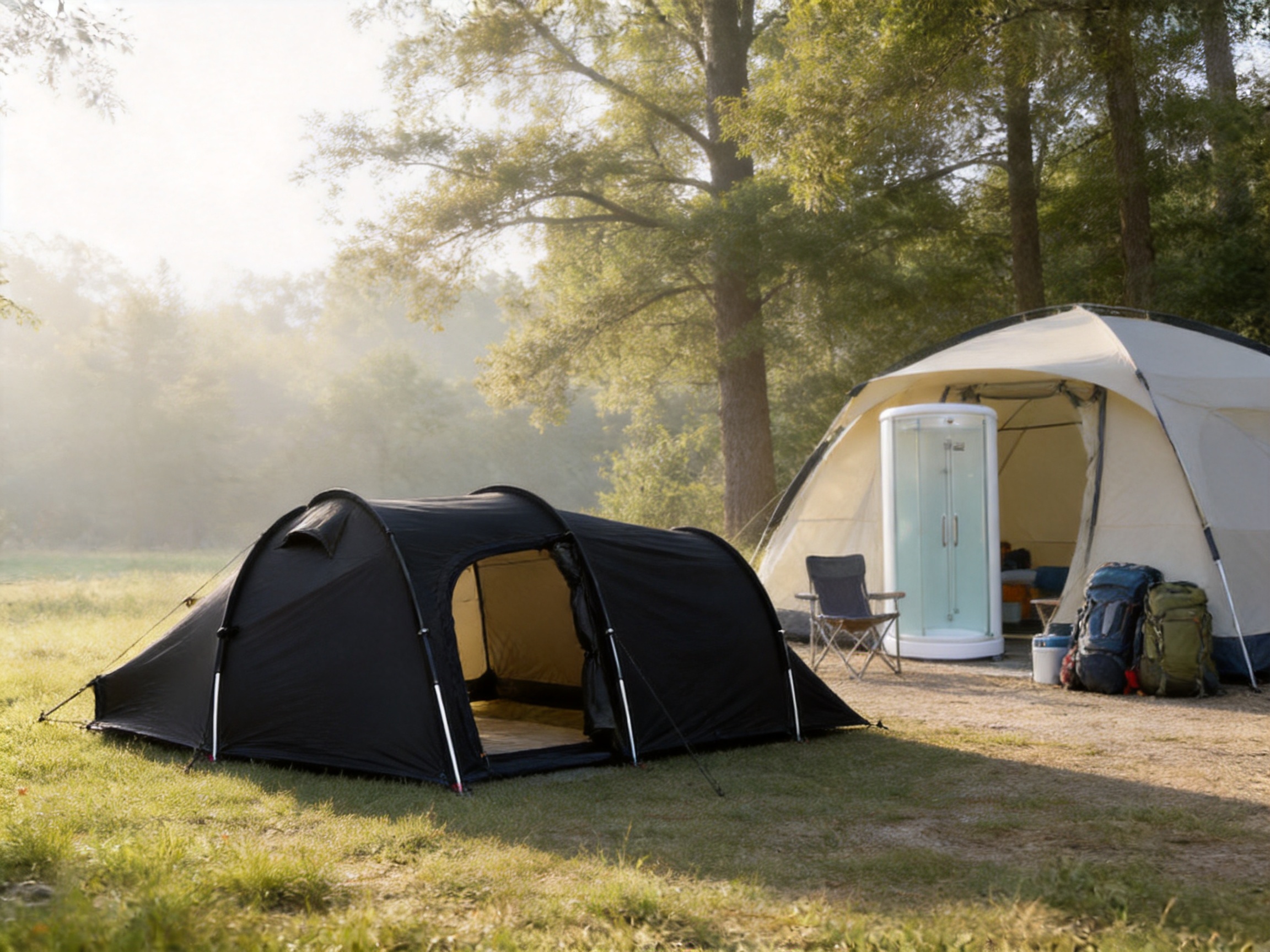 Outdoor activities are becoming more diverse, and modern campers increasingly need more than a traditional sleeping tent. A practical outdoor shelter may need to provide privacy for changing clothes, space for a portable shower or toilet, a secure area for storing equipment, or a quiet place for children and pets. The Custom Size Tunnel Tent for Privacy, Changing, and Flexible Outdoor Shelter is designed to answer these needs with a compact, adaptable, and easy-to-transport structure. Unlike a conventional camping tent that is primarily designed for sleeping, this tunnel-style shelter is intended for multiple practical uses. It can function as a private changing room, camping shower enclosure, temporary bathroom tent, equipment storage room, dressing area, festival shelter, or supplementary space beside a family tent. Its flexible design makes it suitable for camping trips, beach holidays, outdoor events, festivals, resorts, emergency support, and other situations where privacy and convenience are important. The product is manufactured by Ningbo Zhenhai Tiansai Leisure Products Co., Ltd., a China-based outdoor equipment manufacturer with experience in tent design, production, customization, and international supply. The company operates a factory of more than 13,000 square meters and serves outdoor brands, wholesalers, retailers, and project buyers in multiple global markets. A Practical Shelter for Modern Outdoor Living Outdoor users often face a simple but important problem: a sleeping tent does not always provide enough privacy or functional space. Changing clothes inside a crowded family tent can be uncomfortable. Using a portable toilet without an enclosure may be inconvenient. Storing wet clothing or outdoor equipment inside a sleeping area can create moisture and clutter. A separate privacy shelter solves these problems without requiring the user to purchase a large, expensive multi-room camping system. The Custom Size Tunnel Tent provides a dedicated space that can be positioned beside a primary tent, caravan, motorhome, beach shelter, or outdoor event structure. Because it is designed as a separate functional unit, it allows users to organize their campsite more efficiently. The sleeping area remains cleaner and more comfortable, while changing, showering, and storage can take place in a private and practical environment. The tunnel configuration offers a useful balance between interior room and structural simplicity. Rather than relying on a complicated network of poles, the shelter uses a straightforward frame arrangement that can be assembled and taken down with minimal effort. This makes it suitable for experienced campers as well as families and occasional outdoor users who want a dependable shelter without a difficult setup process. Its customizable sizing is another important feature. Outdoor environments vary considerably, and a shelter designed for a beach changing room may not need the same dimensions as a shelter used at a campground, resort, humanitarian site, or commercial event. Custom dimensions allow buyers to select a configuration based on the intended application, available space, number of users, and equipment requirements. Main Product Advantages Custom Dimensions for Different Applications The most distinctive advantage of this product is the ability to develop the size according to customer requirements. The listed reference size is 200 × 140 × 100 centimeters, while the stated area specification is 340 × 240 × 138 centimeters. Since custom production is available, buyers should confirm the final body dimensions, usable interior area, packed size, and frame configuration with the manufacturer before placing a production order. Custom sizing is particularly useful for professional buyers. A camping retailer may require a compact privacy tent for individual consumers. A resort may need a taller and more spacious changing shelter. An event organizer may request multiple connected units or a specific footprint that fits an exhibition layout. Humanitarian and large-site buyers may need standardized dimensions for field deployment. A customizable production process can accommodate these different requirements more effectively than a fixed-size retail product. Customization may also involve color, logo, packaging, branding, fabric selection, ventilation arrangements, door placement, and accessory configurations. This gives importers and outdoor brands the opportunity to create a product that matches their market positioning rather than selling a completely generic shelter. Multiple Uses in One Compact Product A major benefit over single-purpose shelters is its versatility. The same tunnel tent can be used as a camping shower changing room, private dressing space, temporary toilet enclosure, gear room, or outdoor storage shelter. This multifunctional design improves the value of the product because one item can support several activities during the same trip. For family camping, it can help parents create a private area for changing clothes or managing children. At the beach, it provides a more comfortable place to change out of wet swimwear. At a festival, it can be used as a personal dressing space or equipment shelter. At a resort, it can support guest privacy near swimming pools, cabins, or outdoor recreation areas. For caravanning and motorhome users, it can expand the usable living area without installing a permanent structure. This flexibility distinguishes the product from many basic pop-up changing tents that provide only a narrow vertical enclosure. The tunnel structure can offer a more usable interior shape, especially when the buyer selects a customized length or width. It can accommodate a portable toilet, small shower equipment, clothing, bags, and other necessities depending on the selected dimensions. Privacy Designed for Outdoor Conditions Privacy is a central function of the shelter. The enclosed structure creates a protected area where users can change clothes, organize personal belongings, or use portable facilities with greater comfort. The black color specified for the reference model can help create a visually discreet environment, although other colors may be available for customized orders. Privacy is not only important for individual campers. It is also valuable for commercial and institutional buyers. Resorts, outdoor schools, public event organizers, and humanitarian agencies often need temporary private spaces that can be installed quickly and moved when required. A portable privacy shelter can be deployed without the cost, construction time, or planning requirements associated with permanent facilities. The privacy function should be considered together with ventilation and safe use. For showering or warm-weather applications, buyers should confirm the ventilation design, door structure, mesh panels, and moisture-management features required for their market. The manufacturer can discuss these details during the customization stage. Water-Resistant Materials and Reinforced Construction The reference specifications identify polyester fabric, nylon material, double layers, and waterproof ratings of approximately 2,000 to 3,000 millimeters for both the outer tent and bottom. These specifications indicate that the shelter is designed to resist ordinary outdoor moisture, light rain, splashing, and damp ground conditions. The double-layer construction can provide additional protection compared with a single-layer enclosure. It may also support better separation between the inner living area and external weather conditions. Reinforced seams are important because stress is concentrated at corners, attachment points, door openings, and pole sleeves. A properly manufactured seam structure helps improve durability during repeated assembly, transport, and use. The shelter is intended for outdoor protection, but users should select the product configuration according to expected weather. A portable privacy tent should not automatically be treated as a substitute for a heavy-duty storm shelter. Wind exposure, snow load, extreme rainfall, ultraviolet radiation, and ground conditions can vary significantly. Correct anchoring and responsible use remain necessary, especially in open areas or severe weather. Quick Assembly and Easy Removal Outdoor equipment must be practical not only when it is in use but also when it is being transported and installed. The tunnel tent uses a relatively simple structure and fiberglass poles, allowing the shelter to be assembled in minutes when the components are prepared correctly. Straightforward assembly is especially useful for families, event crews, rental operators, and businesses that need to install several units. A simple frame reduces the risk of confusion during setup. Users can position the poles, attach the fabric, secure the shelter to the ground, and adjust the tension. The same logical process can be reversed during takedown. Clear instructions and correct storage practices can further improve the service life of the product. Compared with more complex multi-room camping systems, this type of shelter can reduce setup time and labor. Compared with permanent changing facilities, it can be installed almost anywhere suitable for temporary outdoor use. These practical advantages make it attractive for mobile applications and seasonal operations. Portable Packing for Transport and Storage The product has a reference weight of approximately 5 kilograms and is packed in a portable bag with an outer carton. The listed single-package size is approximately 45 × 35 × 30 centimeters, with a gross weight of about 5 kilograms. These specifications make it suitable for shipment, warehouse storage, vehicle transport, and consumer delivery. A compact packed form is important for campers who have limited trunk or caravan space. It is also important for distributors because smaller cartons can simplify container loading, warehouse organization, and last-mile delivery. Event companies can transport multiple units without requiring specialized vehicles. Rental operators can store the shelters between seasons without using excessive facility space. For wholesale orders, packaging can be discussed according to the buyer’s distribution model. Retail-ready packaging, customized cartons, instruction labels, barcode placement, logo printing, and protective packing may be considered during product development and order confirmation. Custom Size Tunnel Tent Privacy Camping Changing Room Outdoor Shelter Reference Specifications The following table summarizes the primary specifications supplied for the reference model. Custom orders may differ, so final production details should be confirmed in an approved specification sheet. Item Reference Specification Product Type Custom-size tunnel privacy tent Primary Uses Changing room, shower enclosure, portable bathroom shelter, storage area, outdoor shelter Reference Model LD-725 Reference Size 200 × 140 × 100 centimeters Area Specification 340 × 240 × 138 centimeters Fabric Polyester reference fabric Material Specification Nylon listed in the product information Layer Construction Double layer Waterproof Index Approximately 2,000–3,000 millimeters for outer tent and bottom Pole Material Fiberglass Color Black reference color Weight Approximately 5 kilograms Logo Customized logo available Minimum Order Quantity One piece stated for the reference product; production terms should be confirmed for customized orders Packing Portable bag and outer carton Package Size Approximately 45 × 35 × 30 centimeters Origin Jiangsu, China, according to the product specification Design Details That Support User Comfort Tunnel Geometry and Usable Interior Space The tunnel form is an efficient approach for creating a private enclosure. Its elongated structure can provide more usable floor area than a narrow upright changing pod, while remaining more compact than a full-size room tent. The shape can be adjusted based on the customer’s desired length, width, and height. For changing purposes, users need enough room to move their arms, place clothing, and maintain balance. For shower or toilet applications, additional space may be needed for equipment and personal items. For storage use, floor dimensions and entry width are often more important than sleeping height. Custom manufacturing makes it possible to prioritize these different requirements. The buyer should evaluate the interior based on actual use rather than external dimensions alone. Pole placement, fabric slope, door position, bathtub or shower tray size, and ventilation panels all influence usable space. A professional manufacturer can help convert the buyer’s application requirements into a practical construction drawing. Fiberglass Pole Support Fiberglass poles are commonly used in portable tents because they offer a useful combination of flexibility, low weight, and corrosion resistance. They can bend into a tunnel profile while maintaining enough spring force to support the fabric. Their relatively low weight also contributes to the portability of the packed shelter. As with all fiberglass structures, poles should be handled carefully during assembly and storage. Users should avoid forcing a pole into an incorrect sleeve or sharply bending it beyond its intended curve. Replacement pole sections and spare components may be discussed for wholesale, rental, or institutional applications. Fabric and Weather Protection Polyester and nylon are widely used in outdoor tent manufacturing because they can be produced in lightweight, coated, and durable forms. The final performance depends on fabric denier, coating type, seam construction, color treatment, stitching quality, and finishing processes. Buyers with specific requirements should request the precise fabric composition and coating details for the final version. A waterproof index in the 2,000–3,000 millimeter range can provide useful protection for ordinary camping conditions when the shelter is correctly pitched. The bottom rating is also important because ground moisture can enter through the floor if the base fabric, seams, or surrounding ground conditions are not properly managed. A suitable ground surface, correct tension, and appropriate anchoring help protect the shelter during use. For frequent commercial use, buyers may request additional testing or material documentation. These may include fabric colorfastness, seam strength, water resistance, tear resistance, flame-retardant treatment, and restricted-substance requirements, depending on the destination market and intended application. Manufacturing Strengths of the Supplier Integrated Tent Design and Production Experience Ningbo Zhenhai Tiansai Leisure Products Co., Ltd. specializes in the design, production, and sales of tents and outdoor leisure products. Its experience covers different categories, including camping tents, backpacking tents, glamping tents, inflatable tents, family shelters, and customized outdoor structures. This product range is valuable because a manufacturer that works across multiple tent categories can apply knowledge from one product type to another. Fabric selection, pole engineering, seam reinforcement, packing optimization, ventilation, waterproofing, and user ergonomics are all connected. Experience with various structures can support more effective development of a specialized privacy tunnel shelter. The company’s factory covers more than 13,000 square meters, providing space for material handling, sample development, cutting, sewing, assembly, inspection, and packing. An established production environment can help buyers coordinate product development and manufacturing through one supply partner rather than managing separate design and assembly sources. Professional Product Development Custom tent manufacturing is more than changing the length of an existing item. A size change can affect pole curvature, fabric tension, door dimensions, stability, packed volume, and overall weight. An experienced development team can evaluate these relationships before production begins. The company emphasizes a professional design team and a development process that considers practicality and comfort. Product concepts can be reviewed through prototype development, professional collaboration, outdoor testing, and customer feedback. This approach is useful for privacy shelters because small design details can have a major effect on real-world performance. For example, the height of a door influences ease of entry, while the width of the base affects whether a portable toilet or shower unit can fit comfortably. The location of a ventilation opening influences privacy, airflow, and moisture management. The strength of a pole sleeve affects long-term durability. Product development must consider all of these factors together. Quality Management and Production Control Consistent quality is essential when a tent is sold under a retailer’s or outdoor brand’s name. The manufacturer states that it operates a quality management system intended to ensure that products meet international standards. Quality control should cover incoming materials, fabric inspection, cutting accuracy, stitching, frame components, accessory completeness, waterproof performance, and packing. During production, fabric panels should be cut according to approved patterns to maintain dimensional consistency. Stitching should be checked at stress points and around openings. Pole sections should be examined for visible damage or deformation. Zippers, buckles, webbing, guy lines, and carry bags should be checked for correct quantity and function. For customized orders, the approved sample is especially important. The sample should establish the final color, logo position, fabric, dimensions, structure, accessories, and packing method. Production inspection can then compare bulk goods against the approved sample and specification sheet. Patents and Product Innovation The company has designed products and obtained a number of appearance patents and utility model patents. Intellectual property experience can support the development of differentiated outdoor products rather than relying only on standard market designs. For buyers, design differentiation may be important when entering a competitive camping market. A customized tunnel privacy shelter can be developed with a distinctive shape, branded color scheme, improved access system, specialized accessories, or a unique packing configuration. These details can help a retailer create a recognizable product family. Patent ownership and product rights should be reviewed during individual projects when a buyer requests exclusive designs or market exclusivity. Clear agreements regarding artwork, molds, technical drawings, and production rights can help protect both the buyer and the manufacturer. Advantages Compared with Other Outdoor Shelter Options Compared with Basic Pop-Up Changing Tents Basic pop-up changing tents are often valued for their instant deployment and low cost. However, many have limited interior space, restricted storage capacity, and fewer customization options. Their spring-frame construction may also be less convenient for buyers who want a defined tunnel layout or a specific footprint. The Custom Size Tunnel Tent offers a more adaptable structure. It can be developed around the intended use and can provide a practical balance between privacy, roominess, portability, and weather resistance. Although setup may involve poles rather than a fully automatic mechanism, the tunnel structure remains simple and can be more suitable for repeated organized use. Compared with Full Multi-Room Family Tents Large family tents can contain separate sleeping rooms and living areas, but they are often heavier, more expensive, and more time-consuming to install. Purchasing a full family tent solely to obtain a changing or storage room may be inefficient. A separate tunnel shelter allows users to add functional space only when needed. It can be transported independently, installed beside an existing tent, and packed away when the extra space is no longer required. This modular approach is especially useful for families that already own a primary sleeping tent. Compared with Permanent Changing Facilities Permanent facilities require construction, land preparation, maintenance, and long-term investment. They are not practical for temporary events, remote campsites, seasonal resorts, emergency areas, or mobile operations. A portable tunnel shelter can be deployed wherever a suitable level surface is available. It can be moved, stored, reused, and replaced more easily than a permanent room. This makes it a flexible solution for organizations that need temporary privacy without committing to fixed infrastructure. Compared with Generic Imported Shelters Generic shelters may be available in limited sizes and colors, with fixed packaging and little opportunity for technical adjustment. They may not match the buyer’s brand identity or target market requirements. OEM and customization support provide greater control over the finished product. Buyers can discuss dimensions, logos, colors, packaging, materials, accessory combinations, and application-specific requirements with the manufacturer. This can improve product-market fit and make the shelter more suitable for wholesale distribution. Manufacturing Process for a Customized Tunnel Tent Requirement Confirmation The process begins with a clear understanding of the intended application. The buyer should identify whether the shelter will be used primarily for changing, showering, toilet privacy, storage, resort services, events, or emergency deployment. The number of users, expected weather, frequency of use, transport method, and storage conditions should also be discussed. At this stage, the buyer should provide target dimensions, preferred color, logo files, packaging expectations, destination market, and any compliance requirements. If the product is intended for a commercial project, drawings or site limitations can help the design team prepare a more suitable proposal. Technical Design and Sampling After requirements are confirmed, the design team can develop a structure and prepare a sample. The sample allows the buyer to evaluate the dimensions, interior space, entrance, pole arrangement, fabric appearance, privacy, and overall usability. For a tunnel shelter, sampling is important because external dimensions do not always reflect practical interior space. The buyer should test whether users can enter comfortably, turn around, place equipment, and close the door without difficulty. If showering is one of the intended uses, the buyer should also assess water drainage, ventilation, and the placement of wet items. Material Preparation and Cutting Once the sample is approved, fabric and accessories are prepared for bulk production. Fabric rolls should be inspected for visible defects, color variation, coating irregularities, and width consistency. Cutting patterns are then applied to create body panels, floor sections, doors, sleeves, reinforcement pieces, and storage bags. Accurate cutting supports consistent assembly and helps prevent unnecessary fabric waste. For branded products, color matching should be checked against the approved sample or color standard before large-scale cutting begins. Sewing and Reinforcement Cut panels are joined through sewing operations that must account for fabric direction, seam allowance, load distribution, and waterproofing. High-stress areas such as pole sleeves, guy-line attachment points, door corners, handles, and floor connections may require additional reinforcement. Door systems should be assembled carefully to ensure smooth operation and appropriate closure. Zippers, hook-and-loop fasteners, webbing, and buckles should be aligned correctly. The carry bag should be sized to accommodate the folded tent, poles, and accessories without excessive compression. Assembly and Inspection Finished fabric components are assembled with the pole system and accessories. Inspectors can verify the fit of the poles, the tension of the fabric, the stability of the structure, the completeness of the accessory set, and the appearance of the logo or branding. Inspection may also include measurement checks, visual examination, folding tests, packing checks, and water-resistance evaluation. For repeat orders, production records and approved samples help maintain consistency between batches. Packing and Shipment Preparation After inspection, each unit is folded according to a defined method and placed in its portable bag. The packed unit is then protected in an outer carton suitable for warehouse handling and transportation. Carton markings, product labels, instructions, and quantity information should be confirmed before shipment. The manufacturer’s location in Ningbo provides access to an important Chinese port city and supports international logistics. This can be beneficial for overseas buyers arranging container shipments, consolidated cargo, or export distribution. Applications for Different Customer Groups Families and Individual Campers Families can use the shelter to create a private changing area away from the sleeping tent. It can also store shoes, wet clothing, backpacks, and outdoor accessories, helping keep the main tent clean and organized. Individual campers and couples may value the shelter because it combines several functions without requiring a large camping system. It can be used beside a tent, campervan, or vehicle during weekend trips and extended journeys. Beach and Water-Sports Users Beach users often need a quick and private place to change between swimming and dry clothing. A water-resistant tunnel shelter can help protect personal items from windblown sand and light splashes. For water-sports groups, the shelter can provide a temporary area for changing wetsuits, organizing equipment, or storing clothing. Festivals and Outdoor Events Outdoor events frequently require temporary facilities that can be installed and removed quickly. The tunnel shelter can serve as a dressing room, staff privacy area, equipment room, or temporary support space. Customized colors and logos can help event organizers create a consistent visual identity. Resorts and Hospitality Businesses Resorts, campsites, swimming facilities, and outdoor recreation centers can use customized shelters to provide additional guest services. They may be positioned near pools, beaches, activity zones, cabins, or temporary accommodation areas. For hospitality operators, appearance, durability, cleanability, and brand presentation are important. A customized logo, coordinated color, and robust packing solution can help the shelter become part of a professional guest experience. Humanitarian and Institutional Uses Temporary privacy is essential in disaster response, field medical operations, refugee support, military exercises, and remote work sites. A portable changing or sanitation enclosure can be transported and installed more easily than a permanent facility. Institutional buyers may require larger quantities, standardized specifications, clear packing instructions, replacement parts, and documented inspection procedures. The manufacturer’s OEM capability can support projects that require repeated production and consistent dimensions. How Buyers Can Develop the Right Custom Version Define the Main Function The first decision should be the primary purpose. A changing room may require a large entrance and comfortable standing space. A shower enclosure may require stronger water management and ventilation. A portable toilet shelter may need greater height and a wider base. A storage room may prioritize floor area and access over standing height. Select Suitable Dimensions Dimensions should be based on the equipment and number of users rather than general assumptions. Buyers should measure portable toilets, shower trays, folding chairs, storage boxes, and other items that will be placed inside. Sufficient clearance should be allowed for opening doors, moving safely, and storing clothing. Choose Materials for the Market Different markets may require different fabric weights, coatings, colors, and performance levels. A lightweight consumer product may prioritize portability, while a resort or rental product may require higher abrasion resistance. The intended climate should also be considered, including sunlight, humidity, rainfall, wind, and temperature. Confirm Branding and Packaging Logo placement, print method, color matching, care labels, instruction manuals, retail cartons, and barcode requirements should be confirmed before production. Clear packaging improves the buyer’s ability to sell, distribute, and support the product. Request a Pre-Production Sample A pre-production sample allows the buyer to verify the design before bulk manufacturing. It should be tested for setup, takedown, privacy, fit, stitching, zipper operation, packing, and general appearance. Any requested changes should be recorded in writing and reflected in the final specification. Care, Safety, and Maintenance Guidance The shelter should be erected on a reasonably level surface that is free of sharp stones, branches, and other objects that could damage the floor. Ground stakes and guy lines should be used when supplied or when conditions require additional stability. Users should avoid leaving the shelter unattended in severe weather. Strong wind, heavy rain, lightning, and snow can create conditions beyond the design purpose of a lightweight portable enclosure. When weather deteriorates, the safest procedure is to remove the shelter and store it in a protected location. The tent should be completely dry before folding and packing. Storing damp fabric can lead to mildew, unpleasant odors, coating damage, and reduced service life. If the shelter becomes dirty, it should generally be cleaned with mild soap and water according to the final care instructions. Harsh chemicals, abrasive brushes, and high-temperature drying may damage the fabric or waterproof coating. Fiberglass poles should be inspected before and after use. Damaged sections should be replaced rather than forced into service. Zippers should be kept free of sand and debris, especially after use at the beach. Carry bags should not be overloaded because excessive compression can damage poles or fabric components. For commercial rental and hospitality use, an inspection checklist can help staff verify that each unit is clean, dry, complete, and ready for the next customer. Regular maintenance can reduce replacement costs and protect the user experience. Wholesale and OEM Cooperation The product is suitable for outdoor retailers, camping brands, importers, distributors, resorts, event companies, rental operators, and project buyers. The stated minimum order quantity for the reference product is one piece, while customized production terms should be confirmed according to the requested design and order volume. Wholesale buyers can request a combination of standard and customized models. A retailer may begin with the reference black version and later introduce branded colors or additional sizes. A resort may require a consistent product specification across multiple locations. An event supplier may need a large quantity with reinforced packing and replacement components. OEM cooperation can cover product design, logo application, fabric selection, color development, packaging, documentation, and shipment preparation. The company’s experience in international sales and outdoor product development can help overseas buyers coordinate the full process from concept to delivery. Successful cooperation depends on accurate communication. Buyers should provide measurable requirements and identify which specifications are mandatory and which are flexible. The manufacturer should confirm the final dimensions, materials, waterproof ratings, pole structure, accessories, production schedule, inspection method, and packing details in a formal order document. Why Manufacturing Location and Experience Matter Ningbo is an important port city with established manufacturing and export infrastructure. A supplier located in this region can coordinate material sourcing, production, inspection, warehousing, and international shipment through an experienced supply network. The company’s long-term involvement in outdoor products also supports practical problem solving. Tent manufacturing requires knowledge of textiles, hardware, frame systems, waterproof construction, packaging, and user behavior. A supplier with experience in these areas can identify potential design problems before they become production issues. The company has also supplied products to international customers and developed partnerships with recognized outdoor businesses. Its stated experience includes serving markets in North America, Europe, Asia, and other regions. International exposure can help the manufacturer understand different expectations regarding product quality, packaging, documentation, and customer service. Q&A What is the primary purpose of this tunnel tent? Its primary purpose is to provide a private and flexible outdoor enclosure. It can be used as a changing room, camping shower shelter, portable bathroom enclosure, storage area, dressing room, or supplementary outdoor shelter. Can the dimensions be customized? Yes. The product is described as a customized-size tunnel tent. Buyers can discuss the required length, width, height, door arrangement, and interior space with the manufacturer. The final dimensions should be confirmed in an approved technical drawing or specification sheet. What is the reference size? The listed reference size is 200 × 140 × 100 centimeters. The product information also lists an area specification of 340 × 240 × 138 centimeters. Because these figures may refer to different measurement methods or configurations, buyers should confirm the exact external and usable dimensions before ordering. Is the tent suitable for showering? It can be used as a camping shower changing room, provided that the selected configuration is suitable for water management, ventilation, and the shower equipment being used. Buyers should confirm drainage, floor construction, ventilation, and fabric requirements for regular shower use. Is it suitable for use with a portable toilet? Yes. The tunnel shelter can provide privacy for a portable toilet when the interior dimensions and entrance are suitable. The buyer should measure the toilet and confirm sufficient clearance for comfortable access and safe use. Is the fabric waterproof? The reference specification lists waterproof indexes of approximately 2,000–3,000 millimeters for the outer tent and bottom. This supports protection from ordinary rain and ground moisture. Waterproof performance depends on the final fabric, coating, seams, setup, and weather conditions. What materials are used? The product information identifies polyester fabric, nylon material, a double-layer construction, and fiberglass poles. The precise material composition and coating should be confirmed for the customized version because specifications may change according to the buyer’s requirements. How much does the reference model weigh? The stated product weight is approximately 5 kilograms, and the single gross package weight is also listed as approximately 5 kilograms. Final weight may vary with dimensions, fabric, frame, accessories, and packaging. Is the product easy to carry? Yes. The shelter folds into a portable carry bag and is packed in an outer carton. The reference package size is approximately 45 × 35 × 30 centimeters, making it practical for vehicles, warehouses, shipping, and outdoor travel. What colors are available? Black is the listed reference color. Customized colors may be discussed for OEM and wholesale orders, subject to fabric availability, minimum quantities, and color approval. Can a company logo be added? Yes. The product information states that a customized logo is available. Buyers should provide suitable artwork and confirm the logo position, printing method, color, and packaging presentation before production. What type of poles are used? The reference specification identifies fiberglass poles. Fiberglass provides a flexible and relatively lightweight support system suitable for a portable tunnel structure. Is the tent a four-season sleeping tent? The reference information lists a four-season tent classification, but the product is primarily presented as a privacy and utility shelter rather than a conventional sleeping tent. Buyers should evaluate the final configuration according to the intended weather conditions and application. What is the minimum order quantity? The reference information states a minimum order quantity of one piece. Customized designs, special materials, private tooling, and branded packaging may have different commercial requirements, so buyers should confirm the applicable minimum order quantity for each project. Can the manufacturer supply samples? Sample arrangements can be discussed during the development process. A sample is recommended when the buyer requires custom dimensions, special fabric, branded printing, modified doors, or a new packing format. Who can purchase this product? The product is suitable for individual campers, outdoor retailers, camping brands, wholesalers, distributors, resorts, event companies, rental operators, humanitarian organizations, and institutional buyers. What should be confirmed before placing an order? Buyers should confirm the final dimensions, fabric composition, coating, waterproof rating, pole material, color, logo, accessories, packing, testing requirements, production schedule, inspection process, and shipping terms. A written specification sheet helps prevent misunderstandings. Conclusion The Custom Size Tunnel Tent for Privacy, Changing, and Flexible Outdoor Shelter is a versatile solution for users who need more than a standard sleeping tent. Its tunnel structure, private interior, water-resistant construction, double-layer design, fiberglass poles, compact packing, and customizable dimensions make it suitable for a wide range of outdoor applications. Its strongest advantage is the combination of practical functionality and manufacturing flexibility. Campers can use it as a changing room, shower enclosure, portable bathroom shelter, or storage area, while professional buyers can adapt the size, branding, color, materials, and packaging to match a particular market or project. Ningbo Zhenhai Tiansai Leisure Products Co., Ltd. supports this product with dedicated tent manufacturing experience, a factory of more than 13,000 square meters, product development capabilities, international supply experience, quality management procedures, and OEM customization services. For outdoor brands, distributors, resorts, event companies, and project buyers, these capabilities provide a foundation for developing a reliable and market-ready privacy shelter. With careful specification confirmation, suitable material selection, professional sampling, and responsible outdoor use, this custom tunnel tent can improve privacy, organization, and comfort across many camping and temporary shelter environments. References 1. Product specification sheet for the Custom Size Tunnel Tent, model LD-725. 2. Manufacturer-provided company profile for Ningbo Zhenhai Tiansai Leisure Products Co., Ltd. 3. Manufacturer-provided information regarding tent design, production, quality management, patents, and international distribution. 4. General principles of textile tent construction, waterproof fabric performance, seam reinforcement, and fiberglass pole systems. 5. General outdoor equipment guidelines concerning tent setup, anchoring, ventilation, drying, storage, and weather-safe use. Product: Custom Size Tunnel Tent Privacy Camping Changing Room Outdoor Shelter .profile-card { display: flex; align-items: flex-start; gap: 2rem; background-color: white; padding: 2rem; border-radius: 12px; box-shadow: 0 2px 10px rgba(0,0,0,0.05); } .profile-avatar { width: 120px; height: 120px; border-radius: 50%; overflow: hidden; flex-shrink: 0; } .profile-avatar img { width: 100%; height: 100%; object-fit: cover; display: block; } .profile-info { flex-grow: 1; } .profile-name { font-size:27px; font-weight: 900; margin-bottom: 1rem; color: #1a1a1a; } .profile-bio { line-height: 1.6; color: #333; } @media (max-width: 600px) { .profile-card { flex-direction: column; align-items: center; text-align: center; gap: 1.5rem; } } Wenqiao Lu — International After-Sales Service Manager With over eight years of experience in outdoor equipment customer support, she manages warranty claims, technical inquiries, replacement parts, and post-delivery service for overseas distributors and camping brands.
-
2026-08-224m Inflatable Air Villa Cabin Tent: A Professional All-Weather Shelter for Family Camping
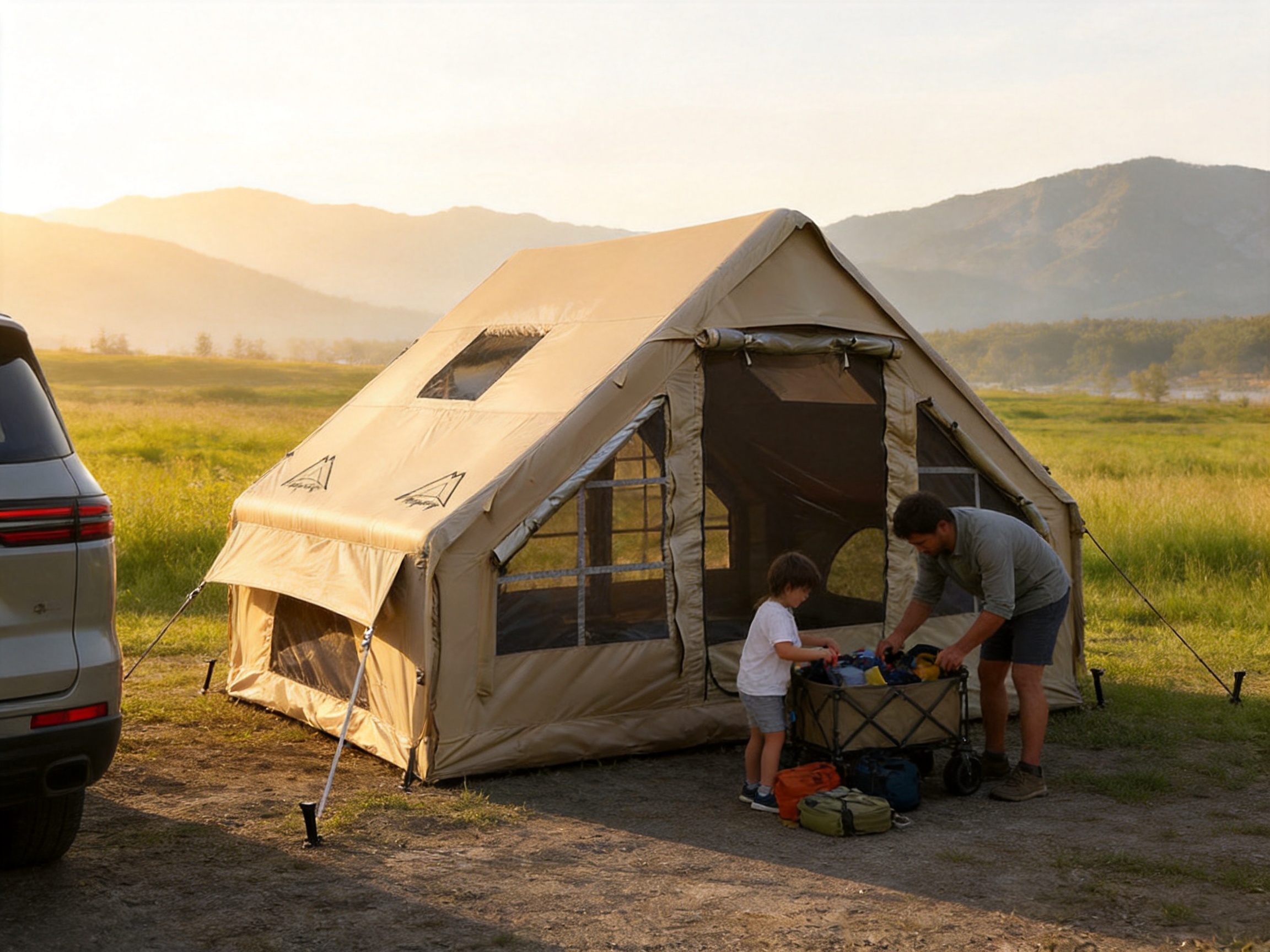 Modern campers increasingly want more than a basic place to sleep. They want a shelter that is quick to deploy, comfortable enough for extended stays, dependable in changeable weather, and practical to transport between destinations. The 4m Inflatable Air Villa Cabin Tent is designed around these expectations. It combines the spacious character of a cabin-style family tent with the structural simplicity of an inflatable air-column system, creating a versatile shelter for family camping, vehicle-based travel, glamping, outdoor events, and resort-style accommodation. Unlike a conventional pole tent, this design uses integrated high-pressure air tubes as its primary structural framework. The result is a shelter that can be erected without assembling a complicated network of rigid poles. Once inflated and properly tensioned, the air skeleton supports the fabric shell and creates a stable, arched living space. The architecture is intended to provide useful headroom, practical floor space, and a strong visual profile while remaining relatively straightforward to pack and transport. This product is positioned for users who value comfort and reliable shelter performance without accepting the long setup process associated with large traditional tents. Its combination of reinforced air tubes, waterproof fabric protection, heat-welded seams, mesh ventilation, and a compact carry format gives it a strong advantage for campers who move between locations or need a dependable basecamp for several people. 4m Inflatable Air Villa Cabin Tent Large Waterproof Canvas Family Sanctuary What Makes an Inflatable Cabin Tent Different? An inflatable cabin tent replaces many rigid poles with air-supported structural tubes. These tubes are inflated through dedicated valves, forming the framework that holds the tent’s roof and walls in position. The external fly or shell is then secured with tension points, guy lines, stakes, and other anchoring components. The air system does not eliminate the need for correct installation, but it simplifies the process by reducing the number of separate frame parts that must be identified, connected, and positioned. The 4m Inflatable Air Villa Cabin Tent uses this principle to create a larger, more livable shelter. Its arched ceiling is intended to make better use of the interior volume than a low-sloping dome. In a dome tent, the walls often angle sharply toward the ground, reducing usable space around the edges. A cabin-inspired inflatable layout can provide a more open central area and improved vertical clearance, which is particularly valuable when campers need room for sleeping equipment, luggage, chairs, tables, and other family necessities. The air-column approach also offers a different response to wind than a rigid pole assembly. A pole can bend, crack, or permanently deform if exposed to excessive force. A properly inflated air tube can flex and recover, helping the structure respond more progressively to gusts. This does not make any tent invulnerable to severe weather, and proper anchoring remains essential, but the flexible framework can offer a useful performance benefit in exposed camping environments. For families and recreational users, the key difference is convenience. A traditional large tent may require several people to unfold, sort, connect, and insert multiple poles. An inflatable model typically allows the main structural tubes to be inflated in a more direct sequence. This can shorten the setup routine and reduce the frustration associated with missing or incorrectly connected pole sections. Core Product Advantages Rapid Deployment for Weekend and Touring Use One of the most important advantages of this tent is its rapid deployment concept. The product is engineered for campers who want to spend less time building their shelter and more time enjoying the destination. The integrated air skeleton eliminates much of the frame assembly associated with traditional family tents. After selecting a suitable campsite, laying out the tent, attaching the relevant points, and inflating the structural tubes, users can concentrate on tensioning and final adjustments. The exact setup time depends on the pump used, the number of people assisting, weather conditions, and the user’s familiarity with the product. Nevertheless, the streamlined folding and inflation system is designed to make the process more accessible than the assembly of a large multi-pole shelter. This is especially useful for families arriving late at a campsite, travelers who change locations frequently, or outdoor hosts who need to prepare several units efficiently. A straightforward deployment process also improves campsite organization. Fewer loose frame components mean fewer opportunities for poles to be misplaced, damaged, or connected incorrectly. The air tubes remain integrated into the tent system, helping create a more unified product package. When packed into the carry bag, the shelter is easier to manage as a single camping unit rather than as a fabric bundle accompanied by several separate pole bags. Flexible Structural Performance The reinforced high-pressure air skeleton is designed to support the shelter while allowing a degree of controlled movement. In changing wind, flexible air tubes can absorb and release some movement instead of behaving like completely rigid members. The tent’s low-profile architecture, reinforced tension points, and anchoring system work together to help maintain stability. Structural performance depends on several factors. Inflation pressure must be appropriate, valves must be closed correctly, seams and tubes must be free of damage, and the tent must be anchored according to the installation instructions. The position of the tent also matters. A sheltered, level site with good drainage is preferable to an exposed ridge, flood-prone hollow, or area beneath unstable trees. Compared with a basic recreational tent, the product is intended to provide a more substantial feeling of security. The reinforced tubes and heavy-duty tension points are particularly relevant for family camping, where the shelter may need to remain stable while people move around inside, open doors repeatedly, or store equipment near the walls. The structure is also suitable for users who prefer the spacious appearance of a lodge or cabin tent but want a more modern setup method. Waterproof Fabric and Seam Protection Weather protection is a central part of the product’s design. The tent uses hydrophobic fabric materials intended to shed rain and reduce water penetration. Waterproof performance is not determined by fabric alone; it also depends on the roof shape, seam construction, door and window design, ground contact, zipper protection, and the quality of installation. The product information emphasizes precision heat-welded seams. Heat welding joins compatible layers through controlled heat and pressure, helping create a continuous barrier at areas that are often vulnerable to water entry. This approach can be more consistent than relying only on conventional stitching and applied seam tape, although the final performance still depends on production control and correct use. Heat-welded seams are particularly valuable along air tubes and exposed fabric junctions. These areas may experience repeated flexing during inflation, packing, transportation, and windy conditions. A well-controlled welding process can help protect the construction from leakage and moisture intrusion while supporting the long-term durability of the shelter. Campers should remember that “waterproof” does not mean that a tent can be placed in standing water or left unsecured during extreme weather. The groundsheet should be positioned correctly, doors should be closed when necessary, ventilation should be maintained, and the tent should be dried thoroughly before long-term storage. Proper care preserves the fabric, zippers, air tubes, and welded areas. Spacious Interior for Family Living The 4m format is intended to provide a generous family camping environment. Instead of treating the tent only as a sleeping compartment, the cabin layout supports a broader range of activities. Campers can organize sleeping areas, gear storage, changing space, and a central living zone according to the trip’s requirements. The arched ceiling helps maximize vertical clearance. This makes it easier for occupants to sit upright, change clothes, arrange bedding, and move around inside. A higher interior can also make a tent feel less confined during rainy days when the family must remain indoors. The cabin character is beneficial for longer stays because the space can be organized like a temporary room rather than a simple floor-level sleeping shelter. Interior organization remains important. Large tents are most comfortable when heavy gear is kept low and close to the floor, walkways remain clear, and sleeping equipment does not obstruct ventilation openings. Families can use storage bags, compact organizers, and low-profile furniture to take advantage of the available volume without overloading the tent. The product is designed to accommodate a full group and its equipment, but the practical capacity depends on the layout selected, the size of sleeping systems, and whether occupants want a separate living area. Buyers should review the manufacturer’s current floor plan and capacity guidance before placing an order, especially for commercial, resort, or high-occupancy applications. Ventilation and Condensation Management Large waterproof tents need an effective ventilation strategy. Moisture generated by breathing, cooking, wet clothing, and changing outdoor temperatures can condense on cooler interior surfaces. The tent addresses this issue through strategically placed high-density mesh windows and airflow openings. Mesh windows serve two functions. They allow air to circulate through the living area and provide protection from insects when the outer weather panels are open. In suitable weather, campers can create cross-ventilation by opening opposing windows or doors. In rain, the outer panels can remain closed while ventilation openings are adjusted to support airflow without exposing the sleeping area unnecessarily. Ventilation is most effective when users avoid blocking openings with luggage or bedding. It is also important to avoid cooking inside the tent unless the product instructions specifically allow it and adequate ventilation and fire-safety measures are available. Open flames, stoves, heaters, and fuel-burning appliances create serious risks in enclosed fabric shelters. Compared with a fully enclosed low-cost tent, the combination of mesh ventilation and a higher ceiling can make the interior feel more comfortable. It helps reduce stuffiness and gives campers better control over airflow during warm evenings. The design therefore supports both weather protection and livability instead of treating ventilation as an afterthought. Design Details That Support Outdoor Reliability Reinforced Air Tubes The tent incorporates multi-layer, puncture-resistant air tubes. Multiple layers are valuable because the tube must withstand internal pressure, repeated folding, contact with the outer shell, and the occasional abrasion associated with transport and campsite use. A puncture-resistant construction does not remove the need for care, but it can provide a more dependable foundation than a thin single-layer inflatable component. Users should keep sharp objects away from the tubes, avoid dragging the inflated shelter across rough ground, and inspect the system before each trip. If a tube or valve shows unusual loss of pressure, the tent should not be used in demanding weather until the problem is identified and repaired. A suitable repair kit and the manufacturer’s maintenance guidance should be kept with the equipment. Military-Grade Valve Design The product description highlights military-grade valves intended to support reliable inflation and long-term air retention. Valves are critical components in any inflatable shelter. They must allow efficient inflation, remain securely closed, and resist leakage during use. Their position and accessibility also influence how easily campers can check pressure or perform maintenance. Valve reliability is supported by correct operation. Dirt, sand, and moisture should be kept away from valve openings. After inflation, the closures should be checked before the tent is fully tensioned. When packing, users should release air according to the recommended sequence rather than forcing air out through unsuitable openings or placing unnecessary stress on the valve assemblies. Heavy-Duty Tension Points Tension points transfer forces from the fabric to the anchoring system. Reinforced attachment areas are essential because wind loads can concentrate around corners, roof edges, doors, and guy-line connections. The product’s heavy-duty tension points are intended to provide a stronger connection between the shelter and the ground anchors. Correct tension is a balance. If the fabric is too loose, water may collect and wind movement can increase. If it is pulled excessively tight, unnecessary strain may be placed on seams, webbing, zippers, and air tubes. Campers should adjust the guy lines gradually, check the roof and side panels, and re-tension the tent if conditions change. Compact Folding and Carrying Large family tents often create a compromise between interior comfort and portability. The 4m Inflatable Air Villa Cabin Tent addresses this issue through a folding system and durable carry bag intended to make transport more manageable. It is not designed to compete with an ultralight backpacking tent in packed size or weight. Instead, it offers a practical middle ground for car campers, touring families, glamping operators, and users who prioritize living space. The carry bag protects the folded tent during storage and transportation while keeping the main components together. Before packing, the shelter should be completely dry. Any trapped moisture can encourage mildew, unpleasant odors, and fabric deterioration. Folding should follow the recommended pattern, with air tubes positioned to avoid sharp creases and unnecessary pressure on valves. For vehicle-based trips, the compact format makes it easier to load the tent alongside camping furniture, cooking equipment, sleeping bags, and personal luggage. For commercial operators, consistent packing can also simplify inventory management and reduce preparation time between guest stays. Advantages over Conventional Pole Tents The principal advantage over a conventional pole tent is setup simplicity. Traditional family tents can deliver excellent stability and durability, but their frame systems may involve numerous poles, connectors, sleeves, and crossing points. Inflatable architecture reduces that complexity by integrating the main structural components into air tubes. A second advantage is the reduced risk of pole-related damage. Rigid poles can be lost, splintered, bent, or broken. An inflatable system has different maintenance requirements, including inspection of tubes, valves, and pressure retention. For many users, the ability to repair or replace an inflatable component is preferable to carrying a large selection of specialized pole sections. A third advantage is the structural feel created by the air framework. The flexible tubes can accommodate movement under wind loads, while the broad fabric shell and tension points create a cohesive structure. This design can be especially appealing in coastal, mountain, and open-field environments where gusts are common, provided that the tent is correctly anchored and conditions remain within its intended use range. A fourth advantage is interior volume. The arched cabin layout creates a useful combination of height and floor area. Many traditional dome tents are efficient for sleeping but offer limited standing or sitting space. The inflatable cabin design is better suited to families who plan to spend time inside the shelter, organize equipment, or remain at camp for several nights. There are also trade-offs. Inflatable tents require a pump, and users must understand pressure management and air-system maintenance. They may be heavier or bulkier than small pole tents. Their performance depends on correct inflation and anchoring. These considerations do not reduce the product’s value; they clarify the type of user who will benefit most from it. Feature4m Inflatable Air Villa Cabin TentBasic Pole Family TentSmall Backpacking Tent Primary structureIntegrated inflatable air columnsRigid or semi-flexible polesLightweight poles Setup approachInflate, anchor, and tensionAssemble and insert multiple polesAssemble a compact frame Interior characterCabin-style volume with arched clearanceVaries by model, often lower at the edgesOptimized mainly for sleeping Weather protectionHydrophobic fabric and heat-welded seam constructionDepends on fabric and seam treatmentDepends on fabric and lightweight construction VentilationHigh-density mesh windows and airflow openingsVaries by modelUsually limited by compact dimensions Best suited toFamily camping, vehicle travel, glamping, and extended staysGeneral recreational campingBackpacking and low-weight travel Maintenance focusAir pressure, valves, tubes, fabric, and seamsPoles, fabric, seams, and zippersWeight-sensitive components and fabric The comparison shows that the inflatable cabin tent is not intended to replace every other shelter category. A backpacker may prefer a smaller and lighter tent, while a user seeking the lowest initial cost may choose a basic pole design. The 4m model is strongest for customers who want a spacious, protective, rapidly deployable shelter and are willing to follow inflatable-system maintenance procedures. Manufacturing Strengths and Product Development The product is manufactured by Ningbo Zhenhai Tiansai Leisure Products Co., Ltd., an established Chinese outdoor-equipment enterprise specializing in the design, production, and sales of tents. The company operates a factory covering more than 13,000 square meters in Zhenhai District, Ningbo. Its location near an important port supports international logistics and export activity, an important capability for wholesale buyers and global outdoor brands. A large production facility can support the separation of key manufacturing activities, including material preparation, cutting, sewing, air-tube assembly, seam processing, inspection, packing, and finished-goods storage. Efficient organization is particularly important for inflatable tents because the product combines textile manufacturing with specialized air-system construction. Consistency must be maintained across both the outer shelter and the internal pressure-bearing components. The company’s experience includes the design and production of multiple tent categories. Its broader product range covers outdoor tents, backpacking tents, glamping tents, inflatable tents, and other camping shelters. This category knowledge allows the manufacturer to understand the different requirements of lightweight travel, family accommodation, resort use, commercial camping, and emergency shelter applications. Design and Engineering Capability Product development is supported by a professional design team that considers practicality and comfort during the design process. This is important because a tent’s success cannot be measured by fabric strength alone. Door placement, window height, airflow, storage opportunities, internal clearance, packed format, inflation access, and repairability all affect the user experience. The company reports that it collaborates with professionals and invites outdoor enthusiasts to participate in product testing. Field feedback can reveal issues that may not be obvious in a studio or factory environment. For example, testers may identify difficulties with packing, tension adjustment, ventilation control, access during rain, or the placement of valves. Incorporating this information helps refine the product for real-world use. The company has also designed products that have received appearance patents and utility model patents. These forms of intellectual-property activity indicate an emphasis on product development and original construction solutions. Buyers should review the specific patent and technical documentation relevant to any individual model, but the company’s patent history demonstrates a continuing investment in design differentiation rather than simple commodity production. Integrated Textile and Air-System Production Inflatable shelters require close coordination between fabric production and air-frame assembly. The external shell must fit correctly around the air tubes, while the tubes must maintain their intended position during inflation and use. If the fit is inconsistent, the shelter may not tension evenly or the frame may experience unnecessary stress. Production begins with material inspection and controlled cutting. Consistent panels help ensure that the finished tent has accurate dimensions and balanced tension. Sewing operations must maintain reliable stitch quality, while welded areas must receive appropriate heat, pressure, and dwell-time control. Air tubes require separate inspection for surface defects, valve attachment quality, and pressure retention. After assembly, the completed product should undergo visual checks, functional checks, and packaging inspections. Depending on the production specification, testing may include inflation checks, seam review, zipper operation, attachment-point inspection, and water-resistance evaluation. Wholesale customers may also request additional quality-control procedures, inspection standards, packaging requirements, labeling, or pre-shipment inspection arrangements. Quality Management and International Supply The manufacturer states that it implements a quality-management system intended to ensure that products meet international standards. For buyers, quality management is most valuable when it is supported by documented procedures and traceable inspection results. Important areas include incoming-material control, in-process inspection, finished-product testing, nonconformance handling, and corrective action. International supply also requires attention to consistency. A retailer or outdoor brand needs products that maintain the same appearance, dimensions, air-system behavior, packaging format, and performance expectations across repeated orders. A manufacturer with an established export background is better positioned to coordinate production schedules, international packaging, shipping documentation, and communication with overseas customers. The company’s presence across North America, Europe, Asia, and other regions demonstrates experience serving customers with different climate conditions, consumer preferences, and distribution requirements. Its core team reportedly includes outdoor-product specialists with more than ten years of experience in research and development, production, and overseas operations. This combination can be valuable for customers seeking a long-term manufacturing partner rather than a one-time supplier. Applications for Different Outdoor Markets Family Camping For families, the tent offers a balance between protection and livability. The interior can be arranged with sleeping areas, luggage storage, and a shared living space. Mesh windows support airflow, while the waterproof shell helps protect occupants from rain and damp conditions. The rapid setup approach is useful for parents who need to organize children, equipment, and campsite routines at the same time. Families should establish clear internal rules. Cooking, sharp objects, muddy footwear, and heavy equipment should be managed carefully. Ventilation should remain available, and children should not climb on air tubes or pull on guy lines. With responsible use, the tent can become a comfortable base for weekend trips, holiday camping, and longer outdoor stays. Glamping and Resort Operations The cabin-style appearance and spacious interior make the product relevant to glamping operators and outdoor hospitality businesses. Guests often expect more comfort than a conventional lightweight tent can provide. A large inflatable shelter can serve as a temporary accommodation unit, lounge, activity room, reception area, or seasonal event structure, subject to local regulations and the operator’s safety assessment. For commercial use, maintenance planning is essential. Staff should inspect the tent between guest stays, clean and dry the fabric, check air retention, examine valves and welded seams, and confirm that all stakes and guy lines are present. A consistent installation checklist helps reduce avoidable damage and improves guest confidence. Operators should also consider fire safety, electrical equipment, heating, local weather limits, occupancy rules, accessibility, ground conditions, and emergency procedures. A recreational tent should not automatically be treated as a permanent building. Commercial users must determine whether additional engineering, certification, or regulatory approval is required for their intended application. Vehicle-Based Touring The product is well suited to car camping and touring because it provides a more substantial living area than a compact backpacking shelter while remaining designed for transport. Travelers can use it as a base at one campsite and move it to another location when their itinerary changes. The carry format supports organized loading. The tent can be stored with its pump, repair materials, stakes, guy lines, and maintenance supplies in a dedicated equipment area. Before departure, users should confirm that every component is dry, properly folded, and secured against movement inside the vehicle. Outdoor Events and Temporary Shelters The product may also be considered for private outdoor gatherings, education programs, sports support areas, and temporary hospitality spaces. Its fast deployment can help organizers prepare a site efficiently. The shelter can provide shade and weather protection for equipment or participants, although its suitability depends on the event’s size, local weather, occupancy requirements, and safety plan. Event organizers should avoid treating the shelter as a substitute for purpose-designed emergency or public-assembly structures unless the product has been specifically approved for that use. Anchoring, fire resistance, evacuation access, and crowd loading must all be assessed before deployment. Setup Recommendations for Best Performance Begin by selecting ground that is level, well drained, and free from sharp stones, branches, glass, and other objects that could damage the floor or air tubes. Avoid depressions where water may accumulate. Consider the direction of prevailing wind and position the lower-profile end toward the strongest expected airflow when practical. Unpack the tent carefully and identify the pump, valves, guy lines, stakes, repair materials, and carry components before inflation. Lay the shelter flat and confirm that fabric panels are not twisted around the air tubes. Connect the pump to the correct inflation valve and inflate each structural section according to the manufacturer’s instructions. Do not exceed the recommended pressure. Excessive pressure can place avoidable stress on air tubes, valves, seams, and attachment points. After inflation, close and inspect each valve. Walk around the tent to confirm that the frame is positioned correctly and that the fabric is evenly distributed. Install stakes and guy lines before weather conditions deteriorate. Tension the shelter evenly rather than pulling one corner tight while leaving another loose. Check doors and windows to ensure that zippers operate smoothly and that the panels are not under excessive strain. During use, inspect the tent after strong wind or heavy rain. Recheck anchor points, adjust tension where necessary, and look for water pooling on the roof. If the structure loses noticeable pressure, move occupants and equipment to a safe location if required and investigate the cause before continuing use. At the end of the trip, clean away soil and debris, release air carefully, and fold the tent according to the recommended method. Never store the shelter while damp. A dry, cool, ventilated storage area is preferable to a hot vehicle, an exposed shed, or a location where rodents may damage fabric and tubes. Maintenance, Safety, and Long-Term Value Regular maintenance protects the product’s performance and extends its usable life. Before each trip, inspect the outer fabric for tears, abrasion, mildew, and damaged zippers. Examine the air tubes for swelling, cuts, unusual creases, or pressure loss. Check valves for contamination and confirm that all attachment points remain securely connected to the fabric. Small repairs should be performed with materials compatible with the tent fabric and air-tube construction. Improvised adhesives may weaken coatings or create a permanent repair that is difficult to remove. Users should follow the manufacturer’s repair instructions or consult the supplier when the damage involves a structural tube, valve, welded seam, or major attachment point. Cleaning should be gentle. Abrasive brushes, aggressive solvents, and unsuitable detergents can damage waterproof coatings, windows, and seam areas. A soft cloth, clean water, and a mild cleaning method are generally preferable, subject to the care instructions supplied with the product. Safety begins with correct site selection and anchoring. Never use the tent near unstable trees, exposed electrical lines, active waterways, or areas at risk of flash flooding. Do not place heaters, candles, grills, or open flames inside the shelter. Maintain clear exits and ensure that every occupant knows how to leave quickly in an emergency. Long-term value comes from combining durable construction with responsible use. The multi-layer air tubes, heat-welded seams, hydrophobic fabric, reinforced tension points, and serviceable valve system provide a strong foundation. However, even a professionally manufactured tent can be damaged by excessive wind, careless packing, sharp objects, neglect, or use beyond its intended conditions. Why Work with an Experienced Tent Manufacturer? For wholesale buyers and outdoor brands, product quality is only one part of the sourcing decision. Manufacturing communication, design support, production continuity, inspection procedures, packaging control, and after-sales cooperation are equally important. An experienced tent manufacturer can help translate a product concept into a repeatable commercial product. Ningbo Zhenhai Tiansai Leisure Products Co., Ltd. offers experience across design, production, and international sales. Its factory capacity, outdoor-product specialization, patent activity, and overseas customer base provide a foundation for cooperation with distributors, retailers, resort operators, and private-label brands. The company’s reported role as the sole global designated supplier for the British company TENTSILE further reflects experience in supplying specialized outdoor products for an international partner. Such relationships generally require attention to product consistency, delivery coordination, quality expectations, and communication across different markets. Customers interested in OEM or wholesale cooperation should discuss technical drawings, fabric selections, color standards, logo placement, packaging, minimum order quantities, sample approval, testing requirements, production schedules, spare parts, and warranty procedures. These details help ensure that the final product matches the commercial application and target market. Customization can be particularly useful for glamping operators and outdoor brands. Different customers may require alternative colors, interior layouts, branding elements, window configurations, accessory packages, or packaging designs. Any customization should be reviewed for its effect on structural performance, ventilation, waterproofing, manufacturability, and compliance requirements. Buyer Evaluation Checklist Before purchasing, buyers should confirm the intended use. The product is a large inflatable family and cabin-style shelter, not an ultralight backpacking tent. It is most appropriate where vehicle access or organized transport is available and where interior comfort is a priority. Ask for the current technical specification, including packed dimensions, product weight, floor layout, recommended occupancy, compatible pump details, air-tube pressure guidance, fabric composition, waterproof performance information, repair-kit contents, and warranty terms. Specifications can vary between production versions, so current documentation should take priority over general marketing language. For commercial buyers, request information about sample approval, inspection procedures, carton dimensions, shipping marks, spare parts, replacement air tubes, valve components, lead times, and production capacity. Clarify whether the supplier can provide private-label packaging, user manuals, and multilingual instructions. For individual campers, compare the tent’s packed size with the vehicle’s available storage area. Confirm that the pump and all anchoring components are included or available separately. Consider how many people will set up the tent and whether the intended campsite has suitable ground for stakes and guy lines. Evaluation AreaQuestions to AskWhy It Matters DimensionsWhat are the erected and packed dimensions?Confirms interior comfort and transport compatibility. Air systemWhich pump, valves, pressure guidance, and replacement parts are provided?Supports correct setup and future maintenance. FabricWhat are the material composition, coating, and care requirements?Helps match the tent to climate and usage patterns. Weather performanceWhat testing and installation conditions support the waterproof and wind claims?Prevents unrealistic expectations and improves safety planning. Commercial supplyWhat are the MOQ, lead time, packaging options, and inspection procedures?Supports inventory, branding, and delivery planning. After-sales supportAre repair kits, replacement tubes, valves, and technical assistance available?Reduces downtime and protects long-term value. Q&A What type of tent is the 4m Inflatable Air Villa Cabin Tent? It is a large inflatable family and cabin-style tent in the Inflatable & Air Tents category. Its primary frame is formed by integrated air columns rather than a conventional set of rigid poles. Who is this tent designed for? It is designed for families, vehicle-based campers, glamping operators, outdoor brands, resort businesses, and other users who want a spacious shelter with a streamlined setup process. It is not primarily intended for ultralight backpacking. Does the tent require a pump? Yes. The air-column structure must be inflated through its dedicated valve system. Buyers should confirm whether a compatible pump is included in the selected package and follow the specified pressure guidance. Is the tent suitable for heavy rain? The tent is designed with hydrophobic fabric materials and precision heat-welded seams for strong moisture protection. It should still be installed on well-drained ground, correctly tensioned, properly anchored, and maintained according to the instructions. No recreational tent should be considered immune to extreme weather or flooding. How does the inflatable frame behave in wind? The reinforced air skeleton is designed to flex and recover under gusts, while the low-profile shape and reinforced tension points support stability. Performance depends on correct inflation, anchoring, site selection, and weather conditions within the product’s intended operating range. Can several people sleep inside? The spacious cabin-style interior is intended to accommodate a full group and its equipment. Practical occupancy depends on the selected sleeping layout and the amount of living space required. Buyers should consult the current floor plan and manufacturer capacity guidance for exact arrangements. How does the tent control condensation? High-density mesh windows and ventilation openings allow air to move through the interior while helping keep insects out. Users should keep ventilation points clear, avoid unnecessary indoor moisture, and open panels when weather conditions allow. Is the tent easy to transport? The product is designed to fold into a manageable package and includes a durable carry bag. It is intended primarily for vehicle-based camping and organized transport rather than long-distance carrying in a backpack. Buyers should verify packed dimensions and weight before purchase. What maintenance does the air system require? Users should inspect air tubes and valves before each trip, keep valve openings clean, follow the recommended inflation pressure, and use compatible repair materials. The tent should be completely dry before storage, and any significant pressure loss should be investigated before use in demanding conditions. Can the product be customized for wholesale or private-label use? The manufacturer provides OEM and camping-tent wholesale solutions. Potential customers should discuss colors, fabrics, branding, packaging, layouts, order quantities, sample approval, inspection requirements, and delivery schedules directly with the production team. What makes the manufacturer suitable for international buyers? The manufacturer has a factory of more than 13,000 square meters, experience in tent design and production, an international customer base, patent-related product development experience, and a team with extensive outdoor-product and overseas-operation knowledge. These capabilities can support retailers, distributors, resorts, and outdoor brands seeking a long-term supply partner. Conclusion The 4m Inflatable Air Villa Cabin Tent brings together the spaciousness of a family cabin tent and the convenience of an inflatable structural system. Its reinforced air columns, hydrophobic fabric, heat-welded seams, mesh ventilation, arched ceiling, heavy-duty tension points, and compact carry format address the main priorities of modern recreational and commercial campers. Its strongest advantage over a basic pole tent is the combination of rapid deployment and generous living volume. Instead of choosing between a complicated large shelter and a cramped lightweight design, users can select a middle path that prioritizes comfort, weather protection, and setup efficiency. The product is particularly well suited to family camping, vehicle touring, glamping, resort applications, and organized outdoor events. The manufacturer’s factory capacity, design resources, patent experience, quality-management focus, international supply background, and OEM capabilities add value for buyers who need more than a finished product. Whether purchased for personal camping or developed as part of a commercial outdoor range, the tent should be evaluated with attention to technical specifications, intended weather conditions, maintenance requirements, and local safety rules. With correct installation and responsible care, this inflatable cabin shelter can serve as a dependable outdoor basecamp. It offers the comfort of a larger temporary room while preserving the practical mobility required for modern camping and outdoor hospitality. References 1. Product information supplied for the 4m Inflatable Air Villa Cabin Tent, including construction features, air-column design, moisture protection, ventilation, portability, and intended outdoor applications. 2. Manufacturer information supplied for Ningbo Zhenhai Tiansai Leisure Products Co., Ltd., including factory capacity, product-development activities, international markets, quality-management approach, and OEM service capabilities. 3. General principles of textile-tent construction, including fabric coatings, seam protection, anchoring, ventilation, condensation management, and outdoor equipment maintenance. 4. General inflatable-structure engineering principles concerning air retention, flexible load response, valve operation, pressure management, and repair procedures. 5. General outdoor-camping safety guidance concerning site selection, weather awareness, fire prevention, ventilation, storage, and responsible use of temporary shelters. Product: 4m Inflatable Air Villa Cabin Tent Large Waterproof Canvas Family Sanctuary .profile-card { display: flex; align-items: flex-start; gap: 2rem; background-color: white; padding: 2rem; border-radius: 12px; box-shadow: 0 2px 10px rgba(0,0,0,0.05); } .profile-avatar { width: 120px; height: 120px; border-radius: 50%; overflow: hidden; flex-shrink: 0; } .profile-avatar img { width: 100%; height: 100%; object-fit: cover; display: block; } .profile-info { flex-grow: 1; } .profile-name { font-size:27px; font-weight: 900; margin-bottom: 1rem; color: #1a1a1a; } .profile-bio { line-height: 1.6; color: #333; } @media (max-width: 600px) { .profile-card { flex-direction: column; align-items: center; text-align: center; gap: 1.5rem; } } Lin Qian — After-Sales Service Manager over eight years of experience in outdoor equipment customer service and manages warranty claims, product troubleshooting, replacement parts, and technical support for international distributors and camping brands.
Message Us Right Now!
-
Mp: +86-18858091910
E-mail: sales@tenplaytent.com
ADD: No. 529, Guangyuan Road, Xiepu Town, Zhenhai District, Ningbo City, Zhejiang Province, China
-
Quick Links
Home Products About Us Advantage News Contact Us -
Product
Inflatable & Air Tents Glamping & Resort Tents Backpacking & Trekking Tents Automatic & Pop-Up Tents Family & Camping Tents Specialty Tents & Shelters Kids Tents Pet Tents Humanitarian & Large Tents Hammock -
Get Connected
Copyright © Ningbo Zhenhai Tiansai Leisure Products Co., Ltd. All Rights Reserved.
 Camping Tent Manufacturer in China