


 English
  عربى
عربى 

How Can an Outdoor Toilet Shelter Handle Different Outdoor Conditions
Outdoor toilet facilities are exposed to conditions that are different from those found indoors. Rain can reach the entrance, wind can affect stability, and changes in ground conditions can make access less convenient. At the same time, a sheltered toilet needs to provide enough privacy without restricting airflow or making the interior uncomfortable.
These concerns are connected. The location affects drainage and privacy, the available space influences door placement, and the ground condition can affect how stable the structure remains. Weather protection also needs to work together with ventilation rather than being considered separately.
For this reason, planning an Outdoor Toilet Shelter involves more than choosing a covered space for a toilet. Its position, surrounding area, openings, ground condition, and maintenance routine all influence how well it fits an outdoor setting. Looking at these factors in a practical order can make the relationship between the shelter and its surroundings easier to assess.
Where Should an Outdoor Toilet Shelter Be Placed
The location has a direct effect on how an outdoor toilet is used. A suitable area needs to provide reasonable access while also keeping the facility away from places where regular activity could interfere with privacy.
A path leading to the toilet should be easy to identify and reasonably clear. If people need to pass through a garden, storage area, or narrow space to reach it, the route can become inconvenient, particularly when the ground is wet. Placement should therefore consider both the toilet itself and the route leading toward it.
Privacy is another consideration. A location beside a frequently used walkway may expose the entrance to unnecessary movement and views. Positioning the shelter beside an existing boundary, wall, or other visual barrier can help create separation without requiring the toilet area to be completely enclosed.
Drainage also belongs in the location decision. A low section of ground may collect water after rainfall, affecting the area around the entrance. Choosing a naturally better-drained location can reduce problems before installation begins.
Several practical questions can be considered when assessing a location:
- Can users reach the entrance without crossing an obstructed area?
- Is the entrance visible from nearby activity areas?
- Does rainwater naturally move away from the proposed position?
- Is there enough surrounding space for installation and routine access?
- Could nearby trees, structures, or other objects interfere with the shelter?
A location that works well on a dry day may behave differently after rain or during windy conditions. Considering these changes during planning gives the shelter a more suitable relationship with its surroundings.
How Much Space Does an Outdoor Toilet Shelter Need
Once the location has been considered, the available space inside and around the shelter becomes important. The toilet itself occupies only part of the usable area. People also need room to enter, close the door, turn, and use the facility without unnecessary obstruction.
Door movement deserves particular attention. A door that opens into a narrow interior can reduce usable space, while an entrance positioned too close to a boundary can make access awkward. The relationship between the toilet position, door, and surrounding walls should therefore be considered together.
The area outside the door matters as well. A small amount of clear space can make entering and leaving easier, especially when the ground becomes wet or muddy. If the shelter is positioned beside a wall, fence, or garden feature, the available clearance should be checked before installation.
Interior space also influences cleaning. Areas that are difficult to reach can collect dirt or moisture over time. A practical layout leaves enough room for routine cleaning around the toilet and along the lower sections of the enclosure.
Rather than focusing only on the footprint of the structure, it is useful to look at the entire movement path:
Approach → entrance → door movement → toilet area → exit
Each part needs to work with the next. This is particularly relevant in compact outdoor spaces, where moving the door or toilet slightly can change how the entire area functions.
How Can an Outdoor Toilet Shelter Maintain Privacy
Privacy depends on more than having walls around a toilet. The position of the entrance, the direction of the door, surrounding objects, and the height of openings can all affect what can be seen from outside.
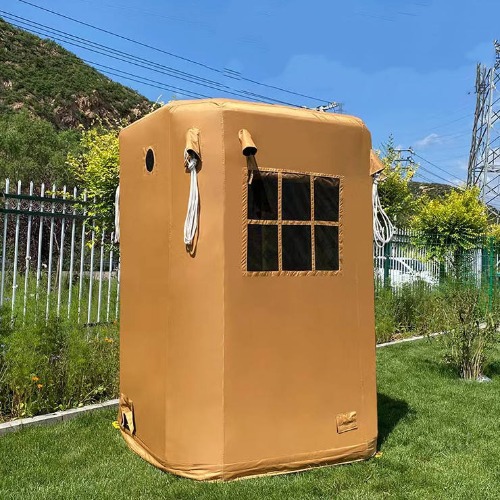
The entrance is usually the area that deserves the most attention. A door facing a busy path may expose users to unnecessary visibility whenever it opens. Turning the entrance away from direct traffic can create a greater sense of separation without changing the overall footprint.
Small gaps can also matter. Openings around doors or between enclosure sections may create lines of sight that are not obvious when viewed from inside. Checking the shelter from several positions around the site can reveal these issues.
Ventilation creates another design consideration. Air needs a way to move through the enclosure, but openings should not create direct views into the occupied area. This makes the position and arrangement of ventilation openings relevant to both airflow and privacy.
Nearby features can provide additional visual separation. Fences, walls, vegetation, or other outdoor structures may reduce direct views, although they should not block access or create drainage problems.
A practical privacy check can include:
- Viewing the entrance from the nearest walking route
- Checking side views around the enclosure
- Considering visibility when the door is partly open
- Reviewing the position of ventilation openings
- Checking whether nearby structures create useful separation
Privacy is therefore connected to site layout rather than being determined by the enclosure alone.
How Can an Outdoor Toilet Shelter Keep Rain Away
Rain affects both the shelter and the area around it. Water can enter through the roof edge, door area, wall connections, or openings, while runoff can create wet ground around the entrance.
The roof provides the main layer of overhead protection, but its relationship with the walls and entrance is equally relevant. If rain runs directly toward the doorway, users may encounter a wet threshold even when the interior remains relatively protected.
The roof edge can influence where water falls. An appropriate overhang can help move runoff away from the wall and entrance area. However, the water still needs somewhere to go once it reaches the ground.
The door is another vulnerable point. Wind-driven rain can reach an entrance from the side rather than simply falling from above. The orientation of the door can therefore affect how exposed it is during wet weather.
Connections between different shelter surfaces should also be checked. Gaps or poorly aligned joints can allow water to move into areas that are difficult to dry.
| Area to check | Practical concern |
|---|---|
| Roof edge | Where runoff falls |
| Entrance | Exposure to wind-driven rain |
| Wall connections | Potential water entry |
| Ground near the door | Standing water or mud |
| Drainage path | Whether water can move away |
Rain protection works as a connected system. Roof coverage, entrance position, and ground drainage need to support one another rather than being treated as separate details.
Where Should Ventilation Openings Be Placed
A sheltered toilet needs some movement of air, particularly when the enclosure remains closed for extended periods. Ventilation openings can influence how quickly air moves through the space and whether the interior feels stagnant.
The position of an opening matters because air needs a path to enter and leave. Openings placed without considering the surrounding enclosure may provide limited airflow even when they appear adequate from the outside.
Higher openings can allow warmer air to move outward, while lower openings can provide another route for air movement. The exact arrangement depends on the shelter layout and surrounding conditions, but the general principle is to avoid creating an enclosure where air has no practical path through it.
Privacy should remain part of the decision. An opening that faces a nearby path may create unwanted visibility. Positioning ventilation openings away from direct sightlines can help maintain separation.
Rain protection also needs consideration. An opening placed directly beneath an exposed roof edge or on a wall facing prevailing rain may allow water into the enclosure. Ventilation and weather protection therefore need to be considered together.
The surrounding environment can influence airflow as well. A shelter placed immediately against another structure may experience different air movement from one located in an open area. Trees, fences, and walls can also affect how air reaches the openings.
How Should the Ground Be Prepared for an Outdoor Toilet Shelter
The ground provides the base for the shelter and influences access, drainage, and stability. A site that looks suitable before installation may become difficult to use if it becomes muddy or holds water after rainfall.
A relatively even surface can make positioning easier. Uneven ground may create gaps beneath parts of the structure or make the entrance less convenient to approach. Before installation, the proposed area should therefore be checked for noticeable slopes, soft patches, loose material, and places where water tends to collect.
Different outdoor surfaces behave differently. Grass can become soft during wet conditions, loose soil can shift, and gravel may move under repeated use. Hard surfaces can provide a different type of base but may require attention to water runoff.
Drainage deserves particular attention around the entrance. Water should have a clear path away from the shelter rather than collecting directly beside the doorway.
| Ground condition | Points to consider |
|---|---|
| Grass | Softness and wet-weather access |
| Soil | Surface stability and drainage |
| Gravel | Movement under repeated use |
| Hard surface | Runoff and surrounding drainage |
| Sloped ground | Level positioning and water movement |
Ground preparation is closely related to the shelter's long-term condition. Persistent moisture near the base can affect cleaning, access, and the condition of lower surfaces.
How Can an Outdoor Toilet Shelter Stay Stable in Strong Wind
Wind introduces a different type of outdoor challenge. Unlike rain, which mainly affects moisture and access, wind can place movement and pressure on the shelter itself.
The surrounding site has an important role. An enclosure positioned in an open area may be exposed to stronger air movement than one partially protected by existing structures. At the same time, surrounding objects should not interfere with access or ventilation.
Ground conditions also influence stability. Loose or soft ground may provide less reliable support than a properly prepared base. This is why the earlier assessment of the installation area is directly connected to wind performance.
The entrance deserves attention during windy conditions. A door can move unexpectedly when exposed to air movement, particularly if it is left open. Its position and the available space around it should allow users to operate it without unnecessary difficulty.
Fixed connection points should be checked as part of routine care. Movement, loosening, or visible changes around these areas can indicate that the shelter needs attention.
Wind protection should not rely on one feature alone. Location, ground preparation, structural connections, and door arrangement all contribute to how the enclosure behaves outdoors.
What Should Be Checked During Outdoor Toilet Shelter Maintenance
Outdoor conditions gradually affect surfaces, connections, openings, and the surrounding ground. Regular visual checks can help identify changes before they interfere with everyday use.
The roof and wall connections should be inspected for visible gaps, movement, or signs that water is no longer being directed away as intended. The entrance should also be checked to make sure the door moves normally and remains properly positioned.
Ventilation openings can collect leaves, dirt, or other outdoor debris. Keeping these areas clear helps maintain the intended airflow through the enclosure.
The ground should be inspected at the same time. Pooled water, mud, erosion, or changes in the surface can affect both access and stability. These conditions may become more noticeable after periods of wet weather.
A simple inspection can focus on the following areas:
- Roof and surface connections
- Door movement and surrounding clearance
- Fixed connection points
- Ventilation openings
- Ground near the entrance
- Areas where water tends to collect
Maintenance is easier when it follows the conditions that the shelter regularly experiences. A location exposed to rain may require closer attention to drainage, while an open and windy location may call for more frequent checks around fixed connections.
This approach keeps the focus on how an outdoor toilet facility interacts with its surroundings: its position affects access, its layout affects privacy, weather influences drainage and airflow, and the ground contributes to stability. Each consideration connects with the next rather than functioning as an isolated design issue.
Message Us Right Now!
-
Mp: +86-18858091910
E-mail: sales@tenplaytent.com
ADD: No. 529, Guangyuan Road, Xiepu Town, Zhenhai District, Ningbo City, Zhejiang Province, China
-
Quick Links
Home Products About Us Advantage News Contact Us -
Product
Inflatable & Air Tents Glamping & Resort Tents Backpacking & Trekking Tents Automatic & Pop-Up Tents Family & Camping Tents Specialty Tents & Shelters Kids Tents Pet Tents Humanitarian & Large Tents Hammock -
Get Connected
 Camping Tent Manufacturer in China