


 English
  عربى
عربى 

How Does a Water Camping Tent Adapt to Both Land and Water Use
Camping has traditionally been associated with solid ground, a level place for a tent, and a nearby source of water for recreation. A different type of outdoor setup is beginning to connect these two environments more closely. A tent that can remain a usable shelter on land and also function as a floating platform changes the way the campsite itself can be arranged.
A Water Camping Tent combines an enclosed camping space with a floating base. Rather than treating the tent and the watercraft as completely separate pieces of equipment, the design brings them together as one outdoor space. This creates several practical questions. How can a shelter remain stable when the ground beneath it changes from soil to water? How should the structure respond to rain, movement, and moisture? What changes when people use a tent while surrounded by water rather than standing on dry ground?
These questions are closely related. The transition between environments affects stability, water protection, ventilation, interior use, and the conditions under which the equipment can be used. Looking at these aspects together gives a clearer picture of how land and water camping can be connected.
What Makes a Water Camping Tent Suitable for Two Environments
A conventional camping shelter is generally designed around contact with the ground. Its base rests on soil, grass, sand, or another relatively stable surface, while the upper structure provides protection from weather. Once the shelter is placed on water, the conditions change considerably.
The supporting surface is no longer fixed. Water moves, people move inside the shelter, and the distribution of weight can change as someone sits down, stands up, or enters and leaves. A suitable design therefore has to consider the relationship between the enclosed shelter and the floating base rather than treating them as unrelated parts.
On land, the main concern is keeping the shelter properly positioned and supported. On water, the supporting structure must remain afloat while carrying the shelter and its occupants. The connection between these functions is central to a two-environment design.
Another consideration is the way people interact with the equipment. A land-based tent can usually be approached from any convenient direction. A floating setup requires more attention when people step into or out of the enclosed space because movement can affect its position on the water.
This difference makes the transition between environments an important part of the overall design rather than a minor feature added after the shelter has been developed.
How Does a Water Camping Tent Transition From Land to Water
Moving between land and water involves more than carrying a tent to the edge of a lake and placing it on the surface. The structure has to accommodate two different forms of support.
When used on land, the floating section can serve as the base of the camping space. Once moved onto the water, that same section becomes responsible for keeping the shelter above the surface. The connection needs to remain organized as the entire unit changes position.
The process also affects how occupants enter the shelter. On firm ground, stepping through a doorway creates little movement. On water, the same action can shift the floating structure. For this reason, the arrangement of the entrance, base, and surrounding space needs to work together.
A practical transition generally involves several considerations:
- The floating base needs to support the shelter and the people using it.
- The shelter needs to remain attached to the floating structure during movement.
- Weight should be distributed rather than concentrated in one area.
- Entry and exit should not require unnecessary movement across the structure.
- The surrounding water conditions should be considered before making the transition.
This creates a useful distinction between a tent that is simply water-resistant and a shelter specifically designed to operate in both environments. The latter has to account for a change in the way the entire structure is supported.
How Does a Floating Water Camping Tent Stay Stable on Water
Stability becomes a central concern once the camping space is placed on water. A floating platform naturally responds to changes in weight and movement. Even a person walking from one side of the shelter to another can change how the structure sits on the surface.
The shape and arrangement of the floating base therefore matter. A broad and evenly supported base can distribute weight across a larger area, while the position of the shelter above it affects the overall balance. The placement of people and camping equipment also has an influence.
Inside a floating shelter, movement should be considered differently from movement inside a land tent. Sitting in one location, moving toward an entrance, or placing equipment near one side can produce different effects on the platform.
This is why the relationship between the upper shelter and lower floating section is important. A stable arrangement does not depend on one component alone. The base, shelter, occupants, and stored items all become part of the same moving system.
| Condition | What Needs Attention |
|---|---|
| People entering | Movement near the entrance can affect balance |
| People changing position | Weight distribution can shift across the base |
| Equipment storage | Items should not be concentrated in one area |
| Small surface movement | The structure needs to respond without unnecessary shifting |
For recreational use, calm surroundings also make a difference. Water conditions can change with wind, waves, currents, or passing activity, so stability is related to both the structure and the environment around it.
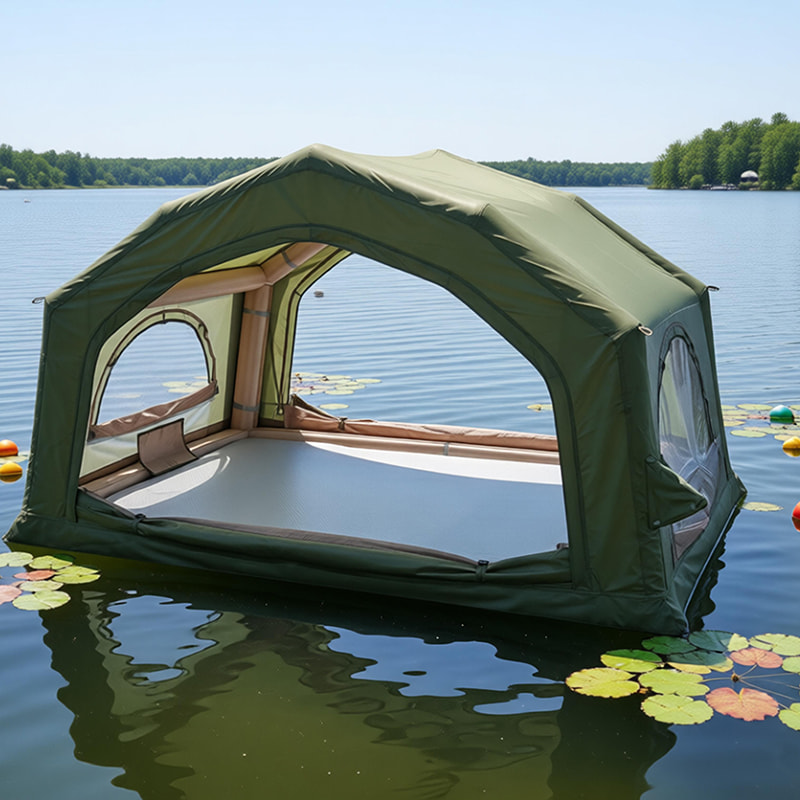
How Does a Water Camping Tent Manage Rain and Splashing Water
Rain protection is familiar to anyone who has used outdoor shelters, but a floating camping space introduces additional sources of moisture. Rain may reach the upper fabric, while water from the surrounding surface can create splashes against the lower section.
The roof and side panels need to direct rain away from the living area. At the same time, areas around openings and connections deserve attention because water can enter through small gaps even when the main fabric sheds rain effectively.
The lower portion has a different role. On land, the bottom of a tent mainly separates the occupants from damp soil and standing water. On a floating structure, the lower section is exposed to the surrounding water environment. Its connection with the upper shelter therefore becomes an important part of keeping the interior dry.
Doors and other openings also require careful use during wet conditions. Opening a shelter while rain is falling can allow water to enter directly, while splashing from the surrounding surface may reach the entrance from below.
A useful way to consider moisture protection is to separate it into several areas:
- Upper protection — dealing with rainfall from above.
- Side protection — limiting water entering through walls and openings.
- Lower protection — separating the interior from surrounding moisture.
- Connection areas — keeping joins between different sections properly protected.
These areas work together rather than independently. Good water protection depends on the overall arrangement of the shelter and floating base.
How Does Ventilation Work in a Water Camping Tent
Keeping rain outside is only part of maintaining a comfortable enclosed space. Air circulation also matters, particularly when people stay inside for an extended period.
An enclosed shelter naturally accumulates moisture from breathing, damp clothing, wet equipment, and the surrounding environment. When warm air meets a cooler surface, moisture may collect as droplets. These droplets can sometimes be mistaken for a leak even when rain has not entered the shelter.
Ventilation openings allow air to move through the interior and help release humid air. Mesh sections can also provide airflow while creating a barrier against insects. Their position is important because air needs a path to enter and leave rather than simply passing through one small opening.
There is also a practical balance between ventilation and weather protection. Openings that provide airflow need to be positioned so that rain is less likely to enter. During wet weather, occupants may need to adjust ventilation according to wind direction and rainfall.
The water around the shelter adds another consideration. A floating campsite is surrounded by a moist environment, so keeping the interior completely closed for long periods may not be practical. Air movement becomes part of maintaining the space rather than an optional feature.
What Interior Features Matter in a Floating Water Camping Tent
The interior of a floating shelter has to serve familiar camping purposes while also accounting for movement on the water. Sleeping, sitting, changing clothes, and storing equipment are all different from simply standing on a floating platform.
Space planning becomes important because unnecessary movement can affect the position of the structure. Heavy items placed on one side may create an uneven load, while loose belongings can shift when the platform moves.
For that reason, the interior is generally easier to manage when frequently used items are kept within reach and stored in places where they are less likely to move around.
The entrance deserves particular attention. It connects the interior with the surrounding environment and may be used while the platform is moving slightly. A clear approach can make entering and leaving easier, particularly when occupants are carrying personal equipment.
The living area also needs to balance comfort with practical movement. A larger open area may provide more freedom inside, but the arrangement still needs to account for the way people and belongings affect the floating base.
Rather than viewing the interior simply as a room placed above water, it is more useful to consider it as part of the complete floating arrangement. The shelter, its contents, and its occupants all interact with the supporting structure.
What Safety Factors Matter When Using a Water Camping Tent
Water-based camping requires a different approach to site conditions than ordinary ground camping. A location that appears suitable from the shore may have changing water movement, wind exposure, or other conditions that affect a floating structure.
Weather should be checked before use, particularly when the shelter is intended to remain on the water. Wind can influence surface movement, while changing water conditions may make entering or leaving more difficult.
The number of occupants and the amount of equipment also matter. A floating structure has a limited capacity to support weight, and the distribution of that weight can affect how it sits on the surface.
Before use, it is reasonable to check:
- Whether the water surface is suitable for the intended activity
- Whether weather conditions are expected to remain appropriate
- Whether the structure and connections are properly secured
- Whether personal flotation equipment is available when appropriate
- Whether occupants can enter and leave without unnecessary risk
- Whether loose equipment is stored securely
These considerations are not unique to one particular shelter. They reflect the basic difference between camping on solid ground and staying in an enclosed space supported by water.
The surrounding environment should also remain part of the decision. Calm water near a suitable campsite presents different conditions from an exposed area with strong movement. Choosing the right setting is therefore as important as preparing the equipment.
Where Can a Water Camping Tent Expand the Camping Experience
The combination of a shelter and floating base creates camping possibilities that are difficult to achieve with a conventional tent alone. Instead of limiting the campsite to the shoreline, the living space can be connected more directly with the water.
Lakes and other relatively calm recreational waters can provide settings where people want to spend time both beside and on the water. A floating shelter can create a different relationship between the sleeping space and the surrounding landscape.
The concept can also suit short outdoor stays where people want to combine camping with water-based recreation. The key difference is not simply that the shelter can float. It is that the boundary between the campsite and the water becomes less fixed.
For example, a campsite can be arranged so that the shelter begins on land and later moves toward the water. In another setting, the floating configuration can become the main part of the outdoor stay while nearby land remains available for access and preparation.
| Camping Environment | Main Consideration |
|---|---|
| Lakeside campsite | Easy movement between shore and water |
| Calm recreational water | Surface conditions and access |
| Waterside leisure area | Transition between land activities and floating use |
| Outdoor overnight setting | Shelter comfort, moisture control, and equipment storage |
This type of arrangement also changes how camping equipment is viewed. A tent no longer has to represent a fixed point on the ground. When the supporting structure can move between land and water, the campsite itself becomes more flexible in its relationship with the surrounding environment.
Message Us Right Now!
-
Mp: +86-18858091910
E-mail: sales@tenplaytent.com
ADD: No. 529, Guangyuan Road, Xiepu Town, Zhenhai District, Ningbo City, Zhejiang Province, China
-
Quick Links
Home Products About Us Advantage News Contact Us -
Product
Inflatable & Air Tents Glamping & Resort Tents Backpacking & Trekking Tents Automatic & Pop-Up Tents Family & Camping Tents Specialty Tents & Shelters Kids Tents Pet Tents Humanitarian & Large Tents Hammock -
Get Connected
 Camping Tent Manufacturer in China